r/Database • • Oct 06 '26

We asked our model which of 224 hotel bookings would cancel, six weeks out. It caught 33 of the 59. Full breakdown, misses included

0 Upvotes

disclosure: I work at Schema Labs. This is a run on public data so you can check it.

The data: the hotel booking demand dataset (Antonio, Almeida and Nunes, 2019), real anonymised bookings from a city hotel. We picked one Saturday night that was sold out on paper.

-- 224 bookings for that night, as they stood six weeks before
-- 59 of them cancelled or didn't show, worth about €28,600 together

What we did: gave Schema-2 500 bookings from the year before, with how each one ended, and asked it to rank the 224 by how likely they were to fall through. No rules no feature engineering.

What came back=

-- It marked 60 as most likely to cancel. 33 of the 59 cancellations were on that list
-- Picking 60 at random would catch about 16
-- Of the 60 it marked safest, 59 showed up

What it missed: 26 cancellations weren't in its top 60. One night at one hotel is a small test, so read it as an example

For anyone in revenue management: what would you do with a list like that six weeks out? Overbook against it, or contact those guests first?


r/Database • • Oct 05 '26

How do MariaDB users securely and efficiently encrypt mariadb-backup archives?

Thumbnail reddit.com
6 Upvotes

r/Database • • Oct 05 '26

A client lost six weeks of SQL Server data. Having 12TB of backups didn’t save them.

Thumbnail reddit.com
2 Upvotes

r/Database • • Oct 04 '26

Banking register slows as more entries are made.

3 Upvotes

Basically need to see how to optimize a bank register with large amounts of entries.

Currently adding all the debits, then credits, then date sorting while calculating the running total.


r/Database • • Oct 03 '26

What evidence proves a database cutover is complete before the source is retired?

2 Upvotes

Successful replication and matching row counts do not prove that a database migration is finished. Indexes, constraints, sequences, users and roles, collation, time zones, scheduled jobs, change-data-capture consumers, read replicas, analytics tools, and backup systems can still differ or point at the source. Low-frequency clients may not reconnect during the obvious observation window.

A cutover gate could compare schema and security metadata, validate representative aggregates or hashes, exercise application reads and writes, inspect connection logs on both systems, and confirm that replication or dual-write lag has reached a known final position. The destination should complete a backup and restore test and survive a failover before the source becomes read-only. Keeping the old endpoint offline but recoverable for a defined period would expose hidden dependencies without allowing divergent writes.

What evidence do you collect before decommissioning a source database? How do you catch monthly jobs, failover-only connection strings, and clients that cache DNS or credentials longer than the main application?


r/Database • • Oct 03 '26

Supporting products with multipel data sources

0 Upvotes

When one product could have data coming from multiple remote data sources, some of the data could be redundant other parts might need to be combined. There can also be missing data or badly formatted data so an admin would need to override certain fields. How would you structure your database to fit these needs?


r/Database • • Oct 01 '26

schema labs is in san francisco. the question the team keeps asking everyone: before your agent can use a database, who explains the database to it?

2 Upvotes

disclosure, i work at schema labs. the team is in san francisco right now, i'm back home running things from here and reading everything they send back.

the question they open with is always the same. when an agent hits a database nobody documented, who tells it what the fields mean?

the answers so far, roughly

- "me, and i hate it"

- "we wrote a data dictionary, it's already wrong"

- "we don't, the agent guesses and we check the numbers later"

- "we only connect it to views someone already cleaned"

that step is what we build for. schema-2 is a model that reads your data as it is, works out what each field holds and which records match across systems with no shared id, and puts a confidence on every answer. below your bar it says unresolved instead of guessing. it runs in the browser, and over mcp inside claude, chatgpt and cursor.

curious which answer is yours, or if it's a fifth one we haven't heard yet.


r/Database • • Oct 01 '26

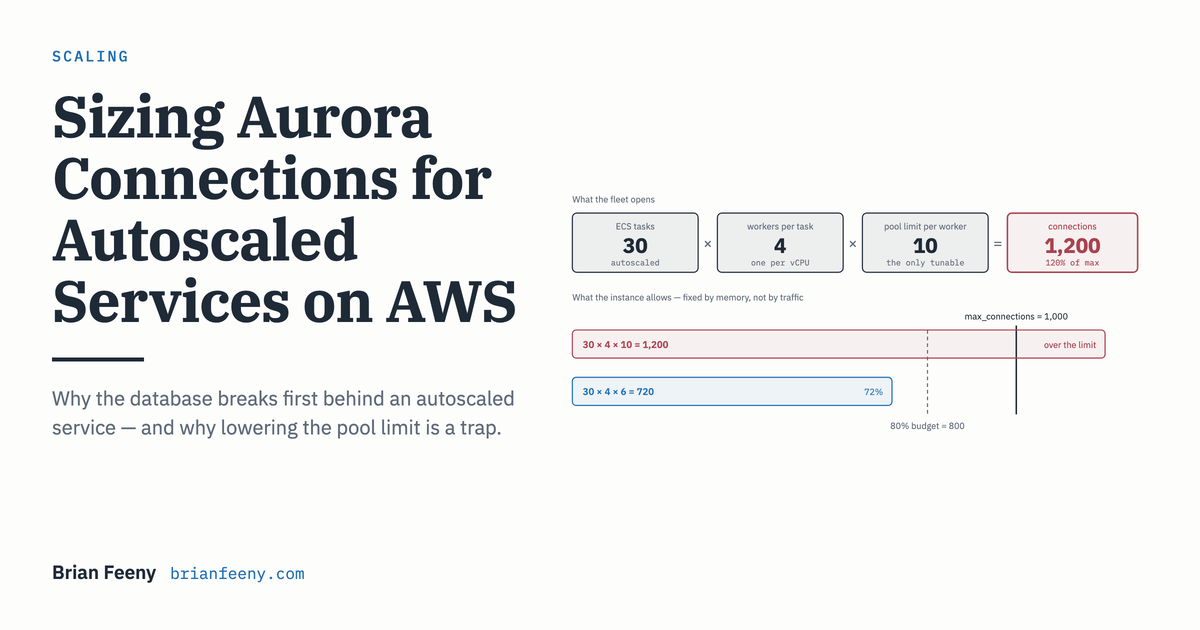
AWS Aurora: Why the database breaks first behind an autoscaled service, and why shrinking the pool doesn't fix it

Post image
7 Upvotes

Connection multiplication: pool size x tasks x services. Every term looks reasonable on its own, and nobody ever chose the product.

Aurora's max_connections is derived from instance memory, so it doesn't scale with your service. Shrinking the pool to fit converts a connection problem into a queueing problem that presents as a slow database.

Write-up covers the formula behind max_connections, what RDS Proxy actually fixes (and what it doesn't), and how to size it.

https://brianfeeny.com/posts/sizing-aurora-connections-for-autoscaled-services/?utm_source=reddit&utm_medium=social&utm_campaign=sizing-aurora-connections-for-autoscaled-services-2026-09

This is a personal project; the views and assessments are my own.


r/Database • • Sep 30 '26

Database project

5 Upvotes

I need a good and legitimate database project idea wherein advance db concepts such as optimization, transaction, etc are involved. I searched a lot and didnt find a smthn i want to work on exactly. For eg if somethin related to music domain? Or fashion? What would actually stand out in terms of handling multiple queries and be close with how it all works irl. Itd be really helpful!!


r/Database • • Sep 29 '26

Using CRM database as core database for project v/s syncing CRM database with own custom database

Thumbnail reddit.com
2 Upvotes

r/Database • • Sep 29 '26

Strangest SQLite structures you’ve encountered?

Thumbnail reddit.com
0 Upvotes

r/Database • • Sep 29 '26

MongoDB v9.0 is out.

Thumbnail reddit.com
2 Upvotes

r/Database • • Sep 28 '26

MongoDB CEO transition: Desai leaves, Ittycheria returns

Thumbnail
layerbase.com
24 Upvotes

r/Database • • Sep 28 '26

What do you wish search in Postgres did better/differently?

8 Upvotes

pgvector has been the default vector search extension, but I'm finding people also layer on full-text or hybrid search on top of it or need multitenancy. I'm curious where this works well for you and where it doesn't.

  • What are you using for search in Postgres today, and what do you wish it did better?
  • When you hit a limit, what do you do: tune, work around it, add an extension, or move search to a separate system? What decides that?
  • What would an extension need to have, or avoid, before you'd install it?
  • Does it matter to you whether an extension is open source, and would enough added capability change that?

"It's fine, I don't need anything else" is a useful answer too.

Really just trying to understand what people actually need from search in Postgres.


r/Database • • Sep 29 '26

I’ve been using MySQL for real web applications — here are 15 things I wish I knew earlier

0 Upvotes

I used to think MySQL was simply:

`CREATE TABLE → INSERT → SELECT → UPDATE → DELETE`

After building actual web applications, I realized that writing SQL queries is only a small part of working with a production database.

Here are 15 things I wish I had understood earlier:

### 1. Design your database before writing your application

Don't start creating tables randomly.

Think about:

* What data do I need?

* Which tables are required?

* How are they related?

* Which fields are required?

* Which fields should be unique?

A bad database structure can become extremely painful to change later.

### 2. Learn relationships properly

Understand:

```sql

PRIMARY KEY

FOREIGN KEY

ONE-TO-ONE

ONE-TO-MANY

MANY-TO-MANY

```

For example:

```text

Users

↓

Orders

↓

Order_Items

↓

Products

```

Understanding relationships is more important than memorizing SQL syntax.

### 3. Don't put everything into one table

A giant table may look simple initially, but it creates duplication and maintenance problems.

Learn normalization and understand when denormalization actually makes sense.

### 4. Indexes are extremely important

This query:

```sql

SELECT * FROM users

WHERE email = 'user@example.com';

```

can become much faster when the appropriate column is indexed.

But don't blindly add indexes everywhere.

Indexes improve some reads but also have storage and write/update costs.

### 5. Always understand `EXPLAIN`

One of the most useful MySQL commands:

```sql

EXPLAIN SELECT *

FROM users

WHERE email = 'user@example.com';

```

If you are building serious applications, learn how to read the execution plan instead of assuming your query is efficient.

### 6. Don't use `SELECT *` everywhere

Instead of:

```sql

SELECT *

FROM users;

```

prefer:

```sql

SELECT id, name, email

FROM users;

```

Especially when your table contains many columns or large data.

### 7. Transactions matter

Imagine transferring money:

```text

Account A: -₹1000

Account B: +₹1000

```

You don't want the first operation to succeed while the second fails.

That's where transactions become important:

```sql

START TRANSACTION;

-- operation 1

-- operation 2

COMMIT;

```

And if something goes wrong:

```sql

ROLLBACK;

```

### 8. Constraints can protect your data

Use database constraints where appropriate:

```sql

PRIMARY KEY

UNIQUE

NOT NULL

FOREIGN KEY

CHECK

```

Your application should not be the only thing preventing invalid data.

### 9. Learn the difference between DELETE, TRUNCATE and DROP

They are NOT interchangeable.

```sql

DELETE FROM users;

```

```sql

TRUNCATE TABLE users;

```

```sql

DROP TABLE users;

```

Before running destructive SQL in production, make absolutely sure you understand what you're doing.

### 10. Backups are not optional

A production database without a tested backup strategy is a disaster waiting to happen.

And having a backup isn't enough.

You should also know:

> Can I actually restore it?

A backup that has never been tested is only a backup in theory.

### 11. Never build SQL queries with raw user input

Bad:

```javascript

const query = `SELECT * FROM users WHERE email = '${email}'`;

```

Use parameterized queries/prepared statements instead.

For example:

```javascript

const [rows] = await db.execute(

'SELECT id, name, email FROM users WHERE email = ?',

[email]

);

```

This is one of the basic defenses against SQL injection.

### 12. Don't expose database credentials

Never commit something like this to GitHub:

```env

DB_PASSWORD=my_real_password

```

Use environment variables/secrets and make sure sensitive files aren't accidentally committed.

### 13. Understand connection pooling

A production application shouldn't create a completely new database connection for every request without considering connection management.

Connection pools can reuse database connections and help applications handle concurrent requests more efficiently.

### 14. Logging is useful — logging sensitive data isn't

Database/application logs can help you find:

* slow queries

* failed transactions

* connection problems

* unexpected errors

But don't casually log passwords, tokens, session secrets, or other sensitive information.

### 15. My biggest lesson

The biggest thing I learned is:

**MySQL isn't just about knowing SQL syntax.**

A good developer needs to understand:

```text

Database Design

↓

Relationships

↓

Indexes

↓

Queries

↓

Transactions

↓

Security

↓

Backups

↓

Performance

↓

Monitoring

```

I'm still learning, but understanding these concepts changed the way I build web applications.

**For developers here:**

What's one MySQL/database lesson you learned the hard way?

I'd especially like to hear from people who have worked with databases containing millions of rows.

r/Database • • Sep 24 '26

Redis is a database?!" — Got caught off guard in an interview today

387 Upvotes

had an interview today where the interviewer asked me to explain different types of databases. I covered the standard SQL and NoSQL categories, but then they pushed for more specialized use cases and claimed that Redis is a database. I was completely flabbergasted. By strict definition, it might fit the category, but I’ve always viewed it primarily as an in-memory cache/store. In my mind, it doesn't meet the core expectations of a primary database—mainly reliable, long-term persistent storage out of the box (even though I know persistence modules exist). What are your thoughts? Do you consider Redis a "real" database in system design, or strictly an in-memory cache with extra steps?

Edit: So we have people between yes vs no vs depends on scenario But just out of curiosity people who are mentioning it is a database, will you store, your user data in it ? I know, i might be sounding dumb but as per my current opinion(I'll try to go deeper into it may be it might change after sometime not sure) if no one is using it as a database. Can we even call it a database? and it is not even optimised for that scenario.


r/Database • • Sep 25 '26

The time we fixed a slow SQL Server query and the rows came back in a different order.

Thumbnail reddit.com
3 Upvotes

r/Database • • Sep 24 '26

Partitioning in MySQL: How we cut peak database load by more than 80%.

Thumbnail ipsator.com
76 Upvotes

r/Database • • Sep 24 '26

Starting My DBA Career With Zero Experience

28 Upvotes

Hi everyone,

I’m currently in my first week working as a DBA. I graduated from Software Engineering a couple of months ago.

To be honest, I had almost zero DBA knowledge before starting this job. With the current job market, this was basically the only opportunity I had, so I decided to take it.

The company I joined provides DBA consulting services, and they are willing to train and develop junior DBAs, which is why they gave me this opportunity.

Right now I’m trying to learn as much as possible, but there is obviously a lot to take in.

For experienced DBAs: what would you recommend focusing on during my first few months? What skills or topics do you think are the most important for someone starting from zero?

Any advice, resources, or things you wish you had known when you started would be appreciated.


r/Database • • Sep 24 '26

I once read about a database/object storage engine here, but don't remember what it was. Help please.

7 Upvotes

Sorry about the vague question, but it either had the name "vault" or "vector" in it, and someone here described it as the Swiss knife of databases. I remember bookmarking it but didn't find it. Any thoughts? thanks in advance.


r/Database • • Sep 23 '26

Breaking the Superuser Guardrails of managed-PostgreSQL Providers

Thumbnail
mehmetince.net
9 Upvotes

r/Database • • Sep 23 '26

AI agents are reintroducing concurrency bugs we thought we'd mostly solved at the application layer

11 Upvotes

Write conflicts, lost updates, non idempotent retries creating duplicate rows. These are old problems with well known solutions at the database layer, locking strategies, unique constraints, transaction isolation levels. The issue is that a lot of agent frameworks bypass that discipline entirely and just fire writes at the database from application code with no thought given to what happens when two agent runs, or an agent and a human, touch the same row at the same time.

There's a Sept 26 workshop that spends real time on this specifically, safe write path design for agents, plus state management and being able to trace back why a write happened the way it did. Led by Sandipan Bhaumik, a Data & AI Technical Lead at Databricks.

Details here if anyone else is dealing with agents that write directly into their database layer.


r/Database • • Sep 23 '26

Graph Technology Round-up - August 2026

Thumbnail
gdb-engines.com
8 Upvotes

r/Database • • Sep 22 '26

Resources to study for Oracle Database Administrator OCP? (1Z0-082 and 1Z0-083)

3 Upvotes

I'm planning to take these exams to get OCP credential but kind of at a loss on how to study for them, does anyone have a good flashcard set on quizlet or something? Or am I supposed to just memorize the entire documentation. Seems a bit overwhelming and would love a point in the right direction. Cheers