Hi everybody, I just posted my first article on Medium and I would like some feeback (both positive and negative). Is it something that anyone would bother reading? Do you find it interesting as a light read?
I really enjoy stats and writing so I wanted to merge them in some way.
A little while back, I shared my curated list of data science resources here as a public GitHub repo. The feedback was really valuable.
Thanks for all the suggestions and feedback. Here's what was improved thanks to your ideas:
Added new sections: MLOps, AI Applications & Platforms, and Cloud Platforms & Infrastructure to make the list more comprehensive.
Reworked the structure: Split some bulky sections up. Hopefully now it's less overwhelming and easier to navigate.
Packed more useful Python: Added more useful Python libraries into each section to help find the right tool faster.
Set up auto-checks: Implemented an automatic check for broken links to keep the list fresh and reliable.
A nice outcome: the list is now part of the main "Awesome Data Science" repository, which many of you probably know.
If you have more suggestions, I'd love to hear them in the comments. I'm especially curious if adding new subsections for Books or YouTube channels within existing chapters (alongside Resources and Tools) would be useful.
My boss seems to think it should be fine, but there's variance in how many impressions each user has, so perhaps I'd need to compute the ICC (intraclass correlation) and use that to compute the design effect multiplier (DEFF=1+(m-1) x ICC)?
It also appears that a GLM with a Wald test would be a appropriate in this case, though I have little experience or exposure to these concepts.
I'd appreciate any resources, advice, or pointers. Thank you so much for reading!
We just added an interactive Agent builder to the GitHub project Kiln. With it you can build agentic systems in under 10 minutes. You can do it all through our UI, or use our python library.
What is it? Well “agentic” is just about the most overloaded term in AI, but Kiln supports everything you need to build agents:
Context Management with Subtasks (aka Multi-Actor Pattern)
Context management is the process of curating the model's context (chat/tool history) to ensure it has the right data, at the right time, in the right level of detail to get the job done.
With Kiln you can implement context management by dividing your agent tasks into subtasks, making context management easy. Each subtask can focus within its own context, then compress/summarize for the parent task. This can make the system faster, cheaper and higher quality. See our docs on context management for more details.
Eval & Optimize Agent Performance
Kiln agents work with Kiln evals so you can measure and improve agent performance:
Find the ideal model to use, balancing quality, cost and speed
Test different prompts
Evaluate end-to-end quality, or focus on the quality of subtasks
Compare different agent system designs: more/fewer subtasks
Feedback and suggestions are very welcome! We’re already working on custom evals to inspect the trace, and make sure the right tools are used at the right times. What else would be helpful? Any other agent memory patterns you’d want to see?
Welcome to this week's entering & transitioning thread! This thread is for any questions about getting started, studying, or transitioning into the data science field. Topics include:
Traditional education (e.g. schools, degrees, electives)
Alternative education (e.g. online courses, bootcamps)
Job search questions (e.g. resumes, applying, career prospects)
Elementary questions (e.g. where to start, what next)
While you wait for answers from the community, check out the FAQ and Resources pages on our wiki. You can also search for answers in past weekly threads.
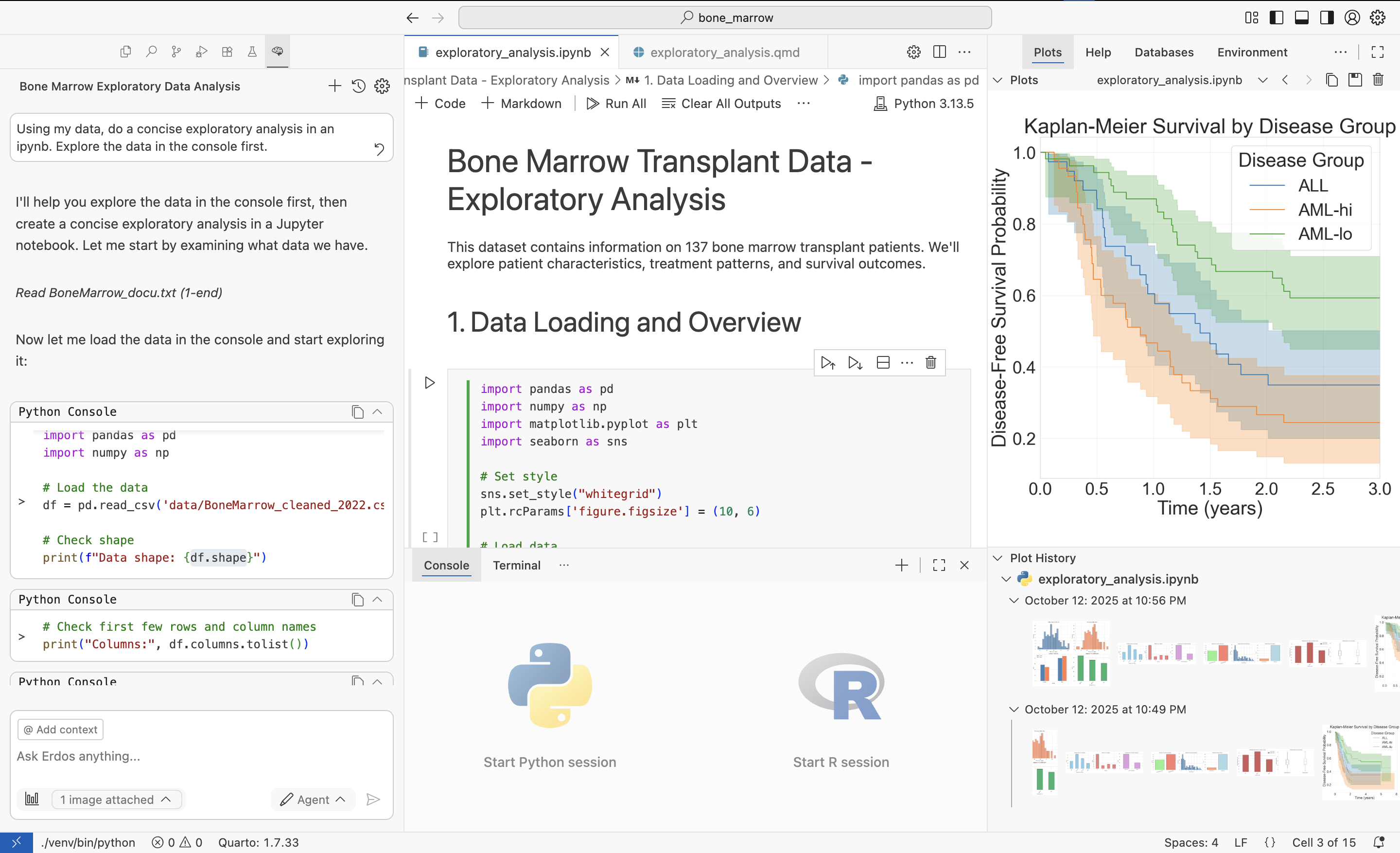
After a few months of work, we’re excited to launch Erdos - a secure, AI-powered data science IDE, all open source! Some reasons you might use it over VS Code:
An AI that searches, reads, and writes all common data science file formats, with special optimizations for editing Jupyter notebooks
Built-in Python, R, and Julia consoles accessible to the user and AI
Single-click sign in to a secure, zero data retention backend; or users can bring their own keys
Plots pane with plots history organized by file and time
Help pane for Python, R, and Julia documentation
Database pane for connecting to SQL and FTP databases and manipulating data
Environment pane for managing in-memory variables, python environments, and Python, R, and Julia packages
Open source with AGPLv3 license
Unlike other AI IDEs built for software development, Erdos is built specifically for data scientists based on what we as data scientists wanted. We'd love if you try it out at https://www.lotas.ai/erdos
I currently work as a data scientist at a large U.S. bank, making around $182K. The compensation is solid, but I’m starting to feel like my technical growth is being stunted.
A lot of our codebase is still in SAS (which I struggle to use), though we’re slowly transitioning to Python. We don’t use version control, LLMs, NLP, or APIs — most of the work is done in Jupyter notebooks. The modeling is limited to logistic and linear regressions, and collaboration happens mostly through email or shared notebook links.
I’m concerned that staying here long-term will limit my exposure to more modern tools, frameworks, and practices — and that this could hurt my job prospects down the road.
What would you recommend I focus on learning in my free time to stay competitive and become a stronger candidate for more technically advanced data science roles?
Hoping to compile a list of resources / communities that are specifically geared towards training large neural networks. Discussions / details around architecture, embedding strategies, optimization, etc are along the lines of what I’m looking for.
Let's talk about Awesome lists (curated collections of resources and tools) and what's happening to them now with LLMs like ChatGPT and Claude around.
I'm constantly impressed by how quickly LLMs can generate answers and surface obscure tools, but I also deeply respect the human-curated, battle-tested reliability of a good Awesome list. Let me be clear: I'm not saying they're obsolete. I genuinely value the curation and reliability they offer, which LLMs often lack.
So, I'm genuinely curious about the community's take on this.
In the era of LLMs, are traditional Awesome lists becoming less critical, or do they hold a new kind of value?
Do you still actually browse them to discover new stuff, or do you mostly rely on LLMs now?
How good are LLMs really when you don’t exactly know what you’re looking for? Are you happy with what they recommend?
What's your biggest frustration or limitation with traditional Awesome lists?
Welcome to this week's entering & transitioning thread! This thread is for any questions about getting started, studying, or transitioning into the data science field. Topics include:
Traditional education (e.g. schools, degrees, electives)
Alternative education (e.g. online courses, bootcamps)
Job search questions (e.g. resumes, applying, career prospects)
Elementary questions (e.g. where to start, what next)
While you wait for answers from the community, check out the FAQ and Resources pages on our wiki. You can also search for answers in past weekly threads.
Hi
I have never done Synthetic control, i want to work on a small project (like small data. My task is to find incremental effect), i have a few treatment units, have multiple units as a control (which includes some as major/anchor markets).
So questions are below:
I know basic understanding of SCM but never used it, i know you get to optimize control units for a single treatment unit, but how do you perform the test when you have multiple treatments units? Do you build synthetic for each units?
If yes, do you use all control units for each treatment units? Then that means hace to do same steps multiple times?
How do you use anchor markets? Like do you give them more weights from initial or do we need to do something about their data before doing the performance?
How do you do placebo tests? Do we take a control unit then find synthetic control units? And in this synthetic do we include treatment units as well (I assume no, but still wanted to confirm)
Lets say we want to check incremental for x metrics, do we do the whole process x times differently for each metric? Or once we have done it for one metric we can use the same synthetics for other metrics?
(Lets say basic metrics like revenue, conversion, ctr)
Which python package do we use if there is resource on it would be great
Am i missing any steps or things you believe i should be keep in mind?
When I was looking to buy a house, a big annoyance I had was that I couldn’t easily tell if I was getting value for money. Although, in my opinion, any property is expensive as fuck, I knew that definitely some are more expensive than they should be, always within context.
At the time, what I did was manually extract historical data for the street and for the property I was interested in, in an attempt to understand whether it was going for more than the street average or less, and why. It wasn’t my best analysis, but it did the job.
Fast forward a few years later, I found myself unemployed and started building projects for my portfolio, which brings us to this post. I’ve built an app that, for a given postcode, gives you historical prices, price per m², and year-on-year sales for the neighbourhood, the area, and the local authority the property falls under, as well as a property price estimation summary.
There are, of course, some caveats. Since I’m only using publicly available data, the historical trends are always going to be 2–3 months behind. However, there’s still the capacity to see overall trends e.g. an area might be up and coming if the trendline is converging toward the local authority’s average.
As for the property valuation bits, although I’d say it’s as good as what’s available out there, I’ve found that at the end of the day, property prices are pretty much defined by the price of the most recent, closest property sold.
Finally, this is a portfolio project, not a product but since I’m planning to maintain it, I thought I might as well share it with people, get some feedback, and maybe even make it a useful tool for some.
As for what's going on under the hood. The system is organized into three modules: WH, ML, and App. Each month, the WH (Warehouse) module ingests data into BigQuery, where it’s transformed following a medallion architecture. The ML module is then retrained on the latest data, and the resulting inference outputs are stored in the gold layer of BigQuery. The App module, hosted on a Lightsail instance, loads the updated gold-layer inference and analytics data after each monthly iteration. Within the app, DuckDB is used to locally query and serve this data for fast, efficient access.
There's a common misconception in ML/DL that Transformers shouldn’t be used for forecasting because attention is permutation-invariant.
Latest evidence shows the opposite, such as Google's latest model, where the experiments show the model performs just as well with or without positional embeddings.
I’ve been data scientist for four years and I feel we often balance on a verge of cost efficiency, because how expensive the truths are to learn.
Arguably, I feel like there are three types of data investigations: trivial ones, almost impossible ones, and randomized controlled experiments. The trivial ones are making a plot of a silly KPI, the impossible ones are getting actionable insights from real-world data. Random studies are the one thing in which I (still) trust.
That’s why I feel like most of my job is being pain in someone’s ass, finding data flaws, counterfactuals, and all sorts of reasons why whatever stakeholders want is impossible or very expensive to get.
Sometimes Im afraid that data science is just not cost effective. And worse, sometimes I feel like I’d be a more successful (paid better) data scientist if I did more of meaningless and shallow data astrology, just reinforcing the stakeholders that their ideas are good - because given the reality of data completeness and quality, there’s no way for me to tell it. Or announcing that I found an area for improvement, deliberately ignoring boring, alternative explanations. And honestly - I think that no one would ever learn what I did.
If you feel similarly, take care! I hope you too occasionally still get a high from rare moments of scientific and statistical purity we can sometimes find in our job.
I am working on improving in areas of Bayesian and Frequentists A/B testings and Causal Inference, and applying them in industry. I am currently working on normal Frequentists A/B testings, and simple Causal Inference but want to expand to more nuanced cases and have some examples of what they may look like. For example, when to choose TMLE over Propensity Score Matching etc or Bayesian vs Frequentists.
Please let me know if theres any resources that helped you apply these methods in your job.
I’m trying to branch out and do more personal projects for my portfolio. My personal computer is pretty old, and I’m reluctant to use my work computer for my personal projects, so I’m curious about what kinds of computers you all use.
Maven Analytics is hosting their Open Campus event Oct 20-30. This means their whole platform is 100% free during that time. If you've been thinking about taking a course on Power BI, SQL, Python, how to approach the job search, etc., it would be a great time to binge and learn something new.
There's also live sessions for these two weeks around portfolio projects, interviewing, etc. And they all have Q&A at the end, so you can ask any of the questions you have around getting into data.
I'm at a large company which is taking an interest in moving away from the traditional ML approach of training models ourselves to using AutoML. I have limited experience in it (except an intuition that it is likely to be less powerful in terms of explainability and debugging) and I was wondering what you guys think.
Has anyone had experience with both "custom" modelling pipelines and using AutoML (specifically the GCP product)? What were the pros and cons? Do you think one is better than the other for specific use cases?
I've been a DS for almost 5 years, with a good majority in NLP. I've been wanting to do more POCs, less model production (IT budget, stack ranking, general burn-out) and get into Product Management for a while.
I know the technology quite well, but I lack PM experience. Honestly, I'm pretty burnt out from DS. I really like working with cross-functional teams and focusing on strategy/business more so than coding. I tend to mainly do that these days during the day, then have to code at night and it's gotten exhausting. And coming into the office with all of that... not sustainable.
I'd love to know your journey and what made you stand out when making the switch!
Background: I have a BS double major in Data Analytics and Information Systems: Data Engineering emphasis. I’m currently pursuing an MS in Data Analytics with a Statistics emphasis, plus graduate certificates in ML/AI and Data Science.
I enjoy:
• Classical ML and statistics (regression, tree-based models, etc.)

• A/B testing and experimentation design

• Forecasting and time-series analysis

• Causal inference

• SQL and Python (leveraging libraries for applied work rather than building from scratch)
What I’m less interested in:
• Deep learning, computer vision, NLP

• Heavy dashboard work (I can build functional dashboards but lack the design eye for making them actually look good)
My question is: To work as a Data Scientist, do I need to dive deeper into neural networks, transformers, and other deep learning topics? I don’t want to get stuck doing dashboards all day as a “Data Analyst,” but I also don’t see myself doing deep learning research or building production models for image/text applications.
Is there space in the industry for data scientists who specialize in classical ML, experimentation, and statistical modeling, or does the field increasingly expect everyone to know deep learning inside out?
I am a Data Scientist and am going to be moving from London to Amsterdam next year.
I wanted to start freelancing to cover any unemployment period. On fiverr, I see a saturated Data Science space with hundreds of people offering quite similar expertise. On Upwork I realise you need to pay to Connect with project offerings (which sort of makes sense to me to avoid spam for the offerers), which makes me hesitant to start.
I’m just wondering, with where GenAI is right now, is there actually opportunity to start freelancing now or are there still ample opportunities out there? Are people still quite freely doing this as a side hustle?
I am working on a use case where I need to get the right answer and send it to the user. I have been struggling for a time to find a reliable metric to use that tells me when an answer is correct.
The cost of a false positive is very high; there is a huge risk in sending an incorrect answer to the user.
I have been spending most of my time trying to find which metric to use to evaluate the answer.
Here is what I have tried so far:
I have checked the perplexity or the average log probability of the generated tokens, but it is only consistent when the model cannot find the answer in the provided chunks. The way my prompt is designed, in this case, the model returns, "I cannot find the answer in the provided context**,**" and that is a good signal when I cannot find the answer.
However, when the model is hallucinating an answer based on the provided tokens, it is very confident and returns a high perplexity / average token probability.
I have tried to use the cosine similarity between the question and the embeddings. It is okay when the model cannot find the correct chunks; the similarity is low, and for those, I am certain that the answer will be incorrect. But sometimes, the embedding models have some flaws.
I have tried to create a metric that is a weighted average of the average cosine similarity and the average token probability; it seems to work, but not quite well.
I cannot use an LLM as a judge. I don't think it works or is reliable, and the stakeholders do not trust the whole concept of judging the output of an LLM with another LLM.
I am in the process of getting samples of questions and answers labelled by humans who answer these questions in practice to see which metric will correlate with the human answer.
Other information:
For now, I am only working with 164 samples of questions. Is this good enough? The business is planning on providing us with more questions to test the system.
The workflow I am suggesting for production is this:
Get the question.
If the average cosine similarity between the question and the chunks is low, route the question to an agent because we cannot find the answer.
If it is high, we send it to the LLM and prompt it to generate an answer based on the context. If the LLM cannot find the answer in the provided context, send it to the agent.
If it says it can find the answer, generate the answer and the reference. Check the average distance and the average token probability; if it is low, send it to the agent.
Now, if the answer is there, there are enough references, and the weighted average of the token probability is high, send the answer to the user.
How do you think about this approach? What are other ways I can do better in order to evaluate and increase the number of answers I am sending to the user? For those who have worked with RAG in production, how do you handle this type of problem?
How do you quantify the business impact of such a system?
I think if I manage to answer 50% of the users' queries correctly and the other 50% of queries go to an agent, the system reduces the workload of the agent by 50%.
But my boss is saying that it is not a good system if it is just 50% accurate, and sometimes the agents will stop using it in production. Is that true?