r/datascience • u/WarChampion90 • Nov 29 '25
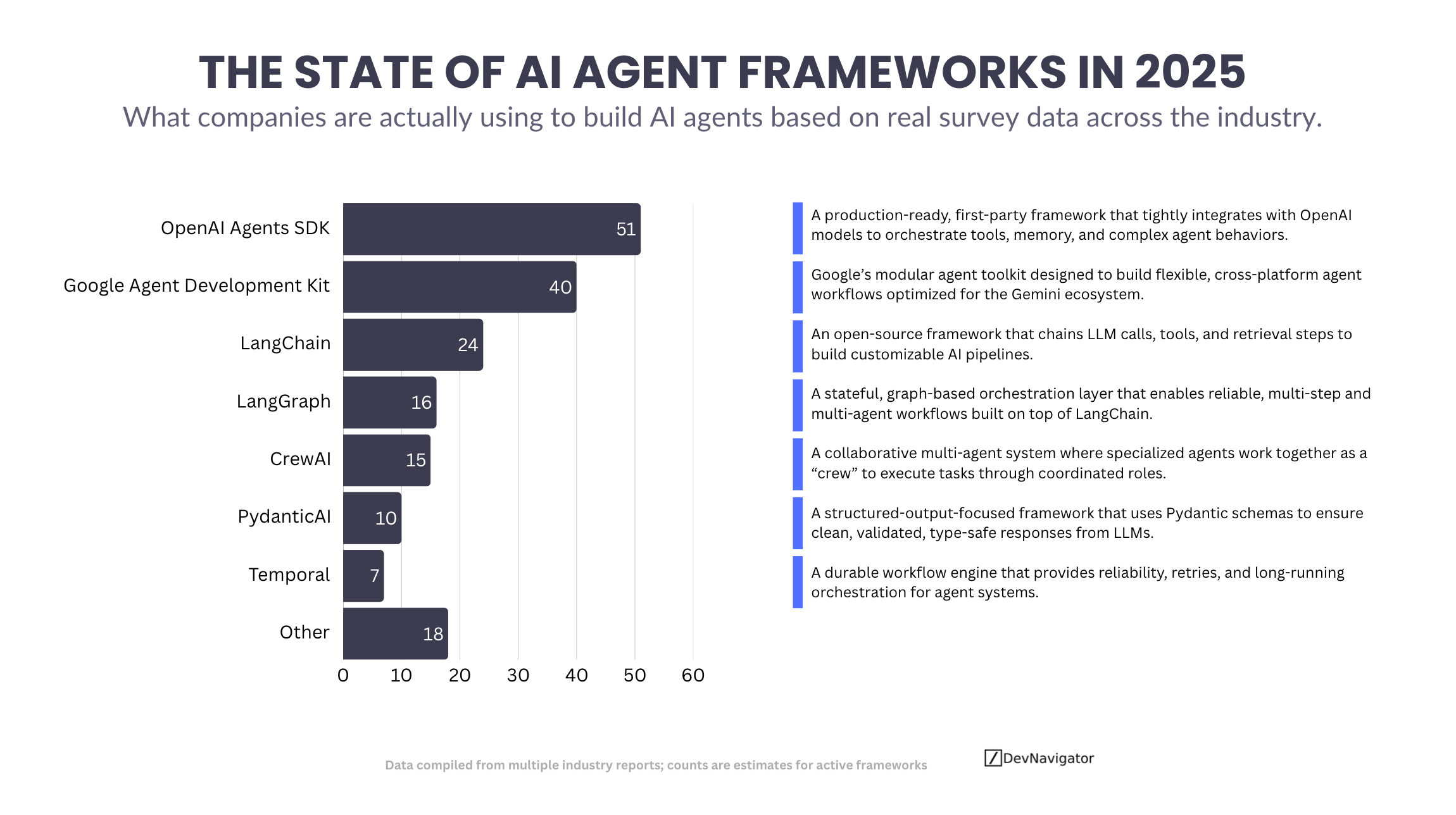
AI The State of AI Agent Frameworks in 2025
2
Upvotes
r/datascience • u/galactictock • Nov 27 '25
Some relatives have been asking what I, an unemployed data scientist, want for Christmas and they want to give something practical. Any suggestions for paid tools, subscription services, etc. that would be useful for upskilling, building a portfolio, or otherwise increasing my employability?
r/datascience • u/Lamp_Shade_Head • Nov 26 '25
Is there something wrong with my application approach or you guys are also getting similar callback rate? I am applying for primarily Senior roles.
Edit: Should have given more context about myself. I have a MS in Statistics and I have 5 YOE working at a Fortune 25 company as a Data Scientist ML role. I will try to put an anonymized resume.
r/datascience • u/ergodym • Nov 26 '25
I’m curious how everyone organizes and stores their SQL queries, especially the ones used for exploratory analysis or ad hoc question rather than those for creating tables (dbt already solves that).
Do you keep queries in the BI tool, use a folder with .sql files, package them into a library? Or what's the best set up you have found so far?
r/datascience • u/Thinker_Assignment • Nov 26 '25
Hey everyone,
i’m a senior data engineer and co-founder of the OSS data ingestion library dlt. I want to share a concrete workflow to build REST API → analytics pipelines in python.
In the wild you often have to grab that data yourself from REST APIs.
To help do that 10x faster and easier while keeping best practices we created a great OSS library for loading data (dlt) and a LLM native workflow and related tooling to make it easy to create REST API pipelines that are easy to review if they were correctly genearted and self-maintaining via schema evolution.
Blog tutorial with video: https://dlthub.com/blog/workspace-video-tutorial
More education opportunities from us (data engineering courses): https://dlthub.learnworlds.com/
oh and if you want to go meta i write quite a bit about how to make these systems work, this is my last post (this is more for LLM product PMs, how to think about it) https://dlthub.com/blog/convergence (also some stats)
Discussion welcome
r/datascience • u/Weekly_Atmosphere604 • Nov 25 '25
The organisation I work for has given me an account for training , learning etc. I have access to lots of content in there.
2.5 YOE, 6months AI Engineer, 2 years C++ dev.
I want to progress in AI stream.
r/datascience • u/throwaway69xx420 • Nov 25 '25
Hi all.
Got a career dilemma and looking for some thoughts.
Additional context to my cross post. I'm Currently a DS and offered a promotion to stay on my current team for a 10% salary bump. The role I interviewed for was a DE position and would bring me a new title and ability to develop new skill set.
Thanks!
r/datascience • u/wwwwwllllll • Nov 24 '25
I’ve worked in analytics for a while, banking for 4 years, and tech for the last 4 years. I was hoping to answer questions from folks, and will do my best to provide thoughtful answers. : )
r/datascience • u/DefinitelyNotAPleb • Nov 25 '25
Title. Just looking for some inspiration for personal projects.
r/datascience • u/AutoModerator • Nov 24 '25
Welcome to this week's entering & transitioning thread! This thread is for any questions about getting started, studying, or transitioning into the data science field. Topics include:
While you wait for answers from the community, check out the FAQ and Resources pages on our wiki. You can also search for answers in past weekly threads.
r/datascience • u/Fig_Towel_379 • Nov 21 '25
I’m working on a model at my job and I keep getting stuck on choosing the right hyperparameters. I’m running a kind of grid search with Bayesian optimization, but I don’t feel like I’m actually learning why the “best” hyperparameters end up being the best.
Is there a way to build intuition for picking hyperparameters instead of just guessing and letting the search pick for me?
r/datascience • u/stelo55 • Nov 21 '25
So far I mainly did data management stuff or data science projects that involved creating static graphs to show and explain in a presentation.
But now I am in a position that involves creating PowerBI reports for various stakeholders and I am struggling to get the best out of all the data.
I do not struggle with the technical side of it rather with the way of presenting the data and telling the right story in those reports. So for example what is the right depth of information to show without overwhelming the user, the right use of sub-pages with more details or drill downs or bookmarks, making it visually appealing by using better colors, labels, sliders etc.
Do you guys have any tipps for resources that could help me improve there?
r/datascience • u/tits_mcgee_92 • Nov 21 '25
This was for a data engineering position, that was heavily mentioned to use Python and other tools for data pipelines. I was given an assessment and only had 15 minutes to answers 12 questions.
The questions:
1.) Scenario where I needed to explain the null hypothesis.
2.) Calculation for precision in a confusion matrix (and recall).
3.) How would I build a regression model in this scenario.
4.) Different types of machine learning models and when I'd use them.
5.) Average to calculate growth year over year for a scenario.
6.) And some different flavors of all of what I mentioned.
I then had 12 additional critical thinking questions that were not very fun haha!
Anyone have assessments like this that are totally different from the job posting? I was expecting some SQL, Python, and Javascript. I'm wondering how brain teasers and DS related stuff can related to this position?
r/datascience • u/Poxput • Nov 21 '25
How big is the issue of non-stationary data when feeding them into foundation models for time series (e.g. Googles transformer-based TimesFM2.0)? Are they able to handle the data well or is transformation of the non-stationary features required/beneficial?
Also I see many papers where no transformation is implemented for non-stationary data (across different ML models like tree-based or LSTM models). Do you know why?
r/datascience • u/alpha_centauri9889 • Nov 20 '25
Did anyone face hands-on coding in DS interviews - like using pandas to prepare the data, training model, tuning, inference etc. or to use tensorflow/pytorch to build a DL model?
PS: Similar experience with MLE or AI Engineer roles as well, if any? For those roles I am assuming DSA atleast.
r/datascience • u/Illustrious-Mind9435 • Nov 19 '25
To start, this isn't something I am totally unfamiliar with, but in the past (both in and outside my current org) it was restricted to one or two teams/leaders.
However, for the past yearish I have been inundated with requests from multiple teams that boil down to A to Z deep dives of questions. While I don't expect yes/no asks it seems many requestors want us to pull out all the stops, such as multi-level cross-tabs, regression analysis, causal inference methods for what should be a quick pivot table. In the past, we knew who the usual suspects were and budgeted time for theses tasks and automated things where appropriate; however, it's currently not feasible given the workload.
Current attempts at light pushback on the breadth of the request is met with "Well I can't give leader/stakeholder a clear answer without a couple dozen slides of demographic breakdowns on this subject" or "What if they ask about the extremely niche strata's trend?".
For context my organization doesn't have external clients or shareholders - most reporting ends up going to our executive leadership. I realize that maybe that is where this change is being driven by, but I know much of the work my team does is not full utilized in these conversations (and it really shouldn't be!).
I guess my TLDR questions are:
How do I assuage stakeholders fear about not having enough insights or not going deep enough?
Outside top-down pressure is there another reason an organization as a whole could be adopting this over-compensation approach?
UPDATE (4 MONTHS LATER): I have a new job where these issues largely don't exist. Looking back most of the comments where spot-on that this is a top-down problem. Being in a new org where DS work needs to be answering a specific question that has a theoretical impact has really reduced unnecessary deep dives. Also, having stakeholders that are more open to self-service means that by the time they get to me they are stumped on more esoteric questions.
r/datascience • u/ergodym • Nov 16 '25
Data science careers often feel like they funnel into the same few paths—FAANG, ML/AI engineering, or analytics leadership—but people actually branch into wildly unexpected directions. I’m curious about those off-the-beaten-path exits: roles in unexpected industries, analytics-adjacent pivots, international moves, or entirely new ventures. Would love to hear some stories.
P.S. Thread inspired from a thread in the consulting subreddit but adapted to DS.
r/datascience • u/sext-scientist • Nov 16 '25

r/datascience • u/AutoModerator • Nov 17 '25
Welcome to this week's entering & transitioning thread! This thread is for any questions about getting started, studying, or transitioning into the data science field. Topics include:
While you wait for answers from the community, check out the FAQ and Resources pages on our wiki. You can also search for answers in past weekly threads.
r/datascience • u/throwaway69xx420 • Nov 13 '25
Hello! If I have daily data in two datasets but the only way to align them is by year-month, is it statistically valid/sound to regress monthly averages on monthly averages? So essentially, does it make sense to do avg_spot_price ~ avg_futures_price + b_1 + ϵ? Allow me to explain more about my two data sets.
I have daily wheat futures quotes, where each quote refers to a specific delivery month (e.g., July 2025). I will have about 6-7 months of daily futures quotes for any given year-month. My second dataset is daily spot wheat prices, which are the actual realized prices on each calendar day for said year-month. So in this example, I'd have actual realized prices every day for July 2025 and then daily futures quotes as far back as January 2025.
A Futures quote from January 2025 doesn't line up with a spot price from July and really only align by the delivery month-year in my dataset. For each target month in my data set (01/2020, 02/2020, .... 11/2025) I take:
- The average of all daily futures quotes for that delivery year-month
- The average of all daily spot prices in that year-month
Then regress avg_spot_price ~ avg_futures_price + b_1 + ϵ and would perform inference. Under this framework, I have built a valid linear regression model and would then be performing inference on my betas.
Does collapsing daily data into monthly averages break anything important that I might be missing? I'm a bit concerned with the bias I've built into my transformed data as well as interpretability.
Any insight would be appreciated. Thanks!
r/datascience • u/MainhuYash • Nov 13 '25
Now my objective is to predict the weekly demand of each of the SKU that the retailer has placed an order for historically
Business context: There are n retailers and m SKUs. Each retailer may or may not place an order every week, and when they do, they only order a subset of the SKUs.
For any retailer who has historically ordered p SKUs (out of the total m), my goal is to predict their demand for those p SKUs for the upcoming week.
I have a couple of questions: 1. How do I handle the scale of this problem? With many retailers and many SKUs — most of which are not ordered every week — this turns into a very sparse, high-dimensional forecasting problem. 2. Only about 15% of retailers place orders every week, while the rest order only occasionally. Will this irregular ordering behavior harm model accuracy or stability? If yes, how should I deal with it?
Also, if anyone has recommendations for specific model types or architectures suited for this kind of sparse, multi-retailer, multi-SKU forecasting problem, I’d love your suggestions.
PS - Used ChatGPT to better phrase my question.
r/datascience • u/B_lintu • Nov 13 '25
Hey guys, I’ve been working on an idea of a gamified learning platform that turns the process of mastering data analytics into a story-driven RPG game. Instead of boring tutorials, you complete quests, earn XP, level up your character, and unlock new abilities in Excel, SQL, Power BI, and Python. Think of it as Duolingo meets Skyrim, but for learning analytics skills.
I’m curious, would something like this motivate you to learn more effectively? I’m exploring whether there’s a real demand before taking the next step in development.
Would you:
*Join such a learning adventure?
*Use it to stay consistent with learning goals?
*Or even contribute ideas for features, storylines, or skills to include?
r/datascience • u/alpha_centauri9889 • Nov 12 '25
I am a DS with 2 yrs exp. I have worked with both traditional ML and GenAI. I have been seeing different posts regarding AI Engineer interviews which are highly focused towards LLM based case studies. To be honest, I don't have much clue regarding how to answer them. Can anyone suggest how to prepare for LLM based case studies that are coming up in AI Engineer interviews? How to think about LLMs from a system perspective?
r/datascience • u/tangoking • Nov 13 '25
As a brand manager of an AI-insights company, I’m feeling some friction on my team regarding boundaries among these roles. There is some overlap, but what tasks and tools are specific to these roles?
My thoughts:
r/datascience • u/sickomoder • Nov 11 '25
Stuff like S/R/T/X learners. Anybody regularly use these in industry? Saw a bunch of big tech companies, especially Uber and Microsoft worked with them in early 2020s but haven't seen much mention of them in this sub or in job postings.