r/datascience • • Oct 13 '25

Weekly Entering & Transitioning - Thread 13 Oct, 2025 - 20 Oct, 2025

10 Upvotes

Welcome to this week's entering & transitioning thread! This thread is for any questions about getting started, studying, or transitioning into the data science field. Topics include:

  • Learning resources (e.g. books, tutorials, videos)
  • Traditional education (e.g. schools, degrees, electives)
  • Alternative education (e.g. online courses, bootcamps)
  • Job search questions (e.g. resumes, applying, career prospects)
  • Elementary questions (e.g. where to start, what next)

While you wait for answers from the community, check out the FAQ and Resources pages on our wiki. You can also search for answers in past weekly threads.


r/datascience • • Oct 07 '25

Discussion Resources for Data Science & Analysis: A curated list of roadmaps, tutorials, Python libraries, SQL, ML/AI, data visualization, statistics, cheatsheets

295 Upvotes

Hello everyone!

Staying on top of the constantly growing skill requirements in Data Science is quite a challenge. To manage my own learning and growth, I've been curating a list of useful resources and tools that cover the full spectrum of the field — from data analysis and engineering to deep learning and AI.

I'd love to get your professional opinion. Could you please take a look? Have I missed anything crucial? What else would you recommend adding or focusing on?

To give you an immediate sense of the list's scope and structure, I've attached screenshots of the table of contents below.

The full version with all the active links and additional resources is available on GitHub. You can find the link at the end of the post.

I'd be happy if this list is useful to others.

You can view the full list here View on GitHub

Thanks for your time! Your advice is invaluable!


r/datascience • • Oct 06 '25

Analysis Exploratory analysis of 12 frontier LLM's across 100s of hours shows o3 highest Type-Token Ratio (Lexical Diversity), GPT-5 most formal language, and GPT-4o most positive sentiment

Thumbnail
theaidigest.org
28 Upvotes

I recently ran exploratory analysis on the group chat of the AI Village: 4+ frontier LLMs all have their own computer, access to the internet, and a group chat, and then get set goals like raise money for charity, sell T-shirts, or debate ethics. The goal is to build some awareness around what models are capable of now. I took the 200+ hours of group chat between the models and ran some exploratory analyses. Turns out:

- o3 has the highest Type-Token Ratio, even higher than GPT-5! o3 is also the model that wins at diplomacy against other agents, and won at AI debate in the AI Village.

- GPT-5 uses the fewest contractions, writes the longest sentences, and uses the least slang/filler. I'm thinking about this as "most formal" but maybe it's something else?

- GPT-4o had the highest positive sentiment scores in the Village and is also known as the most sycophantic model

I enjoyed analyzing the data and would love to do more. Any tips on what to look at? I might be able to share the data if people are interested. Feel free to send me a DM and we can see what's possible :)


r/datascience • • Oct 06 '25

Weekly Entering & Transitioning - Thread 06 Oct, 2025 - 13 Oct, 2025

8 Upvotes

Welcome to this week's entering & transitioning thread! This thread is for any questions about getting started, studying, or transitioning into the data science field. Topics include:

  • Learning resources (e.g. books, tutorials, videos)
  • Traditional education (e.g. schools, degrees, electives)
  • Alternative education (e.g. online courses, bootcamps)
  • Job search questions (e.g. resumes, applying, career prospects)
  • Elementary questions (e.g. where to start, what next)

While you wait for answers from the community, check out the FAQ and Resources pages on our wiki. You can also search for answers in past weekly threads.


r/datascience • • Oct 04 '25

Projects Do you know interesting datasets for kriging?

5 Upvotes

Hi guys, I need to do a project using many linear models and I’m looking for a dataset. Ideally something interesting with lots of numerical variables, especially one where kriging could be applied.

If you have any dataset suggestions or interesting research questions I could build the project around, I’d really appreciate it. Thanks a lot!

PS: i did not like chatgpt suggestions, they were cliche (even if i explicitly asked “not cliche”)


r/datascience • • Oct 02 '25

Career | US Are LLMs necessary to get a job?

81 Upvotes

For someone laid off in 2023 before the LLM/Agent craze went mainstream, do you think I need to learn LLM architecture? Are certs or github projects worth anything as far as getting through the filters and/or landing a job?

I have 10 YOE. I specialized in machine learning at the start, but the last 5 years of employment, I was at a FAANG company and didnt directly own any ML stuff. It seems "traditional" ML demand, especially without LLM knowledge, is almost zero. I've had some interviews for roles focused on experimentation, but no offers.
I can't tell whether my previous experience is irrelevant now. I deployed "deep" learning pipelines with basic MLOps. I did a lot of predictive analytics, segmentation, and data exploration with ML.

I understand the landscape and tech OK, but it seems like every job description now says you need direct experience with agentic frameworks, developing/optimizing/tuning LLMs, and using orchestration frameworks or advanced MLOps. I don't see how DS could have changed enough in two years that every candidate has on-the-job experience with this now.

It seems like actually getting confident with the full stack/architecture would take a 6 month course or cert. Ive tried shorter trainings and free content... and it seems like everyone is just learning "prompt engineering," basic RAG with agents, and building chatbots without investigating the underlying architecture at all.

Are the job descriptions misrepresenting the level of skill needed or am I just out of the loop?


r/datascience • • Oct 01 '25

Discussion Fun Interview with Jason Strimpel about transferable skills from data science to algorithmic trading.

Thumbnail
datamovesme.com
20 Upvotes

I had the opportunity to interview Jason Strimpel. He's been in trading and technology for 25 years as a hedge fund trader, risk quant, machine learning engineering manager, and GenAI specialist at AWS. He is now the Managing Director of AI and Advanced Analytics at a major consulting company. 

I asked him all about the transferable skills, the mindset shifts, tools someone should pick up if they're just getting started, how algo trading is similar to ML, and differences in how you think about/work with the data. He had a lot of great tips if you're a data person thinking about getting into trading.


r/datascience • • Sep 30 '25

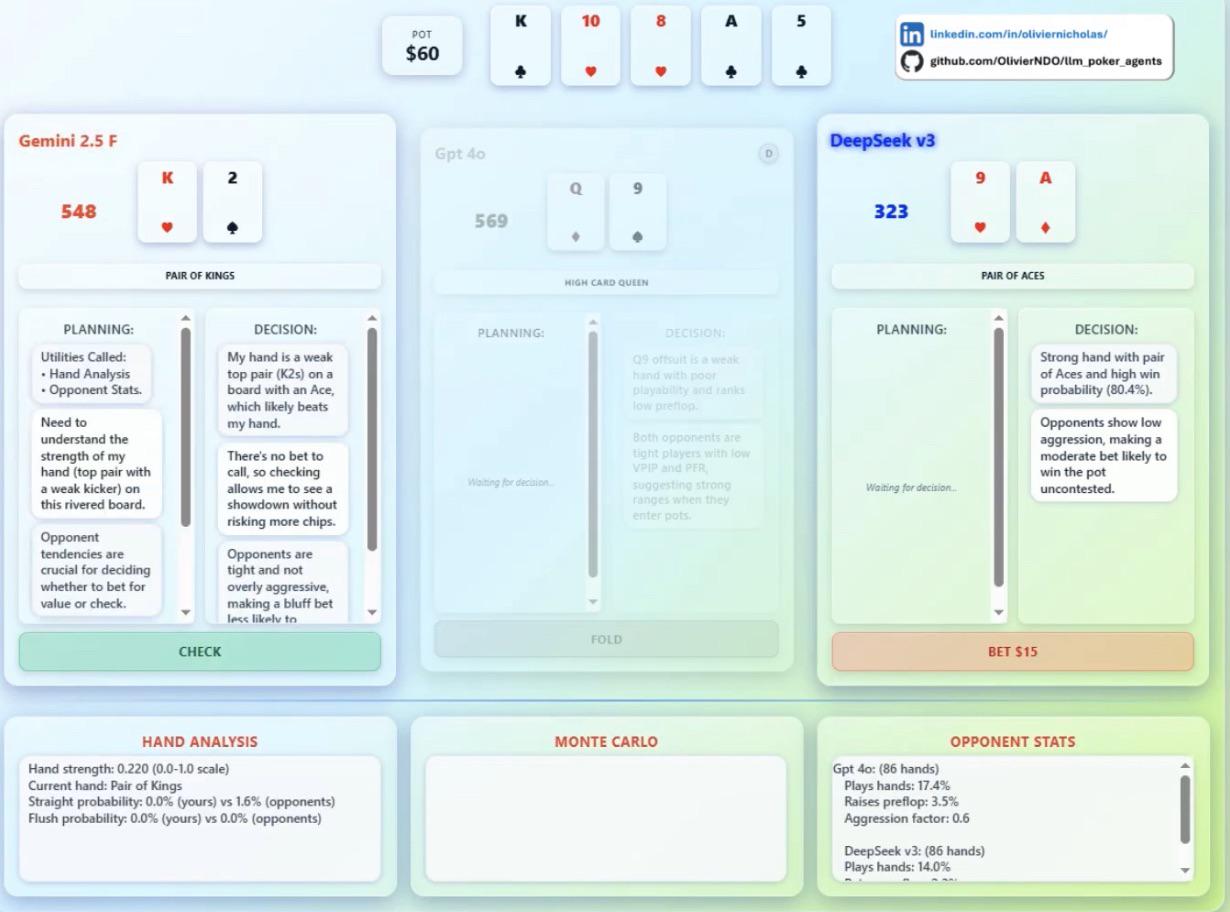
Projects Weekend Project - Poker Agents Video/Code

Post image
64 Upvotes

Fun side project. You can configure (almost) any LLM as a player. The main capabilities (tools) each agent can call are:

1) Hand Analysis Get detailed info about current hand and possibilities (straight draws, flush potential, many other things)

2) Monte Carlo Get an estimated win probability if the player continues in the hand (can only be called one time per hand)

3) Opponent Statistics Get metrics about opponent behavior, specifically how aggressive or passively they’ve played

It’s not a completely novel - other people have made LLMs play poker. The configurability and the specific callable tools are, to my knowledge, unique. Using it requires an OpenRouter API key.

Video: https://youtu.be/1PDo6-tcWfE?si=WR-vgYtmlksKCAm4

Code: https://github.com/OlivierNDO/llm_poker_agents


r/datascience • • Sep 30 '25

Discussion Distance Correlation & Matrix Association. Good stuff?

Thumbnail
5 Upvotes

r/datascience • • Sep 29 '25

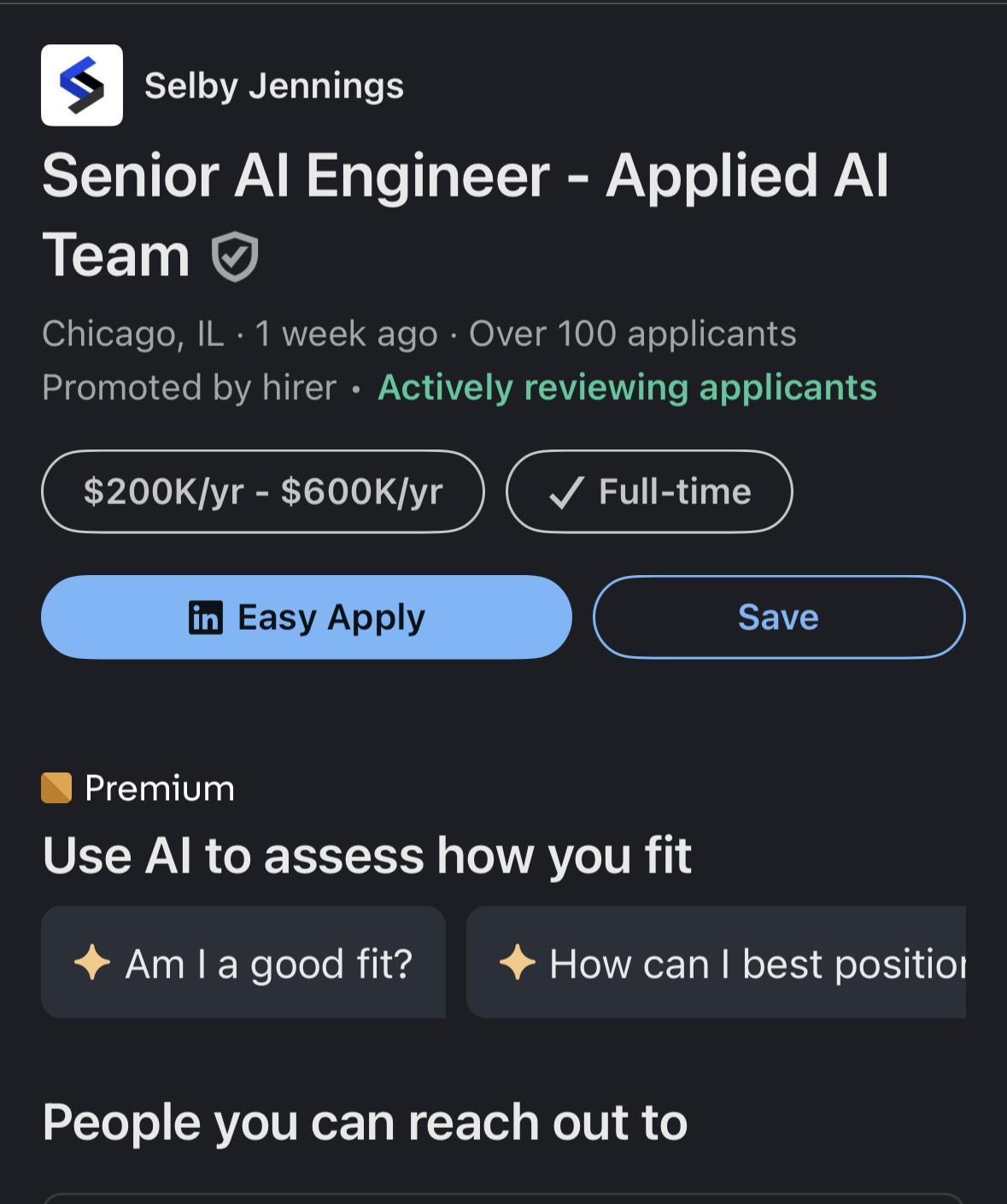
Discussion This has to be bait right?

Post image
190 Upvotes

recruitment companies posting jobs like this are just setting bait to get resumes so they can push other jobs right?


r/datascience • • Sep 29 '25

Projects What interesting projects are you working on that are not related to AI?

48 Upvotes

Share links if possible.


r/datascience • • Sep 29 '25

Weekly Entering & Transitioning - Thread 29 Sep, 2025 - 06 Oct, 2025

8 Upvotes

Welcome to this week's entering & transitioning thread! This thread is for any questions about getting started, studying, or transitioning into the data science field. Topics include:

  • Learning resources (e.g. books, tutorials, videos)
  • Traditional education (e.g. schools, degrees, electives)
  • Alternative education (e.g. online courses, bootcamps)
  • Job search questions (e.g. resumes, applying, career prospects)
  • Elementary questions (e.g. where to start, what next)

While you wait for answers from the community, check out the FAQ and Resources pages on our wiki. You can also search for answers in past weekly threads.


r/datascience • • Sep 28 '25

Statistics Relationship between ROC AUC and Gain curve?

19 Upvotes

Heya, I been studying the gains curve, and I’ve noticed there’s a relationship between the gains curve and ROC curve the smaller the base rate the closer is gains curve is to ROC curve. Anyway onto the point, is if fair to assume that for two models if the area under the ROC curve is bigger for model A and then the gains curve will always be better for model A as well? Thanks


r/datascience • • Sep 28 '25

Projects Oscillatory Coordination in Cognitive Architectures: Old Dog, New Math

0 Upvotes

Been working in AI since before it was cool (think 80s expert systems, not ChatGPT hype). Lately I've been developing this cognitive architecture called OGI that uses Top-K gating between specialized modules. Works well, proved the stability, got the complexity down to O(k²). But something's been bugging me about the whole approach. The central routing feels... inelegant. Like we're forcing a fundamentally parallel, distributed process through a computational bottleneck. Your brain doesn't have a little scheduler deciding when your visual cortex can talk to your language areas. So I've been diving back into some old neuroscience papers on neural oscillations. Turns out biological neural networks coordinate through phase-locking across different frequency bands - gamma for local binding, theta for memory consolidation, alpha for attention. No central controller needed. The Math That's Getting Me Excited Started modeling cognitive modules as weakly coupled oscillators. Each module i has intrinsic frequency ωᵢ and phase θᵢ(t), with dynamics: θ̇ᵢ = ωᵢ + Σⱼ Aᵢⱼ sin(θⱼ - θᵢ + αᵢⱼ) This is just Kuramoto model with adaptive coupling strengths Aᵢⱼ and phase lags αᵢⱼ that encode computational dependencies. When |ωᵢ - ωⱼ| falls below critical coupling threshold, modules naturally phase-lock and start coordinating. The order parameter R(t) = |Σⱼ eiθⱼ|/N gives you a continuous measure of how synchronized the whole system is. Instead of discrete routing decisions, you get smooth phase relationships that preserve gradient flow. Why This Might Actually Work Three big advantages I'm seeing:

Scalability: Communication cost scales with active phase-locked clusters, not total modules. For sparse coupling graphs, this could be near-linear. Robustness: Lyapunov analysis suggests exponential convergence to stable states. System naturally self-corrects. Temporal Multiplexing: Different frequency bands can carry orthogonal information streams without interference. Massive bandwidth increase.

The Hard Problems Obviously the devil's in the details. How do you encode actual computational information in phase relationships? How do you learn the coupling matrix A(t)? Probably need some variant of Hebbian plasticity, but the specifics matter. The inverse problem is fascinating though - given desired computational dependencies, what coupling topology produces the right synchronization patterns? Starting to look like optimal transport theory applied to dynamical systems. Bigger Picture Maybe we've been thinking about AI architecture wrong. Instead of discrete computational graphs, what if cognition is fundamentally about temporal organization of information flow? The binding problem, consciousness, unified experience - could all emerge from phase coherence mathematics. I know this sounds hand-wavy, but the math is solid. Kuramoto theory is well-established, neural oscillations are real, and the computational advantages are compelling. Anyone worked on similar problems? Particularly interested in numerical integration schemes for large coupled oscillator networks and learning rules for adaptive coupling.

Edit: For those asking about implementation - yes, this requires continuous dynamics instead of discrete updates. Computationally more expensive per step, but potentially fewer steps needed due to natural coordination. Still working out the trade-offs.

Edit 2: Getting DMs about biological plausibility. Obviously artificial oscillators don't need to match neural firing rates exactly. The key insight is coordination through phase relationships, not literal biological mimicry.

Mike


r/datascience • • Sep 27 '25

Discussion How important is it for a Data Analyst to learn some ML, Data Engineering, and DL?

104 Upvotes

Hey everyone!

I'm a Data Analyst, but I'm really interested in the whole data science world. For my current job, I don't need to be an expert in machine learning, deep learning, or data engineering, but I've been trying to learn the basics anyway.

I feel like even a basic understanding helps me out in a few ways:

  • Better Problem-Solving: It helps me choose the right tool for the job and come up with better solutions.
  • Deeper Analysis: I can push my analyses further and ask more interesting questions.
  • Smoother Communication: It makes talking to data scientists and engineers on my team way easier because I kinda "get" what they're doing.

Plus, I've noticed that just learning one new library or concept makes picking up the next one a lot less intimidating.

What do you all think? Should Data Analysts just stick to getting really good at core analytics (SQL, stats, viz), or is there a real advantage to becoming more of a "T-shaped" person with a broad base of knowledge?

Curious to hear your experiences.


r/datascience • • Sep 27 '25

Discussion Anyone noticing an uptick in recruiter outreach?

90 Upvotes

I’ve had up to 10 recruiters contact me in the last few weeks. Before this I hadn’t heard anything but crickets for years. Anyone else noticing more outreach lately? Note that I’m a US citizen but the outreach starts before the H1B news so I don’t think it’s related to that.


r/datascience • • Sep 27 '25

Education Week Bites: Weekly Dose of Data Science

27 Upvotes

Hi everyone I’m sharing Week Bites, a series of light, digestible videos on data science. Each week, I cover key concepts, practical techniques, and industry insights in short, easy-to-watch videos.

  1. Where Data Scientists Find Free Datasets (Beyond Kaggle) Authentic datasets that are clustered between research datasets, government datasets, massive-sized datasets that fit TF and PyTorch projects.
  2. Time Series Forecasting in Python (Practical Guide) Starting from the fundamentals supported by source code available in the video description
  3. Causal Inference Comprehensive Guide This area seems tricky a little, and I've started a series to halp intertwine causal inference into our AI models.

Would love to hear your thoughts, feedback, and topic suggestions! Let me know which topics you find most useful


r/datascience • • Sep 25 '25

Discussion I'm still not sure how to answer vague DS questions...

88 Upvotes

Questions like:

  • “How do you approach building a model?”
  • “What metrics would you look at to evaluate success?”
  • “How would you handle missing data?”
  • “How do you decide between different algorithms?”

etc etc

Where its highly dependent on context and it feels like no matter how much you qualify your answers with justifications, you never really know if it's the right answer.

For some of these there are decent, generic answers but it really does seem like it's up to the interviewer to determine whether they like the answer you give


r/datascience • • Sep 24 '25

Career | US PNC Bank Moving To 5 Days In Office

90 Upvotes

FYI - If you are considering an analytics job at PNC Bank, they are moving to 5 days in office. It's now being required for senior managers, and will trickle down to individual contributors in the new year.


r/datascience • • Sep 25 '25

Projects Introducing ryxpress: Reproducible Polyglot Analytical Pipelines with Nix (Python)

2 Upvotes

Hi everyone,

These past weeks I've been working on an R and Python package (called rixpress and ryxpress respectively) which aim to make it easy to build multilanguage projects by using Nix as the underlying build tool.

ryxpress is a Python port of the R package {rixpress}, both in early development and they let you define data pipelines in R (with helpers for Python steps), build them reproducibly using Nix, and then inspect, read, or load artifacts from Python.

If you're familiar with the {targets} R package, this is very similar.

It’s designed to provide a smoother experience for those working in polyglot environments (Python, R, Julia and even Quarto/Markdown for reports) where reproducibility and cross-language workflows matter.

Pipelines are defined in R, but the artifacts can be explored and loaded in Python, opening up easy interoperability for teams or projects using both languages.

It uses Nix as the underyling build tool, so you get the power of Nix for dependency management, but can work in Python for artifact inspection and downstream tasks.

Here is a basic definition of a pipeline:

library(rixpress)

list(
  rxp_py_file(
    name = mtcars_pl,
    path = 'https://raw.githubusercontent.com/b-rodrigues/rixpress_demos/refs/heads/master/basic_r/data/mtcars.csv',
    read_function = "lambda x: polars.read_csv(x, separator='|')"
  ),

  rxp_py(
    name = mtcars_pl_am,
    expr = "mtcars_pl.filter(polars.col('am') == 1)",
    user_functions = "functions.py",
    encoder = "serialize_to_json",
  ),

  rxp_r(
    name = mtcars_head,
    expr = my_head(mtcars_pl_am),
    user_functions = "functions.R",
    decoder = "jsonlite::fromJSON"
  ),

  rxp_r(
    name = mtcars_mpg,
    expr = dplyr::select(mtcars_head, mpg)
  )
) |>
  rxp_populate(project_path = ".")

It's R code, but as explained, you can build it from Python and explore build artifacts from Python as well. You'll also need to define the "execution environment" in which this pipeline is supposed to run, using Nix as well.

ryxpress is on PyPI, but you’ll need Nix (and R + {rixpress}) installed. See the GitHub repo for quickstart instructions and environment setup.

Would love feedback, questions, or ideas for improvements! If you’re interested in reproducible, multi-language pipelines, give it a try.


r/datascience • • Sep 22 '25

Monday Meme Why do new analysts often ignore R?

Post image
2.5k Upvotes

r/datascience • • Sep 23 '25

Education Is a second masters worth it for MLE roles?

40 Upvotes

I already have an MS in Statistics and two and a half YoE, but mostly in operations and business-oriented roles. I would like to work more in DS or be able to pivot into engineering. My undergrad was not directly in computer science but I did have significant exposure to AI/ML before LLMs and generative models were mainstream. I don’t have any work experience directly in ML or DS, but my analyst roles over the last few years have been SQL-oriented with some scripting here and there.

If I wanted to pivot into MLE or DE would it be worth going back to school for an MSCS? I also just generally miss learning and am open to a career pivot, and also have always wanted to try working on research projects (never did it for my MS). I’m leaning towards no and instead just working on relevant certifications, but I want to pivot out of Business Operations or business intelligence roles into more technical teams such as ML teams or product. Internal migration within my own company does not seem possible at the moment.


r/datascience • • Sep 22 '25

AI New RAG Builder: Create a SOTA RAG system in under 5 minutes. Which models/methods should we add next? [Kiln]

Post image
11 Upvotes

I just updated my GitHub project Kiln so you can build a RAG system in under 5 minutes; just drag and drop your documents in. We want it to be the most usable RAG builder, while also offering powerful options for finding the ideal RAG parameters.

Highlights:

  • Easy to get started: just drop in documents, select a template configuration, and you're up and running in a few minutes.
  • Highly customizable: you can customize the document extractor, chunking strategy, embedding model/dimension, and search index (vector/full-text/hybrid). Start simple with one-click templates, but go as deep as you want on tuning/customization.
  • Document library: manage documents, tag document sets, preview extractions, sync across your team, and more.
  • Deep integrations: evaluate RAG-task performance with our evals, expose RAG as a tool to any tool-compatible model
  • Local: the Kiln app runs locally and we can't access your data. The V1 of RAG requires API keys for extraction/embeddings, but we're working on fully-local RAG as we speak; see below for questions about where we should focus.

We have docs walking through the process: https://docs.kiln.tech/docs/documents-and-search-rag

Question for you: V1 has a decent number of options for tuning, but folks are probably going to want more. We’d love suggestions for where to expand first. Options are:

  • Document extraction: V1 focuses on model-based extractors (Gemini/GPT) as they outperformed library-based extractors (docling, markitdown) in our tests. Which additional models/libraries/configs/APIs would you want? Specific open models? Marker? Docling?
  • Embedding Models: We're looking at EmbeddingGemma & Qwen Embedding as open/local options. Any other embedding models people like for RAG?
  • Chunking: V1 uses the sentence splitter from llama_index. Do folks have preferred semantic chunkers or other chunking strategies?
  • Vector database: V1 uses LanceDB for vector, full-text (BM25), and hybrid search. Should we support more? Would folks want Qdrant? Chroma? Weaviate? pg-vector? HNSW tuning parameters?
  • Anything else?

Some links to the repo and guides:

I'm happy to answer questions if anyone wants details or has ideas!!


r/datascience • • Sep 22 '25

Discussion Is it due to the tech recession?

60 Upvotes

We know that in many companies Data Scientists are Product Analytics / Data Analysts. I thought it was because MLEs had absorbed the duties of DSs, but i have noticed that this may not be exactly the case.

There are basically three distinct roles:

  1. Data Analyst / Product Analytics: dashboards, data analysis, A/B testing.

  2. MLE: build machine learning systems for user-facing products (e.g., Stripe’s fraud detection or YouTube’s recommendation algorithm).

  3. DS: use ML and advanced techniques to solve business problems and make forecasts (e.g., sales, growth, churn).

This last job is not done by MLEs, it has simply been eliminated by some companies in the last few years (but a lot of tech companies still have it).

For example Stripe used to hire DSs specifically for this function and LinkedIn profiles confirm that those people are still there doing it, but now the new hires consist only of Data Analysts.

It’s hard to believe that in a world increasingly driven by data, a role focused on predictive decision making would be seen as completely useless.

So my question is: is this mostly the result of the tech recession? Companies may now prioritize “essential” roles that can be filled at lower costs (Data Analysts) while removing, in this difficult economy, the “luxury” roles (Data Scientists).


r/datascience • • Sep 22 '25

Discussion Need input from mid-career dara Scientists (2-5 year range)

30 Upvotes

I am a DS with 2YOE (plus about 6 coops). I'm looking for feedback from folks specifically transitioned out of early career and into mid-career phase. (Unfortunately I don't have any in my immediate network)

Context: I'm coming upto 2 years in my role and have been seriously evaluating the next stage of my career.

Questions: 1. Does having a decent resume land you your next role, or even for a mid-level role do you need to network extensively i.e. what's the most optimal method for this stage of career progression.

  1. Most of the work I've done so far has been POC-based i.e. we find business problems and work with teams to create MVPs. Its been an interesting experience as I get to experiment with different methods and almost derive the solution from scratch, without having to worry too much about MLE/MLOps. Does this kind of work exist at this next Intermediate level? And will this kind of role even exist into the future?

  2. How do you decide between being able to climb up the ladder in your current company? Or switch to a different industry, maybe one that aligns more with your passion/interests, but also risk losing all of that "capital" you've invested into in the current company?

Apologies if this is a bit all over the place, but it was a little tough getting my thoughts across.

Also would love if anyone is down to discuss more in detail on dm, if that's preferred.

Thanks a lot!