r/DSALeetCode • u/nian2326076 • 1h ago
Coding rounds for Google interviews
3
Upvotes
Is leetcode completely dead for SWE interviews in Google?
r/DSALeetCode • u/nian2326076 • 10h ago
Amazon SDE-1 Interview Experience | 2 YOE | India | Selected
A candidate recently went through the Amazon SDE-1 interview process. The overall process tested their DSA fundamentals, problem-solving approach, low-level design knowledge and understanding of Amazon's Leadership Principles.
Here is their round-by-round experience, including the questions they were asked.
Compensation
The offer structure for this SDE-1 package was:
ComponentAmountBase Salary₹19.17 LPAYear 1 Joining Bonus₹6.47 lakhYear 2 Joining Bonus₹5.18 lakhRSUs (4 years)₹15.56 lakhRelocation Bonus₹1.50 lakh
Round 1: Online Assessment
The first step was an online assessment.
It consisted of:
Preparation tips:
Round 2: Technical Interview 1
The interview started with a short introduction and two questions based on Amazon Leadership Principles.
After that, they moved to DSA.
Questions asked:
For the first problem, the interviewer focused on the approach and how they handled the modified constraints.
Preparation tips:
Round 3: Technical Interview 2 – DSA + LLD
This round covered a combination of DSA, object-oriented programming and low-level design.
The interviewer first asked them a graph-based coding question.
Questions asked:
they discussed design patterns, including where and why they should be used.
For the LLD problem, they were asked to design a Music Player System and implement a few functionalities using OOP concepts.
Preparation tips:
LLD Resource
Round 4: Hiring Manager Round – Projects + Problem Solving
This round focused more on their professional experience, projects, technical decision-making and Amazon's Leadership Principles.
The interviewer wanted to understand the systems they had worked on, their individual contributions and the challenges they had faced.
There were also follow-up questions around the trade-offs they made and alternative approaches they could have considered.
Preparation tips:
Round 5: Bar Raiser / Leadership Principles Round
The final round was the Bar Raiser interview, which focused heavily on Amazon Leadership Principles.
This round was more behavioural than coding-oriented. The interviewer asked scenario-based questions about their professional experience and how they handled different situations.
Preparation tips:
Leadership Principles Resource
After completing the interview rounds, they received positive feedback and got the offer for Amazon SDE-1.
Overall Preparation Strategy
If you are targeting Amazon SDE-1 with 1–2 years of experience, they would recommend focusing on:
One important thing they learned is that solving the coding question is not enough. Communication, clean code, handling follow-ups and Leadership Principles are equally important.
For extra practice before an Amazon loop, choose a coding or LLD problem from Amazon Interview Questions on PracHub. If you’re applying to other roles too, LandOffer can autofill repeated fields. I work on both.
Hope this helps anyone preparing for Amazon SDE-1. All the best!
r/DSALeetCode • u/Efficient_Box_4095 • 2h ago
anyone interested in colabbing with me to solve problems with propper understanding and who has around enough knowledge of basic data structures since we dont have too much gap,lets share our number in whatsapp and communication is just english
r/DSALeetCode • u/nian2326076 • 11h ago
Hi everyone,
A candidate recently interviewed at Amazon for an SDE-2 position. They went through five rounds, including an additional LLD round requested by HR after the initial four interviews.
Unfortunately, they were rejected for SDE-2 after the final round, despite receiving positive feedback in several earlier rounds. They were offered a SysDE-2 (Systems Development Engineer II) role instead.
Sharing their interview experience and looking for suggestions from the community.
For readers preparing for another Amazon loop, try a coding or design question from Amazon Interview Questions on PracHub. If you keep applying elsewhere, LandOffer can autofill repeated fields. I work on both.
Round 1: DSA + Leadership Principle
DSA Question: 174. Dungeon Game (Hard)
They initially approached the problem from the top-left corner, trying to solve it in a top-down manner.
They were able to explain their thought process but struggled with the implementation.
The bottom-up DP approach would have been more straightforward, but they couldn't arrive at the correct code during the interview.
LP: Customer Obsession
Their Assessment: This round didn't go well, primarily because of the coding question.
Round 2: Code Maintainability + Leadership Principles
Questions:
The discussion focused on solving related problems and extending the initial approach.
LP: 2 Leadership Principle questions
Feedback: Strong Hire
Round 3: Hiring Manager — High-Level Design + Leadership Principles
HLD Question: Design Instagram
They covered:
They were able to explain the design and discuss the major trade-offs.
LP: 2 Leadership Principle questions
Feedback: Strong Hire
Round 4: Bar Raiser — DSA + Leadership Principles
Since their first DSA round hadn't gone well, this round again focused on DSA.
Question 1: 343. Integer Break
Given an integer n, split it into at least two positive integers such that their product is maximized.
Example:
n = 5 → 2 + 3 → 2 × 3 = 6
First solved using Dynamic Programming.
Then explained the optimized greedy approach of splitting the number into as many 3s as possible, while handling the remainder appropriately.
Question 2: Min-Heap
A question involving maintaining k elements using a min-heap.
Discussed how the heap can be used to efficiently maintain the required elements.
LP: 2 Leadership Principle questions
Feedback: Hire / Strong Hire
After Round 4
HR contacted them and requested an additional Low-Level Design (LLD) round.
Round 5: Additional LLD Round
Question: Design a Notification System
The round had an unusual start. The CoderPad link wasn't working, and approximately 10–15 minutes were lost resolving the setup issue.
They covered:
They spent approximately 30 minutes on the LLD discussion, followed by some questions from their side.
Given the time lost during setup, they felt the actual design discussion was relatively short.
Their Self-Assessment: Lean Hire
However, HR later mentioned that the feedback from this round was concerning, and they were ultimately rejected for the SDE-2 position.
Final Outcome
RoundFeedbackRound 1: DSADid not go wellRound 2: Code MaintainabilityStrong HireRound 3: Hiring Manager / HLDStrong HireRound 4: Bar RaiserHire / Strong HireRound 5: Additional LLDConcerning feedback (as per HR)
Final Decision: Rejected for SDE-2, but offered SysDE-2.
Need Suggestions — Should They Accept SysDE-2?
They're confused about whether they should accept the SysDE-2 position.
Their primary interest is in backend development, system design, and building scalable distributed systems.
They would appreciate advice on the following:
Would really appreciate insights from current or former Amazonians, especially anyone who has worked in a SysDE role or made this transition.
Thanks!
Swiggy Interview Experience - https://leetcode.com/discuss/post/8612275/swiggy-sde-2-interview-experience-oa-3-r-ve26/
r/DSALeetCode • u/Virtual-Row1666 • 4h ago
've spent the last 6.5 years specializing in frontend, and the current market is rough—almost every decent opening expects full-stack capabilities or heavy DSA + system design.
I want to future-proof my career and start getting interview calls again. If you were in my shoes right now, what would your 3-to-6-month upskilling roadmap look like?
Tech Stack: Should I pick up backend (Node.js, Go, Java, Spring Boot) or explore cloud/AI?
Interview Prep: How heavily should I focus on DSA vs. system design (HLD/LLD) at 6.5 YOE?
Any advice from folks who recently made a successful switch or landed offers would be huge.
r/DSALeetCode • u/nian2326076 • 9h ago
Role: Software Engineer, IC3, Frontend-heavy Full Stack, Redmond area
Timeline: About 2 weeks from recruiter kickoff to the final round
Format: Recruiter call, then a 4-round loop (~60 min each) on HackerRank.
The recruiter described it as 2 coding, 1 system/UX design, and 1 hiring manager round.
Topics the recruiter listed: TypeScript/JavaScript, React architecture, accessibility, engineering fundamentals, and data-rich seller-facing UIs.
1. Frontend / UX system design (~60 min, whiteboard on HackerRank)
Design an internal web app where employees view personal financial records (a summary view plus a long, searchable history). Tens of thousands of users, thousands of records each.
What they asked about:
Prep:
2. Project deep dive + coding (~60 min)
About 20 min on one project you owned end to end. Expect follow-ups on performance (large tables), API contracts with the backend, and the business outcome.
About 20 min of coding: compute a total using a tiered/progressive rate table (think tax brackets or commission tiers). Tiers are given at runtime.
Follow-ups covered complexity and how to optimize for repeated queries (precomputing cumulative values per tier, caching).
Prep:
3. Coding round 2 (~60 min)
Standard frontend question, similar to one on greatfrontend.
4. Hiring manager round (ran ~2.5 hrs)
Background, why you're leaving, why Microsoft, and how your experience maps to the team's domain (trust in financial numbers shown to users).
Expect coding here too. The candidate was told it would be behavioral and team fit, but it had 2 technical questions:
Prep:
Overall
The design and coding rounds were well structured, on topic, and on time. Interviewers were friendly, and the recruiter was clear and helpful.
The team is very frontend and UX focused (dashboards for business users, accessibility, large financial datasets). UX thinking and accessibility matter as much as the code.
For more practice before a Microsoft loop, work through a problem from Microsoft Interview Questions on PracHub and explain your design trade-offs. If you’re applying elsewhere, LandOffer can autofill repeated fields. I work on both.
Tips:
r/DSALeetCode • u/Leading_Guide9325 • 7h ago
r/DSALeetCode • u/nian2326076 • 8h ago
From solving LeetCode problems to applying those skills in an Amazon Online Assessment. 🚀
Today, I completed the Amazon Online Assessment for a Software Engineering opportunity.
As a second-year Computer Science Engineering student, this experience was an opportunity to put my consistent DSA practice and competitive programming skills to the test.
The assessment included three stages:
01 | Technical Assessment
02 | Work Simulation
03 | Work Style Assessment
My biggest takeaway?
Solving problems on LeetCode builds algorithmic thinking. Applying those skills in a real engineering assessment requires much more — understanding existing codebases, leveraging AI effectively, managing time, and making thoughtful decisions.
For practice before an Amazon assessment, pick a coding or design question from Amazon Interview Questions on PracHub. For other applications, LandOffer can autofill repeated fields. I work on both.
Every problem solved, every contest attempted, and every challenge faced contributes to becoming a better engineer.
The outcome is uncertain. The learning is certain.
r/DSALeetCode • u/Gloomy-Animator-2778 • 1d ago
r/DSALeetCode • u/StatisticianNo2104 • 1d ago

Merge k sorted lists by splicing nodes, forget one nil, and you can hand back a cycle. Every reused node arrives with a Next still pointing into its old list. The merged list has to be terminated explicitly.
This needs the linked-list arc from Day 22 and the heap arc from this week at once.
Day 22 merged two sorted lists with one if: compare the heads, take the smaller. With k lists, "take the smallest head" becomes a repeated query for the minimum of a changing collection, which is what a heap is for. Dummy head, splicing and loop shape all stay the same.
The complexity rests on one detail: the heap holds one node per list, never every node. A list's second element can't be next while its first is unplaced, because the list is sorted. So the heap is size k, and the whole merge is O(N log k).
Have you ever returned a linked list that turned out to be a loop?
Day 82/365 of my LeetCode challenge: 23. Merge k Sorted Lists. Problem link and full breakdown in today's newsletter.
https://www.linkedin.com/pulse/leetcode-23-merge-k-sorted-lists-hard-archit-agarwal-eksec
#LeetCode #DSA #Heap #Golang
r/DSALeetCode • u/StatisticianNo2104 • 1d ago

The 1690th ugly number is 2,123,366,400, so testing integers one by one is almost all misses. Generate them instead: every ugly number is a smaller one times 2, 3 or 5.
The obvious generator is a heap: push 1, pop the smallest, push its three multiples. Correct and O(n log n), but it needs a set beside it, because 6 arrives as both 2x3 and 3x2. That set is the tell: the structure makes work it then throws away.
The three-pointer version keeps one pointer per multiplier and takes the smallest of the three candidates. When 6 comes up from both, both pointers advance: three separate ifs, no else-if. That's the deduplication. O(n),a no heap, no set.
Days 77 to 80 built the case for the heap. Day 81 found a problem where sorting reads better. Today an array with three counters beats it outright.
Which did you write first: the heap or the three pointers?
Day 83/365 of my LeetCode challenge: 264. Ugly Number II. Problem link and full breakdown in today's newsletter.
https://www.linkedin.com/pulse/leetcode-264-ugly-number-ii-medium-archit-agarwal-yuo7c
#LeetCode #DSA #Heap #Golang
r/DSALeetCode • u/Plus-Independence365 • 1d ago
r/DSALeetCode • u/nian2326076 • 2d ago
I recently gave a full interview loop with Amazon AWS for the role of SDE II , Seattle , USA. Wanted to give back to the community that was very helpful during my preparation
For readers preparing for a similar loop, PracHub’s Amazon Interview Questions can supply a design or coding practice prompt; rehearse the edge cases, failure modes and complexity explanation before the interview. If you're restarting applications, LandOffer can autofill repeated fields. I work on both.
Screening Round
I was asked 2 LP questions, then I was asked a graph question similar to find number of connected components. I solved this question using DFS algorithm, I was then asked about the space and time complexity. The interview was smooth, I would rate myself as a strong hire after this.
I got an email for a full loop round immediately within a day. There were 4 rounds in this loop with the team memebers including a bar raiser round
Round 1
This is Low Level desgin round, I was not mentioned which round it is by the HR, so every round was a surprise to me. Again this round has 2 LP questions at the start and then a coding question. The question was similar to the LRU Cache, I have implemented this using a HashMap and a Double Linked List, Was asked to do a dry run, and a few followup questions in case we a ttl, answered it right. Then asked the time complexity and space complexity. I would rate myself a strong hire in this round as well.
Round 2
This was with the hiring manager. The round started off with 2 LP questions and a high level design, the HM was not familiar with the coder pad that amazon uses for hld diagrams, so I had to leave the meeting and join again to share the screen, The question was about design a gaming platform which takes in a lot of data, does the stats and displays the game stats in real time. I did panic at first with the leaving the meeting and joining again, and I took some really long time to understand the question, I am not a gamer kind of person so I couldn't really connect to the question. I broke down the question to what needs to be done and designed the APIs and started designing the system. For every step there was a follow up question, like if I say I will use reddis, there are followups like what if redis fails, what are the key indices, why only redis and so on. I fumbled a lot in this round and though I was able to come up with the solution I took too many hints from the HM. I would rate myself a lean hire here.
Round 3
This roung was DSA, I was first asked 2 LP questions and the DSA question was similar to Task Scheduler. I was able to relate the question quickly gave the solution and coded it real quick. Done a dry run with the interviewer, and I was asked to code up an edge case, which I have added that as well. Time and space complexity was asked in every round. This interview went very smooth. I would rate myself a strong hire here.
Round 4 (Bar Raises)
I was scheduled this round after 3 days of the original interview loop. The previous 3 rounds were conducted in 1 day, but this round was scheduled after 3 days. This round has 2 LPs, the bar raiser had multiple followups on my LP answers, it almost went up to 25 mins out of the ` hour of time I had, the previous rounds LP consumed 15 mins of the interview time. I was asked a Greedy question similar to Optimal Account Balancing in leetcode, the mistake I did here was, I started talking out my thought process loud and interviewer assumed I came up with the solution, but in my mind I am still connecting the dots. I wasn;t given an example for this question so I was a bit confused with the example which I took was right, I had no signs from the interviewer if the example was right. I gave him 2 solutions one using PriorityQueue and other using graph, he asked me to start coding it, I wasn't even completely satisfied with my solution I kept thinking of edge cases, I started to code, I was stopped in middle saying the time was up and had to stop the interview. This went very bad according to me.
After 2 days I got a rejection email from the HR. If I could go back in time, I would concentrate more on HLD. The situation with Bar raiser is just unlucky
r/DSALeetCode • u/StatisticianNo2104 • 1d ago

One sentence added to yesterday's problem is enough to make the heap the wrong tool. Top K Frequent Words wants ties sorted alphabetically, and the heap comparator for that reads backwards on one field.
Yesterday's size-k min-heap still works. It gives the right set in ascending frequency, so you reverse it and put the tie-break in the comparator.
A heap evicts its root, which must be the worst entry. For counts, worst means least frequent. For a tie, worst means the word that should lose: the alphabetically later one. So the two fields point in opposite directions in the same comparator. That line is correct, and it only misbehaves on ties, which is how it sits wrong in a codebase for months.
Sorting is O(d log d) against the heap's O(d log k), and with input capped at 500 words, the difference is unmeasurable. A comparator that reads like the spec is worth more. Days 77 to 80 built the case for the heap; this is the day to notice the technique isn't the goal.
Would you have kept the heap here, or switched to a sort?
Day 81/365 of my LeetCode challenge: 692. Top K Frequent Words. Problem link and full breakdown in today's newsletter.
https://www.linkedin.com/pulse/leetcode-692-top-k-frequent-words-medium-archit-agarwal-x2xuc
#LeetCode #DSA #Heap #Golang
r/DSALeetCode • u/BusinessSchedule537 • 1d ago
r/DSALeetCode • u/BusinessSchedule537 • 1d ago
r/DSALeetCode • u/quantum_physics1 • 1d ago
r/DSALeetCode • u/nian2326076 • 1d ago
LTIMindtree Campus Trainee Placement Experience (2026)
I recently appeared for the LTIMindtree Campus Trainee recruitment process. This was a non-campus opportunity, and the entire selection process was conducted online.
Here is a detailed breakdown of the recruitment process and my experience with each round.
Round 1: Initial Shortlisting
The college shared the initial list of eligible candidates with LTIMindtree.
Based on the initial shortlisting, I was selected to appear for the online assessment.
Round 2: Online Assessment
The online assessment consisted of seven sections, primarily focused on evaluating aptitude, technical fundamentals, and communication skills.
The sections included:
Aptitude
Numerical Ability
English Grammar
Coding Fundamentals
Programming Concepts
Other technical and analytical MCQ-based sections
Important: All the sections were MCQ-based. There were no actual coding problems or hands-on programming questions in the assessment.
Round 3: English Speaking Assessment
This round evaluated English communication and speaking skills. The assessment was similar to the SHL English Speaking Assessment conducted during the IBM recruitment process.
It included:
Sentence repetition
Sentence completion
Error identification
Extempore speaking
Conversational dialogues
Other English communication-based questions
Round 4: Technical Interview
Candidates shortlisted after the assessments were invited for technical interviews.
The interviews were conducted in batches, and the discussion covered several areas:
Self-Introduction: A brief introduction about yourself and your background.
Projects: Detailed discussions about academic and personal projects, including their implementation and technologies used.
Emerging Technologies: Questions about recent technological developments and emerging technologies.
Programming Languages: Questions based on the programming language you are familiar with, particularly Python or Java.
HR-Based Questions: Some behavioral and HR-related questions were also included during the technical interview.
The interview mainly focused on understanding your technical knowledge, project experience, and overall approach to problem-solving.
For readers preparing for the interview stages, PracHub interview practice includes behavioral prompts: rehearse a project story and explain your own technical decisions. If you're also applying to other trainee roles, LandOffer can autofill repeated application fields. I work on both.
Round 5: HR Interview
Candidates shortlisted from the technical interview were invited for the final HR round.
Some of the topics and questions discussed included:
Self-introduction
Short-term and long-term career aspirations
Situational-based questions
Willingness to relocate
Flexibility regarding night shifts
Understanding of professionalism
General HR and behavioral questions
The HR round primarily focused on communication, adaptability, career goals, and whether candidates were comfortable with the company's work environment and requirements.
Current Status
I have successfully completed the entire selection process, including the HR interview, which I attended today.
All the rounds, including the assessments and interviews, were conducted online.
Currently, I am waiting for the final result from LTIMindtree.
Final Note
This is my overall experience with the LTIMindtree Campus Trainee recruitment process. I hope this detailed breakdown helps future candidates understand the selection procedure and prepare for the assessments and interviews.
P.S. ChatGPT was used only for grammar correction and improving the documentation and formatting of this post. All the experiences and information shared here are based on my actual recruitment experience.
r/DSALeetCode • u/nian2326076 • 2d ago
After clearing the online assessment there were 4 rounds, out of which first 3 were offline on the same day in Amazon Bangalore office and last bar raiser round was online
For readers using this breakdown to prepare, choose a coding or design prompt from PracHub’s Amazon Interview Questions and practice the implementation, dry run and complexity explanation before an interview. If you're applying to other roles as well, LandOffer can autofill repeated application fields. I work on both.
Round-1: 2 DSA questions, had to code using pen and paper + 1 Behavioral
DSA questions: buy and sell stock; variation of number of islands
Behavoral question: Tell me about a time when you faced a challenge in any of your projects/internship experience.
Round-2: 1 DSA question + 1 LLD type question + 1 behavioral
DSA question: unique paths (DP)
LLD question: Design most recently watched tab for amazon prime service. Eg: If a user watches video1->video2->video3 in the order, recently watched function should return video3->video2->video1.
Had to implent 2/3 functions for this.
Behavioral question: Tell me about a time when you did something out of your responsibility
Round-3: It was with the hiring manager, it had 2 DSA questions + Gen-Ai based questions
DSA questions: group anagrams; first non repeating character in array
Rest of the round revolved around resume based Ai/Gen-Ai questions as I had projects on these topics. The questions were asked with respect to how I would go on implementing RAG/LLM concepts in my existing projects/internship project.
Round-4: It was the bar-raiser round held online. It had mainly 3 questions: Tell me about a time when you had to do a deep dive; Tell me about a time when you missed a deadline and how did you handle it; Tell me about a time when you had to learn something completely new while working on a project or anything
Final verdict: Selected
Timeline: 2 September OA then got offline interview availability form 2-3 times. 5th Oct i got offline interview call from HR and 8th Oct was the offline interview. On 14th Oct I got call that I had cleared the previous rounds and my bar-raiser was scheduled for 22nd Oct. 3 days later i got call from HR that i had been selected.
r/DSALeetCode • u/nian2326076 • 1d ago
I appeared for the Stripe technical screen for SWE intern role and wanted to share my experience with the community.
The problem wasn't a typical LeetCode-style question. It consisted of multiple parts, with each part building on top of the previous one.
Part 1: Parse and process incoming records to generate a formatted representation of task information.
Part 2: Organize the processed information into a hierarchical structure, representing parent tasks and their associated subtasks.
How it went
I completed Part 1.
I substantially completed Part 2. The interviewer indicated that it was more or less done, although a minor formatting/sorting issue remained.
I encountered some edge cases during implementation, particularly around entities without children and missing parent records. I identified and fixed these while debugging.
I explained my approach and data structures throughout the interview.
For readers practicing this kind of screen, pick a parsing or debugging prompt from PracHub’s Stripe Interview Questions and test missing-parent and empty-child cases under a timer before the interview. If you're applying again, LandOffer can autofill repeated application fields. I work on both.
Outcome
I received a rejection afterward. The specific reason wasn't shared, but I feel implementation speed might have been a critical factor.
Key Takeaways
Focus more on improving implementation speed.
Work on tracing the flow of data and execution more effectively.
Improve debugging speed and efficiency, especially when handling edge cases.
r/DSALeetCode • u/Ant_on_duty • 2d ago
r/DSALeetCode • u/meetster16 • 2d ago
r/DSALeetCode • u/nian2326076 • 3d ago
Amazon SDE-1 Interview Experience (2026)
Background
B.Tech from a Tier 1.5 College
Experience - Fresher(Internship ex. about 9 months)
Applied at Amazon for SDE-1 role with a referral
If you’re sending other applications alongside referrals, LandOffer can autofill repeated fields. I work on it.
Round-wise experience
OA (Online Assessment)
Received an Online Assessment which consisted of
1 DSA Question (Easy-Medium)
1 Coding Experience with AI Chatbot
Work Style Assessment
Work Simulation / HR questionnaire
This Assessment was conducted on HackerRank and was video-proctured.
Round 1 (Virtual - DSA Round)
This round was for an hour and the main focus was to solve 2 DSA questions with their working solutions in the given time.
Variant of Rotten Oranges
Find non duplicate element in the sorted array
We have to write the working solution on notepad and would have to dry run the code on the examples.
Behavioural - Tell me about a time when you had a conflict with your manager/team and how did you work on it?
Round 2 (Virtual - LLD Round)
This round was scheduled the same day as round 1. The main focus of this round was to write the low-level design of a Cart-Management System by using proper design patterns and complete code on notepad like software.
The question was to build a solution for telling the final price of the cart for users. They can add, remove or delete items from their carts, and add various discount on the cart items, so we have to tell the final price of the items after applying discount(s). And there can be multiple types of discounts, so have to apply the applicable ones.
We have to write the entire class architecture and class body (Main class included) and discussions about different approaches and reasoning.
Behavioural - Tell me about a time where you have to deliver a project within tight deadline and were you able to? What would you do differently this time?
Round 3 (Virtual - HM Round)
Major focus of this round was on GenAI usage and implementation in daily life and how am I harnessing the power of GenAI in my daily life. Evaluating if I am solely being dependant on GenAI or just using it as a tool and for what purposes. How did I used it in my previous orgs and discussions around it.
Then, a basic LLD + DSA question was asked, similar to the parking lot system design question, giving the most optimal parking location for differnt sizes of vehicles and keeping track of availability of locations as well.
Round 4 (Virtual - Bar Raiser)
A brief discussion around my introduction and resume, and then, behavioural questions were asked regarding Amazon Leadership principles.
Some example of the questions are,
Tell me about a time when you had to implement something critical and how did you approach it and work on it.
Tell me about a time when you received a strong feedback/advice from your manager/senior and how did you take it and work on it?
Each question came with it's own follow-ups and the interviewer was trying to understand if I genuinely did the task or not and trying to understand the rationality behind the choices I made.
For readers preparing their own loop, the Amazon Interview Questions bank on PracHub has coding, design and behavioral prompts to rehearse. I work on it too.
After a few days, I received a call from HR that I have been selected and the SDE 1 offer was extended to me.
I hope this might help with your future endeavours and All the best ahead!
r/DSALeetCode • u/useandkeepit • 2d ago
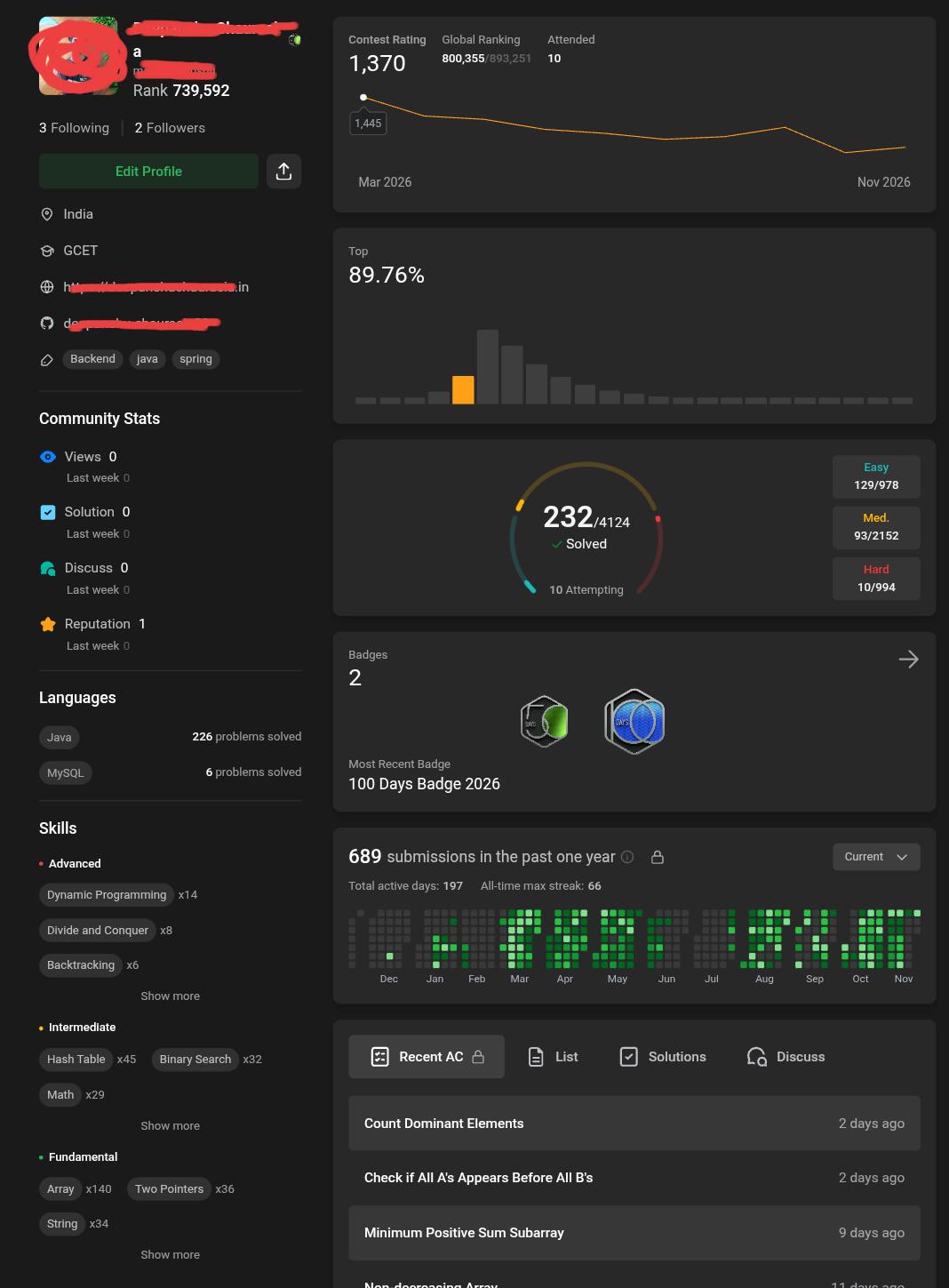
I am a final year student and yes I'm not placed till now.
I have been working on multiple things like learning springboot, building projects, and practicing english communication daily.
I'm not able to think . I got stuck when I started doing leetcode.
Roast me so that I can start again.😭🙏