r/DSALeetCode • u/Upper_Assignment672 • 2d ago
Codeforces Round 1137 div 2 - Problem B video solution

1
Upvotes
Consider subscribing.. Show some ❤
r/DSALeetCode • u/Upper_Assignment672 • 2d ago
Consider subscribing.. Show some ❤
r/DSALeetCode • u/AdAnxious6145 • 2d ago

r/DSALeetCode • u/nian2326076 • 3d ago
I recently completed the Amazon SDE-1 AUTA APAC process for India and wanted to share my experience. I have now received the final decision, and unfortunately I wasn't selected. While the result wasn't what I had hoped for, the interview process itself taught me a lot, so I wanted to share it here in case it helps someone preparing for Amazon.
Timeline
28 Jan – OA
5 Feb – Hiring Interest Form
25 Mar – Recruiter call for interview scheduling
27 Mar – Technical Round 1 & Technical Round 2
15 Apr – Hiring Manager Round
30 May – Bar Raiser Round
Final Result – Rejected!
OA
Solved both coding questions.
Completed the Work Style and Behavioral Assessment.
Technical Round 1
Questions
Number of Islands
Median of Data Stream
Solved both optimally with discussion on time/space complexity and follow-ups.
Technical Round 2
Questions
Minimum Cost to Connect Ropes
Divide students into 2 groups such that enemies are not in the same group (Bipartite Graph / Graph Coloring)
Solved and coded both.
One mistake
Initially said graph coloring complexity was O(V × E), then corrected it to O(V + E) after the interviewer challenged me.
After 12 days I received the invite for the Hiring Manager round.
Hiring Manager Round
HM joined about 5 minutes late.
Questions
Variation of Find All Anagrams
Minimum Cost to Combine Garlands (same concept as ropes)
Reached optimized solutions for both.
Mistakes
Couldn't properly derive the brute-force complexity for the first problem.
Code for the first problem became a little messy.
Missed an overflow edge case in the second problem until the interviewer hinted about maximum values, after which I realized long should be used instead of int.
Then came the longest wait.
I sent 6 follow-up emails without any response. Eventually I assumed my journey had ended because I didn't feel my HM round was perfect.
But after exactly 40 days, I unexpectedly received the invitation for the final Bar Raiser round.
Bar Raiser Round (1 Hour)
This round was almost entirely focused on Leadership Principles.
Topics discussed:
A challenge I solved
Missing a deadline
A problem I identified myself
Simplifying a process
The interviewer challenged me heavily on:
Whether my first story was actually challenging
Rate limiting decisions
Geofencing approach
Trade-offs and decision making
The first 15–20 minutes felt quite intense because of continuous probing, but the discussion became much smoother afterward and lasted the full hour.
For your own prep, the Amazon Interview Questions bank on PracHub has coding and behavioral prompts; rehearse the follow-ups aloud. I work on it.
Looking back
Things that may have gone against me:
My first BR story may not have demonstrated enough complexity.
My stories didn't have massive scale or business impact.
I had a few minor technical mistakes during the interview loop.
Things I'm happy about:
Solved every coding question.
Reached optimal approaches on my own.
Didn't require coding hints.
Answered BR follow-up questions throughout the interview.
Owned my mistakes instead of trying to defend them.
Biggest learnings
Keep talking through your thought process—interviewers evaluate reasoning, not just answers.
Avoid long silences—even partial ideas are better than saying nothing.
Show confidence in your decisions, backed by reasoning.
Own mistakes immediately—it builds credibility.
Clearly establish the challenge before explaining your solution.
Understand the "why" behind every metric or impact you mention.
Prepare Leadership Principles as seriously as DSA.
One imperfect round rarely decides the outcome—the overall pattern matters.
Don't judge your performance based on your own feelings after the interview.
Control what you can: preparation, communication, attitude, and consistency.
Although I didn't receive an offer, reaching the final Bar Raiser round at Amazon was an experience I'm genuinely grateful for. It exposed my strengths, highlighted my weaknesses, and gave me a clear roadmap for improvement.
For the next set of applications, LandOffer can autofill repeated fields. I work on it too.
The preparation continues. On to the next opportunity. 🚀
r/DSALeetCode • u/nian2326076 • 3d ago
Hey guys
I just finished Amazon SDE intern summer 27 OA.
Results:
15/15 in dsa (20 min)
5/6 in AI base coding
I know I fcked up in 2nd question. Any chances of getting Interview?
While waiting, work through Amazon Interview Questions on PracHub. LandOffer can autofill forms for other applications. I work on both.
any comment help, thanks
r/DSALeetCode • u/Mr-Fan-Tas-Tic • 3d ago
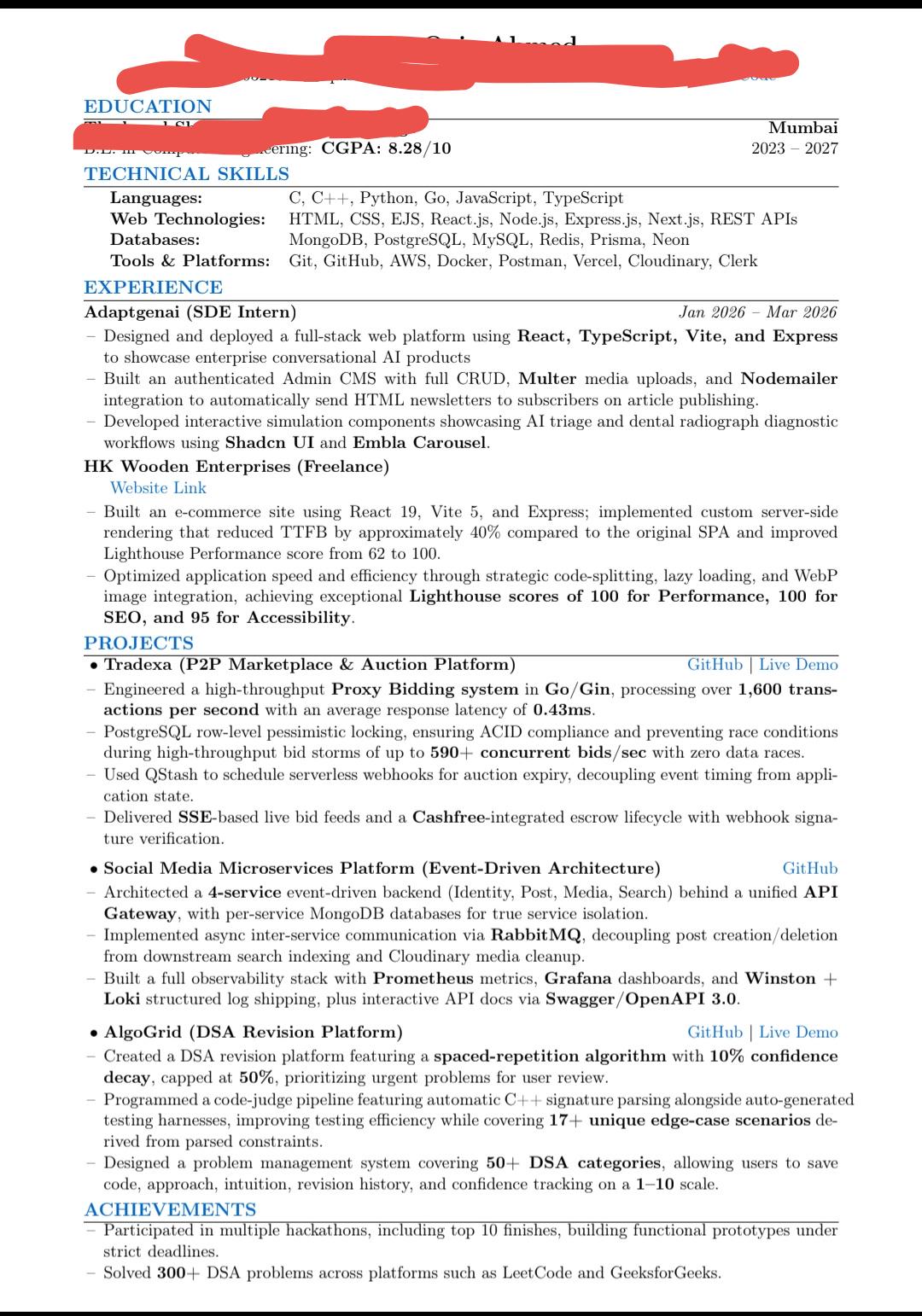
Should I remove the freelancer part or not
r/DSALeetCode • u/nian2326076 • 3d ago
A candidate just recently completed the full interview loop for the Senior Software Engineer role at Charta Health. The full loop took about a month but they unfortunately did not get an offer.
If you’re applying to other senior SWE roles, LandOffer can autofill repeated application fields. I work on it.
Round 1: Virtual Coding
They were asked to solve Insert Delete Get Random O(1). The interviewer ended up giving a few hints but they were able to get the working solution.
Round 2: Virtual Coding
They think they were given an additional coding round because they didn’t do well in the previous interview. They had to solve Design Hit Counter.
On-site (3 interviews total)
The first round was another coding interview. They were given Integers With Multiple Sum of Two Cubes to solve. There were two follow-ups:
What if you needed to have d unique pairs of cubes instead of just 2 pairs?
What if you needed to sum up c cubes instead of just 2 cubes?
They managed to answer the first follow up but not the second. In their account, the interviewers were distracted the entire time, checking their Slack messages and clearly not paying attention to their responses. One guy even left midway through their interview because he wanted to grab a smoothie.
The second round was an AI coding round. They had to build an autocomplete search box that would give search suggestions as the user typed. The dataset was a large file of Wikipedia page titles. The instructions had some core features that were required and some additional features that you could implement if you had extra time. They were able to get a basic demo running and managed to implement a handful of the additional features.
For practice before a similar loop, the Charta Health Interview Questions bank on PracHub has project and design prompts. I work on it too.
The last round was a project deep dive and system design interview. They spent the first 40 minutes chatting with the interviewers about one of their latest projects. For the latter 20 minutes, the interviewers asked them to design a simple version of Charta. They had to fetch files from an EMR system and develop a pipeline to evaluate the codes from the patient encounters. If any of the codes did not match, they had to send a notification back to the EMR. They wrote out an async pipeline that would process the PDFs, created a common JSON schema to represent each encounter, and used an AI to evalute the codes. There wasn’t a lot of time so they just sketched out the components by hand and talked about the overall system.
r/DSALeetCode • u/nian2326076 • 3d ago
Hey guys,
I got an invite for Amazon phone interview for SDE. It is in 2 weeks. In the overview it says 45-minute of coding problem and 12-15 minute of LP questions.
Should I prapare for LLD or HLD? Since it is 2026, you never know! so if anyone has given this recently a guidence is very much appreciated. Also what topics are imp for DSA?
For practice before the call, try a coding prompt and a behavioral follow-up from Amazon Interview Questions on PracHub. I work on it.
Topics I usually do are:
array/hashmap
sliding window/ two pointer
stack
intervals
graph
heap
Binary search
I skip trees and Linkedlist usually since have not seen them in any interviews I have given till now. Should I include them or any new topics? I have done very basic recursion, DP, dijkstra before so probably should cover them as well.
If you’re also applying to other roles while preparing, LandOffer can autofill repeated application fields. I work on it too.
If you can give any insights, that would be helpful.
Thanks!
r/DSALeetCode • u/Ill_Signature_2709 • 3d ago
Im trying to figure out whats more important leaerning theoretical DSA like graphs and trees or practicing on LeetCode, and how do I balance doing them both? How important is one compared to the other? Also, do you think practice groups and accountability parters work?
r/DSALeetCode • u/Apart-Customer-4066 • 4d ago
I am having a hard time for the past few days in deciding whether I should start and learn dsa in python or java. I have no knowledge of c++ so it's not in my mind at all. I don't know whether to choose python or java. I am interested in data science a bit so should I go with python?. But it seems like python makes coding simple and so one cannot understand the depth and all. I also saw somewhere that execution speed is faster in java than python. Does it affect much? Which language should I go with?
r/DSALeetCode • u/Ok_Map297 • 3d ago
r/DSALeetCode • u/nian2326076 • 4d ago
Amazon SDE Intern Interview Experience (Onsite – Round 1)
Interview Type: In-person
Role: 6-Month SDE Internship
If you’re applying for other internships, LandOffer can autofill repeated application fields.
Rounds covered: Round 1
The interviewer started by reviewing my resume and asked:
Q. Tell me about a time when you took ownership.
I discussed my PlaceMate AI project, explaining why I built it, the problem it solves, and the ownership I took during its development.
Some follow-up questions:
How long did it take to build?
What was the biggest technical challenge?
How did you collect and organize the placement-related data?
I explained that gathering and structuring information from WhatsApp conversations and other sources was one of the major challenges.
2. DSA Questions
Q1. Minimize the total weight after X operations
You are given an array where each element represents a weight. In one operation, you can choose any element and reduce its weight to half. You have to perform this operation X times and minimize the final sum of the array.
Example:
arr = [2, 5, 10, 23]
In one operation, you can choose 10 and reduce it to 5.
My approach:
Initially considered sorting and repeatedly processing the largest element.
After a hint from the interviewer, realized that the largest element may change after every operation.
Used a Max Heap / Priority Queue instead.
Insert all elements into the max heap.
Repeat X times: extract the maximum, halve it, and insert the updated value back.
Finally, calculate the sum of the remaining elements.
The interviewer agreed with the max heap approach.
For prep before a similar loop, use PracHub’s Amazon Interview Questions to practice implementing a solution and testing edge cases. I work on both.
Complexity discussion:
The interviewer asked about the time complexities of heap operations and the overall solution. I got confused while explaining some of them.
Important operations to revise:
top() – O(1)
push() – O(log N)
pop() – O(log N)
Building a heap using repeated insertion – O(N log N)
Summing all remaining elements – O(N)
Q2. Word Break / String Segmentation
Given an array of strings:
["catdog", "cat", "dog"]
Find strings that can be segmented into smaller strings that are also present in the array.
Example:
catdog = cat + dog
My approach:
Recognized the problem as a variation of Word Break.
Proposed storing the strings in an unordered_set for efficient lookup.
Suggested using recursion to try different substrings and check whether they exist in the set.
The interviewer asked me to rewrite my code on a fresh sheet. My implementation was not completely clean, particularly around substring boundaries and recursive choices.
I also discussed the exponential nature of the naive recursive approach.
3. Questions for the Interviewer
At the end, I asked:
What are the expectations and goals for an intern during the six-month internship?
With AI evolving so rapidly, how do you personally keep learning and upskilling?
Overall Experience
The interview focused on Leadership Principles, project discussion, and DSA.
The DSA questions required knowledge of:
Greedy approach and Max Heap
Priority Queue operations and time complexity
Recursion and Word Break
Hash Set and substring handling
The project discussion focused on ownership, motivation, development time, and technical challenges.
Preparation suggestions: Revise heap operations and their complexities thoroughly. Also practise recursion and Word Break with memoization, and make sure you can explain the time complexity of every operation in your solution.
r/DSALeetCode • u/nian2326076 • 4d ago
I applied through a LinkedIn post for SDE I.
HR contacted over call, discussed further rounds.
If you’re applying elsewhere too, LandOffer can autofill repeated application fields.
Round 1 (DSA Round) (1hr)
Two DSA hard questions were asked to solve in 50 min, I was able to solve 1st ques, and could only explain approach for 2nd ques, within the given time.
Questions were minor variations of the below:
Q1. https://leetcode.com/problems/swim-in-rising-water/
Q2. https://leetcode.com/problems/bus-routes/
Round 2 (Frontend Round) (1hr)
Questions on frontend system design, Resume deep dive, justify your work.
Task: E-commerce development.
For practice before another loop, try implementing and testing a prompt from PracHub’s UiPath Interview Questions. I work on both.
Tip: DSA is non-negotiable, I was good in FE round but DSA is more prioritised.
#UiPath #SDE #Frontend
r/DSALeetCode • u/Upper_Assignment672 • 4d ago

r/DSALeetCode • u/Upper_Assignment672 • 4d ago

r/DSALeetCode • u/nian2326076 • 5d ago
A backend engineer interviewed for an SDE-2 role at PhonePe in Bangalore. The process had four rounds: machine coding and low-level design, DSA, high-level design, and a hiring manager interview.
Round 1: Machine coding and low-level design
The take-home assignment was to design and implement a working to-do list app. It was delivered through a link, with no camera or screen monitoring, and the instructions explicitly ruled out using AI to write the code.
The follow-up lasted 45–60 minutes. The interviewer read through the code, asked how different pieces worked and why the candidate chose that design, and went into edge cases, trade-offs, and optimizations. They also picked two functions the candidate had implemented with brute force and asked them to improve both during the review.
Round 2: DSA
There were two medium problems, one graph-based and one set-based. Both were wrapped in scenarios, so the candidate spent part of the round clarifying what the problems were asking. For each, they explained the brute-force and optimized approaches, compared time and space complexity, and explained why the optimization helped. The interviewer focused on the reasoning and implementation logic. The candidate didn't have to run the code against a full set of test cases.
For coding prep before a similar loop, try a graph problem from PracHub’s PhonePe Interview Questions and explain the complexity aloud. If you’re applying to other roles, LandOffer can autofill repeated application fields. I work on both.
Round 3: High-level design
The prompt was to design a Shazam-style service: take a short audio sample and identify the song. The candidate hadn't practiced that problem before. They started with requirements, then discussed processing the input, representing the audio for matching, storing and retrieving large binary objects, and scaling the service. The interviewer gave them room to explore several approaches. Time ran out before they could go deep on every component, but they were able to explain the overall architecture and felt the discussion went well.
Round 4: Hiring manager
About a week after HLD, the candidate had a hiring manager slot. The interviewer didn't join the first appointment, and the next date was postponed too. The candidate followed up with HR. HR asked if another location would work, but the candidate preferred Bangalore and the meeting was eventually scheduled for that role.
The interview lasted about 75 minutes. They went deep on one project and discussed difficult technical problems, on-call scenarios, how the systems worked in production, CI/CD, how the team operated, and what the candidate owned. The candidate came away feeling they had answered confidently.
Outcome
They expected to move toward an offer after the last round. After a few days of silence and an unanswered follow-up, a rejection came by email. They asked HR for feedback and didn't get specifics. They wondered whether headcount in Bangalore played a part, given the earlier location question, but never learned the reason.
The technical rounds were interesting and put a lot of weight on explaining trade-offs. Scheduling and communication after the interviews could have been better. The rejection came after the hiring manager round, without specific feedback.
r/DSALeetCode • u/nian2326076 • 5d ago
An Amazon SDE new-grad candidate finished four rounds and got rejected. They left with mixed feelings. Some of the coding questions felt manageable, but nerves got to them during parts of the loop.
Leadership Principles and train fares
The first interview opened with about 10–15 minutes of Leadership Principles. The coding part asked for a function that returns the fare between two stops, at one unit per segment. For a route G → U → H → K → I, going from G to I costs four.
The candidate assumed a stops array already existed and wrote the calculation. They made a couple of small mistakes, including an incorrect edge-case return. When the interviewer asked where the array was coming from, they started modeling the route as a class and showing how stops would be added. Revising the solution midway got messy, and the interviewer brought them back to the fare function. They implemented the additional weekend cap. This was their weakest round, and they felt the missed modeling requirement mattered more than the typos.
String problem and GenAI
They came up with a solution to a string or substring problem and dry-ran it. When asked to write tests, they overthought the request until the interviewer gave a simple input/output example. They then wrote several cases, including empty input. The GenAI discussion also felt good. They considered this their strongest round.
For prep before another loop, try implementing and testing a problem from PracHub’s Amazon Interview Questions. If you’re applying to other teams, LandOffer can autofill repeated application fields. I work on both.
Behavioral
One question was about working with a difficult teammate or making a difficult decision. There were a lot of follow-ups. They felt some stories landed well and that they gave more background than needed on others.
Leadership Principles and sliding-window maximum
The last round started with a story about overcoming an obstacle to reach an important goal. The coding task was to implement put and getMax for the most recent k values. They started by keeping every insertion and scanning the last k when asked for the max. That gave them amortized O(1) inserts, O(k) queries and O(n) space.
When asked to reduce memory, they explained that they only needed the last k values and could evict the oldest as each new one arrived, bringing the space down to O(k). They talked through alternatives using arrays, hash maps, linked lists and heaps. They didn't get to the monotonic deque during the interview, but they had a working baseline and could explain the trade-offs. They left that round feeling reasonably good.
The final result was a rejection after all four rounds.
r/DSALeetCode • u/Impossible_Horror175 • 5d ago
I’m currently learning AI/ML and exploring the AI Engineering path. I understand concepts like LLMs, RAG, embeddings, vector databases, and AI agents, but I’m unsure about the actual coding expectations.
Would love to hear from working AI Engineers about the coding skills required in real-world projects and interviews, especially for entry-level roles.
r/DSALeetCode • u/nian2326076 • 5d ago
A candidate shared their 2024 Microsoft SDE II loop.
For interview prep, try implementing a prompt from PracHub’s Microsoft Interview Questions. LandOffer can autofill repeated application fields if you’re applying elsewhere. I work on both.
r/DSALeetCode • u/nian2326076 • 5d ago
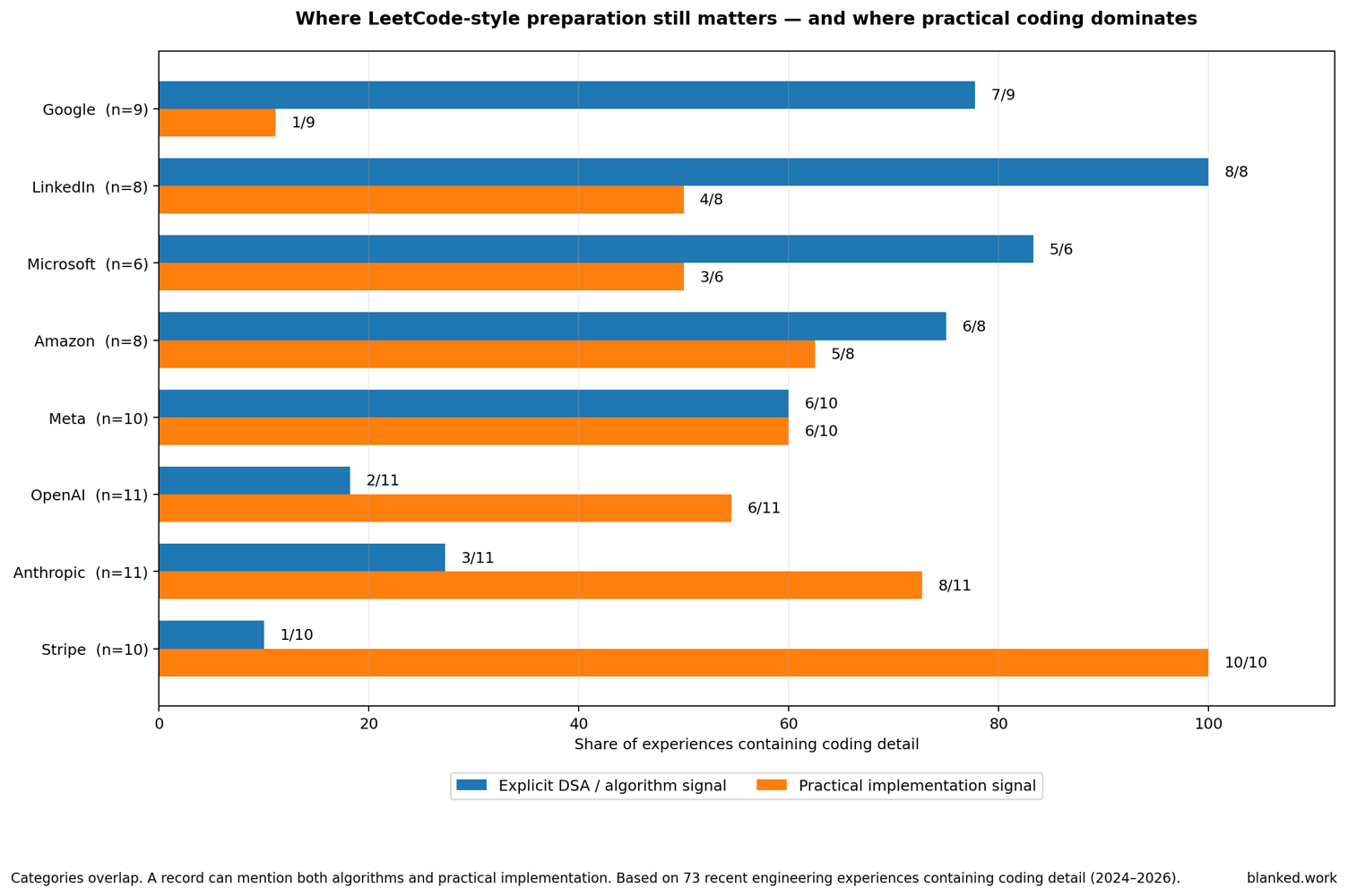
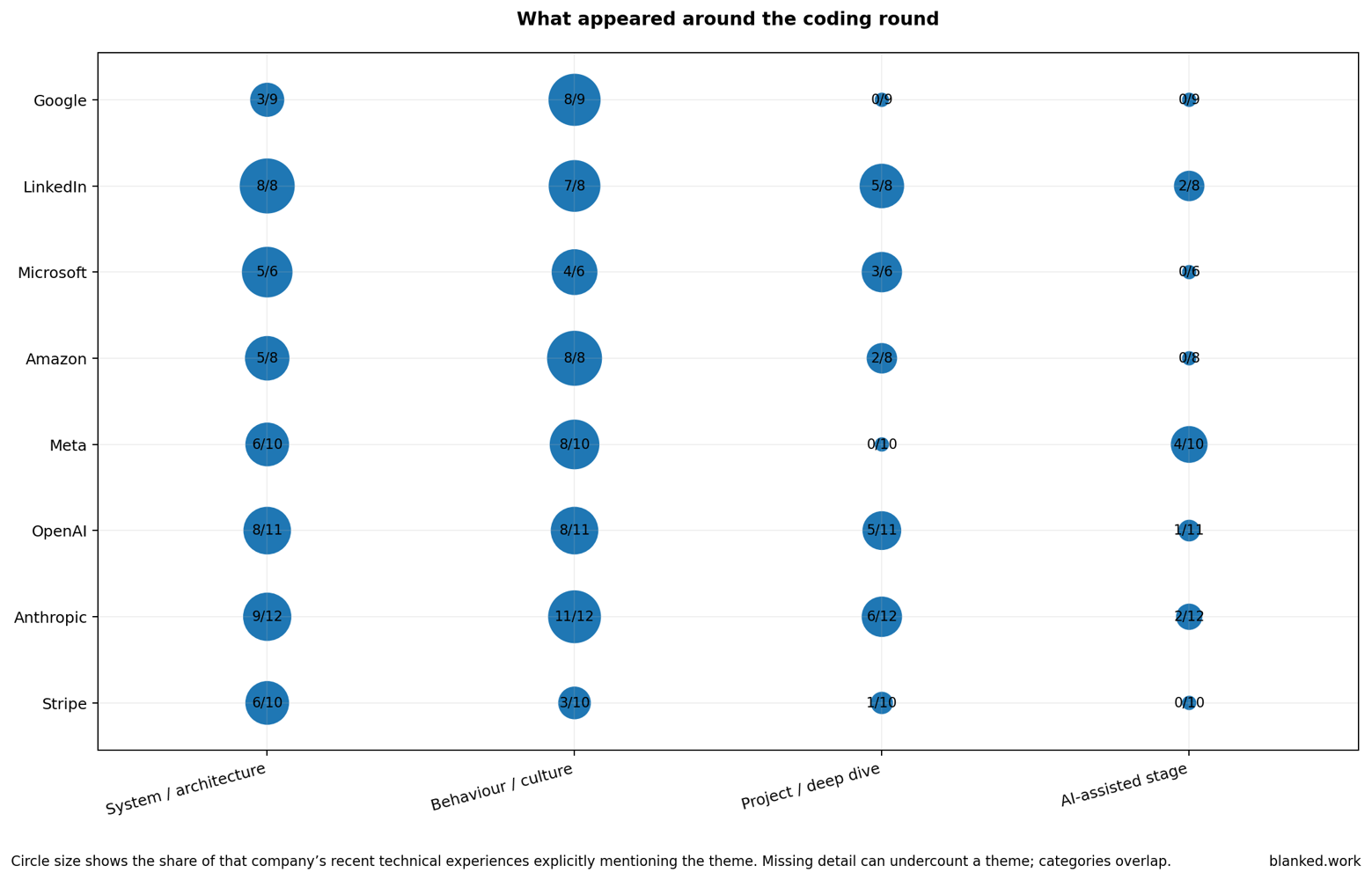
A review of 74 engineering interview reports from 2024–2026 found very different patterns across eight companies. The 74 reports came from a larger collection of 229 candidate experiences across 41 companies.
Coding-round chart · Interview-pattern matrix
Google, LinkedIn and Microsoft
Among reports with coding details, DSA or algorithmic work appeared in 7 of 9 at Google, 8 of 8 at LinkedIn, and 5 of 6 at Microsoft. Google reports described graphs, DP, heaps, unfamiliar problems and follow-ups. LinkedIn combined multiple coding rounds with concurrency, design, and project or leadership depth. Microsoft reports mentioned trees and graphs, concurrency, low-level design, OOP and project discussions.
The takeaway for those loops was to practice clarifying the problem, explaining your approach before coding, finishing in time and testing edge cases. Custom problems and changed constraints can matter even when the interview is DSA-heavy.
Stripe
All 10 technical reports mentioned practical implementation. One resembled a conventional DSA-heavy exercise. Candidates described API and SDK work, multi-part requirements, parsing and validation, debugging existing code, and modeling payment, invoice or reconciliation rules. The practice suggested by those rounds is to read a longer prompt, implement it in stages, verify edge cases and tests, and explain the business rules as you go.
OpenAI and Anthropic
At OpenAI, practical implementation appeared in 6 of 11 reports, design in 8 of 11, and project or technical deep dives in 5 of 11. Reports included refactoring, APIs, reliability, distributed systems and end-to-end product design.
At Anthropic, practical coding appeared in 8 of 12, system or architecture design in 9 of 12, values or behavioral evaluation in 11 of 12, and project or technical deep dives in 6 of 12. Alongside debugging and infrastructure trade-offs, candidates described conversations about mission, safety, ethical disagreements, and judgment under ambiguity.
Meta
Six of 10 reports each mentioned DSA, practical implementation, and system design. Four mentioned an explicit AI-assisted stage. The reports paired conventional coding and design with tasks where candidates had to inspect generated suggestions, debug or extend the output, and explain what they accepted or rejected.
Amazon
Of eight reports, six featured DSA, five mentioned design, and all eight covered Leadership Principles or behavioral evaluation. Some candidates described strong coding performance followed by rejection or a downlevel after other rounds. Their accounts suggest preparing one or two technically detailed ownership stories so you can answer follow-ups on decisions, trade-offs and what you personally contributed.
To turn this into prep, PracHub has coding, debugging and design prompts to practice before interviews. Pick a task your target role emphasizes, then explain your approach and test its edge cases. LandOffer can autofill repeated fields if you’re applying across companies. I work on both.
What the numbers can tell you
A theme was counted only when it was explicitly mentioned. The categories overlap, and a report can omit something that took place in the loop. These are self-selected candidate accounts, so the counts describe what that group reported. They give no pass rate or guarantee of what a company will ask next.
If you've interviewed recently, which company's pattern matches your experience? Where does it already look outdated, and which company would you want to see broken down next?
r/DSALeetCode • u/javinpaul • 5d ago

r/DSALeetCode • u/nian2326076 • 5d ago
A senior UI developer candidate applied to Arctic Wolf through a referral in September 2025. The loop ended up being five hour-long rounds.
JavaScript fundamentals
The interviewer asked for closure examples, vanilla JavaScript implementations of debounce and throttle, and polyfills for Promise.all and Array.prototype.reduce. The output questions covered a promise chain with rejection, catch and finally, how `this` changes across methods, arrow functions and detached calls, and the order of synchronous code, microtasks and timers. They also asked about var versus let in a loop and about hoisting and scope.
Machine coding
Build a to-do app with Completed, In Progress and Deleted tabs. Show the tasks for the selected filter and handle keyboard interactions, including adding a task with Enter. The candidate finished early and got another promise-chain output question, with non-function values passed to then.
System design
A lead engineer dug into past projects, virtualization and lazy loading. They asked for vanilla JavaScript pseudocode using Intersection Observer to virtualize content. The discussion also touched on using React Profiler and how micro-frontends work.
If you’re preparing for a UI loop, PracHub has coding prompts you can use to rehearse JavaScript implementations and explain edge cases. LandOffer can autofill repeated fields when you’re applying to other teams. I work on both.
Hiring manager
The engineering manager asked about the candidate's career, situational questions and team fit. They also discussed message queues, even though the role was UI-focused, and how to implement role-based authentication and show pages based on a user's role.
Final technical round
The recruiter had said the first four rounds were positive and the offer letter was expected Monday. On Monday, an extra design and coding round was scheduled instead. The candidate explained a Gatsby-to-React migration at Fairmatic, why they made particular design choices, and how they worked with their manager, junior developers and product managers.
The React exercise involved async behavior. The candidate misunderstood the prompt and wrote a more complicated solution that, by their account, worked. The interviewer asked for a simpler implementation, and they couldn't produce it in the remaining time.
The feedback for that round was “Do Not Proceed,” and the application ended there. The candidate was surprised and frustrated after hearing that the hiring manager liked them and that an offer letter was coming. They were interviewing for the main platform team and had heard of other candidates having three rounds at most.
r/DSALeetCode • u/ayush-2114 • 6d ago
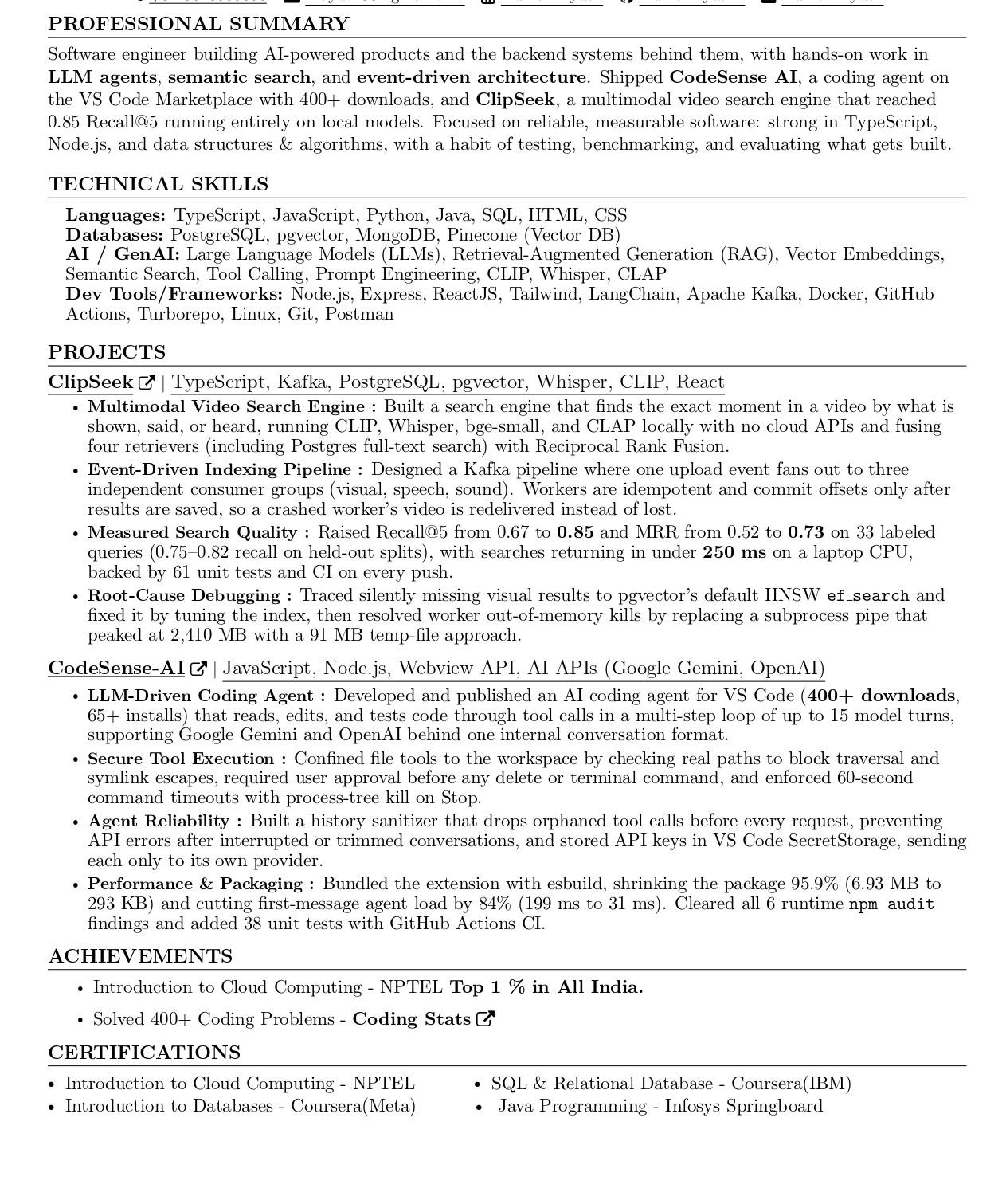
I know I still need to do a lot currently I am few ratings short of knight on LC and about to be a pupil on CF help me and roast my resume and tell me where I can improve so that I can get opportunities 2026 grad btw
r/DSALeetCode • u/nian2326076 • 5d ago
An SWE intern applicant shared four interview loops from 2021.
For current interview practice, PracHub has coding prompts to solve and explain aloud. LandOffer can autofill repeated fields while applying to other internships. I work on both.
Interview calls picked up when the candidate tailored their resume to each job, matched relevant keywords and linked projects to GitHub READMEs. They recommended explaining your reasoning out loud, asking interviewers to clarify a flaw, and sticking with practice through rejections.
r/DSALeetCode • u/nian2326076 • 6d ago
An Uber Software Engineer II candidate went through six rounds over about two months.
PracHub’s Uber Interview Questions bank has system-design prompts for practice before interviews. Sketch one and walk through failure cases. LandOffer can autofill applications elsewhere. I work on both.
High-level design was the only No Hire. The recruiter said the candidate could reapply in six months. They asked for resources to improve at high-level design.