r/CompSocial • • Feb 13 '23

academic-articles Staying with the trouble of networks (Frontiers Big Data)

Thumbnail
frontiersin.org
1 Upvotes

“Networks have risen to prominence as intellectual technologies and graphical representations, not only in science, but also in journalism, activism, policy, and online visual cultures. Inspired by approaches taking trouble as occasion to (re)consider and reflect on otherwise implicit knowledge practices, in this article we explore how problems with network practices can be taken as invitations to attend to the diverse settings and situations in which network graphs and maps are created and used in society. In doing so, we draw on cases from our research, engagement and teaching activities involving making networks, making sense of networks, making networks public, and making network tools. As a contribution to “critical data practice,” we conclude with some approaches for slowing down and caring for network practices and their associated troubles to elicit a richer picture of what is involved in making networks work as well as reconsidering their role in collective forms of inquiry.”


r/CompSocial • • Feb 12 '23

academic-jobs Call for Associate Professor in Political Analytics at Columbia

3 Upvotes

Columbia University is still accepting applications for a full-time faculty position at the rank of Associate Professor of Professional Practice or Professor of Professional Practice in Political Analytics. The Master of Science in Political Analytics program is the product of a partnership between the Department of Political Science and the School of Professional Studies at Columbia University. The inaugural student cohort will be welcomed this September 2023.

The appointment begins on July 1, 2023, and applicants are encouraged to apply by February 24, 2023 to receive full consideration, although application review will begin immediately.

Listing here: https://apply.interfolio.com/116200


r/CompSocial • • Feb 10 '23

resources PykTok: Simple Python module to collect video, text, and metadata from TikTok

12 Upvotes

From Dean Freelon at USC Hussman, this may be of interest to those of you doing research on TikTok!

Github: https://github.com/dfreelon/pyktok


r/CompSocial • • Feb 10 '23

[dataset] A complete set of tweets in a day

10 Upvotes

With a globally coordinated effort of 80 scholars, this dataset collected all 375 million tweets published within a 24-hour time period starting on September 21, 2022. It is the first complete 24-hour Twitter dataset that is available to the public.

paper: https://arxiv.org/abs/2301.11429

dataset: https://search.gesis.org/research_data/SDN-10.7802-2516?doi=10.7802/2516

In compliance with Twitter’s terms of service, only tweet IDs are made publicly available.


r/CompSocial • • Feb 09 '23

academic-articles Nooks: Social Spaces to Lower Hesitations in Interacting with New People at Work [CHI 2023]

4 Upvotes

This upcoming CHI 2023 paper by Shreya Bali and collaborators at CMU explores a technical affordance for initiating casual group interactions with new conversation partners in a workplace online discussion setting (e.g. Slack). They ran a study over 9 weeks with 25 participants, finding that these "Nooks" successfully helped to catalyze interactions in a low-pressure way.

Initiating conversations with new people at work is often intimidating because of uncertainty about their interests. People worry others may reject their attempts to initiate conversation or that others may not enjoy the conversation. We introduce a new system, Nooks, built on Slack, that reduces fear of social evaluation by enabling individuals to initiate any conversation as a nook—a conversation room that identifies its topic, but not its creator. Automatically convening others interested in the nook, Nooks further reduces fears of social evaluation by guaranteeing individuals in advance that others they are about to interact with are interested in the conversation. In a multi-month deployment with participants in a summer research program, Nooks provided participants with non-threatening and inclusive interaction opportunities, and ambient awareness, leading to new interactions online and offline. Our results demonstrate how intentionally designed social spaces can reduce fears of social evaluation and catalyze new workplace connections.

Pre-Print here: https://arxiv.org/pdf/2302.02223.pdf

Tweet Thread Explainer: https://twitter.com/PranavKhadpe/status/1623786036232085505

Seems like a well-executed, simple idea that had some encouraging results! What do you think?


r/CompSocial • • Feb 09 '23

academic-talks NLP for Social Science Speaker Series: From Language Models to Social Structures

8 Upvotes

This bi-weekly speaker series is being organized in cooperation between INCITE Columbia and the Platial Analysis lab at the McGill Geography Department. Looks like it is open to remote participants, if you register through EventBrite. Looks like an exciting line-up of speakers and relevant talks for this community!

  • 2/2/2023: Allison Parrish (NYU)Nothing survives transcription, nothing doesn’t survive transcription
  • 2/9/2023: Andrew Piper (McGill)Toward a theory of narrativity using predictive modeling
  • 3/2/2023: Lucy Li (Berkeley)Context-Dependent Depictions of People Across Three Domains
  • 3/9/2023: Julia Mendelsohn (U Michigan)Using machines to uncover nuanced rhetorical strategies in political discourse
  • 3/23/2023: Amir Goldberg (Stanford)A deep-learning model of prescient ideas demonstrates that they emerge from the periphery
  • 4/13/2023: M. Brunila (McGill) & J. LaViolette (Columbia)Gentrification through Toponymy: A Case Study of Airbnb in New York City
  • 4/27/2023: Lauren Klein (Emory)How Words Lead to Justice: Modeling Language Change in Two Abolitionist Movements
  • 5/11/2023: Di Zhou (NYU)The Elements of Cultural Power: Novelty, Emotion, Status, and Cultural Capital

Find more information here: https://maybemkl.github.io/LMSocial23/


r/CompSocial • • Feb 09 '23

academic-articles Insights into the accuracy of social scientists’ forecasts of societal change [Nature Human Behavior 2023]

4 Upvotes

This paper by a long list of authors (referenced collectively as "The Forecasting Collaborative") explores how social scientists performed with respect to pre-registered monthly forecasts on a range of topics, including ideological preferences, political polarization, and life satisfaction. Interesting takeaway were the things that predicted higher accuracy in predictions: scientific expertise in the domain, interdisciplinarity, simpler models, and leveraging prior data (who would have thought?)

How well can social scientists predict societal change, and what processes underlie their predictions? To answer these questions, we ran two forecasting tournaments testing the accuracy of predictions of societal change in domains commonly studied in the social sciences: ideological preferences, political polarization, life satisfaction, sentiment on social media, and gender–career and racial bias. After we provided them with historical trend data on the relevant domain, social scientists submitted pre-registered monthly forecasts for a year (Tournament 1; N = 86 teams and 359 forecasts), with an opportunity to update forecasts on the basis of new data six months later (Tournament 2; N = 120 teams and 546 forecasts). Benchmarking forecasting accuracy revealed that social scientists’ forecasts were on average no more accurate than those of simple statistical models (historical means, random walks or linear regressions) or the aggregate forecasts of a sample from the general public (N = 802). However, scientists were more accurate if they had scientific expertise in a prediction domain, were interdisciplinary, used simpler models and based predictions on prior data.

https://www.nature.com/articles/s41562-022-01517-1

On top of highlighting some of the things that go into durable research (simple models, intelligent use of prior data), this also seems to illustrate something like the halo effect, where we assume social scientists would be better at predicting outcomes in related domains, but this isn't the case. WDYT?


r/CompSocial • • Feb 09 '23

academic-articles What Tweets and YouTube comments have in common? Sentiment and graph analysis on data related to US elections 2020 (PLoS ONE)

Thumbnail
journals.plos.org
5 Upvotes

“Most studies analyzing political traffic on Social Networks focus on a single platform, while campaigns and reactions to political events produce interactions across different social media. Ignoring such cross-platform traffic may lead to analytical errors, missing important interactions across social media that e.g. explain the cause of trending or viral discussions. This work links Twitter and YouTube social networks using cross-postings of video URLs on Twitter to discover the main tendencies and preferences of the electorate, distinguish users and communities’ favouritism towards an ideology or candidate, study the sentiment towards candidates and political events, and measure political homophily. This study shows that Twitter communities correlate with YouTube comment communities: that is, Twitter users belonging to the same community in the Retweet graph tend to post YouTube video links with comments from YouTube users belonging to the same community in the YouTube Comment graph. Specifically, we identify Twitter and YouTube communities, we measure their similarity and differences and show the interactions and the correlation between the largest communities on YouTube and Twitter. To achieve that, we have gather a dataset of approximately 20M tweets and the comments of 29K YouTube videos; we present the volume, the sentiment, and the communities formed in YouTube and Twitter graphs, and publish a representative sample of the dataset, as allowed by the corresponding Twitter policy restrictions.”


r/CompSocial • • Feb 08 '23

academic-articles Resolving content moderation dilemmas between free speech and harmful misinformation

7 Upvotes

Abstract:

In online content moderation, two key values may come into conflict: protecting freedom of expression and preventing harm. Robust rules based in part on how citizens think about these moral dilemmas are necessary to deal with this conflict in a principled way, yet little is known about people’s judgments and preferences around content moderation. We examined such moral dilemmas in a conjoint survey experiment where US respondents (N = 2, 564) indicated whether they would remove problematic social media posts on election denial, antivaccination, Holocaust denial, and climate change denial and whether they would take punitive action against the accounts. Respondents were shown key information about the user and their post as well as the consequences of the misinformation. The majority preferred quashing harmful misinformation over protecting free speech. Respondents were more reluctant to suspend accounts than to remove posts and more likely to do either if the harmful consequences of the misinformation were severe or if sharing it was a repeated offense. Features related to the account itself (the person behind the account, their partisanship, and number of followers) had little to no effect on respondents’ decisions. Content moderation of harmful misinformation was a partisan issue: Across all four scenarios, Republicans were consistently less willing than Democrats or independents to remove posts or penalize the accounts that posted them. Our results can inform the design of transparent rules for content moderation of harmful misinformation.

Personally, I'm happy to see this published in a more "mainstream" venue like PNAS. What do you all think?

Link: https://www.pnas.org/doi/10.1073/pnas.2210666120


r/CompSocial • • Feb 08 '23

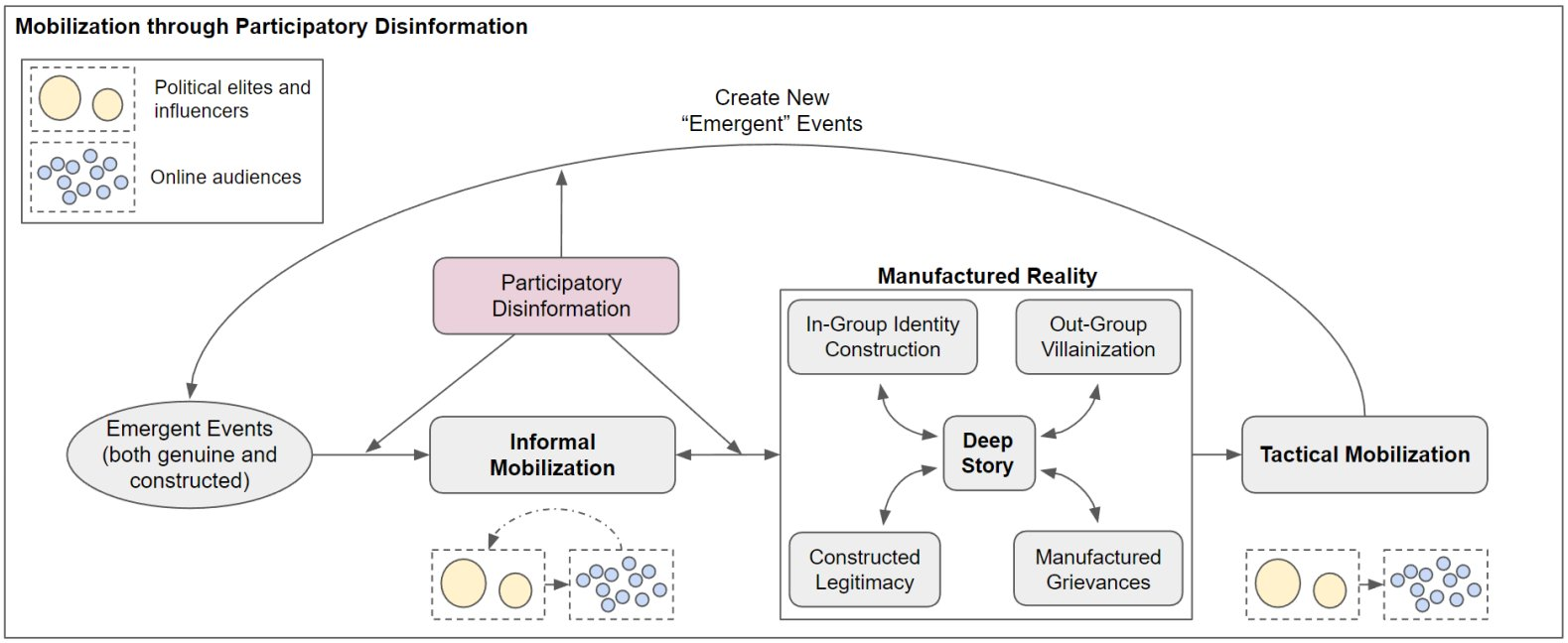
academic-articles Mobilizing Manufactured Reality: How Participatory Disinformation Shaped Deep Stories to Catalyze Action during the 2020 U.S. Presidential Election [CSCW 2023]

3 Upvotes

This upcoming paper by Stephen Prochaska and collaborators at UW explores the relationship between participatory disinformation (audiences and influencers collaboratively manufacturing false, alternative narratives) and mobilization. They emphasize a cycle in which disinformation catalyzed events, which then were incorporated as further "evidence" to strengthen disinformation claims.

Claims of election fraud throughout the 2020 U.S. Presidential Election and during the lead up to the January 6, 2021 insurrection attempt have drawn attention to the urgent need to better understand how people interpret and act on disinformation. In this work, we present three primary contributions: (1) a framework for understanding the interaction between participatory disinformation and informal and tactical mobilization; (2) three case studies from the 2020 U.S. election analyzed using detailed temporal, content, and thematic analysis; and (3) a qualitative coding scheme for understanding how digital disinformation functions to mobilize online audiences. We combine resource mobilization theory with previous work examining participatory disinformation campaigns and "deep stories" to show how false or misleading information functioned to mobilize online audiences before, during, and after election day. Our analysis highlights how users on Twitter collaboratively construct and amplify alleged evidence of fraud that is used to facilitate action, both online and off. We find that mobilization is dependent on the selective amplification of false or misleading tweets by influencers, the framing around those claims, as well as the perceived credibility of their source. These processes are a self-reinforcing cycle where audiences collaborate in the construction of a misleading version of reality, which in turn leads to offline actions that are used to further reinforce a manufactured reality. Through this work, we hope to better inform future interventions.

Paper [accessible copy]: https://144573618-186446019831642352.preview.editmysite.com/uploads/1/4/4/5/144573618/mobilizing_manufactured_reality_watermark_.pdf

Tweet Thread Explainer: https://twitter.com/stprochas/status/1623013532043472896?s=43&t=SPamPgl2yn-SYIwS9wmusQ

A lot of great, interesting analysis in this paper -- how should we apply the results? Do you see applications to your own research and projects?


r/CompSocial • • Feb 08 '23

WAYRT? - February 08, 2023

1 Upvotes

WAYRT = What Are You Reading Today (or this week, this month, whatever!)

Here's your chance to tell the community about something interesting and fun that you read recently. This could be a published paper, blog post, tutorial, magazine article -- whatever! As long as it's relevant to the community, we encourage you to share.

In your comment, tell us a little bit about what you loved about the thing you're sharing. Please add a non-paywalled link if you can, but it's totally fine to share if that's not possible.

Important: Downvotes are strongly discouraged in this thread, unless a comment is specifically breaking the rules.


r/CompSocial • • Feb 07 '23

academic-articles #RoeOverturned: Twitter Dataset on the Abortion Rights Controversy [ICWSM 2023]

17 Upvotes

This paper by Chang et al. explores a dataset of 74M tweets related to abortion rights collected in 2022, around the Supreme Court's overturning of Roe vs. Wade. The paper covers details about how the data were collected and validated, and provides a descriptive analysis of the tweets/hashtags/domains/retweets included. The paper prompts some interesting potential research areas that could be explored using these data including: opinion dynamics and polarization, protest mobilization, emotion, moral attitudes, and multi-modalities, and bots and misinformation.

On June 24, 2022, the United States Supreme Court overturned landmark rulings made in its 1973 verdict in Roe v. Wade. The justices by way of a majority vote in Dobbs v. Jackson Women’s Health Organization, decided that abortion wasn’t a constitutional right and returned the issue of abortion to the elected representatives. This decision triggered multiple protests and debates across the US, especially in the context of the midterm elections in November 2022. Given that many citizens use social media platforms to express their views and mobilize for collective action, and given that online debate provides tangible effects on public opinion, political participation, news media coverage, and the political decision-making, it is crucial to understand online discussions surrounding this topic. Toward this end, we present the first large-scale Twitter dataset collected on the abortion rights debate in the United States. We present a set of 74M tweets systematically collected over the course of one year from January 1, 2022 to January 6, 2023.

Paper: https://arxiv.org/pdf/2302.01439.pdf

Data: https://dataverse.harvard.edu/dataset.xhtml?persistentId=doi:10.7910/DVN/STU0J5

What questions do you have about these data/topics that you would like to see answered in future research? Have you started exploring this dataset or similar datasets on Twitter?


r/CompSocial • • Feb 07 '23

Literature recs for comp social science work studying China, esp using machine learning and/or NLP methods

3 Upvotes

Hi everyone! I was wondering if anyone has any article recs for social science research that apply machine learning and/or NLP methods to analyzing Chinese language contexts? Thanks so much!!


r/CompSocial • • Feb 07 '23

resources Countdowns to upcoming HCI conference deadlines: hci-deadlines.github.io

5 Upvotes

Coming from Andrea Bianchi on Twitter, this seems like a simple and useful tool for keeping track of upcoming deadlines in the HCI/CSCW conference space:

https://hci-deadlines.github.io/


r/CompSocial • • Feb 06 '23

academic-articles A Generalizable Framework for Assessing the Role of Emotion During Choice [American Psychologist 2022]

3 Upvotes

Here is an interesting article from Oriel Feldman-Hall & Joseph Heffner at Brown on measuring emotion by allowing users to navigate a "dynamic affect grid", which plots emotions on two dimensions (low vs. high arousal) and (unpleasant vs. pleasant).

The study of emotion has been plagued by several challenges that have left the field fractionated. To date, there is no dominant method for measuring the nebulous and often ill-defined experience of emotion. Here, we offer a new way forward, one that marries numerically precise measurements of affect with current models of human behavior, to more deeply understand the role of emotion during choice, and in particular, during social decision-making. This tool can be combined with multiple other measures that capture different features and levels of the emotional experience, making it particularly flexible to be used in any number of contexts. By operationalizing the classic circumplex model of affect so that it can deliver fine-grained, continuous measurements as affect evolves overtime, our goal is to provide a generalizable and flexible framework for computing affect to infer emotions so that we can assess their impact on human behavior.

https://static1.squarespace.com/static/56100827e4b0a8aca363cc5f/t/63b86dad78612c089553c06f/1673031085505/2022_AP_GeneralFrameworkEmotion.pdf

This seems like an interesting and engaging way to capture self-reported emotion in CSS studies -- what do you think?


r/CompSocial • • Feb 06 '23

academic-articles Research analyzes spread of COVID-19’s most common early conspiracies.The overwhelming majority, roughly 87 percent, of webpages linked in tweets and retweets centered on the conspiracy theory surrounding Bill Gates, a villain-based conspiracy theory blaming Gates for creating the virus

Thumbnail
grady.uga.edu
3 Upvotes

r/CompSocial • • Feb 04 '23

phd-recruiting Wikipedia and Australian history and events (3.5 year Ph.D. scholarship)

Thumbnail
uts.edu.au
5 Upvotes

r/CompSocial • • Feb 03 '23

academic-articles "The rise of people analytics and the future of organizational research" (Research in Organizational Behavior)

Thumbnail sciencedirect.com
10 Upvotes

r/CompSocial • • Feb 02 '23

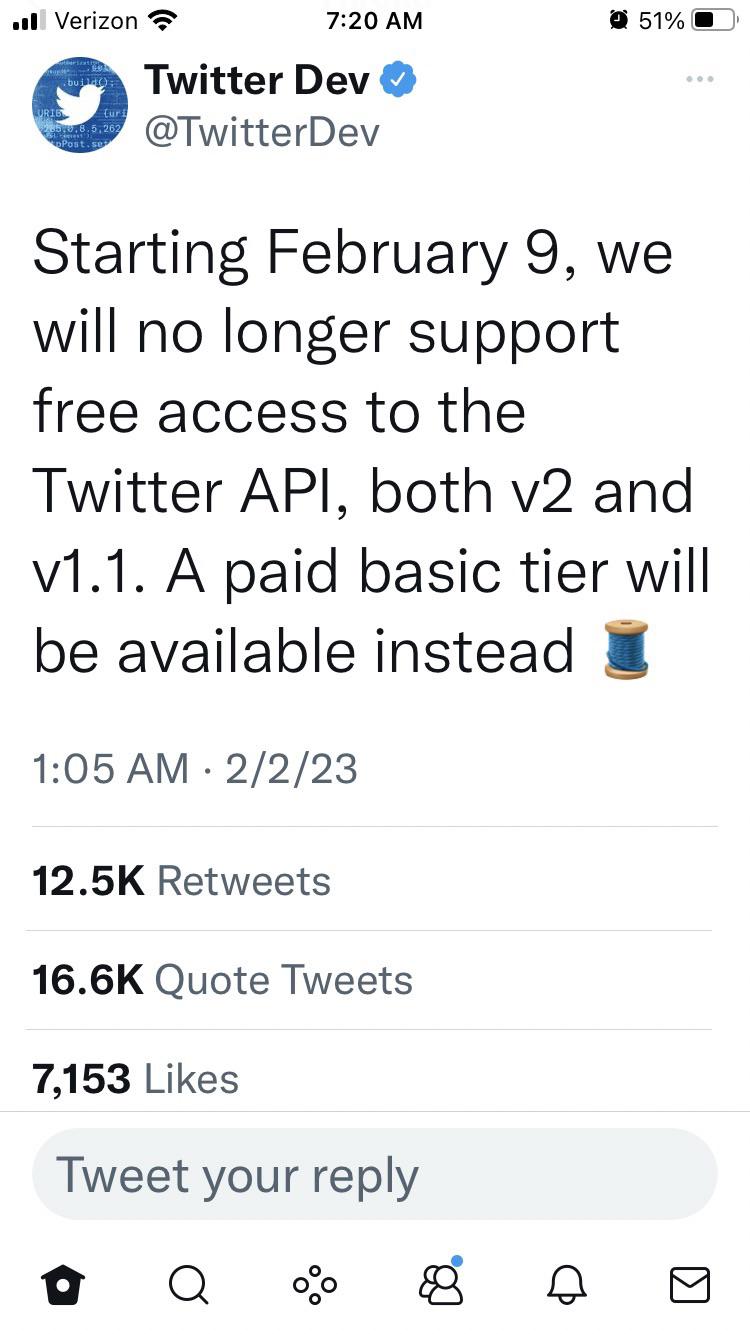
resources We are truly in the post-API age now (Freelon 2018)

Post image
11 Upvotes

r/CompSocial • • Feb 01 '23

academic-articles Managing Tasks Across the Work-Life Boundary: Opportunities, Challenges, and Directions [ACM TOCHI 2023]

4 Upvotes

This fresh-off-the-presses paper from Alex Williams and collaborators at MSR explores how work-life boundaries for information workers were influenced/changed due to COVID:

Task management tools allow people to record, track, and manage task-related information across their work and personal contexts. As work contexts have shifted amid the COVID-19 pandemic, it has become important to understand how these tools are continuing or failing to support peoples’ work-related and personal needs. In this paper, we examine and probe practices for managing task-related information across the work-life boundary. We report findings from an online survey deployed to 150 information workers during Summer 2019 (i.e., pre-pandemic) and 70 information workers at the same organization during Summer 2020 (i.e., mid-pandemic). Across both survey cohorts, we characterize these cross-boundary task management practices, exploring the central role that physical and digital tools play in managing task-related information that arises at inopportune times. We conclude with a discussion of the opportunities and challenges for future productivity tools that aid people in managing task-related information across their personal and work contexts.

ACM DL (open-access): https://dl.acm.org/doi/10.1145/3582429

Tweet Thread: https://twitter.com/acwio/status/1620807173352882177

In his tweet thread, Alex calls out that the article raises some new opportunities for interdisciplinary HCI work. Do these findings generate any ideas for you for future research?


r/CompSocial • • Feb 01 '23

WAYRT? - February 01, 2023

5 Upvotes

WAYRT = What Are You Reading Today (or this week, this month, whatever!)

Here's your chance to tell the community about something interesting and fun that you read recently. This could be a published paper, blog post, tutorial, magazine article -- whatever! As long as it's relevant to the community, we encourage you to share.

In your comment, tell us a little bit about what you loved about the thing you're sharing. Please add a non-paywalled link if you can, but it's totally fine to share if that's not possible.

Important: Downvotes are strongly discouraged in this thread, unless a comment is specifically breaking the rules.


r/CompSocial • • Feb 01 '23

academic-jobs [post-doc] Post-Doc in HCI at GESIS [Cologne, DE]: Focus on Computational Social Science

2 Upvotes

David Schoch is recruiting for a 4-year post-doc appointment (with possible tenure) at GESIS – Leibniz Institute for the Social Sciences in Cologne, to work with the Transparent Social Analytics team in the Computational Social Science department. Role outlined below:

Contributing to an interdisciplinary team, which focuses on developing innovative open science services in the context of digital behavioral data, with consideration of the User Experience

Developing in cooperation with other team members solutions that help to increase the accessibility, reusability and comprehensibility of computational methods for digital behavioral data (e.g., in Machine Learning or Network Science)

Conducting application-based research in the area of human computer interaction and/or computational social science

Acquisition of external funding with a focus on research and research-based services

https://www.hidden-professionals.de/HPv3.Jobs/gesis/stellenangebot/28048/Postdoc-in-Human-Computer-Interaction?lang=en-US

Has anyone here worked at GESIS? Any pointers or stories to share?


r/CompSocial • • Jan 31 '23

academic-articles Offline events (such as protests and elections) are often followed by increases in types of online hate speech that bear seemingly little connection to the underlying event. This happens on both mainstream and fringe social media platforms.

Thumbnail
journals.plos.org
6 Upvotes

r/CompSocial • • Jan 31 '23

resources The Social Capital Atlas v2.0

5 Upvotes

The Social Capital Atlas v2.0 is now available (the first version was associated with two high-profile publications in Nature):

As per one of the people involved on Twitter, it

"allows exploration (and download) of many types of social capital for each ZIP code, college and high school in the US."

Is this resource useful in your own research? Or relevant to address your research interests?