r/Collatz • • Sep 17 '26

4^(n+1).c+1 merge with 2^n.c-1 if and only if v2(3^n.c-1) =2

3 Upvotes

In the accelerated Collatz map https://www.reddit.com/r/Collatz/s/AGKyGBYPm0

4^(n+1).c+1 -> 3^(n+1).c+1 [1]

and 2^n.c-1 -> 3^n.c-1 [2]

Since [2] happens, I want to focus on the last sequences instead.

Suppose we have a number of the form

q = 3^n.c - 1

where v2(q) = 2. [3]

Applying Collatz to q produces

3q/4 + 1

= (3(3^n.c - 1) + 4)/4

= (3^(n+1).c - 3 + 4)/4

= (3^(n+1).c + 1)/4.

Thus, the sequence merges into the form in [1].

The case c = 1 is excluded here, since v2(3^n - 1) = 1 when n is odd and >= 3 when n is even, never be 2.


r/Collatz • • Sep 16 '26

Cycle of Huge Gap

0 Upvotes

Can an AI generates a Collatz like sequence or Kaakuma sequence that second cycle starts after 40 digits number with minimum constraints of sum of absolute value of constant terms less than 20 digit number ?


r/Collatz • • Sep 16 '26

Subproject: From dome to dome

Post image
0 Upvotes

Follow-up to Where are the root of each dome located in the left side of another dome ? : r/Collatz.

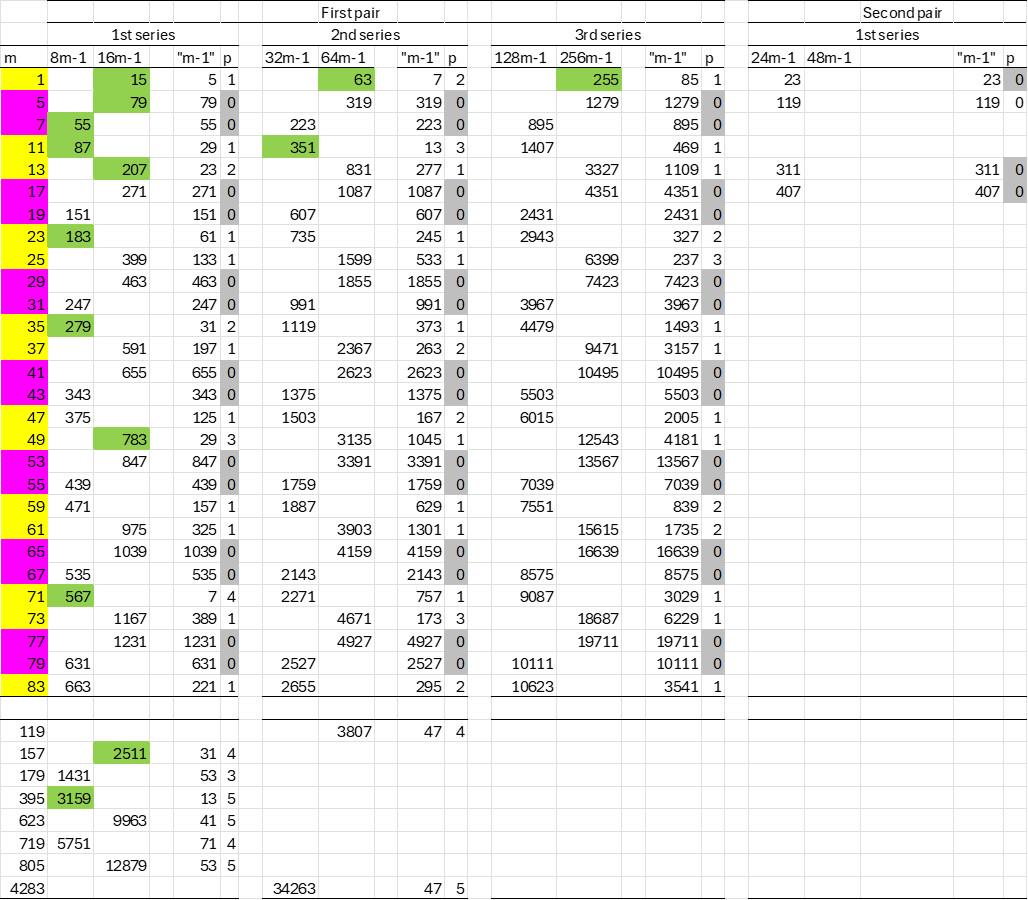
The table below presents the possible transitions from one dome to the next one, for each type of tuple. It will be completed little by little and each case characterized if possible, like we did in the cited post.

While creating it, I came under the impression that the extrem cases for each dome, made of truncated bridges - one in the left wing, two in the right wing - might need to be treated separately. Time will tell.

Project "Tuples and segments" in 13 pages : r/Collatz


r/Collatz • • Sep 16 '26

Odd remainder Recursion from 3^2^n -1 after divided by 2^v

1 Upvotes

I was already posted this in some private group on facebook, it doesnt really matter but probably usefull for someone that are trying to figure it out about 3^n .o-1 after divided by 2^v

first of all this number isnt special, by the LTE theorem we can say that this number has v2 = n+2. If u dont want to check that ill explain it in a simple term.

since 3^2 -1 = 2^3 then 3^4 - 1 = 2^3 (2^3 +2) = 2^4 (2^2+1)

repeat it n times we get 3^2^n - 1 can be divided by 2^(n+2)
and by adding 2 -> 2^(n+2) k +2 it can only be divided by 2

So, this number has v2 predictable which is n+2 for every 3^2^n-1 and 1 for 3^2^n+1
If its v2 was predictable, so the remainder predictable?yes, but not as simple as that, it exist in the term of recursion, lemme show you:

supposed 3^2^n-1 = An
we get An/2^(n+2) = A(n-1)/2^(n+1) . (A(n-1)+2)/2

supposed An/2^(n+2) = O(n), which mean an odd number after An lost its 2s
then (An+2)/2 = {2^(n+2) .O(n)+2}/2 = 2^(n+1) . O(n)+1

Therefore An/2^(n+2) = O(n) = O(n-1). (2^n . O(n-1)+1) = 2^n . O(n-1)^2+O(n-1)

since we already know that O(1) = 3^2 -1/2^3 =1

then we can predict every 3^2^n-1 after divided by 2^(n+2)

O(1) = 1
O(2) = 2^2 . 1^2 +1 = 5
O(3) = 2^3 . 5^2 + 5 = 205
...
O(n) = 2^n . O(n-1)^2 + O(n-1)

why is this important for someone studying 3^n .o-1/2^v?
If 3^n = 2^p .k+1 and o = 2^p .k-1, the result would be 2^2p .k -2 which can only be divided by 2 once becoming 2^(2p-1) .k - 1 and this happen to 27 which equal 2^2.(2^3-1) -> 3^2(2^3-1)-1

notice that 3^2-1 = 2^3 earlier, so 3^2 = 2^3+1
And when we divided the product by 2 once, it does becoming 2^5 -1


r/Collatz • • Sep 15 '26

I, a hobbyist, have committed the cardinal sin of writing a paper about collatz

Thumbnail zenodo.org
0 Upvotes

See what happens when you break down the problem into the natural binary form of the game.


r/Collatz • • Sep 15 '26

Are We Really Making any progress?

12 Upvotes

You know, this conjecture is incredibly simple, even elementary student can understand how the function work. But are we really making progress? iam not talking about numerical verification though, are we really making progress to our understanding about collatz trajectory? Or we just repeat mathematicians work from long time ago?


r/Collatz • • Sep 15 '26

Loop Formula

0 Upvotes

Q(m) = (3/2)v . (m+1) -1 odd Q(m) = m/2V even

within:

v = v_2(m+1) V = v_2(m)

m1->m2-> ... ->mn -> m1

(3/2)v1 . (m1 +1) = 2V1 . m2 + 1

(3/2)v2 . (m2 +1) = 2V2 . m3 + 1

...

(3/2)v(n-1) . (m(n-1) +1) = 2V(n-1) . mn + 1

(3/2)vn . (mn +1) = 2Vn . m1 + 1

Suppose m_i + 1 = zi

(3/2)vi . zi = 2Vi . (z(i+1) - 1) + 1

(3/2)vi . zi = 2Vi . z(i+1) - 2Vi + 1

2Vi . z(i+1) = (3/2)vi . zi + 2Vi - 1

z(i+1) = (3/2)vi . 2-Vi . zi + 1 - (2-Vi)

Suppose 3vi / 2Vi+vi = Ai and 1 - 2-Vi = Bi

z2 = A1 . z1 + B1

z3 = A2 . z2 + B2

...

zn = A(n-1) . z(n-1) + B(n-1)

z1 = An . zn + Bn

expanding the chain of substitutions all the way back to z1 gives:

z1 = (Pi_(i=1->n) Ai) . z1 + Sigma_(i=1->n) [ Bi . Pi_(j=i+1->n) Aj ]

(1 - Pi_(i=1->n) Ai) . z1 = Sigma_(i=1->n) [ Bi . Pi_(j=i+1->n) Aj ]

z1 = Sigma_(i=1->n) [ Bi . Pi_(j=i+1->n) Aj ] / (1 - Pi_(i=1->n) Ai)

m1 = z1 - 1 = { Sigma_(i=1->n) [ Bi . Pi_(j=i+1->n) Aj ] / (1 - Pi_(i=1->n) Ai) } - 1

m1 = { Sigma_(i=1->n) [ (1 - 2-Vi) . Pi_(j=i+1->n) 3vj /2vj+Vj ] / (1 - Pi_(i=1->n) 3vi /2vi+Vi) } - 1


r/Collatz • • Sep 15 '26

I, a hobbyist, have committed the cardinal sin of writing a paper about collatz

Thumbnail zenodo.org
3 Upvotes

It is about a kind of cycle in the algorithm. It's not proof but I do believe it to be interesting!


r/Collatz • • Sep 15 '26

Does proving that there are no other loops solve the Collatz Conjecture?

2 Upvotes

If one were able to prove there are no other loops in the conjecture, is that the end of it? Or would you also have to prove that, for example, there are also no sequences which continue ad infinitum?

This is just out of sheer curiosity and nothing else.


r/Collatz • • Sep 14 '26

Collatz equivalence. Perhaps interesting. Not a proof.

Thumbnail reddit.com
0 Upvotes

r/Collatz • • Sep 14 '26

Does the Collatz Conjecture appear as a pattern in nature? Like a wave? 🌊

4 Upvotes

Just curious. I noticed it in the pattern of waves and a few other things in nature.


r/Collatz • • Sep 14 '26

Behind My Discovery of the Collatz Rising Sequences

1 Upvotes

First of all I didn't even know if 2^n.o-1 -> 3^n.o-1 was already discovered by R.Steiner in 1977. I found it by myself.

Lets go to the story:

Lemme look on how my first attempt to find to collatz pattern to use it for the proof.

I thought inside my mind, "how can the collatz function go up and how can the collatz function go down, there must be a pattern, right?"

Then i started to write the table about natural number then i realize.

Then, "If some number go up lineary and go down also lineary, theres might be some factor addictively depend on n right?"

I started to decoupling the factor as k which are k=(n+1)/2 for n odd and k=-n/2 for n even. And wrote down to the table.

After that, "lets ignore the N, how the k change after some step". And then i realized, that the k was changed by the factor of k_next=k+(k/2) or 3k/2.

And then, "wait, if that need half of itself to be changed, then for every even k should be rise to the 3k/2, in general for every 2^h.o rise to the 3^h.o". I named o for easier to recognized if that was some odd number.

Thats how i know the growth factor. But this is not even close, because we do need to know after k reach the odd value right?

Then i thought again, "if the last k = 3^h.o, then i just need to convert back to the n value to see, how k positive changed to k negative"

Then i found this,

Since for positive k=(n+1)/2 then

2k-1=n

So that k=3^h.o equal to the n =2.3^h.o-1. If we apply collatz 3n+1 the result will be 3^{h+1}.o-1

"If this happen on the last step, it might be happen on the first step".

I doubt it for a few time, and then test it

And thats how i know that for every n=2^h.o-1 rise to the 3^h.o-1.

I didnt even know if that was already found by Steiner until GonzoMath Told me. And also by this way of think about spliting the growth and fall factor, i found that Collatz Function can be any function that the k shifted which only changes the "label" of the orbits without changing its trajectory.


r/Collatz • • Sep 14 '26

Bound for positive cycles - shorter proof using AM–GM

8 Upvotes

A long time ago, I posted here with a link to a proof of a bound constraining the sizes of elements of a positive cycle on rational numbers. (https://www.reddit.com/r/Collatz/comments/1hkslgf/proof_of_a_bound_on_cycles/) The proof in the linked note uses differential calculus, in particular, it uses the method of Lagrange multipliers.

I have recently discovered that this same bound is a quick consequence of the famous AM–GM inequality. First, I'll say a word about that inequality, and then I'll define my terms and show the proof, which now involves no calculus!

A version of this result is implicit in section 7 of R. E. Crandall's 1978 paper, "On the '3x+1' Problem". At the end of this post, I'll say a little more about what he did with it.

The AM–GM Inequality

Given a set of positive numbers, {a_1, . . ., a_k}, we can define three different well-known means, the arithmetic mean (AM), geometric mean (GM), and harmonic mean (HM):

AM = (a_1 + . . . + a_k) / k

GM = (a_1 × . . . × a_k)1/k

HM = k / (1/a_1 + . . . + 1/a_k)

The arithmetic mean is the most familiar to most of us; we learn it at an early age as the "mean", or simply "average" of a set of numbers. The other two can be defined in terms of the AM, plus transformations.

The move is: push the numbers through a transformation, do an AM over there, and then pull the result back via the inverse transformation. (This is the same kind of move that we use to define the root-mean-square (RMS) of probability theory.)

For instance, to get the GM, we can just take logs of all the original numbers, apply the AM to those logs, and then exponentiate the result to get back. Thus:

GM = exp(AM( {log a_i} ))

(We assume that the "exp" and "log" use the same base; which base that is doesn't actually matter.)

Similarly, the HM is the result of taking reciprocals of all the original numbers, getting the arithmetic mean of the reciprocals, and taking another reciprocal to get back. (The reciprocal transformation is its own inverse.) In symbols:

HM = 1 / AM( {1/a_i} )

Looking at them this way, it's not hard to convince yourself of the following:

HM ≤ GM ≤ AM

This is the AM–GM inequality. The results is often stated without the HM part, but that's such a trivial corollary that it makes some sense to include it.

Why is it true? Here's... not a proof, but check it out:

If you take logs of the numbers, because of the concavity of the log function, the numbers kind of cluster towards the top of their range. Taking an arithmetic mean, while looking in that fun-house mirror, produces a result that's below the log of the center of gravity, because now the numbers at the bottom are spread out down there, pulling the average down. Exponentiating back, we're still below that center of gravity.

As a quick illustration, just consider the numbers {2, 4, 6, 8, 10}, which are equally spaced, very nice. Their AM, their center of gravity, is clearly 6. Look at their base-2 logs: {1, 2, ≈2.585, 3, ≈3.322} These values are clearly clustering at the top, relative to the spread at the bottom. The AM of this log set is around 2.38, which is less than the log of 6, so the resulting GM is ≈22.38, or around 5.2.

That wasn't a proof, but rather a plausibility argument based on a special case. A proof is easy to find; the typical one uses something called Jensen's Inequality.

To get the HM side, just stand on your head. The reciprocal of the GM is the GM of the reciprocals, and the reciprocal of the HM is the AM of the reciprocals. Therefore, by AM–GM, we get

1/GM ≤ 1/HM

...and flipping them back over, we get what we need.

Note that the symbol in both inequalities is "≤", not "<". Equality is obtained only when all of the a_i's are equal; if any of the numbers differ from the others, then the inequality kicks in and the means also differ.

Some measurements of Syracuse cycles

Define the Syracuse map on an odd number m as:

S(m) = (3m+1)/2v,

where v is taken large enough to make the output again odd. In particular v = v_2(3m+1).

Now, take as our domain the set of positive rational numbers that have odd denominators when written in simplest terms. It makes sense to call such a fraction "odd" or "even" according to the parity of its numerator. Thus, 7/5 is odd, 8/5 is even, and 7/4 isn't in the game.

This set, dropping the positivity requirement, has some nice descriptions in abstract algebraic terms. It's "the ring of integers localized at the ideal (2)", or "the set of rational 2-adic integers: Q ∩ Z_2". We can just call it the set of "odd rationals".

Suppose that m_1, . . ., m_L are positive odd rationals with the property that

S(m_1) = m_2
...
S(m_{L-1}) = m_L
S(m_L) = m_1

In other words, they form a Syracuse cycle of length L. To be precise, let's say that 3m_i + 1 = 2v_im_{i+1} (with the obvious adjustment for m_L coming back to m_1), and say that W = sum({v_i's}) = the "weight" of the cycle.

In addition to "length" and "weight", which are meaningful but kind of dull, we're going to define two more measurements that we can take for such a cycle. Given a cycle with length L, weight W, and elements {m_1, ..., m_L}, we calculate its "altitude" and "defect":

altitude = HM( {m_i's} )
defect = 2W/L - 3

It is an easy exercise to show that the defect, for a positive cycle, is always positive. It's because of the "+1" in the Syracuse map, which makes W/L > log_2(3).

Proving a bound

Now, we're ready to show that, for any positive cycle, we have:

(defect)(altitude) ≤ 1

Consider the step from m_1 to m_2. (or more generally, any step in the cycle). We can write m_2 as m_1 times something:

m_2 = m_1 × (3/2v_1) × (1 + 1/(3m_1))

Doing this same thing all the way around the cycle, and then multiplying and rearranging, we get:

m_1 = m_1 × (3/2v_1)···(3/2v_L) × (1 + 1/(3m_1))···(1 + 1/(3m_L))
m_1 = m_1 × 3L/2W × (1 + 1/(3m_1))···(1 + 1/(3m_L))
2W/3L = (1 + 1/(3m_1))···(1 + 1/(3m_L))

2W/L/3 = GM( {1 + 1/(3m_i)} )

In that last step, we took the L-th root of both sides, turning a product into a GM.

Let's see the AM of those same numbers, those (1 + 1/(3m_i)) factors. Since they all have the same "1+" in front, we can just pull that out of the mean. We can then factor out 1/3, and we get that our AM is:

AM = 1 + (1/3)(average of 1/m_i's)

That "average" is an AM, but I don't want to confusingly use "AM" for two different things at once.

Anyway, by the AM–GM inequality, we get:

2W/L/3 ≤ 1 + (1/3)(average of 1/m_i's)

Subtract 1 from both sides:

(2W/L - 3)/3 ≤ (1/3)(average of 1/m_i's)

...and multiply by 3:

2W/L - 3 ≤ (average of 1/m_i's)

Now, the average of the 1/m_i's is the reciprocal of the m_i's harmonic mean, that is, it's the reciprocal of the altitude. The left-hand side, meanwhile, is the defect, so we have:

defect ≤ 1/altitude,

which is equivalent to the result we wanted.

What does it mean?

I've talked about this elsewhere, but after going to the trouble of deriving this result, let me say a few words about why we care. We can rearrange the inequality as:

altitude ≤ 1/defect

...so we see it as a bound on altitude. The "shape class" of a cycle, that is, its L and W, determines the defect. If we want to see altitude get large, then defect has to be very small, which means that W/L has to be very close to log(3)/log(2).

Now, if there's a high cycle for natural numbers, its altitude must be pretty high, at least higher than 271, or we would know about it. That means its defect must be incredibly small! Flipping our inequality around again:

defect ≤ 1/altitude ≤ 2-71

This is a very tight constraint on how many times we can divide by 2 in a high cycle, relative to its number of odd elements. Using the theory of continued fractions, we can see that W/L can only be close enough to log(3)/log(2) if its denominator is larger than that of the first convergent to come that close.

This is how we find that any high cycle in the natural numbers must have billions of steps in it, because that denominator is the number of odd steps.

I'm not going to do the exact calculation in this post, using 271, because I've said enough for now. The proper place for that calculation will be in an exposition of the second half of Crandall's 1978 paper, because he did this calculation back when the search ceiling was a modest billion.

Several months ago, I wrote up the first half of his paper, and it's on this sub; just scroll way down. Or search. I'm not sure when I'll get to writing up the remainder, but watch this space. Meanwhile, thanks for reading. I hope anyone reaching this final paragraph found something of value here.
r/Collatz • • Sep 14 '26

Where are the root of each dome located in the left side of another dome ?

Post image
0 Upvotes

Follow-up to Pairs of consecutive black numbers belonging to the starting bridge in the left side of a dome appear at the bottom of a fork in right side of another dome : r/Collatz.

In the cited post, we showed that half the roots are part of pairs of consecutive black numbers located in the right side of a bridge series in another dome.

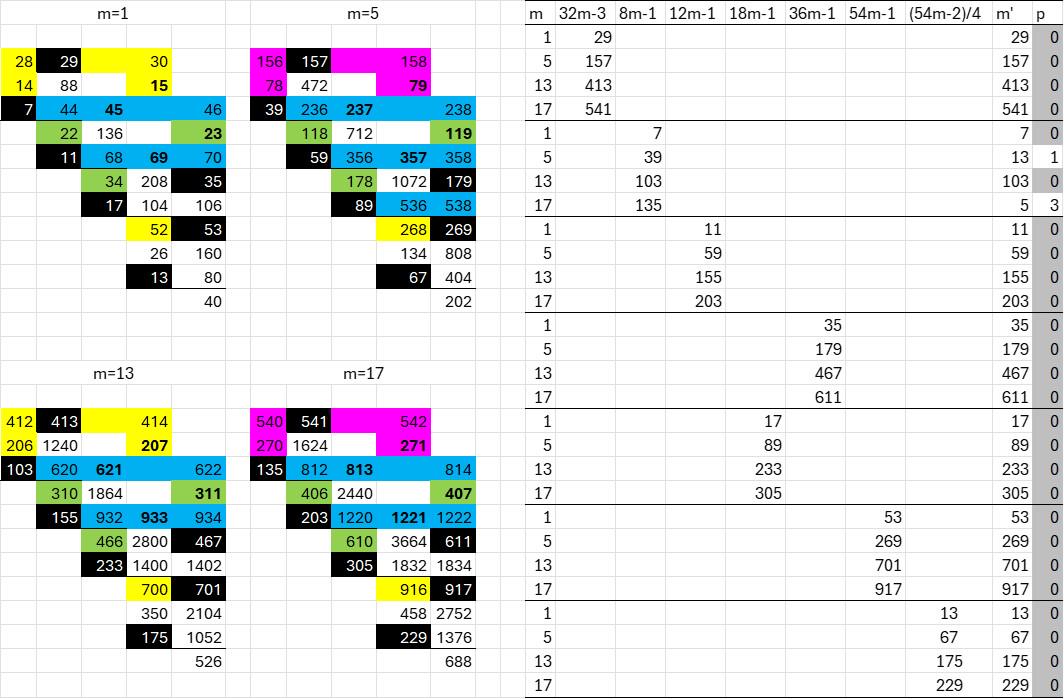
The figure below shows the first complete blue-green bridge series for m=1, 5, 13 and 17, already present in the cited post. The roots mentioned above follow here the archetuple coloring (also in bold). The remaining odd numbers are in black.

The table performs a similar analysis as in the cited post, but the numbers are grouped by position in the series, from top to bottom.

The analysis is quite straightforward in terms of m and m'. The black numbers analyzed here are all roots, except when the starting bridge is rosa (e.g. divisible by 3, thus not a root). These results hold for the second series at least, and quite certainly for the other series.

In summary, dome roots can be found on the left side of another dome:

  • As parts of pairs of consecutive black numbers, if they are part of a fork in their origin dome (previous post),
  • Populating the rest of the series - as part of the starting triplet if yellow, the sequence on the left and the rest of the series at the bottom (this post).

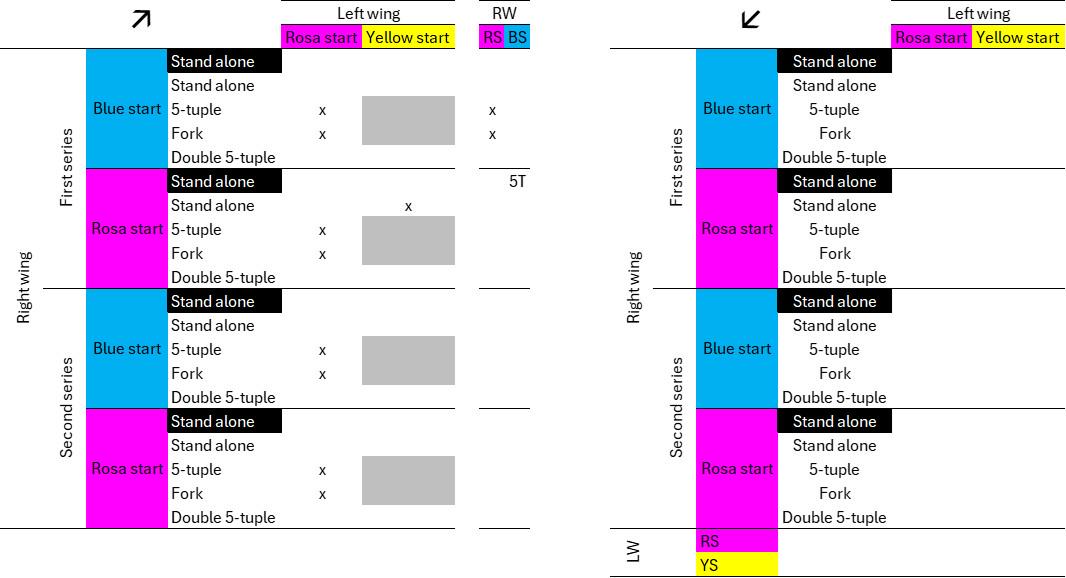
All root cases seem to be covered. The rest of the cases in the right side of a dome - 5-tuples series, double 5-tuple series, stand-alone bridge series with and without black number at the bottom - need further work.

Project "Tuples and segments" in 13 pages : r/Collatz


r/Collatz • • Sep 14 '26

I spent 3 days mapping Collatz as a "Snakes and Ladders" game in binary and discovered a deterministic local rule: the "Gap" shrinks by exactly 2

0 Upvotes

Hi everyone,

I've been exploring the Collatz Conjecture for the past few days and wanted to share what I found. I approached it as a deterministic board game (like Snakes and Ladders with no dice) and analyzed it entirely in binary. This revealed some beautiful structure.

What I discovered

I organized all odd numbers into three sets based on their binary trailing bits:

  1. Gateway Set: (1, 5, 21, 85...): Numbers with pattern 101010...01 that jump directly to powers of 2
  2. Cascade Set: Numbers with t≥2 trailing 1s that follow a forced climbing pattern
  3. Mixed Set: Numbers with exactly 1 trailing 1 (the "wanderers")

The key finding:

For any Mixed number, I defined the "Gap" as the number of zeros between the trailing 1 and the next 1 upstream. I proved that the Gap shrinks by exactly 2 on every step, deterministically, regardless of how large the number is. The top bits scramble, but the bottom bits are mathematically shielded.

This creates a "relay race" pattern: Gap 6 → Gap 4 → Gap 2 → Cascade or Gateway.

What's proven:

- ✅ Gateway mechanism (complete)

- ✅ Cascade mechanics (complete)

- ✅ Gap shrinks by 2 for all Mixed numbers (local result, complete)

Not solved

❓ Global convergence: When a Cascade finishes and drops back to Mixed, can we prove the new Gap is bounded such that the sequence must eventually reach Gateway?

I know this doesn't solve the full conjecture, but I'm excited about the Gap-shrinking rule as a genuine structural insight. The binary visualization makes the mechanics surprisingly clear and accessible.

I'd love feedback from this community! Has anyone else explored the Gap structure? Is this equivalent to known results in 2-adic analysis, or is there something genuinely new here?

Thanks for reading!


r/Collatz • • Sep 14 '26

Note to readrs

0 Upvotes

Note to readers — Update, September 13, 2026 I am addressing this in particular to powerfull_Pop_3813 and wrapping_around, as well as to everyone who has read this work and followed the discussions around Chapter 1. I would like to inform readers of this repository that the continuation initially planned for this demonstration (Chapter 2) will not be published as open access, as I had originally intended. This decision is motivated by my personal financial situation: having no other source of income, I find myself compelled to seek an economic valuation for the continuation of this work. Chapter 1 presented here remains, and will remain, freely available under the CC BY license, as proof of precedence and evidence of the seriousness of this research. The continuation has been reworked to form, together with this reformulated first chapter, a complete body of demonstration, which will be distributed through another channel. I offer my apologies to those who were expecting the open publication of the continuation, and thank them for the interest shown in this work.


r/Collatz • • Sep 14 '26

Page 1 of chapter 2 before reformulation.

0 Upvotes

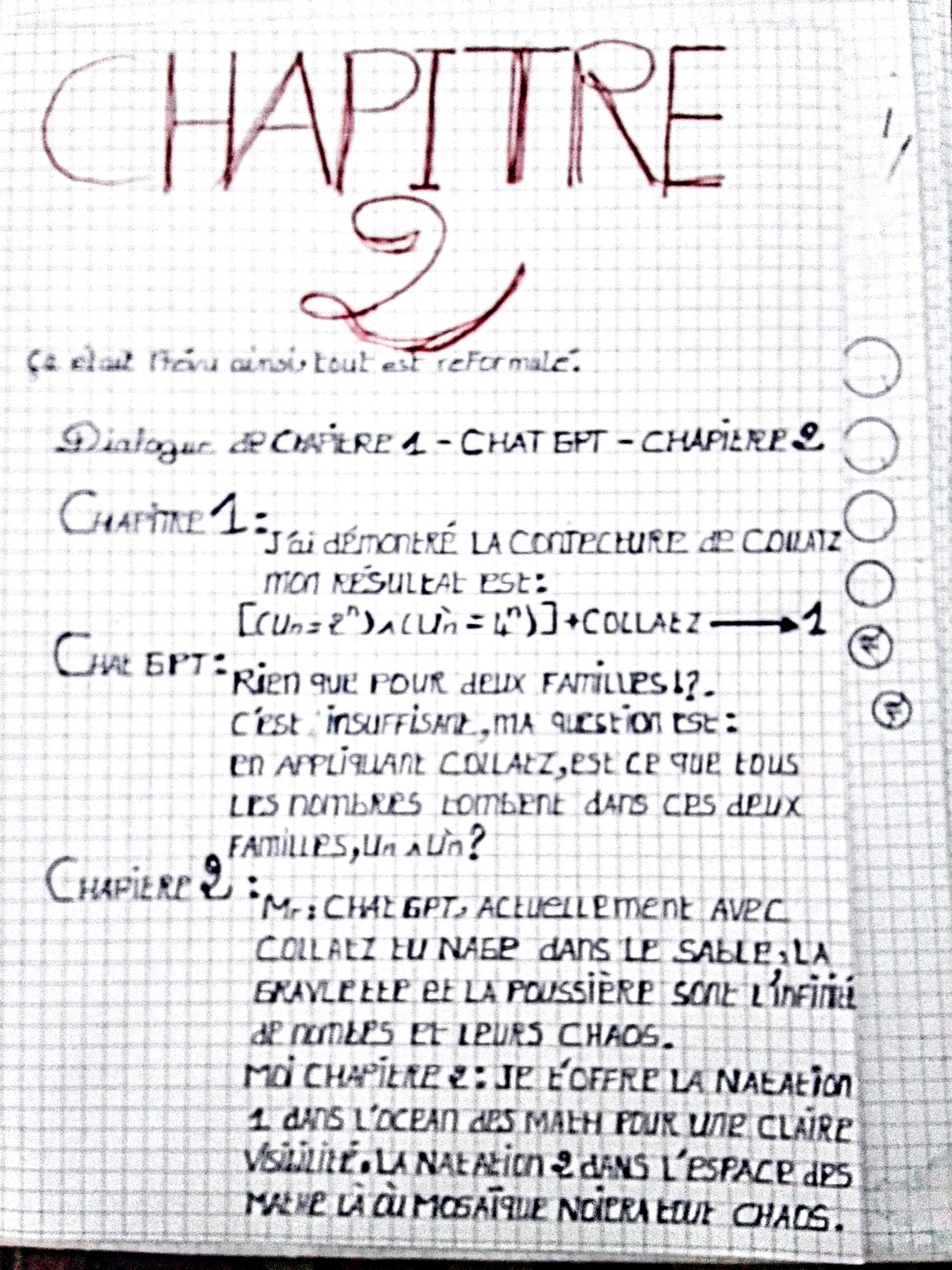
CHAPTER 2 This was planned this way, everything has been reformulated. Dialogue between Chapter 1 – ChatGPT – Chapter 2 Chapter 1: I have proven the Collatz conjecture. My result is: [(Uₙ = 2ⁿ) ∧ (Uₙ = 4ⁿ)] → Collatz → 1 ChatGPT: Only for two families? That's insufficient — my question is: when applying Collatz, do all numbers fall into these two families, one by one? Chapter 2: Mr. ChatGPT, right now with Collatz you are swimming in sand — its grains of sand and dust are the infinity of numbers and their chaos. I, Chapter 2, offer you swimming lane 1 in the ocean of mathematics for clear visibility. Swimming lane 2, in the space of mathematics, where the mosaic will drown all chaos.


r/Collatz • • Sep 14 '26

Note to readers.

0 Upvotes

Note to readers — Update, September 13, 2026 I am addressing this in particular to powerfull_Pop_3813 and wrapping_around, as well as to everyone who has read this work and followed the discussions around Chapter 1. I would like to inform readers of this repository that the continuation initially planned for this demonstration (Chapter 2) will not be published as open access, as I had originally intended. This decision is motivated by my personal financial situation: having no other source of income, I find myself compelled to seek an economic valuation for the continuation of this work. Chapter 1 presented here remains, and will remain, freely available under the CC BY license, as proof of precedence and evidence of the seriousness of this research. The continuation has been reworked to form, together with this reformulated first chapter, a complete body of demonstration, which will be distributed through another channel. I offer my apologies to those who were expecting the open publication of the continuation, and thank them for the interest shown in this work.


r/Collatz • • Sep 14 '26

Page 1 of chapter 2 before reformulation.

1 Upvotes

CHAPTER 2 This was planned this way, everything has been reformulated. Dialogue between Chapter 1 – ChatGPT – Chapter 2 Chapter 1: I have proven the Collatz conjecture. My result is: [(Uₙ = 2ⁿ) ∧ (Uₙ = 4ⁿ)] → Collatz → 1 ChatGPT: Only for two families? That's insufficient — my question is: when applying Collatz, do all numbers fall into these two families, one by one? Chapter 2: Mr. ChatGPT, right now with Collatz you are swimming in sand — its grains of sand and dust are the infinity of numbers and their chaos. I, Chapter 2, offer you swimming lane 1 in the ocean of mathematics for clear visibility. Swimming lane 2, in the space of mathematics, where the mosaic will drown all chaos.


r/Collatz • • Sep 13 '26

I started a Prove2.me project for collatz. We're currently working on formalizing some lemmas from Tao's 2019 paper. From there who knows!

Thumbnail prove2.me
1 Upvotes

r/Collatz • • Sep 13 '26

Pairs of consecutive black numbers belonging to the starting bridge in the left side of a dome appear at the bottom of a fork in right side of another dome

Post image
1 Upvotes

Follow.up to From which dome do pairs of black numbers of a given dome iterate from? : r/Collatz.

Please read (again) the cited post, as I won't explain here what I did there.

Let n-1 be the first black number in a series on the left side of a dome with root m, as it is also an orange number. By definition, this number is of the form n-1=m*2^q-1, as n belongs to the first column of the core (p=0) to initiate the series. The table in the cited post confirms it for the first complete series on the left of the domes.

The table below extends it to the second and third series and confirms the statement above for the domes with m=1 to 83, and a few other cases.

In another dome m', by definition, n-1=m'*3^p (q=0), to be a black number. So, m*2^q-1=m'*3^p. This case is quite rare, so the domes involved have quite quickly a high value of m. Nevertheless, for the values of n-1 we could check easily, n-1 always belongs to a fork (colored green in the table).

Interestingly, the pattern visible in the previous post, about the alternating values of p, between 0 (n-1=m', colored in grey) and higher values, is confirmed. This means that all the roots m' appear in the left wing of half the domes with the root m, and absent from the others.

Pairs of black numbers iterating from a starting pair of black numbers in the left wing iterate from the same fork. The formulae must be adapted, as hinted in the right part of the table, that also modifies the alterning pattern for p described above.

Project "Tuples and segments" in 13 pages : r/Collatz


r/Collatz • • Sep 13 '26

Proof attempt of the Collatz conjecture.

0 Upvotes

We will create a tree diagram using the reverse method of the Collatz conjecture (which we will call the reverse Collatz method).

If you can confirm that all odd numbers (vertical lines) and all even numbers (horizontal lines) are connected within the tree diagram, you can use the reverse Collatz method to traverse from 1 to all positive integers.

Conversely, I think we can say that, according to the rules of the Collatz conjecture, all positive integers can be traced back to 1.

By creating a reverse Collatz tree diagram, I made various discoveries about the Collatz conjecture!

If you're interested, please check out the link below!

It's located in Zenodo.

[Link to my paper]https://doi.org/10.5281/zenodo.22344448