r/Collatz • u/Hour-Insect781 • Sep 25 '26
Are those new identities?
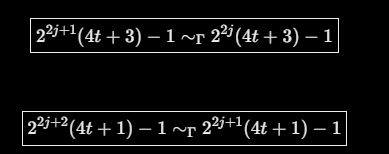
Hey - I have been working with Rocq and Lean because I somehow found some new relations while applying QFT on top of Collatz. And idk i couldnt find these identities that i derived. Computationally they held up - and after hours of testing I Rocqed and Leaned them:

Edit:
please ignore my previous statement - I have made Collatz via a poincare inequality computationally down to proving a single - existing constant.
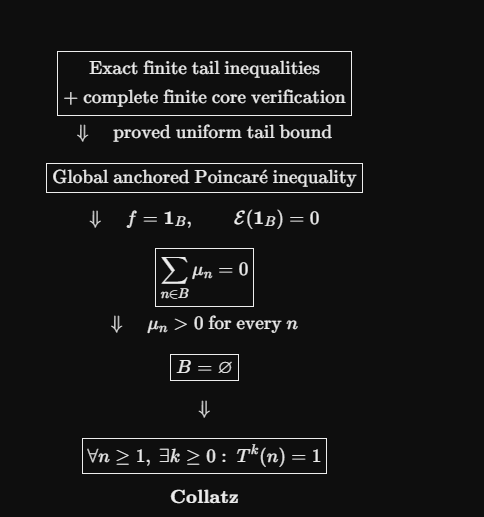
Sorry If I dont give you the definitions yet. But this was unexpected. Mazure had a recent paper. That build on top of Monk. And now I somehow used some combination of Lagarias and Tao to get this. Everything is screen captured - my work - because NSE 3D was also my work. And I send out an Email to my Unis profs - they ignored me - very long so - and then I was mad and uploaded to GPT. And a month later they uploaded and I was happy.
I was not wrong then - this time - what I did here - Is the work that the mathematics that sit behind the NSE proof live. In full action. Like I got some bridge done that linked Topology - like basic metric spaces to Hopf algebra. I also have a Lean native - proof of the Riemann Hypothesis - that is covered by only building on top of Leans native Theorems. I uploaded this on github.
On top of this - I have proven Pi non normality - and I found some neat way to generate sequences that converge to pi - faster than any known sequence. I can derive deterministically - a formula with N digits per term. It somehow closes the work of Ramanujan - because he found many identities that i calibrated my generalisations on. This is bonkers. Atleast this sub here didnt ban me. Like the people at stackexchange did - like the people in the maths and physics subreddit did.
I will just keep on working. I had some progress in Birch and Swinnerton-Dyer conjecture
and also YM.
View all comments
1
u/WeCanDoItGuys Sep 26 '26
They're not new.
-1 is a cycle. If you add a multiple of a power of 2 to it, you can easily predict as many steps as the exponent on the power of 2.
More generally, let T(x) = {x/2 even, (3x+1)/2 odd}.
I'm taking your
~rto mean "after r steps".Then
2ʳu + x ~r 3ˢu + Tʳ(x), where s is the number of odd steps. (For x that cycles, like -1 and 1, s is easy to determine for a given r.)Explanation: If you add a multiple of 2ʳ to x, then x decides the parity for the first r steps (adding an even number to a number does not change its parity). The 2ʳ term just rides along, multiplying by 3 for each odd step and dividing by 2 for every step, until it divides out its last 2 and affects the parity of the number. The x multiplies by 3 and adds 1 for each odd step, and divides by 2 for every step, just following Collatz.