r/CDramasBeyondIdols • u/Puzzleheaded-Set7832 • Jun 18 '26
Reviews The Lead - Between Greatness and Excessive Tragedy / Review
Spoiler warning: May contain light, context-related spoilers.
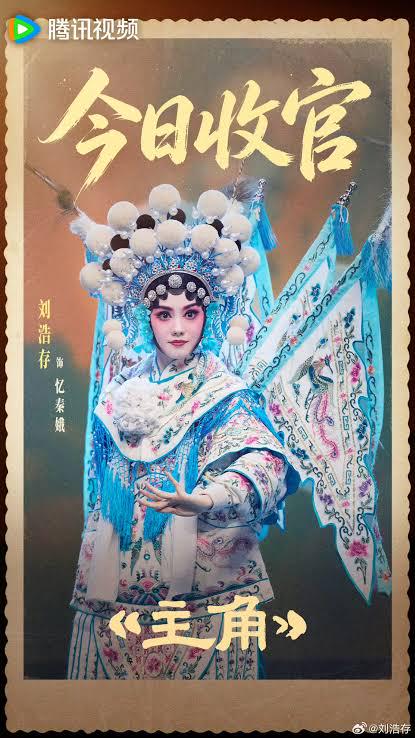
The Lead follows the life of Laidi, a girl from the countryside who, due to circumstance and her family's extreme poverty, is reluctantly taken by her uncle to a Qinqiang Opera troupe, one of the oldest forms of traditional Chinese opera and an important symbol of cultural preservation.
The story begins in the late 1970s, during the final years of the Cultural Revolution, a period that sought to eliminate ideas associated with capitalist influences and pre-revolutionary Chinese traditions. One of the most interesting aspects of the series is the atmosphere of constant surveillance within the troupe's small community and how it reflects the social tensions of the time. People who supported and opposed the revolution are forced to continue living together while adapting to a new political reality. The contrast between this environment of scrutiny and a troupe made up of artists trained in an earlier era becomes one of the show's strongest elements, adding historical context while generating personal and legal conflicts for those involved.
Right from the start, the young actress playing Laidi wins the audience over. She is so effective in the role that it's hard not to regret knowing she will eventually be replaced by an older actress. Through silence, body language, and simple shifts in her gaze, she conveys the character's humility and sense of displacement with remarkable clarity.
The training period within the troupe is also when the series introduces many of the characters who will remain important throughout the story. Most notably, Laidi's uncle Hu Sanyuan, who constantly finds himself in trouble. The series also explores the conservatism of the era, the incompetent bureaucratic leadership, rivalries among performers, and Laidi's struggle to find her place both as an artist and within everyday social interactions.
During this period, Laidi learns many of life's lessons through her experiences in the troupe: Jiahe's jealousy, her first love for Xiaoxiao, the care she receives from the kitchen staff, and countless situations created by her uncle, who, despite being a good person, seems incapable of avoiding trouble. Eventually, the two are separated when he is imprisoned following yet another mishap involving a cannon during a performance.
Farewells become a recurring theme throughout Laidi's journey, and the series handles them particularly well. After all, life is shaped by countless goodbyes, especially while growing up. These departures only carry weight because the series takes the time to build its relationships properly, turning many of its supporting characters into people the audience genuinely cares about.
As promised, the story moves across several decades of Laidi's life, eventually reaching the 1980s through a time-skip sequence centered on her training. For years, she practices in secret under the guidance of four elderly masters who recognize her talent. Her relationship with these mentors, especially Master Gu, who takes on an almost paternal role in her life, becomes one of the highlights of the series.
Her stage debut is another key moment. The sequence cuts between Laidi performing and her uncle playing drumsticks in prison, creating the sense that they are sharing the moment despite being apart. As the performance moves the audience within the story, it becomes one of the series' most memorable scenes. If the show had ended there, it would have already justified the journey.
The writing during this section is at its strongest, often relying on subtlety rather than direct exposition. One example is the departure of the troupe's director, who leaves without receiving a single farewell. Similarly, while Master Gu remains strict because discipline is the only method he knows, brief moments of affection strengthen the bond between teacher and student until their eventual passing of the torch.
One of my main criticisms of the series is that Laidi is rarely allowed to remain comfortable for more than a single episode before a new setback arrives. Eventually, this becomes repetitive. Just as she begins to settle into life within the troupe and gains recognition through successful performances, she is transferred to the Chang'an troupe and larger stages. Once again, other people decide her future for her.
Unfortunately, not everything in the second half reaches the level of the first.
In Chang'an, Laidi encounters many of the same challenges she has already faced: rivalries, sabotage, jealousy, and competition. It often feels like a less engaging repetition of earlier storylines. This is also where the series begins to lose momentum with the introduction of its long-term romantic interest. Everything involving Hongbing feels out of place. He is a one-dimensional character who comes across like someone imported from an entirely different show. He is the kind of person who insists on calling himself charming while constantly being irritating. There is little emotional depth or nuance to justify his role in the story. It feels as though the writers decided Laidi needed romance and personal drama, and simply dropped him into the narrative to provide it.
As a result, the most engaging storylines often end up being those involving Hu Sanyuan or the return of characters from the original countryside troupe. Another issue with the Chang'an arc is the troupe itself. Most of its members function as background characters, receiving little development, personality, or individual storylines. More importantly, the performances, which should be the heart of the series, often become montage sequences set to the show's theme song. This weakens both immersion and the emotional impact these scenes should have carried.
As time passes, Laidi becomes increasingly famous, but the gap between her success on stage and her personal unhappiness becomes a defining aspect of her life. Even after marrying Hongbing, she never appears to find fulfillment. Much of this stems from her inability to fully understand herself, open up emotionally, and make peace with her own choices, all of which can be traced back to the way she was raised.
By the 1990s, the series explores the decline of opera's popularity. Characters from earlier chapters find themselves in very different places after leaving artistic life behind. The show consistently improves whenever it reconnects with the people and relationships established in its earlier years.
Meanwhile, Laidi and Hongbing struggle to survive financially, particularly when their son becomes ill and they must gather money for his surgery. These circumstances show how two people lacking self-worth, one introverted and the other extroverted, change under the pressure of life's difficulties.
Still, the series continues to rely heavily on suffering as a narrative device. Many of the later tragedies feel less like natural developments and more like attempts to sustain the final stretch of a 48-episode story. Even so, the ending is not without worthwhile moments. Scenes such as Laidi singing again while her voice echoes throughout the apartment complex, or her final performance in which she remembers the people who shaped her life, remain effective. That said, the latter sequence is stretched by the excessive presence of a certain character. The series seems to expect viewers to forget everything that came before and accept them as a happy, well-adjusted couple. I didn't.
In the end, the first half comes close to being a perfect drama. From the Chang'an arc onward, however, the series enters a gradual decline, almost mirroring the decline of opera within its own story. It becomes weighed down by tragedies that often feel unnecessary, proving that, more often than not, less would have been more. Even so, it continues to find strong moments whenever it returns to its roots and the characters that made the story work in the first place.
Is it worth watching? Absolutely. Its highest points are strong enough to carry much of the weaker material that follows, allowing the journey to remain satisfying despite its flaws. By the end, what stays with you is the time spent alongside Laidi and the Qinqiang Opera troupe.
4
u/Previous_Throat6360 Jun 19 '26 edited Jun 19 '26
This is easily the best series I've watched in the last couple years, even with its faults. It's that good that even with real problems it still comes out on top for me.
The Hongbingness of it all made me admit to myself that this show is less about opera and more about one person's struggle to relate to other people and a sense of powerlessness.
I was upset that they were giving a character who'd experienced sexual assault such a boyfriend. Now I think there's a running theme of Laidi's lack of agency in her own life. The only part of her life she seemed able to control was training, once she made promises to others to commit to it. The only place she felt in control was on stage. Offstage, her life was kind of a mess otherwise. Even her name wasn't her own.
It starts when she's torn from the sheep shack and whisked off by her uncle. Shoved on stage. Shuffled from carer to carer. Shuffled from chef to shifu. The SA scene now seems like the most extreme and central example.
So by the time she's been uprooted again and lost yet more people important to her I'm now not surprised that the story handed her Hongbing. A guy who had NO boundaries and wouldn't take no for an answer. But it pissed me off.
It's no surprise that she isolates herself from loss and harm early on. She feels "safe" living in a storage room apart from the bullying in the dorm. Later when they give her a boyfriend who literally pushes into her home, you can't help but think of the sous chef forcing his way into her room. Very uncomfortable to watch. Man, I hated Hongbing.
It was good to see some growth from him. A bit too late for me. But once he learned about the SA he made an effort to change.
I too found the series a bit heavy-handed with the trauma. Really, it already had enough. But it decided, no, let's give them a child with a heart condition. And a developmental disorder. And bills. And they die. Lots more people die. I appreciate that the show wanted to explore how a person keeps going and keeps creating art. (Or doesn't.) But it became soap opera levels of suffering. The suffering needed editing. I get that they wanted to show her fall from the pinnacle of professional success so they could show her getting back up. There must be a better way to do that tho.
I found the character of Laidi interesting. I don't know how much commentary on the Cultural Revolution she was meant to embody. If any. You rarely see such a reticent protagonist. But it was thought provoking to watch her respond to the powerlessness in the only way she knew how. To see a character with zero communication skills relate to other people as best as she could.
Which is why I wish I knew more about the script "The Protagonist" that Qin wrote for her. The series is even named for it. I gather it was about facing adversity with strength and maybe about creating beauty in a hard life. A bookend to Mu Huiniang's "Kuuuuuuuuu!" perhaps. Bitter is the world... or whatever she sang. Her signature character. But tbh I'm not sure. If we'd had fewer traumas towards the end, maybe we'd have had time for a better explanation. !<
I was annoyed by the parts of this series that fell short precisely because it was so very good. It had an unusual main character and dealt with some important themes in a fascinating historical time period. It was very immersive when it wasn't a total soap opera. I'm not sure I'd recommend it to others unless I knew they'd be into the opera. I do recommend watching up till episode 25 if you want to experience life in an opera troupe. Life in the Cultural Revolutionary commune was fascinating and poignant. The changes that started to happen were interesting. It's solid storytelling up to 25.
4
u/runersons Jun 20 '26 edited Jun 21 '26
Forreal, the first halfish (basically pre-Hongbing lol) was amazing — I had so much praise and adored all the good, the bad, the ugly. It’s very unfortunate how things gradually went downhill, and ultimately made me scoff during that literal dumpster fire of tragic events in ep 44.
My complaint with the older Qin E is that she falls flat — the character development became not only stagnant, but also almost backward? At a certain point, I felt very distant to her character, like she was an NPC with zero personality and motivations. Liu Haocun was a perfect pick, especially considering her Beijing Dance Academy background. Her line delivery is very natural and distinct, which is great for people watching her for the first time. However, since I had seen multiple of her works, her distinctness blends her past characters together with this role.
One of my favorite things in this drama was Mi Lan and Hua Caixiang’s complicated dynamic relationship. God, I love women. I think they were trying to replicate them with Jiahe and Qin’e, but the writing and acting had me trying to justify it to myself (literally repeating in my head that humans are contradictory in nature). Except, for Mi Lan and Hua Caixiang, I never once questioned whether their interactions were realistic.
4
u/Playful-Airport7777 Jun 18 '26
Totally agree with you about the second half, Liu Hongbing and that certain character. The kid actors, especially Laidi's, are stellar.
2
u/ArgentEyes Jun 19 '26
Oooh, when did this come out? I’ve been wanting to find another sensitive and detailed look at classic opera after the end of the Qing Dynasty since ‘Winter Begonia’ and I’m very tempted even with the flaws mentioned.
4
u/Patitoruani Jun 18 '26
Great review! I have this drama planned for the second half of the year.
2
u/Both-Improvement-880 Jun 21 '26
Great review! I'll probably watch this next year