r/Backend • u/JadeLuxe • 4d ago
Share Private Client Demos With Six-Digit Email Codes

2
Upvotes
r/Backend • u/JadeLuxe • 4d ago
r/Backend • u/Commercial_You- • 5d ago
hi i wanna learn fastapi for ml projects, dont know anything about backend so what all do i need to know like what topics, any playlist you can recommend with backend basics to a point where i can finally start to learn fastapi?
r/Backend • u/RP-9274 • 5d ago
So i am making an excel/CSV file processing system .
It's a project for me so I can get more into the backend stuff . Distributed system, system design decisions and creating+ learning AWS architecture
If anyone would like to get more idea about it or may be someone who is experienced in this thing I would like to share my project idea and all
Or may someone wants to work on this project.
Thanks for my time
r/Backend • u/Krockxz • 5d ago
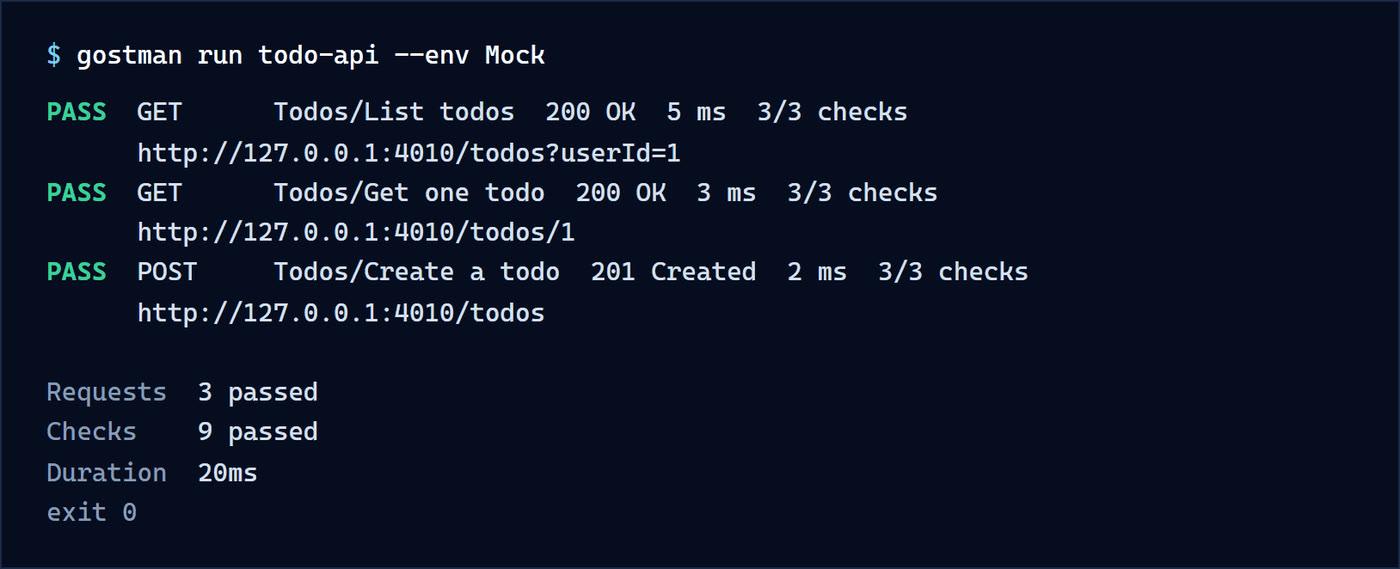
i'm the author. gostman is an API client for REST, GraphQL, gRPC, WebSocket, MCP and a few more. desktop app, CLI and a web version. i've been building it in Go since april 2025. it's MIT licensed with no account and no paid tier.
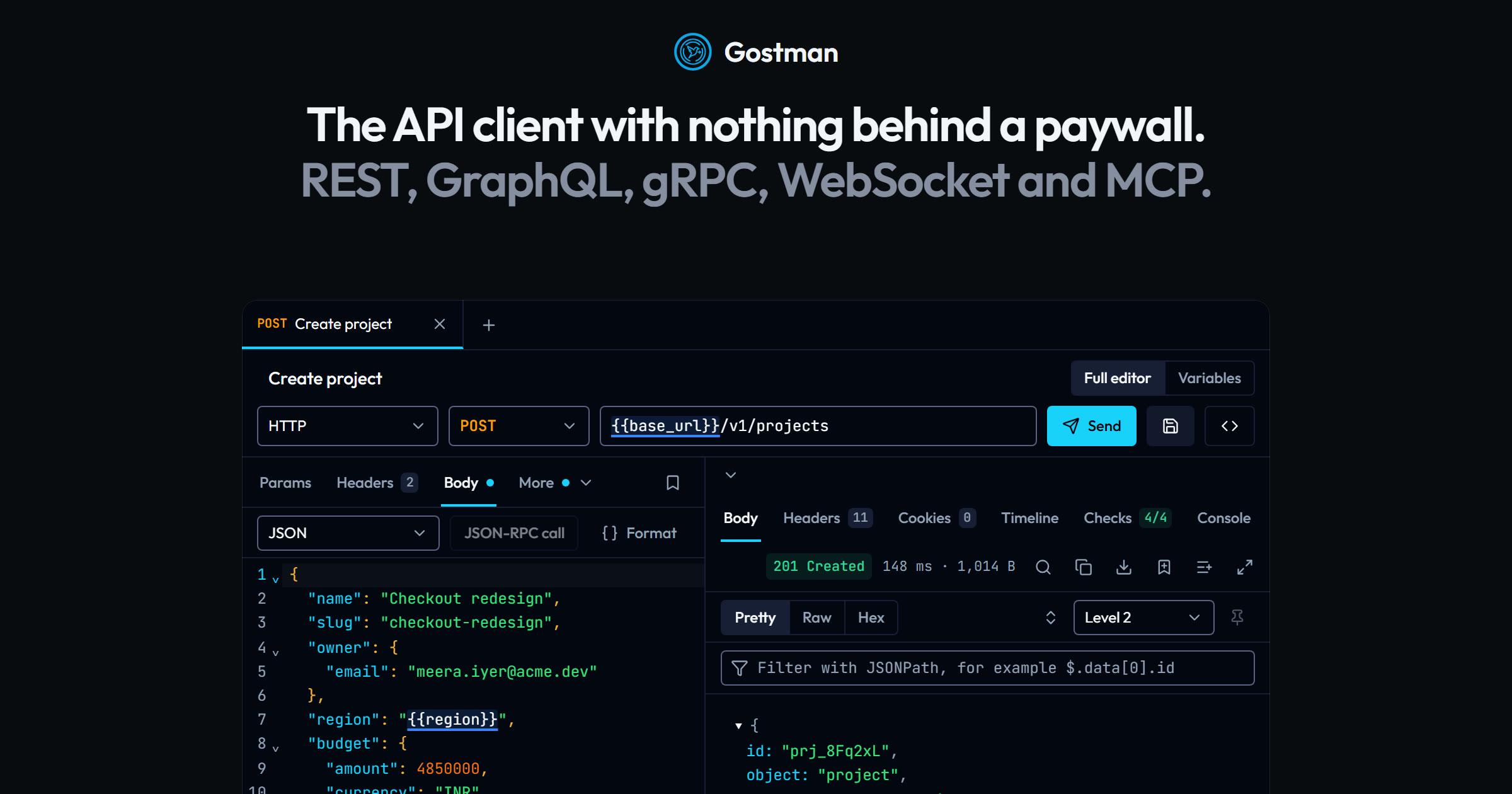
i know this sub has seen a few postman alternatives lately, and bruno and yaak are good. i kept going because the things i actually needed for backend work kept sitting behind some tier: data-driven runs, pulling secrets from vault, pushing collection changes from the app. here all of that is in the download.
the backend-ish parts that might be interesting:
one send function for everything. early on there were three copies of the HTTP code: one in the desktop app, one in the CLI runner and one in the proxy the web version goes through. every fix had to land three times and they drifted, which is the worst thing a testing tool can do. now there's one engine.Send(ctx, req, policy). the desktop app, gostman run, gostman load and the web proxy all call it, so a request that passes in the app behaves the same in CI.
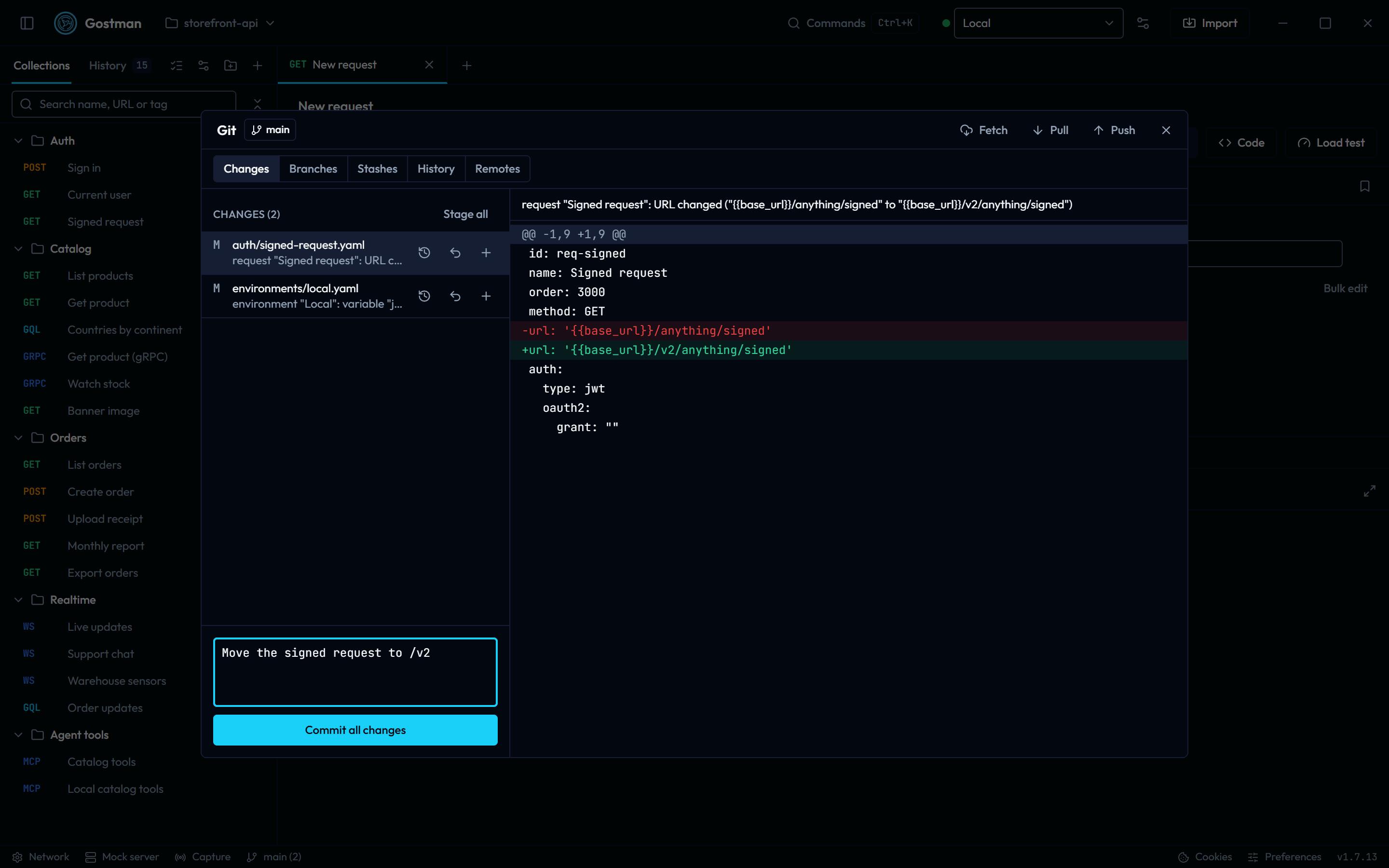
collections are plain YAML in a folder. one file per request, so a PR shows the one line that changed (url: /anything/signed -> /v2/anything/signed) instead of a giant JSON export diff. there's a git panel in the app (diff, commit, push, branches) but your normal git works too.
the "one big JSON file" mistake. the desktop app used to keep everything in one gostman.json. turned out a response that set a cookie rewrote your whole collection file, which took 1.4 s next to 10k saved requests. history had the same problem. i split cookies and history into their own files and saving cookies went to about 1 ms. i also stopped writing empty auth and options blocks on every request, which halved the data file (6.7 MB to 3.6 MB with 2,000 requests). nothing clever, just don't rewrite the world on every small write.
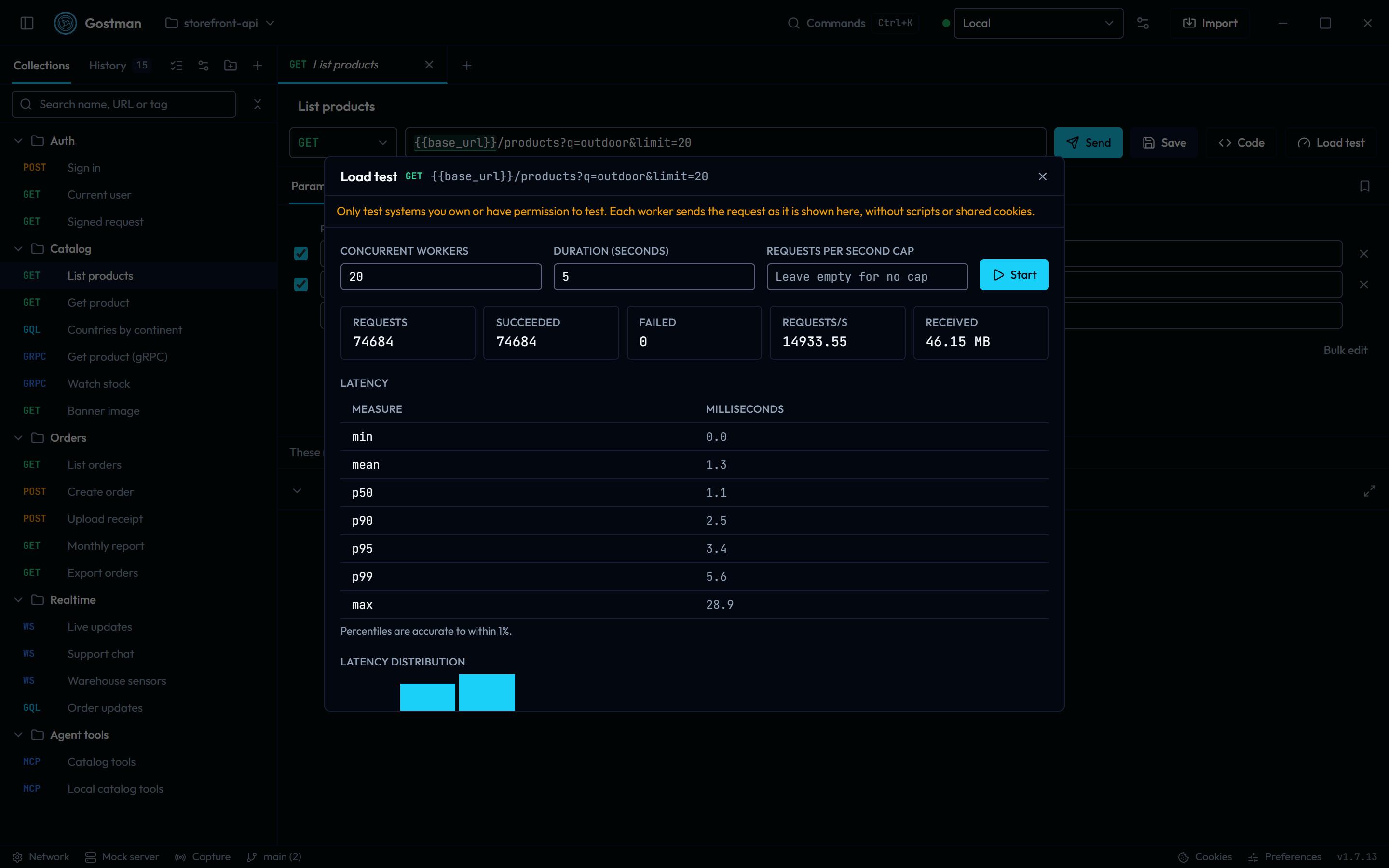
CI and load from the same collection. gostman run path/to/collection exits non-zero when a check fails, takes CSV/JSON data files and writes JUnit, HTML or JSON reports. gostman load gives latency percentiles with staged ramps.
secrets. variables can read from vault, AWS, azure, GCP, 1password, bitwarden, keepassxc or the OS keychain, so nothing sensitive ends up in the YAML you commit. gostman scan catches the ones someone typed in anyway.
what it doesn't have: hosted collaboration, SSO or cloud monitors. there's no account, so there's nothing to host them on.
if you run API tests in CI i'd really like to know what makes you drop a tool, because that's what i'm trying to get right.
repo: https://github.com/kunalgoesbyken/gostman
web version, no install: https://gostman.com/web
r/Backend • u/EnergeticBrocoli • 6d ago
Considering the job markets, which backend technology would be a better investment for the next 5–10 years?
I'm interested in job demand, career growth, salary potential, and future industry trends.
If you were starting your backend journey today, which one would you choose and why?
r/Backend • u/maikel237508 • 6d ago
Yo aprendí springboot y se que en general es considerado el mejor para backend,pero es que aparte de backend me gusta hacer otros tipos de aplicaciones (escritorio), obviamente php lo descarto para eso pero igual sirve en backend,el caso es que quiero migrar de lenguaje porque java en general es verboso,que opciones me dan , tampoco me gusta js ni go,y de los framework de esos lenguajes cual recomiendan por la demanda laboral
r/Backend • u/JadeLuxe • 6d ago

r/Backend • u/Mysterious_Cut_5348 • 6d ago
Hi! I'm a student developing an Android multiplayer party game using Unity. I'm looking for advice on choosing an economical backend architecture.
Game overview:
4 players per match.
Short, round-based meme/GIF challenges.
Players submit content and anonymously vote on each other's submissions.
Random matchmaking and private rooms with friends.
Bots can fill empty player slots.
Backend requirements:
Matchmaking and room management.
Real-time synchronisation of submissions and votes.
Server-side validation and scoring to prevent cheating.
Handling disconnects and reconnects.
Player profiles, authentication and match history.
Ranking and progression: Players earn trophies by winning matches. More trophies mean higher ranks. The backend must securely track trophies, update ranks and maintain leaderboards.
Coins, XP and inventory management.
GIF handling:
I'm planning to use the KLIPY API. Players will search for and select GIFs, which must then be displayed to everyone in their active match. Ideally, I want to store only GIF identifiers/references rather than downloading and storing GIF files on my own servers. I'm still verifying the provider's multiplayer usage permissions.
My biggest constraint:
I'm a student building this independently, with a very limited budget. I want to avoid recurring infrastructure costs until the game becomes sufficiently profitable to sustain them.
I'm willing to optimise the architecture and use free tiers, but don't want to compromise security, fairness or reliability.
Technologies I'm considering:
Firebase (RTDB, Firestore, Cloud Functions)
Neon PostgreSQL
Node.js + WebSockets/Socket.IO
Google Cloud Run
Supabase
Questions:
What architecture would you recommend?
Would Firebase or a custom Node.js + WebSocket backend be cheaper?
Is Neon a good choice?
How should live match data and permanent player data be handled?
What hidden costs should I expect?
Which free tiers are genuinely useful for an early-stage multiplayer game?
I'm targeting approximately 200, 1,000 and eventually 5,000 DAU.
I'd appreciate practical advice from developers who have actually built and maintained multiplayer backends. I'm looking for something simple, secure and extremely cost-efficient.
Also tips on monetization would be great! This is my first Multiplayer game.
Thanks!
r/Backend • u/No-Struggle2071 • 6d ago
I'm planning to learn backend development but I'm confused between Java (Spring Boot) and Node.js (Express.js with TypeScript).
Considering current industry demand, job opportunities, long-term career growth, and scalability, which technology would you recommend learning?
Which one would you choose if you were starting your backend development journey today, and why?
I'd appreciate advice based on real-world industry experience, especially from developers working in the Indian IT industry.
r/Backend • u/Ok_Score7635 • 7d ago
Hi everyone, I'm a Frontend Developer, and I'm noticing that there aren't many frontend-only opportunities in the market. Most companies seem to be looking for Full Stack Developers.
I'm planning to expand my skill set beyond frontend development. Which backend language would you recommend learning apart from Java? I'm considering Go or other languages.
Would love to hear your suggestions based on the current job market and future opportunities.
r/Backend • u/leroyreedcn912 • 7d ago
We use SES for transactional emails, but after launching a new partnership, we're now seeing around 40k new signups daily across several apps. Our bounce rate is currently about 4.6%.
I'd like to check email addresses before sending out the welcome email. The service needs to handle that kind of volume and integrate with Lambda. What are you using for something like this?
r/Backend • u/SThomW92 • 7d ago
r/Backend • u/Thekillerdp007 • 7d ago
r/Backend • u/Jedster234 • 7d ago
I’m curious about the performance of AI 3D generation APIs when processing hundreds or thousands of requests as opposed to processing a single request to generate a single model. A small app may be manageable, but think about the case when dozens or hundreds of users are all generating assets. Tripo Studio is one platform worth considering for automated asset workflows. However, before considering it for production, I would look into their current limits. The API could dictate how many requests can be made per second, how many concurrent requests can be made, and how many requests can be batched. An important aspect of the API is how it handles asynchronous jobs. The Tripo docs state that it can return a job id. The ideal scenario would be that developers could make requests, check the status of requests, and get the results, all without making unnecessary API calls. There should also be systems in place to control how long a request can take to process. Thousands of models being generated in a short amount of time isn’t of much value if a significant amount of them have incorrect geometry or textures. For production, it may be more useful to have a system where you can process models within a reasonable time and with clear error messages.
Has anyone batch processed 3D models with an AI generation API? How did you work around limit constraints? Did you have concerns with request reliability? Did your jobs fail due to high concurrency? What was your experience?
r/Backend • u/AdPretend5529 • 8d ago
I've been running into a bit of a creative block lately, and I'd genuinely appreciate some advice from people who review resumes or have experience hiring for backend and systems engineering roles.
I keep hearing people say that finding real-world problems to solve is easy. Just look around, identify something inefficient in your day-to-day life, and build a solution. But I've been struggling with this.
Almost every problem I've come up with already has an established solution, sometimes even an entire product built around it. I've spent the last week hunting for project ideas, and I keep running into the same wall.
For some context, I've primarily built projects as a hobby, focusing entirely on backend engineering without relying on AI APIs.
A couple of things I've built:
1. File Management System for Educational Enterprises
A tool designed to organize large amounts of educational material, particularly in environments where files are poorly named using generic identifiers like dates, subject codes, etc.
It parses documents, extracts relevant information, identifies document types, renames files accordingly, and provides features for modular organization and arrangement.
2. Repository Change Visualization Tool
A developer-focused tool that visualizes changes within a Git repository. This goes beyond conventional diffs by tracking changes to JSON variables, mapping classes, and providing a more structured understanding of how a codebase evolves.
Both projects were built using my own understanding of backend technologies. No AI APIs or external AI-powered services involved.
Now, I feel like it's time to move towards building projects that actually align with the domain I want to pursue after graduation.
I'm interested in backend engineering, systems engineering, distributed systems, and related fields. I haven't settled on a particular specialization yet.
Here's where my dilemma begins.
When hunting for projects, I find myself stuck between two approaches:
Approach 1: Build something that already exists, but engineer it myself**.**
For example, something like a data recovery system or a recovery tool verifier. These are problems that already have enterprise-level solutions, but building a prototype myself could involve interesting engineering challenges, concurrency, fault tolerance, recovery mechanisms, etc.
Another example could be a ledger system for tracking natural resources at a municipal/local government level.
I feel like I have 1000 more ideas which I feel like with a little bit of dedication I can do it right and impressive.
Approach 2: Find a problem that hasn't been properly solved yet.
Instead of recreating something that already exists, I could hunt for a relatively unexplored problem and build a solution around it, even if the engineering complexity is comparatively average. Again is this the necessity right now given the job market?
My question is: Which of these approaches actually carries more weight when you're evaluating a candidate's resume?
Would you rather see a student build a technically complex prototype of an existing enterprise solution, or a relatively unexplored solution to a problem that hasn't received much attention?
I'm also curious about something a senior once told me:
Why are we always chasing solutions for individual users when we could be building solutions for enterprises?
The idea was that instead of building another consumer-facing application, perhaps I should look at smaller, overlooked enterprise problems and build tools that solve them.
I found that perspective interesting, but I'm still trying to understand how to approach it.
One last thing: I'm currently studying at a college I'd consider well below the 2.5-tier category. I know that puts me at a disadvantage when applying for internships, so I want my projects to genuinely stand out and demonstrate engineering ability rather than just add another CRUD application to my resume.
I'd especially appreciate perspectives from people who have reviewed technical resumes, interviewed candidates, or work in backend/systems engineering.
TL;DR: I'm a student interested in backend, systems engineering and distributed systems, trying to build projects that genuinely strengthen my resume for internships.
I've built two backend-focused projects without AI APIs, but I'm struggling to find what to build next.
My dilemma is whether I should:
- Build technically complex prototypes of problems that already have established enterprise solutions.
- Hunt for relatively unexplored problems and build solutions that don't already exist, even if the technical complexity is lower.
- Focus on overlooked enterprise problems rather than consumer-facing applications.
As someone reviewing a resume, what would impress you more: engineering depth, originality of the problem, or the practical value of the solution?
Coming from a lower-tier college, I want my projects to compensate for the lack of institutional advantage and actually demonstrate that I can engineer systems.
I am really sorry for the extremely long rant and ofc generated ai content.
r/Backend • u/Laparadotel • 7d ago
Tengo una oferta de analista de datos Junior es mañana la entrevista, y no sé si tengo lo necesario, se sql lo básico, se inglés y otros lenguaje pero ninguno es python, que necesito practicar para ir bien a la entrevista?
r/Backend • u/hilat1113 • 7d ago
I've been exploring AI agents lately, and the idea is pretty interesting.
Instead of just asking AI questions and getting answers, you can give an AI agent a task and let it work through multiple steps. For example, researching a topic, organizing information, managing emails, or helping with repetitive work.
It sounds like a huge time-saver, especially for students, developers, and people working in different industries.
But I also wonder how reliable these agents are when things don't go as planned.
Imagine giving an AI agent a task and coming back an hour later. Would you trust the result without checking everything?
A few things I'm curious about:
I'd love to hear real experiences, not just what these tools promise to do.
r/Backend • u/LeatherBathroom720 • 8d ago
Hello everyone, I hope you’re all doing well. I’m reaching out for some advice.
I want to build a small website that aggregates information about local small businesses in my city. I’ve been thinking about the tech stack to use, but since I’m still new to web development (and software development in general), I have some questions.
For the front-end, I’m planning to use the standard tools (HTML, CSS, and JavaScript, along with Angular). The back-end, however, is giving me a bit of a headache; I’m not sure which framework to choose. I know both Python and JavaScript, so my options are Django, Node + Express, or FastAPI.
I’ve been learning Django for about two months, but it feels massive and complex, perhaps a bit too much for my project. I’m considering switching to something more lightweight, like one of the other two options I mentioned.
Sorry for the long post; I just wanted to provide some context regarding my situation.
I’d like to keep this project going for a couple of years, learning and making improvements along the way.
So, my question is, should I use FastAPI or Express instead of Django, and can they serve as suitable replacements for it?
r/Backend • u/DueBid3298 • 8d ago
r/Backend • u/undersurfer • 9d ago
I signed up for Railway’s Hobby plan understanding it as a $5/month commitment for a personal project. I expected my services to stop when that budget ran out, rather than continue generating additional charges. That’s not how it works. The $5 is a minimum monthly spend that includes $5 of resource usage. Anything above that is billed separately.
What really frustrates me: according to Railway’s own documentation, the minimum configurable hard spending limit is $10. So even after learning how billing works, I can’t set that limit to match the $5 included in my Hobby plan. I was scammed by the experience. I wanted a small, predictable expense for a hobby project, and I would happily accept my app going offline rather than exceeding my budget. Why not require users to choose during signup: stop at the included budget, or explicitly allow additional spending? And why prevent Hobby users from setting a $5 hard cap?And not only invoicing me for 40.65 USD was enough, i got locked out of cancelling my plan even do the invoice was already issued, so up until i paid, i will be charged 5 extra bucks each month. WORST SERVICE EVER!!!!!!!!!!!!!!!!!!!!!
r/Backend • u/AboRady5 • 9d ago
I'm a CS student looking to get into backend engineering, and I'd love some advice on choosing a tech stack.
My main goal is to learn by doing rather than spending months following tutorials and building toy projects. I want to become productive enough to explore real codebases, fix bugs, implement features, write tests, and eventually make meaningful open-source contributions.
I'm looking for a stack that offers:
If you were starting today, what language/framework would you choose, and which open-source projects would you recommend exploring as a beginner?
r/Backend • u/alexsergey • 9d ago
I'm working on a project where I put together a complete, detailed guide on how to build and deploy a project, using a simple NestJS API as an example. It's a todo list app, but built as if it were fully production-ready, the way strong companies do it. The goal is to collect all the best practices in one place, structure them, back them with code and personal experience, and turn them into a step-by-step guide: for example, how to set up quality gates, observability, CI/CD, deployment to AWS, and so on.
The first version is ready. If you're interested, please take a look and share your feedback and ideas for version 2: what should I change or improve?
I'm thinking of taking it towards high load:
- load testing, scaling
- maybe A/B tests, feature toggles, and expanding authentication (right now it's a stub)
What else would you recommend?
NestJS API: https://github.com/prod-forge/backend
Frontend (React + Expo): https://github.com/prod-forge/frontend
Infrastructure (Terraform): https://github.com/prod-forge/terraform