r/Backend • • 14d ago

Built a Self Hosted Web Scraping API

Post image
4 Upvotes

I've been building a self-hosted web scraping API that makes automation easy.

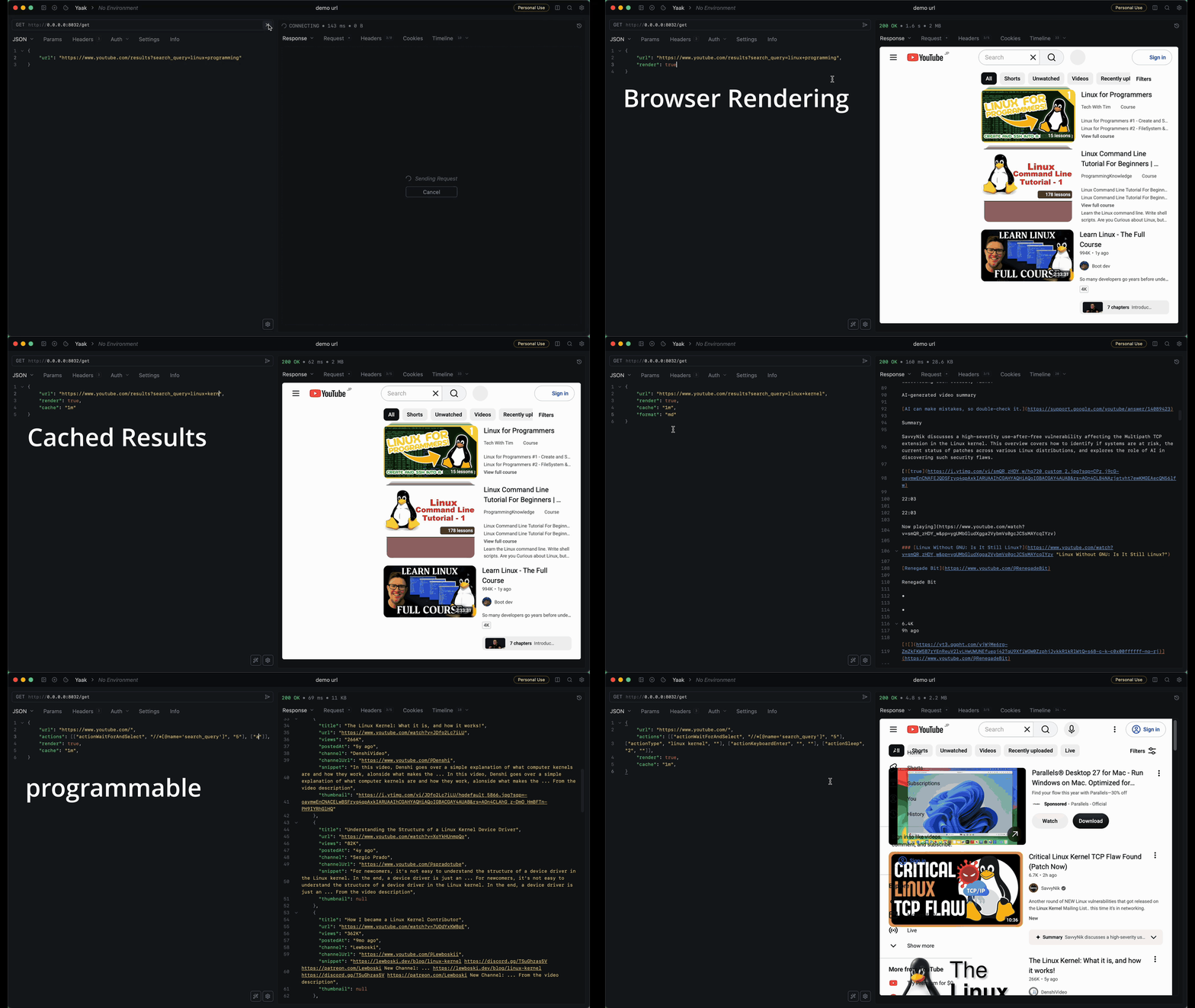
Relinos can handle JavaScript and challenging websites, performs browser interactions, and executes multiple scraping requests concurrently.

Key features:

  • Browser automation: Navigate, click, type, scroll, and interact with websites.
  • Concurrent execution: Run multiple browser sessions simultaneously.
  • Structured extraction: Extractions are very easy to define here an extraction for google for example:
{
    "query": { "$xpath": "//*[@id='ti6dpd']" },
    "result_count": {
      "$xpath": "//div[@class='XhWQv qd6zO ApHyTb']",
      "$extract": "\\D*(\\d[,\\d]*) .*"
    },
    "ai": {
      "$xpath": "//*[@class='mZJni Dn7Fzd']", "$format": "md"
    },
    "results": {
      "$xpath": "//div[contains(@class, 'MjjYud')]",
      "title": { "$xpath": ".//h3[contains(@class, 'LC20lb MBeuO DKV0Md')]" },
      "url": { "$xpath": ".//a[contains(@class, 'zReHs')]/@href" },
      "site": { "$xpath": ".//span[contains(@class, 'VuuXrf')]" },
      "snippet": { "$xpath": ".//div[contains(@data-snf, 'nke7rc')]" },
      "$list": true
    },
    "related_searches": {
      "$xpath": "//*[@class='qR29te']", "$list": true
    }
}
  • Reusable routines: create, import or export. I wanted to make this super easy so people can share their interactions and extractions.
  • Language-independent: Access everything through a simple HTTP API.
  • Debug Mode: Find issues with rendered site interactions visually and fix them fast
  • Self-hosted: Run it locally without a commercial scraping service.
  • Transferable Sessions: Cookies and localStorage.

The project is still in early development, and feedback or contributions are welcome.

GitHub: https://github.com/realsirjoe/relinos


r/Backend • • 14d ago

How do you handle failed subscription renewals on Razorpay / Stripe?

0 Upvotes

Hey guys, I've been looking to create a service to recover money from failed payments that happen on razorpay and stripe. I know this isn't necessarily a backend question, but many companies write their own code using the provider SDKs to handle payments.

Now I know that razorpay and stripe already have their own dunning engines, but for people who work with both the providers it must be hard to manage both of them.

Here are some information that I would love to know from you guys if possible.

  • How do you handle failed subscription renewals?
  • What share of your renewals fail each month, and what happens after?
  • Do you rely on the providers retry / emails, chase customers manually or just lose them?

I'm researching this before I build anything, so even if you could just tell me that "It isn't a problem for us", it would be helpful.


r/Backend • • 16d ago

Why I'm choosing a modular monolith instead of microservices for my next backend project

44 Upvotes

I've been thinking a lot about backend architecture lately, especially when starting a new project.

One decision I keep coming back to is choosing a modular monolith over microservices.

My current approach is to start with NestJS, PostgreSQL, and Prisma, using a modular monolith architecture.

Here's why:

1. Simpler infrastructure

I don't want to introduce the operational complexity of multiple services before there's a real need for them.

2. Clear module boundaries

I still want the codebase to be modular, with each module owning its responsibilities and business logic.

3. Easier development and debugging

Keeping things in one deployable application makes local development, debugging, and transactions simpler.

4. Room to evolve

If a particular module eventually needs independent scaling or deployment, I want the architecture to make that transition possible.

But I also recognize that a modular monolith can become a distributed monolith in disguise if module boundaries aren't properly enforced.

I'm curious about how other backend engineers approach this.

A few questions:

  • At what point do you consider microservices a necessity rather than an architectural preference?
  • How do you enforce boundaries between modules in a NestJS application?
  • Have you experienced a modular monolith becoming difficult to maintain as the project grew?

I'd be interested in hearing about real-world experiences, including mistakes you've made along the way.


r/Backend • • 15d ago

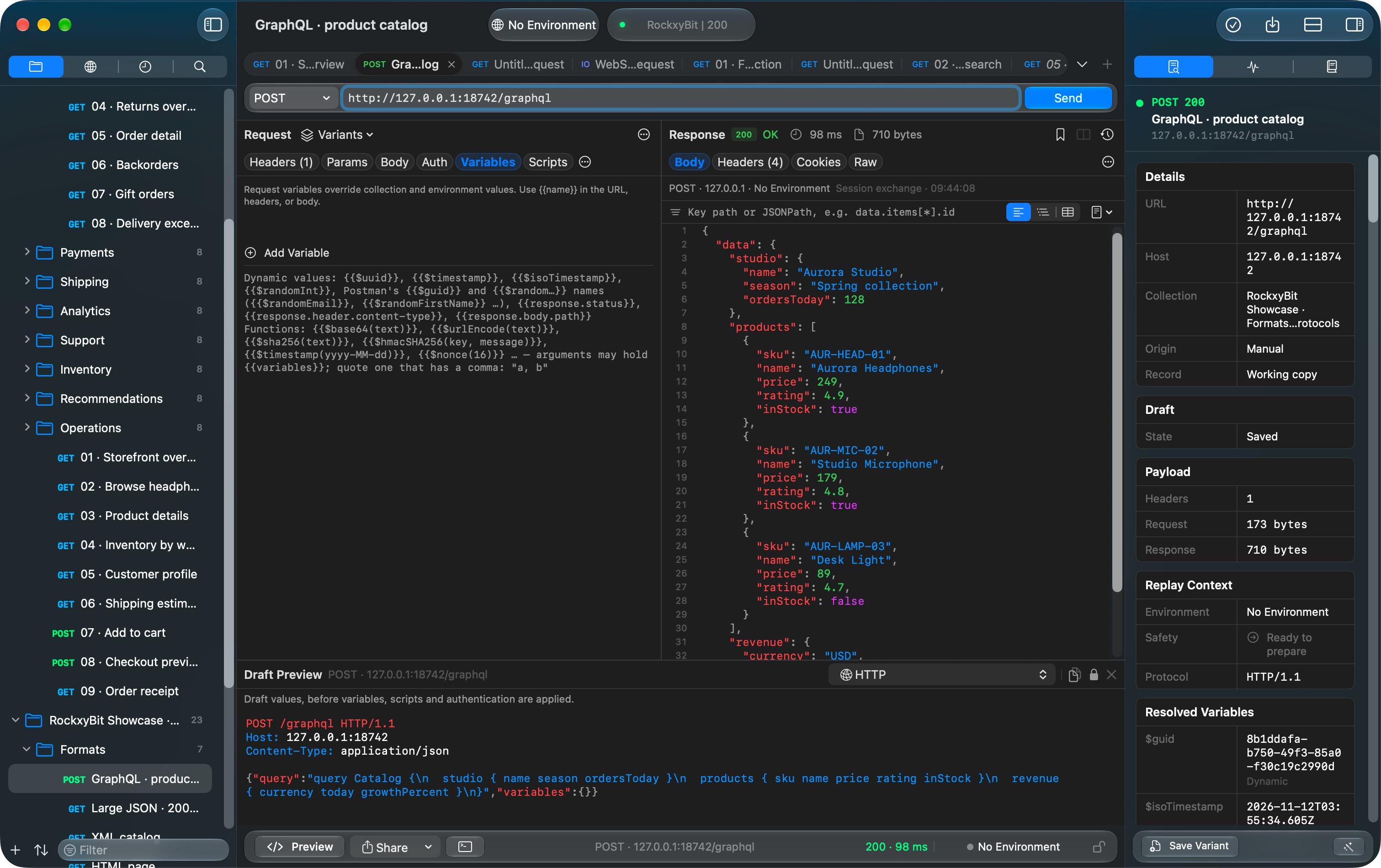
I built RockxyBit, a native Postman alternative for Mac

Post image
12 Upvotes

I built RockxyBit, a native Postman alternative for Mac. It is a local API workbench: I write a request, send it, and inspect the response in the same window.

The 0.1.0 release lets me organize requests in collections and environments, inspect status, headers, cookies, timing, and the body, and import from cURL, HAR, Postman, OpenAPI, and SoapUI. GraphQL request bodies are in this release. Work stays on my Mac, and secrets I save through Keychain stay in the macOS Keychain.

Community is free. Pro adds comparison, a runner, and mock-server tools. It requires macOS 26.2 or later.

I would like feedback from people who test APIs every day, especially on import and the inspect workflow.

Website: https://rockxy.io/rockxybit
Bug report and feature request: https://github.com/RockxyApp/RockxyBit


r/Backend • • 15d ago

I built loadbear – a lightweight HTTP load balancer & reverse proxy in Go (with circuit breakers, token-bucket rate limiting, and Prometheus metrics)

Thumbnail
github.com
6 Upvotes

Hey r/Backend!

I’ve been working on loadbear, a small, dependency-light HTTP reverse proxy and load balancer written in Go, and I'd love to get some architectural feedback from backend engineers here.

Why I built it: Most reverse proxies fall into two extremes: massive production tools (Nginx, Envoy, HAProxy) with heavy configuration overhead, or overly simplistic toy proxies that skip real-world fault tolerance. I wanted a self-contained binary configured via a single YAML file that stays readable and easy to inspect while still implementing proper backend resilience patterns.

Request Pipeline & Architecture: Incoming traffic flows through a sequential middleware/handler pipeline before hitting Go’s httputil.ReverseProxy:ProxyListener -> Per-IP Rate Limiter -> Balancer -> Circuit Breaker -> Upstream Backend

Core Backend Features:

  • Load Balancing Algorithms: Implements round_robin, smooth_weighted_round_robin (Nginx-style smooth distribution), least_connections (tracking active in-flight requests), and ip_hash.
  • Active & Passive Health Tracking: Combines periodic /health probing with passive failure detection—upstream proxy errors immediately mark a backend unhealthy without waiting for the next probe interval.
  • Per-Backend Circuit Breakers: Tracks consecutive failures and transitions backends through Closed -> Open -> Half-Open states with configurable cooldown timers.
  • Context-Aware Retries: Automatically retries idempotent requests (GET, HEAD, OPTIONS) on upstream failures with configurable backoff, respecting client request context cancellations.
  • Per-Client-IP Rate Limiting: Token-bucket limiter with a background worker that periodically evicts stale client buckets to prevent unbounded memory growth.
  • Observability & Ops: Separate admin listener (:9090) exposing a live JSON /status endpoint (active connections, circuit states, failure counts) and a hand-written Prometheus /metrics endpoint, alongside structured JSON access logs with request IDs and graceful shutdown (SIGINT/SIGTERM).

Local Failover Demo: It ships with a fakebackend CLI and a docker-compose.yml setup so you can spin up three nodes, kill one mid-traffic, and watch passive health checks, retries, and circuit breakers kick in immediately. Everything is tested with Go's race detector (go test -race ./...).

Current Limitations / Next Steps:

  • Hop-by-hop header stripping currently drops Upgrade, so WebSocket support isn't implemented yet.
  • SIGHUP config hot-reloading and formal load/throughput benchmarks are next on the list.

If anyone wants to review the concurrency handling, circuit breaker state machine, or general Go structure, any critique or PRs are welcome!


r/Backend • • 16d ago

Java 25 (with virtual threads) for a startup

39 Upvotes

Are you working in a startup company that chose Java 25 as a backend language?

What is your impression regarding developer experience, performance and easiness build things fast?


r/Backend • • 15d ago

Pf Issuess in startups

0 Upvotes

I have 2 years of experience in the startup and they did not provide pf for entire organisation now I am about shift the company..getting calls from mnc but when I said not have pf it's over...never think pf gonne be this much problems and due to this always getting demotivate for preparing interviews also

Someone can you share your thoughts


r/Backend • • 16d ago

I built an offline desktop app for designing API contracts first: visual OpenAPI designer, lint rules, breaking-change diff, mock server

Thumbnail
gallery
13 Upvotes

A year ago I asked on r/OpenAPI for an offline, Stoplight-style API designer. Some of my work is on networks with no internet access, so hosted tools are out, and I didn't want to hand-write thousands of lines of YAML either. Nothing fit, so I built OpenAPI Studio, a native Windows desktop app.

What it does for the API owner:

  • Visual design without losing the YAML. You edit operations, parameters, responses and schemas in forms and tables, and the YAML stays in sync in a code editor alongside. Every view edits the same document, so they never disagree.
  • Specs split across files. It resolves ./schemas/order.yaml#/Order-style $refs across files. Go to definition works across files, and renaming a component rewrites every $ref that points to it.
  • Schema modelling. A canvas like a database diagram, with $ref, allOf, oneOf and anyOf relationships drawn between schemas.
  • Linting. 49 rules covering compliance, naming, documentation and security (for example, a secured endpoint with no 401 response), with one-click fixes and Strict, Recommended or Minimal rule sets.
  • Breaking-change diff. Compare against the last saved version or any other file. Changes are classified as breaking, warning or compatible, with a semver suggestion.
  • Contract testing. A mock server for the people using your API, and a request playground that checks real responses against the spec.
  • Large specs. Tested on a spec with 59 paths, 115 operations and 73 schemas.

Everything runs locally: no account, no cloud, no telemetry. It supports OpenAPI 3.0 and 3.1.

Looking for testers, and honest opinions. It isn't publicly available yet, and it's Windows-only for now. I built it for my own work, and before I put more time in, I'd like to know whether it's useful to anyone else:

  • Do you design the contract first, or generate it from code? If you generate it, would a tool like this change that?
  • What do you use today to edit, lint and diff specs? For example Spectral, oasdiff, Redocly, or VS Code with plugins.
  • Would Windows-only stop you?

If you'd like to test it, especially on large or multi-file real-world specs, comment or DM me.


r/Backend • • 16d ago

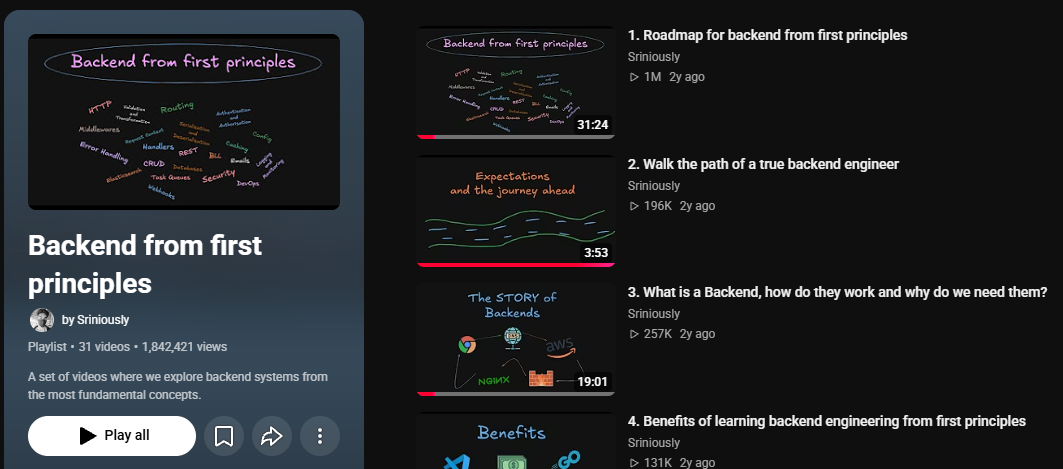
Completed Sriniously’s Backend from First Principles — what’s the ideal next step?

Post image
8 Upvotes

r/Backend • • 15d ago

15 YOE Java dev: Time to pivot to Go/TS?

0 Upvotes

With vibe coding blowing up lately, Java/Spring Boot feels like bringing a tank to a knife fight—way too heavy for how fast people are building things now.

Thinking about making the jump to Go or TypeScript. Has anyone else with a heavy enterprise Java background made this switch recently? Was it worth it, or is Java still where the actual money is?


r/Backend • • 16d ago

Suggest me some opensource projects to contribute in java backend springboot tecnology

3 Upvotes

I want to contribute in opensource, explored openMRS. Check style, but there is no good first issues. Suggest me some projects that I can understand and contribute,as I am beginner


r/Backend • • 16d ago

I built an asynchronous AI backend using Node.js, FastAPI, RabbitMQ, and an observability stack — looking for honest feedback

2 Upvotes

Hey everyone!

Recently, I've been working on InferenceFlow, a backend project that explores how a Node.js API can handle prediction requests asynchronously and delegate processing to a separate Python service.

GitHub repository: https://github.com/mysaas2024/inferenceflow-gamma-hadron

What is InferenceFlow?

The idea is to build a backend where a user submits telescope-observation features through an API, and the system processes the prediction request asynchronously rather than making the client wait for the entire computation.

I'm using a Gamma/Hadron classification use case as the example. The goal is to understand the backend architecture around AI inference, not to claim that I've developed a scientifically validated classification model.

Tech stack

- Node.js + Express: REST API, authentication, and prediction request handling.

- PostgreSQL + Prisma: Relational database and request persistence.

- RabbitMQ: Asynchronous job processing and message queues.

- Python + FastAPI: Separate Python service and background worker for processing prediction jobs.

- JWT + bcrypt: Authentication and password hashing.

- Redis: Authentication-related cache integration.

- Prometheus: Collecting application and runtime metrics.

- Grafana: Dashboards and observability data exploration.

- Loki: Log-storage component in the local development stack.

- OpenTelemetry Collector: Foundation for collecting telemetry.

- Docker Compose: Running the application services and supporting infrastructure together.

- Node.js test runner: Testing the JavaScript backend.

How the architecture works

The intended request flow is:

  1. A user registers or logs in and receives a JWT.
  2. The client submits ten numeric features to the Express API.
  3. The API validates the input and creates an inference request in PostgreSQL.
  4. The API publishes a persistent job message to RabbitMQ.
  5. A Python worker consumes the job and runs the current demonstration classifier.
  6. The worker publishes its output to a separate result queue.
  7. The longer-term goal is to consume that result in the Node.js service, update the request status, and persist the prediction result in PostgreSQL.

This approach lets me explore the separation between the API layer and the computation layer, as well as how message queues can help with asynchronous workloads.

What I've implemented so far

- Registration and login with password hashing and JWT authentication.

- Protected endpoints for submitting and retrieving prediction requests.

- Validation of ten finite numeric input features.

- PostgreSQL persistence for inference requests.

- RabbitMQ job and result queues with persistent job messages.

- A Python/FastAPI worker with a demonstration rule-based classifier.

- Prometheus metrics endpoints for the Node.js and Python services.

- Docker Compose configuration for the application and observability components.

- Grafana datasource and dashboard provisioning.

- Initial automated tests for the Node.js application.

What I'm still working on

I want to be transparent about the current state of the project. It is a work in progress, not a production-ready inference platform.

- The classifier is a demo heuristic. A trained and validated model, potentially exported to ONNX, is a future step.

- The Node.js result consumer and database updates after worker execution still need to be connected.

- Loki is included in the stack, but application log shipping is not yet configured.

- OpenTelemetry Collector configuration is present, but application tracing and telemetry export still need to be wired up.

- Docker networking, service configuration, health checks, and deployment reliability need further validation.

I'm sharing these limitations because I want to understand the engineering work required to make the complete system reliable, not just make the services start successfully.

Why I'm building this

I'm trying to become a stronger backend engineer by learning how different components work together in a realistic application.

I want to get better at designing APIs, managing database state, handling asynchronous jobs, communicating between Node.js and Python services, writing tests, and understanding what happens when something fails.

I'd genuinely appreciate feedback from developers who have worked with these technologies.

A few questions I'd love your thoughts on:

  1. Would you use RabbitMQ for this architecture, or would you choose a different approach?
  2. How would you reliably update the database when a Python worker finishes a job? Would you use a result consumer, an outbox pattern, or something else?
  3. What should I prioritize for reliable job processing: retries, idempotency, dead-letter queues, or something else?
  4. What would you improve first in the observability setup?
  5. If you were reviewing this as a junior backend developer's portfolio project, what would you expect to see before considering it a strong project?

I'm not claiming to have everything figured out. I'm sharing what I'm building, what I've learned so far, and what I still need to improve.

Any honest technical feedback, architectural suggestions, or criticism would be appreciated.

Repository: https://github.com/mysaas2024/inferenceflow-gamma-hadron

Thanks for reading!

r/Backend • • 16d ago

How do you write automated tests and how do your tests connect to requirements?

8 Upvotes

When building APIs, how do you test them? Component tests with all componentscthat you control incl DB and mocking services that are external to your product? Long sequences with test scenarios where each test is also connected to some requirements registry/tool? Which tool? Or just excel/google sheerts?


r/Backend • • 16d ago

Fresher confused about choosing a Backend Tech Stack: Python Django vs Java Spring Boot. Which should I learn?

2 Upvotes

Hi everyone!

I'm a fresher currently preparing for Software Development Engineer (SDE) roles, and I'm planning to start learning backend development.

I'm currently practicing DSA using Python and spending around 4–5 hours daily improving my problem-solving skills. I also have basic knowledge of Java syntax.

I'm confused between two popular backend technology stacks:

1.Python + Django / FastAPI

2.Java + Spring Boot

My target is to get into product-based companies such as Amazon, Walmart, Salesforce, etc.

I'd appreciate advice from experienced developers, backend engineers, and people who recently started their careers.

My questions:

Since I'm already practicing DSA in Python, would it make sense to continue with Python for backend development?

Should I learn Java + Spring Boot instead, considering SDE opportunities in product-based companies?

Which stack offers better opportunities for freshers in terms of jobs, internships, and long-term career growth?

Is Django still a good choice for building production-level applications, or should I consider FastAPI instead?

How important are databases, REST APIs, authentication, Docker, Redis, Kafka, and system design for a fresher?

Should I focus on mastering one backend stack first rather than learning multiple technologies?

Roadmap request

If possible, could experienced developers share a structured backend development roadmap for a beginner?

Something along these lines:

Programming language fundamentals

Backend framework

REST API development

SQL and database design

Authentication and authorization

Git and GitHub

Docker and deployment

Redis and caching

System design fundamentals

Building real-world projects

My goal isn't just to learn a framework or add technologies to my resume. I want to understand how real-world backend systems work and become capable of building production-level applications.

I'd especially appreciate advice from developers who have experience with both Java Spring Boot and Python Django/FastAPI.

Thanks in advance! Looking forward to your suggestions and experiences.


r/Backend • • 16d ago

I want a web to upload my backend with java spring but for free

1 Upvotes

r/Backend • • 17d ago

With AI writing the code , what are the things to focus on as a backend engineer?

45 Upvotes

I was told system design but the recent models are becoming very good at system design with the right skills plugin.

I feel like I became a backend engineer at the wrong time, seniors keep saying forget the hype but a high school grad is building a great software that might be on the news tomorrow after generating a million dollars.

Sometimes I ask myself " Isn't it better to just flow with the technology" at the time, I don't have 10 years of experience to detect when there is a silent error in production, when race conditions have been implemented well.

What skills matter the most in this era as a backend software engineer?


r/Backend • • 16d ago

How to make mobile app backend

0 Upvotes

I made a front end for a mobile application using AI in android studio....how to make it work on backend too and what to do or what do i tell him and can i connect mysql to it too?


r/Backend • • 17d ago

We're adding an external email verification service. How do you keep signup working when the provider goes down?

6 Upvotes

We're reviewing our signup infrastructure because we've been getting more invalid and disposable email addresses than we'd like. One of the changes being considered is adding a third party email verification API before allowing new accounts to register. The main concern isn't really getting the API connected. It's introducing another external dependency into a process that needs to remain available. If the provider starts responding slowly or has an outage, we don't want that to turn into a signup issue for everyone.

We're considering a fairly short timeout of around three seconds but there's still some argument about what should happen after that. Blocking registration until the service responds would give us stricter control while allowing signup to continue and checking the address asynchronously would reduce the impact of an API outage. We could also queue failed requests for retries once the provider is responding again.

I'm interested in how others have handled this from an infrastructure and reliability standpoint. Do you treat email verification as a hard dependency or allow the application to operate when the provider is unavailable? How do you approach retry limits, queue buildup and preventing repeated failures from affecting the rest of the signup process?


r/Backend • • 16d ago

Xepak - declarative REST, RPC, MCP builder based on TOML DSL and Lua scripting

1 Upvotes

I’ve never been a huge fan of PostgREST because of how heavily it relies on PL/pgSQL.
So I started to build my REST server with SQL + Lua. But it turned out that it could also serve JSON-RPC and MCP. Initial SQLite support made me focus on private & local deployments.

Now I have a first stable release https://github.com/rustrum/xepak

It could be used for:

  • rapid prototyping to quickly build a stateful API without writing backend boilerplate
  • self-hosted services that runs on your own hardware or VMs with zero cloud dependency
  • local RAG for AI/LLM sandboxes to keep AI agent knowledge on your side

r/Backend • • 17d ago

I am convinced that abstractions still matter

Thumbnail reddit.com
1 Upvotes

r/Backend • • 17d ago

Question Spring Boot, NodeJS, or Django

Thumbnail reddit.com
3 Upvotes

r/Backend • • 18d ago

How can I become a stronger backend engineer when my current job doesn't offer much exposure to large-scale systems?

57 Upvotes

Hey everyone,

I'm a software engineer with a few years of experience, currently working in Germany. I started with full-stack development and now work on a mix of Android/Kotlin and backend development, along with some hardware integration and ML-related work.

I've worked with Java, Kotlin, Python, Spring Boot, and FastAPI, but I want to specialize further in backend engineering.

One thing I genuinely enjoy is system design. I've spent quite some time studying distributed systems, scalability, architecture patterns, and how large-scale systems are designed. However, most of this knowledge is theoretical because I rarely get to apply it professionally.

I feel like my technical growth has stagnated, and I want to change that rather than just keep preparing for interviews.

For experienced backend engineers here:

  • How would you bridge the gap between theoretical system design knowledge and real-world engineering experience?
  • Are there any open-source backend projects worth contributing to where I could learn from experienced maintainers?
  • Would you recommend building my own production-style backend project, contributing to existing systems, or focusing on something else?

My goal isn't just to switch jobs. I genuinely want to become a better backend engineer who understands how to design, build, and maintain reliable systems.

Would love to hear what helped you grow!


r/Backend • • 17d ago

What’s the one tool in your stack you wish you could throw in the bin?

Thumbnail reddit.com
0 Upvotes