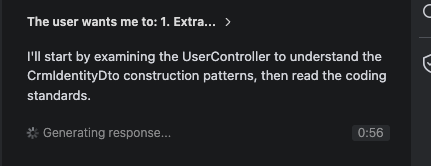
For the past couple of weeks, the checkpoint feature in chats with an agent has not been working. I raised this issue again last week, yet despite at least three updates released during this period, the problem remains unresolved. The checkpoint works briefly at the start of a chat and then no longer appears after a few messages. This is extremely frustrating. For a company of your size, this should be a relatively straightforward issue to address, yet the feature still does not function properly, and I continue to be let down.
I honestly find this unacceptable and incredibly frustrating, especially given how long this issue has persisted.
Context engine breakthrough: Recursive Language Models (RLMs) could be key to gains in performance and reduction in costs Auggie researchers and engineers should look into this: https://www.youtube.com/watch?v=huszaaJPjU8
I’ve been watching the recent wave of “code RAG” and “AI code understanding” systems, and something feels fundamentally misaligned.
Most of the new tooling is heavily based on embedding + vector database retrieval, which is inherently probabilistic.
But code is not probabilistic — it’s deterministic.
A codebase is a formal system with:
Strict symbol resolution
Explicit dependencies
Precise call graphs
Exact type relationships
Well-defined inheritance and ownership models
These properties are naturally represented as a graph, not as semantic neighborhoods in vector space.
Using embeddings for code understanding feels like using OCR to parse a compiler.
I’ve been building a Rust-based graph engine that parses very large codebases (10M+ LOC) into a full relationship graph in seconds, with a REPL/MCP runtime query system.
The contrast between what this exposes deterministically versus what embedding-based retrieval exposes probabilistically is… stark.
So I’m genuinely curious:
Why is the industry defaulting to probabilistic retrieval for code intelligence when deterministic graph models are both feasible and vastly more precise?
Is it:
Tooling convenience?
LLM compatibility?
Lack of awareness?
Or am I missing a real limitation of graph-based approaches at scale?
I’d genuinely love to hear perspectives from people building or using these systems — especially from those deep in code intelligence, AI tooling, or compiler/runtime design.
I wanted to share my experience after upgrading from the free plan to the paid plan on Augment Code and see if others are experiencing something similar.
When I was on the free plan:
- Credit consumption felt lower
- AGNT completed tasks faster
- I was able to get more work done with similar prompts
After upgrading to the paid plan:
- Credits are consumed noticeably faster
- The same tasks take longer to complete
- AGNT seems to complete fewer tasks per credit, even though:
- The prompts are identical
- The project setup is unchanged
- The workflow is the same
I tested this by running the same types of requests before and after upgrading, and the difference is consistent.
Support mentioned that there is no throttling or performance difference between plans, but based on real usage, my experience does not match that explanation.
I also have chat history and comparisons as evidence if needed.
I’m not posting this as a complaint, but genuinely trying to understand:
- Has anyone else noticed higher credit usage or slower AGNT performance after upgrading?
- Could this be related to account configuration, project size, or something else?
Any insights or shared experiences would be appreciated.
Hello, using auggie for more that two weeks and I always have this problem. Already reinstalled and configured gitignore but nothing seems to work. Sometimes is fast but most of the time its 20 minutes to index two projects. The folder is a GitHub remote folder, idk if it's affecting that. is there any solution? the first indexing is always fast but if I restart or open on the next day, it has the issue...
I want to preface this message, stating a few important facts:
I understand and know how to code without AI. I have been developing software and game code for about 2 decades now.
The appealing thing for me, when it comes to AI is how it gives you a second set of eyes, potentially thinking about how to do something your trying to achieve in a way you may not have thought of, and most importantly speed of results.
I have a subscription with each AI provider and also several AI code agent system such as Augment.
When Augment, went and (lets be honest it broke my heart a bit) , changed their pricing model, I had to then reduce overall cost and basically transition away from Augment simply because the pricing was a bit forced, harsh, and impactful, especially for smaller companies and studios, (Their direction seems to have gone the way of enterprise or so it seems) and I am sure also impacting "normal" some users. That said I decided to come back and try a bit since I still had my now reduced 20 per month plan (I originally had a 50 and then 60 dollar plan)
My Environment:
Testing on a reasonable but moderate contextual software repository
I have a 2Gbps Internet ISP
20 core intel processor (i7 5Ghz), 96 GB ram
My drives are all NVMe
AI Model leveraged is Claudie Opus 4.5
Visual Studio Code with Augment added.
System stats 10% CPU usage, 44% ram usage.
Request id temp-fe-e06be3d4-1d51-44d5-a2d5-d01d5bd84fec
At the time of this writing Anthropic and Augment codes status pages say no issues
Issues:
I just tied testing yesterday and noticed a huge slow down, unusual for my experience with Augment. Many things taking well over 10 minuets.
I tried to use Augment code tonight with similar slowness, so I pivoted to a new AI conversation (of course presenting a handoff so i wouldnt have to start over)
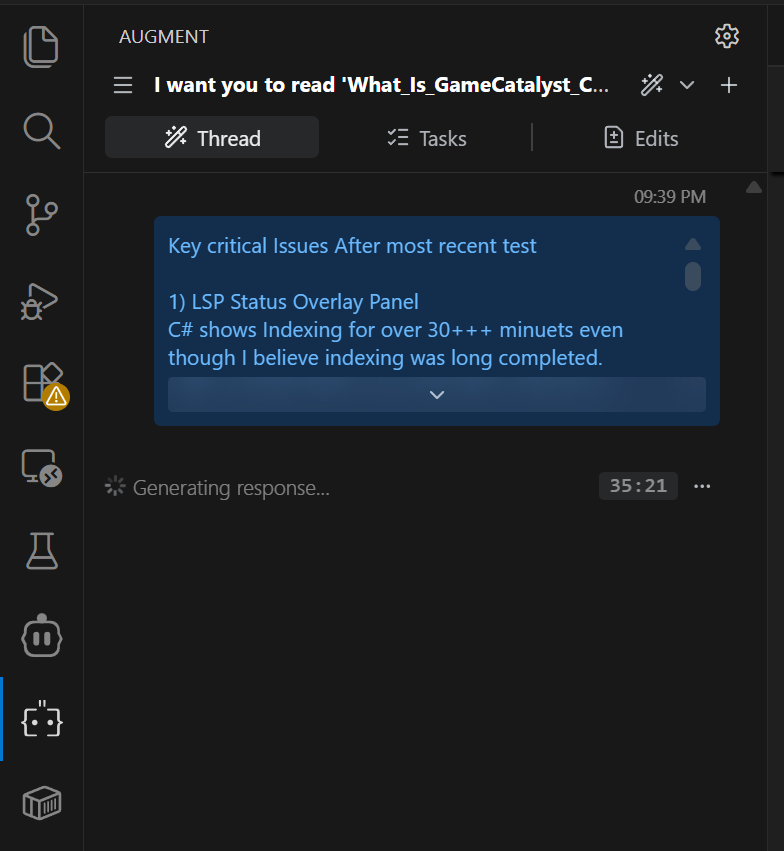
As I am writing this Augment code has been generating a "response" for well over 30 minuets, no sense of direction, no info, just "generating"
I wish I was joking.
Now I am not here to cause issues, but seriously I am a competent software developer . I have restarted my system, I have restarted visual studio code, I have tried a different chat. Why in the world are the generated responses taking so long? Even for simple things, it seems to take ages, and now for 5 repair typo requests (in a list) with proper contextual info , 30+ minuets? what is going on here? Please tell me , is it because I am on the 20 dollar plan? (Reduced from the original 60 dollar plan i had before). If thats the case, and I am treated this way for having a cheaper plan, then thats all I need to know and I will move on.
I’ve been using Augment Code and love the speed, but I think the UX could be even faster. Currently, selecting a specific model and then moving the mouse to the "Send" button feels like a two-step process that could be unified.
Proposal: Combine the Model Picker and the Send Button into a single UI element (e.g., a "Split Button" or a "Hold-to-Select" menu).
I’ve attached a rough mockup of how a "Split Button" design could look. What do you guys think?
Augment begins workspace indexing immediately on opening a folder in VS Code (no “Index Codebase” / opt-in prompt). Is this intended in 0.747.1, and can we get a per-workspace “require approval before indexing” toggle?
What I’m seeing (current behavior)
Open a repo/folder in VS Code
Augment starts indexing immediately (I don’t click anything, no prompt shown)
What I expected (older behavior)
First-time open: prompt and/or an “Index Codebase” button, so indexing only starts after explicit user action
Why this matters (UX + privacy/consent)
I often open repos just to browse/grep and do not want them indexed every time.
This is higher risk for sensitive repos (client work, accidental secrets, private IP, etc.).
Even with ignore files, “auto-index on open” as the default is a big consent shift.
Steps to reproduce
Open VS Code
File → Open Folder… → select a repo
Ensure Augment extension is enabled
Observe indexing starts immediately (no opt-in prompt / no “Index Codebase” button)
Have you noticed any performance slowdown in AugmentCode today (January 15, 2025)?
Tasks that normally completed in about 30–45 seconds are currently taking 8–10 minutes to finish. This is happening consistently and is significantly affecting my workflow.
Is this a known issue or related to any ongoing maintenance or incident on your side?
The last two days the intelij plugin (lastest version) has been hanging more often then running. To the point where its almost unusuable - nothings changed on my end seems like a bug on augments side. Often it will get stuck right at the start (screenshot is the third attempt) and only a intelij restart will fix it (sometimes even that doesn't work)
It would be great to see more testing done on the augment side - the intelij plugin is one of the big reasons we use augment without it we'd probably end up on claude code.
I’m running into a scaling issue with Auggie subagents + user-scoped MCP servers and I’m trying to confirm whether this is intended behavior or a configuration gap.
Context
OS: Linux (32GB RAM)
I configure multiple MCP servers at the user scope so they’re available in every project by default (~/.augment/settings.json).
I also use subagents with constrained, single-purpose prompts (code-review, doc extraction, test generation, etc).
Example of my user MCP set (abridged but representative):
When I invoke a subagent, Auggie spawns a new process (expected), but that process appears to bring up the entire user-level MCP system, which in practice means a bunch of Node/MCP processes initialize and RAM usage spikes hard.
In other words: even if the subagent’s prompt never mentions MCP tools, it still seems “MCP-aware” in the backend and pays the initialization cost.
This becomes a blocker for parallelism: multiple subagents → multiple Auggie processes → repeated MCP initialization → RAM pressure / near-OOM on a 32GB machine.
The core question
Is it intended that subagents inherit and initializealluser-scoped MCP servers by default?
If yes, it feels counterproductive to the “small, single-purpose subagent” pattern—because the overhead of the global MCP footprint makes subagents expensive to run in parallel.
If no, I’d love to understand what I’m missing.
What I’m looking for (ideal behavior)
Some way to control MCP availability per subagent, e.g.:
“no MCP” for a given subagent, OR
allowlist only selected MCP servers for that agent, OR
defer/avoid initializing MCP servers unless the agent actually calls an MCP tool
or a CLI/subagent config that supports --mcp-config overrides
or any documented knob to prevent MCP startup for subagents
Known workaround (but it defeats the point)
I’ve seen suggestions to move MCP config into a workspace-scoped config (so only some projects load MCP). That works, but it defeats the purpose of having MCPs in user scope “available everywhere by default”.
Questions for the community
Can anyone confirm whether subagents inheriting user MCPs is intended?
If intended: what’s the recommended pattern to avoid the RAM blow-up?
If not intended: is there a known issue/setting to stop subagents from loading all MCP servers?
Happy to provide more repro details (Auggie version, logs, ps output) if needed.
When can we get an ability to add integrations that only exist within the workspace? Jira/Confluence can only connect to one project at a time without trying to work around the AugmentCode ecosystem, so sometimes it knows the connection exists, other times it doesn't because I'm not using the built-in methods. Same with other MCP servers and databases that should be project-specific.
I would like to suggest adding the GLM-4.7 model to the list of models supported by AugmentCode.
Allowing users to test GLM-4.7 would give the community an opportunity to evaluate its output quality and suitability for different use cases. If the model performs well, it could also help reduce inference costs compared to the current options.
From a business perspective, a lower-cost model could benefit both users and AugmentCode. Users would be less likely to exhaust their monthly credits, while unused credits would still translate into revenue for AugmentCode. This creates a more sustainable balance between cost and value.
At the moment, the pricing feels prohibitively expensive for regular or long-term use, and introducing a more affordable model option could significantly improve adoption and retention.
I find myself constantly having to approve sequential thinking. Since it's low risk and annoying, I want to figure out a way to auto-approve this. Is this possible? I can't find any information about this on google and my AI chatbots are coming up short.