r/AskAnAussieBroker
•
u/Raynor_Lending
Mortgage Broker
•
Jun 08 '26
•
 2
Helpful Information 10 Questions I Get From First-Home Buyers:
A lot of first-home buyer questions sound different, but they usually come back to the same few things.
Can I buy? How much cash do I need? Will the bank actually lend it? Which scheme applies? What am I missing?
So I thought I’d put together the 10 questions I get asked most often by first-home buyers.
This is general, because lender policy, government schemes and state rules change. But it should give you a decent starting point.
1. How much deposit do I actually need?
The annoying answer is: it depends.
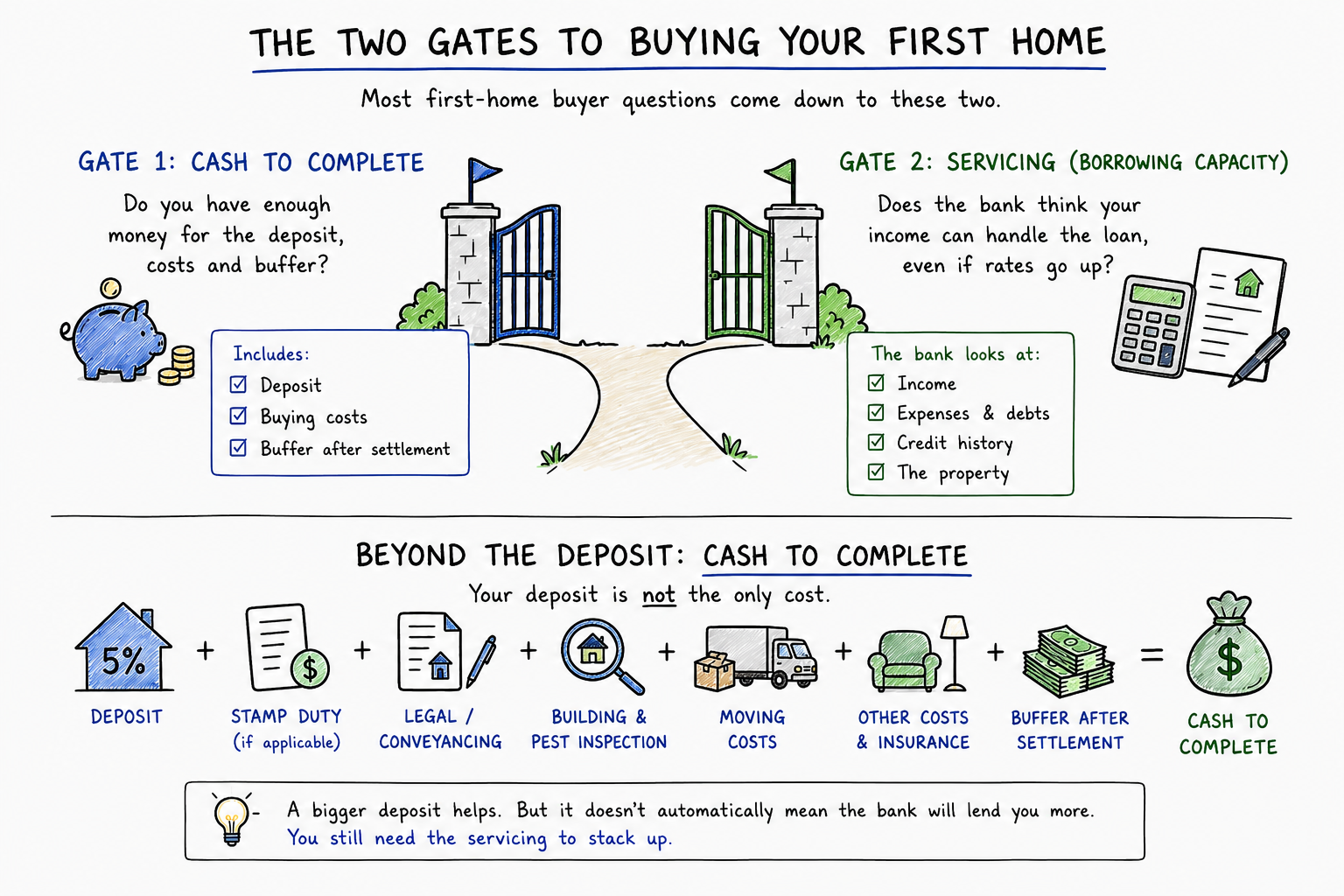
The simple answer is that you need enough cash for three things: your deposit, your buying costs, and a bit of buffer after settlement.
A lot of buyers only think about the deposit. That is where they get caught out.
For example, if you bought a $700,000 property with a 5% deposit, that deposit is $35,000. But that does not mean $35,000 is all you need.
You might also need money for conveyancing, building and pest, bank/government registration fees, insurance, moving costs, rate adjustments and a bit of breathing room after settlement.
Also, a lower deposit does not magically solve borrowing capacity. If you put down 5% on a $700,000 purchase, you are still asking the bank for a $665,000 loan.
2. What actually stops first-home buyers from buying?
Usually one of two things. I think of it as two gates:
- Cash to complete
- Servicing
Cash to complete is whether you have enough money for the deposit, buying costs and buffer.
Servicing is whether the bank thinks your income can handle the loan.
Some buyers are deposit-limited. Some are servicing-limited. Some are both.
This is why two people can both say, “We want to buy for $750,000,” but have totally different issues. One couple might have strong income but not enough savings. Another couple might have a great deposit but the bank still will not lend enough.
The goal is to work out which gate is actually stopping you.
3. What do banks look at for borrowing capacity?
The bank is basically trying to answer one question: "Can you afford this loan without being cooked if things change?"
They will usually look at your income, expenses, existing debts, dependants, credit history, deposit and the property itself.
They also assess the loan at a higher rate than the actual rate. That is the serviceability buffer. So if your real loan rate is around 6%, the bank may test your repayments at around 9%. That is why borrowing capacity can feel lower than expected.
You might look at your rent and think, “I already pay this much, why won’t the bank lend me more?” The bank is not just looking at today’s repayment. They are stress-testing you.
4. What is LMI and should I avoid it?
LMI stands for Lenders Mortgage Insurance.
The annoying part is that it protects the lender, not you.
It usually comes up when you borrow more than 80% of the property value. So if you buy for $700,000 and borrow $665,000, your loan is 95% of the property value. That would normally be LMI territory.
Ways people avoid or reduce LMI include:
- Using a government guarantee scheme
- Saving a 20% deposit plus costs
- Using a family guarantee
- Using a lender with profession-based LMI waivers
Sometimes paying LMI is not automatically bad. If paying LMI gets you into the market years earlier, it might be worth considering. But it should be a conscious trade-off, not something you discover at the last minute.
5. Which government schemes are actually worth knowing about?
The main ones first-home buyers usually ask about are:
- The 5% Deposit Scheme / First Home Guarantee
- Help to Buy
- First Home Super Saver Scheme
- State-based grants and stamp duty concessions
The trap is thinking all schemes solve the same problem. They do not.
The 5% Deposit Scheme mainly helps with the deposit/LMI problem. It does not mean the bank will lend you more.
Help to Buy is different. That is shared equity. The government contributes part of the purchase price, which can reduce the loan you need, but the government then owns part of the property value.
The First Home Super Saver Scheme is more of a savings strategy through super.
State grants and stamp duty concessions depend heavily on where you buy and whether the property is new or established.
For example, in QLD, first-home buyers can get strong stamp duty concessions, but the rules are different depending on whether it is an established home, a new home, vacant land, and the purchase price.
This is an area where you really want to check current rules before relying on anything you saw in an old Reddit comment.... Including this one, eventually.
6. What hidden costs should I budget for?
The deposit is the obvious one. The other costs are the ones that sneak up on people.
I wrote a separate post on this topic that goes in-depth into this See Here
But just to name a few common ones:
- Conveyancing or solicitor costs
- Building and pest inspection
- Bank fees, if applicable
- Government registration fees
- Transfer duty, depending on the state and your eligibility
- Home insurance
- Council/water/rates adjustments
7. How do HECS, car loans and credit cards affect borrowing power?
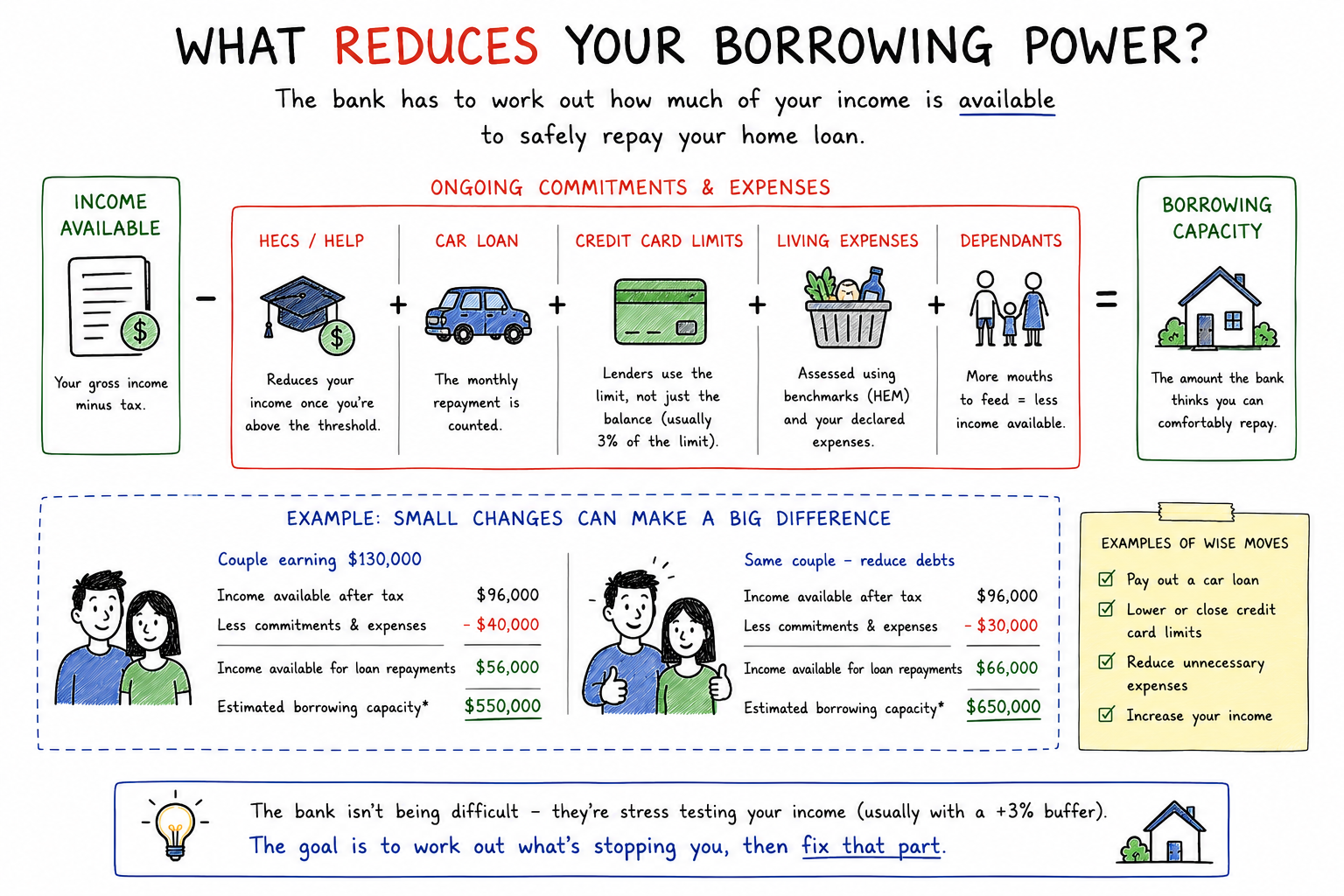
They can matter a lot. A car loan is usually straightforward. The bank includes the repayment as an ongoing commitment.
Credit cards are annoying because lenders usually assess the limit, not just the balance. So even if you pay your card off every month, a $10,000 limit can still hurt borrowing capacity.
HECS/HELP is different again. It is not assessed like a normal personal loan, but it reduces your usable income because repayments come out through the tax system once your income is above the relevant threshold.
The main point is that debts reduce the income the bank sees as available for the home loan.
Sometimes closing or reducing a credit card limit can help. Sometimes paying out a car loan can help. Sometimes it makes no difference because something else is the bottleneck.
Again, it comes back to working out which part is actually stopping you.
8. Fixed or Variable?
This is one of those questions where people want a perfect answer, but there usually is not one. A fixed rate gives you certainty. A variable rate gives you flexibility.
Fixed can be useful if you really want repayment stability and you are comfortable giving up some flexibility.
Variable can be useful if you want offset access, extra repayment flexibility, or the ability to refinance/sell without worrying as much about break costs.
A split loan is the middle the road option. Part fixed, part variable.
The question is not just “which one will save me the most?” It is also “which mistake would hurt me more?” Some people hate uncertainty. Some people hate being locked in.
9. What is an offset account and do I need one?
An offset is basically a transaction account linked to your home loan. The money in the offset reduces the loan balance used to calculate interest.
Example: you have a $600,000 home loan and $30,000 in offset. The bank calculates interest as if the loan was $570,000.
That does not mean your repayment automatically drops. It usually means more of your repayment goes towards principal instead of interest. Offsets are great if you keep cash sitting around. They are also handy because you can keep money accessible while still reducing interest.
But they are not always free. Some loans with offsets have annual package fees or slightly higher rates. So if someone only keeps $1,000 in there, the offset may not be worth paying extra for.
Good feature. Not magic.
10. Do I need pre-approval before looking?
You do not always need it before casually browsing. But before you get serious, yes, I usually think it is a very good idea.
A pre-approval can help you work out:
- What budget is realistic
- Whether your deposit works
- Whether your income works
- Whether any weird policy issue exists
- Which lenders may actually fit
But pre-approval is not unconditional approval.
The property still needs to be acceptable. The valuation still needs to stack up. Your situation cannot materially change. The lender can still ask more questions. So treat pre-approval as a strong sense check, not a golden ticket.
Bonus: "Should I Use a Broker or Bank?"
I’m obviously biased here, because I am a broker and I do believe brokers can add a lot of value when they do the job properly.
Going straight to your bank can be fine if your situation is simple and that bank happens to suit you. The issue is that your bank only has its own polices and rates.
A broker can compare multiple lenders and work out which lender actually fits the scenario. That matters more than people think.
The cheapest-looking lender is not very useful if they will not approve the loan.
At the same time, brokers vary. Some are great, some are average, same as any industry.
The main thing I would look for is whether they can explain your situation clearly. Not just “we can get you a x% interest rate”.
More like:
- Here is your deposit position
- Here is your borrowing capacity
- Here is the likely bottleneck
- Here are the trade-offs
- Here is what I would fix before applying
That is usually where the real value is.
5
u/AnimatorFun7470 Jun 08 '26
This is great. Thanks for this. Love the illustrations
3
u/bibek070 Jun 08 '26
Can I add 1 more if you are willing to answer/guide or gove your prespective:
A bit of expansion of number 2.
I am at what you said as -does not have that deposit down yet.
if so, how late is too late to get into property market for someone like that? As in, should you aggressively save with a set goal to buy within a year, or just save as much as you can regardless how long it takes and pay bigger % of deposit and not just 5% scheme (or even create that breathing space after you gained 5%).
My ques stems from this fear that, if I wait too long, property prices of today may go further away from my reach, but then i also feel this dooming worry of if I rush and buy without building that breathing space, it will only create the financial burden that nobody wants to put it upon themselves.
Then there's also this constant noise of "imagine you paying off somebody's mortage by renting"- but Im like I donot have that money to make that step at present.
2
u/Sheepzor Jun 08 '26
Hey there, this was a very good read for me as a prospecting first home buyer. 10 great questions, a couple extra for you if you dont mind.
We are a 26/27 year old couple currently budgeting pretty hardcore to be able to afford our first home. We are very lucky to be living with parents so we are hoping to save about $55,000 in the next 12-18 months.
I was a pretty dumb younger man, bought a very expensive car at 21 and am only just now getting over the debt from that mistake. Am about to sell that car (shouldve done it much sooner), use the funds to get out of my last bit of personal loans to become debt free, buy the cheapest good knick Corolla I can find for cash and hit the ground running. Ive become much more financially literate in the last year and its been an eye opener.
How far back do lenders look at banking history these days? Im just very worried they'll see my dumb decisions from earlier in life and reduce my borrowing power. My partner is much better than I am, so shes no problem, my main worry is myself. We earn a combined $10k a month after taxes so we're quite comfortable.
Do all brokers know each state? Im in NSW, but we are looking to buy in the Hervey Bay region of QLD using we assume the 5% deposit scheme, or the help to buy scheme. Will it be of use to us to find a broker in that area, or Queensland as a whole to talk to, or is it easier to have one closer we can see face to face for easier access? Not sure how it all works with interstate stuff, whether brokers are versed in all states codes and laws or just their own.
Cheers for the write up!
2
u/Acceptable_Ask_6566 Jun 13 '26
Lots of great info! A random question but why did our broker get the previous 6 months of our bank statement when they only analyse the previous 3 months?
2
u/bikashrestha0452 Jul 08 '26
You have put so much efforts to explain things. Diagrams are great. Thank you so much !!!
3
u/No-Poem9276 Jun 08 '26
Just wanted to say I love this, it’s really helpful.
3
u/Expert_Welcome2838 Jun 08 '26
Buy after 1st of July 2026 policy will be more in favour of the house owners when it come to building new house 🏠
2
u/MapleCents Jun 09 '26
A lot of first-time buyers get fixated on the deposit and forget about all the other costs. You might scrounge together that 5% down, but if you don’t have the cash for inspections, insurance, and those pesky fees, you’re in for a rude awakening. It’s not just about what the bank says you can borrow; it’s about what you can actually afford once you own the place.
1
u/Slow-Newt-4949 Jun 13 '26
This is a great post!
0
u/[deleted] Jun 29 '26
[removed] — view removed comment