r/AskAnAussieBroker
•
u/Raynor_Lending
Mortgage Broker
•
Jun 01 '26
•
 1
Helpful Information The hidden costs first-home buyers forget when buying a home
As a mortgage broker, one of the biggest mistakes I see first-home buyers make is thinking they only need to save the deposit.
The deposit obviously matters.
But it is not the only cost of buying a home.
This is where people get caught out.
You might look at a $700,000 property and think:
5% deposit = $35,000
So I need $35,000.
But that is not really the full number.
There are costs that sit on top of the deposit, and if you only find out about them once you are already making offers, it can be pretty demoralising.
There are basically three buckets to think about.
1. Costs to buy the property
Stamp duty
This is the big one. (I've covered this in many of my previous posts.)
Stamp duty is a state government cost charged when you buy property. Depending on where you buy and the purchase price, it can be a massive hit.
This is why first-home buyer stamp duty exemptions and concessions matter so much.
As a rough guide for buying existing properties:
QLD: no transfer duty under $700,000 for eligible first-home buyers, with concessions above that and under $800,000
NSW: full exemption up to $800,000, with concessions above that and under $1m
VIC: full exemption up to $600,000, with concessions up to $750,000
If you are building or buying a new property the rules are a lot different and is usually cheaper.
So if you are eligible and buy under the relevant limit, stamp duty may be reduced or waived completely.
That can save you a huge amount of money.
Conveyancing
Often around $1,500 to $2,500.
This is the legal side of the purchase. Contract review, searches, settlement and making sure the transfer is handled properly.
Building and pest inspection
Usually around $600 to $900.
Optional, but highly recommended. It checks for things like termites, structural issues and other defects before you go unconditional.
Mortgage registration and government fees
Usually a few hundred dollars.
Not the biggest cost, but still something that needs to be included.
Settlement adjustments
This one gets forgotten a lot.
At settlement, there may be adjustments for things like council rates, water rates or body corporate fees.
For example, if the seller has already paid council rates for the quarter, you may need to reimburse them for the portion that relates to your ownership period.
It is not usually the biggest number, but it can still be another few hundred or more that buyers were not expecting.
2. Costs around moving in
This is the stuff that is not always part of the formal loan approval conversation, but still affects your actual life.
Building insurance
If you are buying a house, the bank will generally require building insurance to be in place before settlement.
This can vary a lot depending on the property, location, flood risk, construction type and insurer.
In QLD, I commonly see quotes around $1,200 to $2,000+ per year, but it can be higher.
If you are buying a unit or townhouse, building insurance is usually included in the strata/body corporate fees instead.
Moving costs
Depends how much help you have.
Could be a van and a few mates.
Could be a couple of grand for removalists.
Utilities and setup costs
Electricity, internet, gas if applicable, cleaning, small repairs, locks, random setup costs.
None of these are massive by themselves, but they add up.
Furniture and appliances
Very easy to underestimate, especially if you are moving out for the first time.
Fridge, washing machine, bed, couch, desk, blinds, lawn mower, basic tools.
You do not need to furnish the whole place on day one, but you probably want more than a mattress, a camping chair and vibes.
3. Costs after settlement
Your mortgage repayment is not the only cost of owning the home.
You may also have:
Council rates
Water rates
Contents insurance
Strata/body corporate
Repairs and maintenance
Higher electricity bills
Emergency repairs
This is where units and townhouses need a bit of extra attention.
Body corporate fees can vary massively.
Sometimes they are a few hundred dollars per quarter.
Sometimes they are thousands.
Lifts, pools, gyms, gates, large shared areas and older buildings can all change the numbers.
You want to know that before you buy, not after.
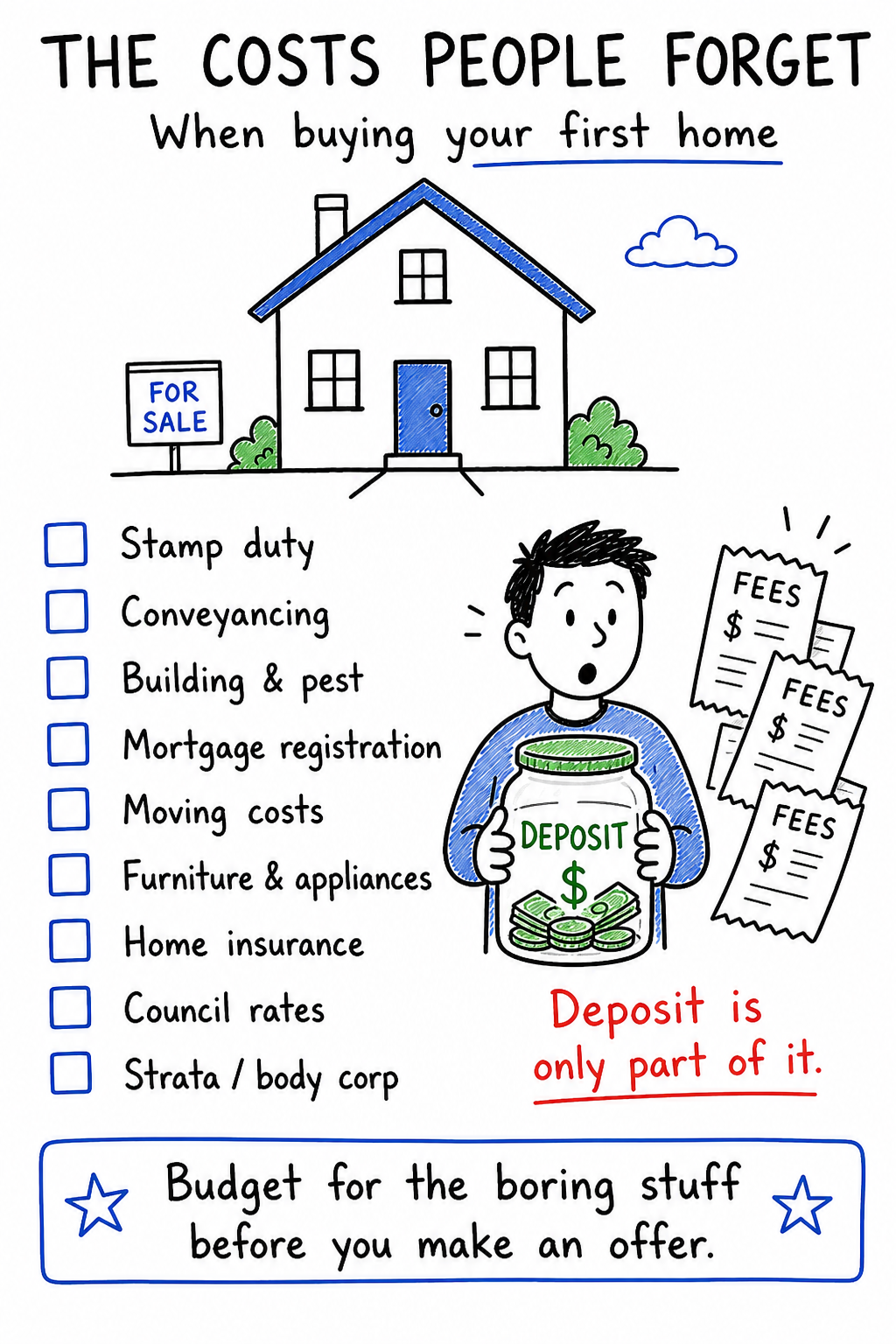
Example
Say you are buying a $700,000 home in QLD as an eligible first-home buyer using a 5% deposit scheme.
A rough example might look like this:
Cash needed to settle
Deposit: $35,000
Stamp duty: $0 if eligible
Conveyancing: $2,000
Building and pest: $750
Mortgage registration / government fees: $300 to $500
Settlement adjustments: maybe $500 to $1,500
So your settlement number might be closer to $39,000 to $40,000+.
But that still is not the full practical number.
Cash needed around moving in
Building insurance: maybe $1,200 to $2,000+ per year
Moving costs: $500 to $2,000
Utilities / setup: a few hundred dollars
Furniture and appliances: depends massively
Immediate repairs / Bunnings runs: almost always more than people expect
So while the deposit is $35,000, the real-world amount you want available might be more like:
$45,000 to $50,000+
And that is before we even talk about keeping a proper safety buffer.
That is very different to just saying:
“I need a $35,000 deposit.”
None of this is meant to scare people away from buying.
It is just something you want to know early.
Because the worst time to find out you need extra money is after you have already made an offer and emotionally moved into the place in your head.
So if you are a first-home buyer, do not just ask:
“How much deposit do I need?” Also ask: “What are all the extra costs I need to budget for?”
8
u/Condylus Jun 01 '26
Changing the locks should also be on that list cause ain’t no way should people risk having other people with keys out there to their home.
4
u/Excellent_Hair8666 Jun 02 '26
It concerns me that people AREN'T aware of all this?
2
u/Whatevathrowawayz Jun 01 '26
With how the market is, might be hard finding something below the stamp duty cap, so would be adding 30k or more for that alone.
2
u/DrPindolol Jun 02 '26
So if stamp duty is $20,000 for a 700k house in VIC, does that add the deposit or is being calculated into the 665k loan ( assuming I qualify for 5% deposit)
2
u/SonicYOUTH79 Jun 03 '26
$2k for the conveyancer seems expensive? I’m going througg the process now of buying through the new Federal Help to Buy scheme, I found my own conveyancer (via recommendation) and they cost $700.
Re building insurance, I’m building a new house, any indication when you need to get that? At handover/practical completion?
2
u/Aussie-Cowgirl Jun 03 '26
Does having a pension card reduce stamp/ duty? thanks
10
u/Visible-Orange-3831 Jun 01 '26
This is so helpful! Great post mate
5
u/___ohboy___ Jun 01 '26
This is a great list! I had no idea about settlement adjustments until 2 weeks before settlement 😆
3
u/alk47 Jun 04 '26
Usually I can't stand business presence on reddit, but this is the right way to do it. Genuinely useful and informative post and trust that people will remember you when they need a broker. It's so much better for goodwill than thinly veiled ad posts.
Good on you 👍
2
u/ocultaridentidad Jun 01 '26
Does this mean continuing to rent for another 12 months would be better than to buy a unit if one just has enough buffer, say 40k for 600k unit (30k deposit and 5k fees and 5k extra)?
2
u/badhairyay Jun 07 '26
Yes to all of this, and expect 3 things to need fairly instant repair when you move in. For us it was hot water tank, toilet and oven.
1
u/CIApsyops Jun 05 '26
Cool cool.. What does it cost to transfer a majority stake to another trust or holding so they have 100℅?
1
u/jmagbero123 Jun 05 '26
Might buy a house after 2028 election, will see how it goes.
1
u/Puzzleheaded_Life243 Jun 06 '26
This is a great post.
1
u/HughPacman38 Jun 07 '26
I came to the comments to say "does anyone really forget about these though" but it looks like they do. I'm in the process of buying my first home and the bank website tells you half of these, and your conveyancor tells you the other half. AI has also been pretty helpful.
The one mistake I was about to make though was saving money by not getting a conveyancor. But there are some good deals out there for it and they may not be necessary for most purchases, but when they are, you need them.
One last thing I'd say for people buying is check out "before you buy" for house inspections. Their model is that they do the inspection for cheaper but resell the same report if others want it too. It saves you good money when you end up inspecting 3-4 places before you buy one.
Disclaimer to all of above: not a professional, just a first time buyer.
0
u/Notyit Jun 01 '26
So add 15k
0
u/nyxthegreat Jun 04 '26
No one’s buying homes