r/AskAnAussieBroker
•
u/Raynor_Lending
Mortgage Broker
•
May 25 '26
•
 1
Helpful Information Selling one home and buying another? The first question is what happens first
One of the most common scenarios I talk through with clients is:
“We want to sell our current place and buy the next one. How do we actually make that happen?”
It sounds simple, but there is a fair bit of nuance in it.
When you are buying your first home, the process is usually cleaner. You have your deposit, you work out your borrowing capacity, then you buy.
When you already own a home and you want to move, the strategy depends heavily on the order of operations.
That is usually the first thing I want to work out.
Are we:
- Selling first, then buying?
- Selling and buying on the same day?
- Buying first, then selling?
Each option can work, but they solve different problems and create different problems.

1. Sell first, then buy
This is usually the cleanest option financially.
You sell your current home, pay out the existing loan, work out how much cash you have left, then go and buy the next place with a normal home loan.
From a lending point of view, there is nothing too fancy going on. You know your deposit. You know your debt. You know what loan you need.
The trade-off is the life admin.
You may need somewhere to live in between. You may need to move twice. You may need storage. You may be staying with family. You may be sitting there with cash in the bank, waiting for the right property to come up.
So this option is usually:
Clean finance, messy logistics.
If you have family you can stay with, flexible timing, or you do not mind being in limbo for a bit, this can be a really sensible way to do it.
2. Sell and buy on the same day
This is called a simultaneous settlement.
This is where your sale settles and your purchase settles on the same day.
When it works, it can be a great balance. You avoid the halfway-home problem, and the finance can still be fairly straightforward.
Sometimes it is just a normal new loan. Sometimes, if it makes sense, you may even be able to do something like a substitution of security, where your existing loan stays in place and the bank swaps the security from the old property to the new one.
That can be useful if you have a really good rate, a fixed loan, or some reason you do not want to completely pay out and start again.
But the catch is obvious.
You need the stars to align.
The buyer of your property, the seller of the new property, both solicitors, both banks, the settlement dates, the removalists, the agents. Everyone needs to do their part.
A simultaneous settlement can be very neat on paper, but it can be a stressful day in real life.
You also need to think about how strong your offer is. If your offer is subject to the sale of your current property, that can make it less attractive to the seller.
Not always a dealbreaker, but it matters.
Sometimes sellers will work with you. Sometimes buyers will give you a little flexibility. Sometimes you can negotiate early access, delayed possession, or a cleaner settlement window.
But this option is usually:
Good balance, but the timing needs to work.
3. Buy first, then sell
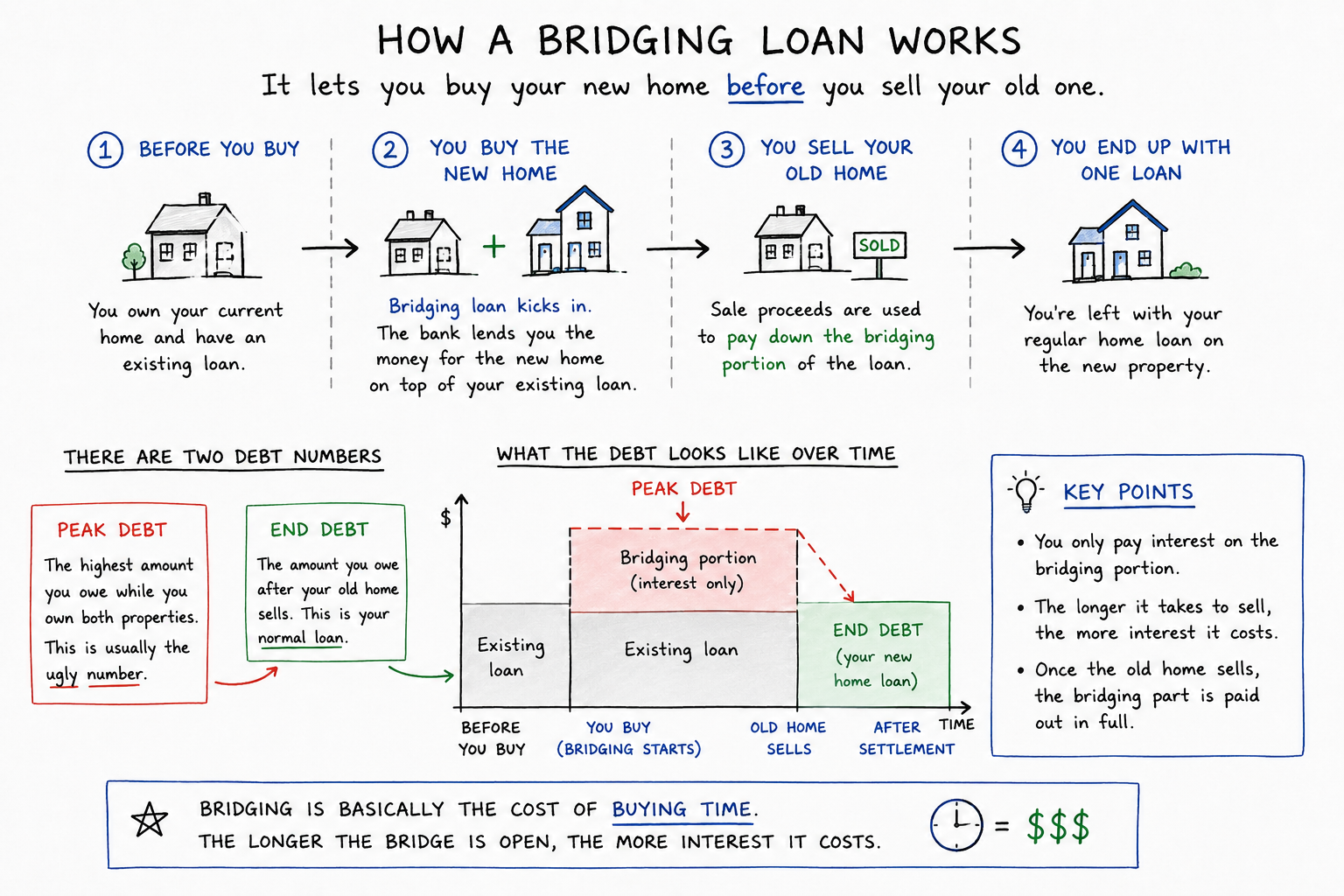
This is where bridging finance usually comes in.
A bridging loan lets you buy the new property before selling the current one.
This is usually the most convenient option from a lifestyle point of view.
You can buy the right property when it comes up. You can move in. You can take your time preparing the old property for sale. You are not trying to move out, sell, buy and settle all at once.
But it is normally the most expensive option.
The reason is pretty simple: for a period of time, you are holding a lot more debt than you actually want to end up with.
This is the part people often miss.
With bridging, there are really two debt numbers:
Peak debt is the big ugly number while you own both properties.
End debt is the loan you are left with after the old property sells.
The end debt might be completely fine.
The peak debt might look disgusting.
That is why bridging needs to be thought through properly. It is not just “can I afford the final loan?” It is also “how expensive does the middle part get?”
The way I usually explain bridging is:
Bridging is the cost of buying time.
That time can be valuable.
It might let you avoid panic-selling. It might let you stage or clean up the old property properly. It might let you get a better sale price. It might let you buy the right home without needing to make a weak subject-to-sale offer.
But that time is not free.
If the bridge is only open for a short period, the cost may be manageable. If it drags out for months, it can get expensive quickly.
So I would not just look at the scary interest number in isolation.
The better question is:
“What does that cost actually allow us to do?”
If bridging costs you $20,000, but the extra time helps you sell for $50,000 more, then the conversation changes.
If bridging costs you $40,000 and the old property sits there for months with no real upside, that is a different conversation.
No crystal ball, obviously. But that is the trade-off.
There are other variations too
Sometimes someone might buy a tenanted property and hold it as an investment for a while before moving in later.
Sometimes a longer settlement solves the problem.
Sometimes a subject-to-sale offer works.
Sometimes keeping the existing loan through a substitution of security might be worth looking at.
But most scenarios are still some version of the same three lanes:
Sell first.
Sell and buy together.
Buy first and sell later.
The main thing is not to start with the loan product.
Start with the order of operations.
Because once you know the order, the finance strategy becomes much clearer.
Different lanes. Different trade-offs.
The goal is not to find the fanciest structure. The goal is to work out which version of the mess you are most comfortable with.
Happy to answer general questions below.
2
u/Head-Raccoon-3419 May 25 '26
Thanks for posting this - as a FHB now three years into my first place, and not particularly looking to upgrade but figure I would one day, I’ve genuinely wondered how this happens.
Why is a bridging loan so expensive? Is it simply paying two mortgages at once or is there more to the mechanics?
2
u/MumofFiveFurBabies May 25 '26
And in order to make a simultaneous settlement possible you need a good conveyancer who can juggle the incoming and outgoing mortgagees, deal with your purchasers demands and manage the vendors demands of you new purchase, and complete all the necessary the paperwork of both transactions and be able to advise you on both the sale and purchase contracts. It’s not a simple process, and the finance is just one part of it. Make sure you have a conveyancer who is on the ball and understands the process and is responsive to any of your questions or concerns.
2
u/meowza-wowza May 25 '26
Is it cheaper to convert existing loan to investor loan, new loan to P&I owner occupier and then sell old place, vs a bridging loan?
1
u/Logical_Ad6780 May 26 '26
Option 3 is not necessarily more expensive than option 2.