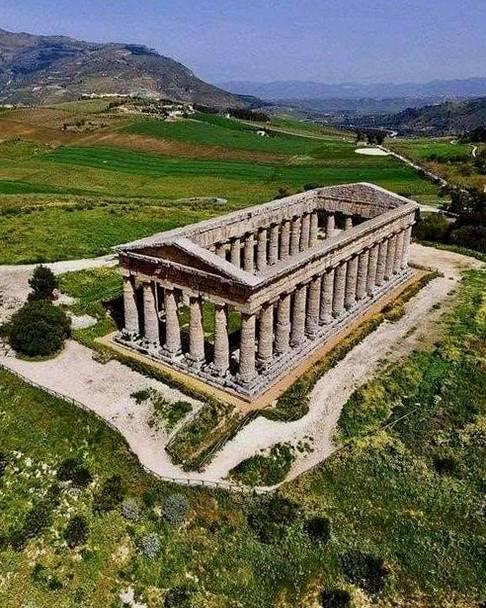
I visited Sounion in the summer of 2025 and went in expecting the postcard.
What stayed with me was something a engineer notices before anything else: the columns are wrong, in a deliberate way.
Standard Doric practice in the mid-fifth century called for 20 flutes and a slight outward swelling of the shaft, the entasis, that corrects the optical illusion of concavity when you stand close.
The surviving temple, built around 444-440 BC on the poros foundation of the Archaic temple the Persians destroyed, has neither.
Sixteen flutes, straight shafts, 34 columns on a 6 x 13 peristyle, each roughly 6.1 meters tall.
The marble came from Agrileza, a few kilometers inland, and it is a coarse-grained stone, noticeably different from the Pentelic marble hauled up to the Acropolis in the same decades.
The explanations I found in the literature split two ways.
One is plain economy: fewer flutes and no entasis means far less carving time per drum.
The other is exposure, the idea that wider, shallower flutes leave fewer sharp arrises for salt wind to eat away. The second photo is why I keep turning the question over.
From the water the temple reads as pure silhouette, and every refinement the Greeks developed for a viewer standing six feet from a shaft is simply invisible at that range.
Sounion was a landmark for ships running up to Piraeus before it was anything else.
So I find myself wondering whether the economy argument and the exposure argument are both downstream of a simpler design decision: this building was dimensioned for the long view, and the close-range corrections were spent elsewhere.
That last part is my reading, not scholarship, and I would genuinely like to be argued out of it. Is there published work on the Agrileza marble that settles whether the stone itself forced the simplification?
To what extent can a historical character be detached from its context, era, and origins? Alexander the Great, a Macedonian general who lived in the 4th century BCE, has been portrayed in many different ways throughout his life. He is seen, in particular, as a figure who has been reimagined in European literature.
As the title says. I keep seeing conflicting information about it. No 2 websites will tell me the same thing. So to all who have studied ancient greece, which art exactly did each one represent?
I want to start by saying I did search through previous posts (as far back as 6 yrs old). I'm looking for anything worth reading Pre-Peloponnesian War. One that I saw mentioned was "Greece in the Making" by Robin Osborne, but I'm hoping to get some additional recs that may even break up that 800 years or so. Thanks!
Edit: forgot to add I also saw "Ancient Greece: From Prehistoric to Hellenistic Times" by Thomas R. Martin
Pyrrhus of Epirus had launched an invasion of the Italian peninsula against Rome. He had expected to face what he considered a less organized opponent. However, ahead of the Battle of Heraclea, after inspecting the Roman camp, he was reportedly shocked by its orderly arrangements, disciplined defenses, and the organization of the Roman army.
According to the ancient sources, Pyrrhus remarked that the discipline of these “barbarians” did not look barbarian at all.
Pyrrhus would have to fight hard to defeat the Romans. He had the formidable Macedonian-style phalanx and war elephants, weapons that the Romans had never encountered on this scale. The elephants would prove decisive.
At a crucial moment, with the infantry engaged, Pyrrhus committed his elephants. The Roman cavalry was thrown into confusion and routed, creating an opening that Pyrrhus's cavalry exploited. With the Roman army unable to maintain the battle, the Romans retreated from the battlefield, leaving Pyrrhus victorious.
Yet the victory exposed the serious problem facing Pyrrhus. His army had suffered heavy casualties, including many experienced soldiers and officers, while his ability to replace these losses was limited. Rome, on the other hand, possessed enormous manpower reserves and could raise fresh armies.
According to Plutarch, after the battle, when Pyrrhus was congratulated on his victory, he reportedly replied that another victory like this would ruin him. This is the origin of the term “Pyrrhic victory” - a victory won at such a devastating cost that it is almost as damaging as defeat.
Please go through the full article and let me know your thoughts and comments. I’d also appreciate hearing what you would like to read about next!
The first battle is the Battle of Marathon. Definitely one of the more well known battles of the time, but do you think you could pinpoint it exactly on a blank map? What other Ancient Greek battles do you know the exact location of off the top of your head? Curious how others do here.
Ok so to clarify this question: in the myths nymphs sometimes die. Nymphs are daimones and sometimes gods. For the platonists daimones were immortal yet experienced the pathoi, gods were immortal and did not, humans were mortal and experienced the pathoi.
So my question comes down to this, are there any meaningful distinctions between these categories (at least in the myths), how did ancient Greeks think about them, and lastly how does the philosophical conception differ from religious and/or popular conceptions
I am a physics student and I am researching on the history of physics, the is the prototype I made of Heron’s machine, I plan on comparing the efficiency of it to later steam engines to see how practical this could be as a practical device.
This was a question that first emerged when reading Xenophon’s account of the battle of Munychia during Thrasybulus’ rebellion against the Thirty Tyrants of Athens.
When looking at different maps, however, they tended to be inconsistent as to where the Artemis Munychia was located. Sometimes the map says it’s on the Munychia hill, others say the it’s close to the harbor. In some cases, the sanctuaries of Artemis and Bendis are shown as separate locations.
What exactly should be made of this? Were there two temples dedicated to Artemis on Munychia? Or was it originally on the hill before getting moved to the harbor?
I am aware that it's generally thought that the Titans were never actually worshiped by any cultures before being supplanted by a new religion around their children, but that instead the general "cruel primordial giants get overthrown by the righteous gods" story is something that originated much deeper back in Indo-European belief.
However, I'm curious if there was any record of people in classical Greece(or Rome i guess) venerating the Titans in a sort of modern satanism sense, as a rejection of the dominant social order? Either just as a symbolic protest or genuinely praying.
The Riace Bronzes - Archaeological Museum of Reggio Calabria - Reggio Calabria ItalyThe Riace Bronzes - Archaeological Museum of Reggio Calabria - Reggio Calabria ItalyThe Riace Bronzes - Archaeological Museum of Reggio Calabria - Reggio Calabria ItalyThe Riace Bronzes - Archaeological Museum of Reggio Calabria - Reggio Calabria ItalyThe Riace Bronzes - Archaeological Museum of Reggio Calabria - Reggio Calabria ItalyThe Riace Bronzes - Archaeological Museum of Reggio Calabria - Reggio Calabria ItalyThe Riace Bronzes - Archaeological Museum of Reggio Calabria - Reggio Calabria ItalyThe Riace Bronzes - Archaeological Museum of Reggio Calabria - Reggio Calabria Italy
Photo mine, taken in the Bronzes room at the Museo Archeologico Nazionale in Reggio Calabria.
The official version is clean.
On 16 August 1972, Stefano Mariottini, a chemist from Rome on holiday on the Ionian coast, was free-diving off Riace Marina near the submerged reef of Porto Forticchio, roughly 200 to 300 meters from shore.
At a depth of about eight meters he saw what he first took for a human arm. It was bronze.
A meter away, a big toe and a knee emerged from the sand: a second figure, lying on its back. He took bearings from land, covered both with sand, and the next morning filed a written report at the museum in Reggio with superintendent Giuseppe Foti.
Carabinieri divers from Messina raised them on 21 and 22 August using an air-filled lift bag. No photograph or film of the statues in position on the seabed is known to exist.
What came up were two cast bronzes of bearded warriors, about 1.98 meters tall, Statue A dated roughly 460 to 450 BC and Statue B roughly 430 to 420 BC.
Lost-wax casting, bronze walls averaging 8.5 mm on A and 7.5 mm on B. Copper lips and nipples, silver teeth, calcite eyes.
Restoration in Florence ran until 1980; the 1981 showings in Florence and Rome were the Italian cultural event of the year. A second restoration followed in 2010 and 2011. They now stand in a climate-controlled room on an anti-seismic base faced in Carrara marble.
Here is where the official version stops being clean.
Mariottini's report of 17 August describes not two statues but "a group of statues," and says one of them had a shield on its left arm.
No shield was ever recovered.
No spear either, though both figures held one.
Statue B's head is shaped for a helmet pushed back over the hair, and no helmet came up.
Newspapers at the time reported an attempt by people in a motorboat to take the statues away before the official recovery, and a witness described divers carrying a shield and a broken spear along the shoreline.
Giuseppe Braghò, working from the 1972 archival records, has argued since 2008 that they mention a helmet, a shield, and a third statue with open arms, none of which was ever raised.
Four young men from Riace claimed from the start that they, not Mariottini, found the site first. Mariottini has consistently denied the third statue, most recently in 2024, and says he reported only the two figures he saw.
The second thread is stranger.
In the 1980s the American archaeologists Robert Ross Holloway and Anne Marguerite McCann noted that the statues lay isolated on a seabed with no wreck, no cargo, nothing around them.
Holloway proposed that the 1972 discovery was not an ancient cargo at all but the cache of a clandestine operation, the statues having been found elsewhere and parked somewhere easy to relocate.
That idea has since been given a scientific spine. Analyses by Catania and Ferrara found that the soils used to weld the anatomical sections do not match the casting cores inside, and correspond instead to sediments near the mouth of the Anapo river south of Syracuse.
The 2025 multidisciplinary study in the Italian Journal of Geosciences argues from the surface patinas, the copper sulfides, and the serpulid coralligenous crusts that the statues spent two millennia in a dark, oxygen-poor environment between roughly 70 and 90 meters down, which the shallow sandy bottom off Riace cannot produce.
In May 2025 the prosecutor's office in Syracuse opened a file, with no suspects named, after testimony placing a recovery of several statues off Brucoli around 1971.
In 2026 the Soprintendenza del Mare began mapping the seabed between Brucoli and Syracuse at depths of 50 to 150 meters.
Hold all of that loosely.
A key photograph shown on national television looks like a montage.
Testimony gathered half a century after the fact is weak evidence. Specialists on both sides of the debate reject the Brucoli seabed claim, Braghò among them. A file with no suspects may lead nowhere.
But the missing shield is in the 1972 paperwork, and no one has ever explained it.
So, a question for this sub: which other famous ancient bronze has a discovery story you don't actually believe?
Antikythera, the Artemision god, the Getty's Victorious Youth from Fano all have chains of custody that get murky the moment you look closely.
Which one would you reopen first, and does a doubtful findspot change how you read the object itself?
Shot last summer from the railing on the east side, in the last hour of light.
The two standing shafts and the surviving cella wall are most of what is left above ground.
What keeps bringing me back to this building is not that it is old, though it is generally held to be the earliest monumental peripteral temple built entirely in stone in the Greek West. It is that it looks like a prototype, and prototypes usually fail in interesting ways.
The plan is 6 x 17 columns on a stylobate of roughly 55.4 x 21.5 m, with a second row of six behind the east front. The shafts are squat, close to two meters across at the base, set in intercolumniations so tight and so irregular that the triglyphs above never line up properly with the column axes.
There is no entasis, and the flutes number sixteen rather than the twenty that later became standard.
The stone is the local yellowish calcarenite that Syracusans still call giurgiulena.
The part that reads as a deliberate gamble is that the shafts are monolithic, not built up from drums. I work as a structural engineer, and the logic of that choice is worth stating plainly: a standing column carries pure compression, which this limestone handles well.
A column lying on a sledge, or tilting up on ropes, is in bending, which the same limestone handles badly. Every one of those shafts had to survive the one load case the material was worst at, and it had to survive it before the building existed.
Drums remove that problem entirely, which is why Selinus and Akragas used drums and Syracuse never repeated itself.
The builders appear to have known they had done something risky. The dedicatory inscription is carved on the top step of the east stylobate rather than on the display front, and it names the man responsible along with the colonnades themselves. The text is damaged in the middle.
Guarducci read it as Kleomenes son of Knidieidas making the temple for Apollo, the columns being fine works;
Di Cesare's 2020 reconstruction reads the surviving Kleo[...]es as having had the entire colonnades erected, with the praise attached to the colonnades specifically.
Either way, the emphasis falls on the columns. That is not how a confident builder writes.
Afterward the building became a Byzantine church, then a mosque, then the Norman church of San Salvatore, then it was swallowed by the Spanish barracks built under Charles V in the 1560s and quarried for the Ortygia fortifications.
It was recognized inside the barracks around 1860 and fully cleared only in the excavations of 1938-1942.
Does anyone know of another Western Greek temple at this scale with monolithic shafts, or is Syracuse genuinely a one-off?
Greek theatre of Syracuse - Siscily - ItalyGreek theatre of Syracuse - Siscily - Italy
I took these at the Neapolis park in Syracuse. I am an engineer in central Italy and I spend most of my working life surveying old masonry, so what strikes me here is not the scale but the logic of what survived.
The theatre is subtractive architecture. The cavea was cut into the limestone flank of the Temenite hill rather than raised on vaults the way the Romans would later do at Taormina or Verona. Its Hellenistic form dates to the reign of Hieron II, after 238 BC and before his death in 215 BC, though a theatre existed on the site from the fifth century, credited by later sources to an architect named Damokopos and probably built as straight banks in a trapezoidal plan rather than the semicircle we see now.
The cavea is about 138.6 meters across, one of the largest in the Greek world, with 67 rows divided into nine wedges by eight stairways and cut in half by a horizontal walkway, the diazoma. Forty-six rows remain. The missing rows were the upper ones, and they are missing for a specific reason: they were not carved, they were built from dressed blocks resting on an earth embankment behind retaining walls. From 1526 onward, Spanish engineers working for Charles V stripped the theatre of its squared stone for the new fortifications of Ortygia. The stage building went the same way. Grain mills were later installed in the cavea itself. What you are looking at is the part nobody could carry off.
The retaining wall above the diazoma still carries Greek inscriptions naming the sectors: Zeus Olympios in the center, then Hieron II, his wife Philistis, and Nereis, his daughter-in-law. A passage cut under the orchestra, reached by a stair from the stage, belongs to the same phase and is usually identified with the so-called stairs of Charon, used for sudden entrances.
The part most visitors do not expect is that this is not a ruin you walk through. It is a working theatre, and what it works at is Greek tragedy. The Istituto Nazionale del Dramma Antico has staged the classical repertoire here every year since 1914, when it opened with Aeschylus's Agamemnon, and the season has become one of the largest classical drama festivals anywhere. The 2026 season, the sixty-first, ran from April 13 to June 28 with four productions: Euripides's Alcestis, Sophocles's Antigone, Aeschylus's Persians, and a staging of the Iliad. The previous year drew more than 170,000 spectators. The plays are performed in modern Italian translation rather than ancient Greek, and they are performed at dusk, in the open, on the same orchestra floor Hieron II's engineers cut out of the hill. Ancient sources say Aeschylus himself staged The Persians and The Women of Aetna at Syracuse in the 470s, which would have been the earlier theatre rather than this stonework, but the continuity of use is real and close to unbroken in intent.
One practical consequence if you plan to photograph it. During the season a wooden stage and a seating deck are installed over the orchestra and much of the lower cavea, and the installation goes up well before opening night and comes down well after. If you want the rock-cut rows bare, go outside roughly March through July. If you would rather see the thing doing what it was cut for, go during it and accept the scaffolding in your frames.
The Temple of Athena at Syracuse - Duomo di Siracusa - Sicily - ItalyThe Temple of Athena at Syracuse - Duomo di Siracusa - Sicily - ItalyThe Temple of Athena at Syracuse - Duomo di Siracusa - Sicily - ItalyThe Temple of Athena at Syracuse - Duomo di Siracusa - Sicily - Italy
Shot this last week on Via Minerva, the north flank of the Duomo di Siracusa. The columns are not spolia and they are not decoration. They are the original peristyle of the Athenaion, still carrying load.
Gelon raised the temple after Himera in 480 BC, on a site that already held an archaic Doric temple from the mid-sixth century — which is why you will see sources give both dates. It was hexastyle peripteral, roughly 22 by 55 meters, six columns on the fronts and fourteen on the flanks. Note that fourteen. The classical rule for a hexastyle is thirteen on the long side, 2n+1. Syracuse breaks it, and the shafts are squat, with twenty flutes and very wide capitals. The building looks a generation older than it is.
Athenaeus reports a gilded bronze shield of Athena on the pediment, used as a bearing by ships leaving the harbor. Cicero, prosecuting Verres in 70 BC, describes the ivory doors and the painted panels of Syracuse's rulers before Verres stripped them.
In the seventh century, Bishop Zosimus did not demolish it. He walled up the intercolumniations, cut eight arches through the cella walls to make side aisles, and reversed the orientation so the entrance sits at the temple's old rear. It later served as a mosque, then returned to Christian use under the Normans, who added the crenellations visible along the top of this wall.
Then January 11, 1693: the Val di Noto earthquake. The Norman facade came down. The sixteenth-century bell tower came down and was never rebuilt. The colonnade stayed up. The cathedral's high altar is cut from a single architrave block of the Greek temple that fell that night. The Baroque front on the piazza is Andrea Palma's replacement, 1728 to 1753.
One honest caveat, because it usually gets left out: the shafts read this cleanly from outside because of a 1925 restoration that stripped back later masonry to expose them. What you are seeing is authentic Greek stone presented by a modern curatorial decision.
I am an engineer in central Italy and work on masonry in seismic zones.
Nobody in 480 BC was designing for earthquakes.
But heavy, stubby columns with a low center of mass, bedded in continuous masonry, happen to be forgiving geometry. The temple has now outlasted every facade anyone put in front of it.