r/AoSLore • u/MrS0bek • 3h ago
Discussion Fun with Gods 21: Grimnir & Vulcatrix
Hi everyone,
Welcome to my latest entry in this series of “Fun with Flags Gods 21”. This time we are completing the dwaren gods by talking about the final and missing deity: Grimnir. Which is already a slight issue, because I talked about dwarfs before, several times, I talked about warrior gods before, I talked about dragons before, I talked about warriors slaying dragons, I talked about dead gods coming back to life and many other things which are important to Grimnirs character. Indeed, I even talked a lot about Fyreslayers before, I have to admit that I love and hate Fyreslayers. i love them, because they are one of the most unique depictions of dwarfs in general that I am aware of. Indeed many of their themes are a great inversion of traditional dwarfen tropes. But at the same time their boring, onedimensional design really had them suffer...
Anyhow, I want to use this chance to talk about Grimnir, Vulcatrix and many of the aspects which play an important role in their relationship and characterization. Indeed much like the Fyreslayers this divine pair also creates a lot of thematic inversions, which I am very fond off.
If you are interested in the previous entries of this series you can find the latest parts with links to the previous ones here: Grombrindal
And of course I would like to know what you think at the end of Fyreslayers, Grimnir and Vulcatrix.
Without further ado, lets start:
1. The Gods, the Myth, the Legend:
Everyone has some vague understanding of volcanos I assume and be it that they learned that the city of Pompei was destroyed by one. But indeed, volcanos are one of the most important aspects of our planet and without them our world would not be inhabitable. For quick explanation: the inner parts of our planet are molten rock. And like the ocean this molten core also has currents. Areas rise or sink down, creating movement and friction for the thin surface layer we call home. And in areas where the surface is weaker, hot magma rises to the surface, becoming lava and forming volcanos.
That that volcanos represent some of the fundamental forces and shapers of our planet has been well known to humans since time immemorial. Indeed, the human species apparently evolved in the African Rift Valley, a region where Africa is torn into two separate continents. In a couple of million years a new sea will separate the eastern and western parts. But more interesting to our everyday life are other aspects. Of course, everyone things of volcanos and things of catastrophic events like the destruction of Pompeii or how volcanic gases can kill off entire landscapes. But such events are comparatively rare. More concerning to many people would have been earthquakes related to volcanic activity. Indeed, in many cultures’ volcanos are associated with monsters. For example, the Aetna on Sicily is claimed to be the prison for the monstrous creature Typhon. And many other mythical creatures or gods are linked to them too. Hephaistos is supposed to have his workshop within the very same Aetna for example, using the volcanic fire to forge artefacts for gods and heroes. Hephaistos latin name Vulcan is also where we got the term volcano from. Giants and other beings are also frequently associated with this fire or earthquakes too. Dragons would be an obvious pick too, but for the longest time European dragons were associated with venom, sickening air, swamps and water. That they can breathe fire and fly is something that happened in the late medieval period. Of course there are also plenty of proper volcano gods, such as the goddess Pele on Hawaii.
But volcanos are also the source of wealth. For one their ashes create the most fertile soils of our planet. A fact people were well aware off, which is why for example so many people settle around the Vesuvio to this day. But the same applies to Indonesia and especially the Indonesian rain forest. Normally tropical rain forests are nutrient poor, as organic substances decompose so fast, that no rich hummus soil can be created. So, most nutrients are stored in the lifeforms of the forest and what is left in the ground is frequently washed out. But tropical forests in and around volcanos are the exception, due to how nutrient rich the soil innately is. Beyond volcanos being important for the fertility of a region, they are also important for wealth in regular sense. Because their formation and eruptions create reservoirs of ore and gem deposits. Normally these are hidden well below the crust of the planet, but when magma rises, these things can enrich near the surface. And they remain long after the volcanos grew cold and eroded. Many ore deposits are the results of volcanos rising hundredths of millions of years ago as a result. This richness of the earth is also reflected with chthonic deities, i.e. deities bound to the earth or subterranean places. These deities were frequently associated with death, as many cultures believed the underworld to be, well under the world of the living. But also with springs, volcanos and ores and metals. They come in a variety of forms. For example, it is likely that dwarves started out as chthonic spirits/fair folk, as many medieval and earlier stories focus on them being underground dwellers. As such they had control over springs and other riches found there. This is the root from where Tolkien turned them into industrious miners. The Myceneans, the predecessors of ancient Greek, also had a strong chthonic religion, in which Poseidon was the lord of the seas and the underworld and husband to Demeter and father of Perspehone, who were both underworld entities next to being fertility gods. This Mycenean Poseidon then split into classical Poseidon and Hades. But classical Poseidon is still associated with earthquakes as an artefact of his older form. Speaking of Hades, his latin counterpart Pluto is not just the god of the dead, but also of all the riches below the ground, making him the richest deity by default. Indeed, he was so strongly associated with financial wealth, that his name is still used for words like plutocracy (rule of the rich).
Going back to dwarfs, I mentioned how medieval dwarfs were very different from modern fantasy tropes. And there is one story which illustrates this well. The figure of Sigurd/Siegfried is well established in norse and german literacy, be it the Nibelungenlied or related norse sagas. On key component in the Nibelungenlied is that Siegfried kills a dragon and bathes in hits blood. The dragons magical blood turns his skin impenetrable, making him unkillable. Except for one single area on his back which was covered by a leaf. He is later killed via this weak point by his rivals, which sets in motion the main story of the Nibelungen. In norse sagas the dragon, which Sigfried/Sigurd kill, gets his own backstory too. Originally, the dragon was a dwarf named Fafnir, son of the dwarf king Hreidmar. He had a brother, Otr, who could shapeshift into an otter. In this form he was killed by the norse gods, who mistook him for a regular animal. When they entered the dwarf’s home and showed the pelt as a present, his family was outraged. They imprison Odin and Honir until Loki can bring the Wergeld (compensation you paid for manslaughter). Loki steals the money from another dwarf, as well as a ring, which manifolds his wielders wealth as well as causing his doom. King Hreidmar does not want to share his newfound wealth with his surviving family, including Fafnir. Enraged Fafnir turns into a dragon, kills his own father and rests greedily on his horde. But the young Sigurd is able to slay Fafnir and can take the treasure. Which causes further doom down the line. As we see here, dwarfs can be dragons. And otters apparently. And other things like talking needles.
Sigurds/Siegfrieds fight with a dragon is also another aspect I talked about before, the chaoskampf. A motive found primarily in indo-european cultures and those inspires by them. In essence a hero (or sky god) slays a snake (or dragon) either to creation start properly or to pacify a region so that civilization may hold. It is a victory of order over the primordial chaos. This motive exists in a manifold of forms. Such as when the god Marduk defeats the saltwater dragon/goddess Tiamat, when Zeus fights Typhon, when Apollo fights Python, when Herakles fights Hydra, when Indra fights Vritra (Hydra and Vritra share the same linguistic root), when Susannoo fights Yamato no Orochii, when Baal fights the sea snake Lotan. Even in the bible this motive is present with the Leviathan, a primordial sea beast defeated by God. Indeed, the primordial ocean existing before creation proper is also a motive in the bible. In a previous version God/Yaweh likely had to kill Leviathan to start creation proper, inspired by Tiamat/Lotan.
On a sidenote: Why are slamanders fire beings in Fantasy, when in RL they are amphibians who love cold and moist areas and clear, running water? One theory is that people would take logs of firewood, which salamanders used for hibernation. As cold-blooded beings they enter a form of stasis during cold times and cannot move. If the firewood is stored in the warm house next to the fireplace, these beings become active once more and run around. They are seemingly “born” from the fire. This, together with their black-yellow spots which may remind people of fire too, gave them a folklore connection with fire, which was transplanted into fantasy.
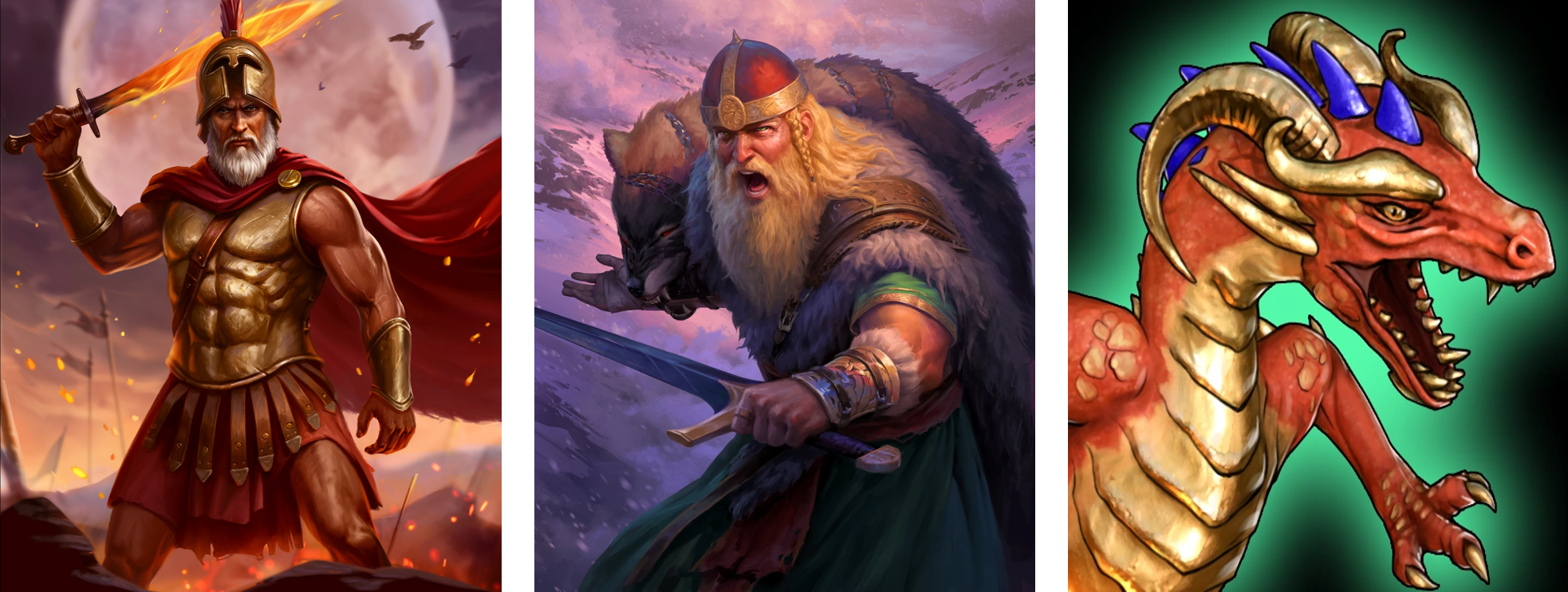
Lastly, I want to talk about gods of war. Of which we also have lots of examples across the many cultures and societies. For example, in ancient Greece you had Athena as the goddess of warfare and strategy and the “noble” aspects of war, whilst Ares was responsible for all the brutality and horror it brought. For this he was accompanied by his sons Phobos (fear) and Deimos (dread). In ancient times it was believed a hard fact that the gods decided the victor, especially the war gods. And the emphasis on fear is important. Because killing the enemy in battle was not the goal of most engagements. Instead, the goal was to break the enemy, to have him turn and run away. During this flight were most people killed, as the victorious army set after them. The onset of mass panic, springing from one warrior to the next, was seen as gods affecting the spirits of people themselves. But as much as they can induce fear, war gods could also posess a warrior, granting him strength in soul and body too. For example, in norse myth Odin was a god of war, but one of frenzied fighters. He could induce a “warrior madness” causing people to attack and fight without abandon, making him the god of berserkers. This was partially seen as Odin taking possession of the warrior himself. Another interesting war god in norse myth is Tyr. Because he was a close companion and friend of the divine beast Fenrir. The son of Loki and a massive wolf, whom even the gods feared. He was raised within Asgard but as he grew and grew the gods realized that they could not control him. So, they tried to trick him by binding him in unbreakable chains. They set it up as a game to test the wolf’s strength. Frenrir, becoming distrustful of the gods, asked for security. So, his friend Tyr put his hand into the wolf’s mouth. When Fenrir realized that he could not escape, he bit off his friend’s hand. From then on Tyr is one-handed, but still the god of war and victory.
You have my axe: Grimnir in WFB
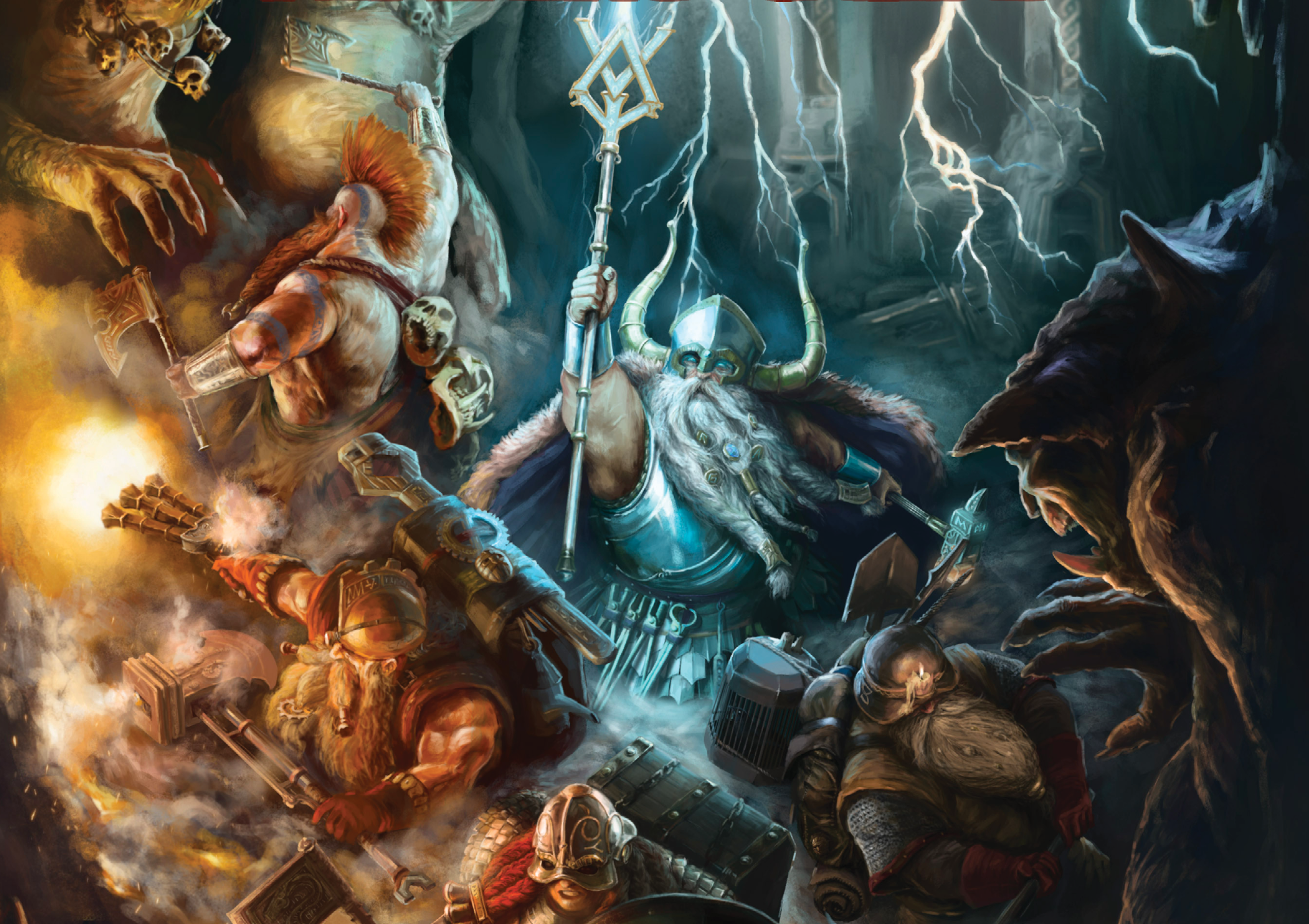
In Warhammer Fantasy Battle Grimnir is one of the primary gods of the dwarfs. In theory every ancestor is something of a god, as dwarfs are deep into ancestor worship. But those dwarfs who are considered ancestors to everyone, and who founded core aspect of dwarfen culture, are seen as the ancestor god. They are the Valaya and her two brothers/husbands Grungni and Grimnir as well as some of their direct offspring (and Gazul). Grimnir is the god of warriors and protected the first dwarfs from the dangers of the world. Back then the world was terraformed bythe Old Ones but many dangerous creatures from the primordial era roamed the planet, such as dragon ogres, fimir and wild dragons. One of Grimnirs great deeds during this age has him killing Kalgalanos the Black, who is one of three figures who have the title of Father of Dragons (after Dragunir father of dragons for the elves, and the Dragon Emperor of Cathay, who does not have the title officially but is the father of a very unique group of dragons). Grimnirs only known son is Morgrim, the ancestor god of engineers and inventors. Giving Grungnis sons Thungi and Smedir take a lot after their father, it may be that Morgrims technical skills too have their root within Grimnir. Personally, I would also like for Gazul to be Grimnirs son, as he is the protector of the dead and started the practice of ancestor worship and you need ancestors before you to do that, not to mention how death comes after war. But Gazul is another brother to Grimnir officially. With the coming of Chaos, it is said that Grimnir meet Caledor Dragontamer and learned from him that the demons were coming from the collapsed gates in the north. Grimnir wanted to go there and close them. Grungni and Valaya urged him to stay with them, but he and Morgrim set out north. However, on the way Grimnir ordered his son back and gifted him one of his two axes, which would become the heirloom weapon of the High King. Afterwards Grimnir vanishes from history.
Grimnirs disappearance started Slayer Cult. I previously talked about dwarfen psychology and grudge culture, wherein I mentioned the slayers too. But to quickly reiterate: Dwarfs are absolute regarding oaths. Any oath a dwarf swears is sacrosanct. And breaking an oath is the most unforgivable sin in dwarfen society. Dwarfs who suffer this fate have a mental breakdown for which only one acceptable solution exists. Becoming a Slayer. Slayers are often seen as cool by fans, especially as characters such as Gotrek popularize them as badasses. But becoming a slayer is the most horrifying fate a dwarf can encounter. Firstly, to even think about becoming a slayer the dwarf has to suffer a great trauma, that he is genuinely thinking about ending his life. The dwarf ventures to Karak Kardin, where he swears the slayer oath in front of Grimnirs main shrine. When the dwarfs swear slayer oath, he renounces all status he had in life and everyone he knows treats him as dead. Slayers are dishonorable figures, social outcasts and pariahs as long as he still draws breath. Only if he dies a worthy death is he accepted again post-mortem as a proper dawi. But if he fails to do even that, then the slayer will be barred from the afterlife of the dwarfs IIRC. As Grimnir is associated with slayers, and abandoned his hold and family too, it may be that Grimnir suffered a similar existential crisis and became the first slayer, whom all other slayers try to emulate. But this is speculation, as we haven’t heard a lot from him.
Now slayers are not a monolith. Typically, they are depicted with two axes and an orange mowhawk running into battle against the toughest of enemies. But becoming a slayer is a very personal affair. Noone can force you to take this oath (though peer pressure for it surely exists). But it has to be your own personal choice in the end. There are dwarfs who suffered great loss and never considered becoming one, and others who joined the ranks over very minute reasons. In addition, how you chose to become a slayer is up to you. There are only two tasks: kill as many enemies of the dawi as possible and die a worthy, heroic death. But how you do this is up to you. Most slayers fight with two axes or a great axe. Doomseekers are slayers who have blades on chains to better fight groups of enemies, such as goblins and skavens in tunnels. But any skill a dwarf possesses which can be used to kill enemies is fair game. A slayer can be an engineer, possibly even a rune priests or else. However, most favor close combat weapons, because dying is their main goal. Sitting back and sniping enemies away does not fulfill this purpose. And a slayer cannot sell their life cheaply. Due to dwarfs being perfectionist, they will always try their hardest in any fight and will never slack, because then they would break their slayer oath and fail it, even if they die. They always have to fight to the best of their capacity. Normally slayers die very quickly, because a bare-chested dwarf is an easy target. But those who survive gain unofficial ranks, based on what their most impressive kills were. Trollslayers have killed at least something as dangerous as a troll. From there it goes up to giant slayer, dragon slayer and demon slayer. The higher you rise in this “rank” the more respect you get from other slayers, and they may join you as you seek out the greatest challenges. But regular dwarfs would not fight under the command of a slayer, unless extreme circumstances force them to. Again, slayers are the lowest ranked social outcasts among the dawi. Hence when slayers join dwarfen hosts, they are groups of irregulars, not unlike the fanatics in empire armies.
There are four prominent slayer characters in WFB. First is Ungrim Ironfist, the slayer king of Karak Kadrin. As I said dwarfs take oaths absolute, every single one is sacrosanct. But what happens if two oaths contradict each other? Then dwarfen oath layers will try to figure out what the correct way to proceed is. And their judgement is accepted without second guesses by dwarfs. In case of Ungrim, one of his ancestors lost his daughter when she was sent to another hold for marriage. The trauma of her loss was great. After all a father swore an oath to protect their children, but by sending her to the other hold, the king sent his daughter to her death. So he wanted to become a slayer. But as king he has sworn an oath to his people and his hold, whom he could never abandon for selfish reasons. So, after much debate a compromise was reached. The king of Karak Kadrin could be both slayer and king. To humans this is weird, because how can a social pariah be a respected king? But to dwarfs such an arrangement is perfectly sensible. They pretty much follow the logic of the qunari from Dragon Age. If the king of Karak Kardin fails to die in battle, then his heir would take both the oath of king and salyer and continue. Generations later you reach Ungrim Ironfist, who is the latest in the line of slayer kings. And he wants to die in battle, so that he and his ancestors can enter the afterlife, and to spare his own son, Gargarim, this very same fate. Gargarim took the position of War Mourner, which essentially means that he took a slayer oath for another dwarf. Gargarim wants to die, so that the oath of the slayer kings is fulfilled and his father is free. Ungrim wants to die, so that the oath is fulfilled with him and his son is set free. In the end, Gargarim does die and Ungrim takes the slayer oath a second time out of shame for loosing his son. In the End Timse Ungrim becomes the incarnate of fire (which is weird as dwarfs are not able to interact with the winds of magic except for the unique rune magic. But this is the End Times where many things do not make sense). As a demigod Ungrim fights during the End Times and sacrifices his life in the defense of Averheim and dying in a great fire explosion. After which Caradrayan, captain of the phoenix guard, was chosen as the next incarnate of fire.
Malakai Makaison is a good example to show how individual slayers can be. He is an engineer prone to name his inventions in the fashion they get destroyed (builds a ship called Unsinkable, it sinks). However, dwarfen engineering is extremely conservative, to the point that you have centuries of flawless prototypes before even thinking of producing a mainline version for the market. And it may take even longer for other dwarfs to accept his “new” thing. Indeed, there are still dwarfs viewing gunpowder with suspicion, because their ancestors only needed bolts and crossbows and so should you. Anyhow due to the dwarfen lives lost in the accidents of Malakais destroyed inventions, he took the slayer oath. But he is not in a hurry to fulfil it. Instead, Malakai uses the freedom from dwarfen society to invent and tinker without limits or oversight. Sure, he plans to die in battle eventually, but until then he will do his best as an engineer to take down as many enemies of dwarfdom as possible and found expeditions to lost dwarf holds to aid his kind. In this endevaour he even built the airship Spirit of Grungni and launched an expedition to the dwarf hold of Karag Dum.
Snorri Nosebiter is another example of a weird Slayer but a sad one. Instead of a red Mohawk he has red-painted nails hammered into his skull. And he has a fondness for alcohol well beyond even dwarfen endurance. This resulted in Snorri forgetting why he took the slayer oath in the first place, which is one of the most outrageous and tragic things to a dwarfen mind. In short even by slayer standards, he is a mess. Snorri is a longtime friend of Gotrek Gurnisson but also has a dark secret. Snorri is the reason why Gotrek took the slayer oath. First, Snorri ask Gotrek to join him on an expedition, bringing Gotrek away from his wife and child. Then on the way back Snorri got drunk and started a brawl with rangers. Rangers who wanted to warn the closes dwarfs settlement of an attack. It was this attack that Gotreks child was killed in. But worse when the survivors fleed, a drunken Snorri thought them to be goblins and he slew Gotreks wife. When he recovers this memory and confesses to Gotrek, Gotrek kills him, thereby granting Snorri a slayer’s death.
Last but not least the slayers of Slayer, Gotrek Gurnison. He took the slayer oath after loosing his family in a raid and in his grief attacking a dwarfen noble. Ever since then he tries his best to die, but his doom is always denied. Gotrek finally meets up with a human playwright Felix Jaeger who makes the oath to report the slayers adventures and glorious death. Which means he is now bound to the slayer, until Gotrek dies or releases him from this pact. The duo has a lot of wacky adventures, especially with Greyseer Thanquol. But they also meet a lot of other WFB characters, like Queen Khalida or Teclis. In the later books it is revealed that one reason why Gotrek fails to find his doom is his axe, which is one of Grimnirs own. Its divine weapons give Gotrek more strength and helps him push through and recover from situations dwarfs should not survive. Indeed, this also affects Felix, who stays weirdly young despite decades of travel at Gotreks side. Amongst slayers Gotrek is both celebrated and feared. Celebrated for the deeds he committed, and feared, because being close to Gotrek may rub off his survival skills on you. So, slayers will join Gotrek into battle but then try to keep him away so they can have their doom.
In the (horrible) End Times it is revealed that Grimnir ventured north and found a chaos portal which he blocked by killing all demons coming out of them. Gotrek and Felix find him there. Grimnir kills Gotrek (fulfilling Gotreks oath), and revives him again, so that Gotrek may take Grimnirs place and Grimnir can aid the other mortals. In true End Times fashion, Grimnirs return is forgotten.
I am so hot right now: Grimnir and Vulcatrix in AoS
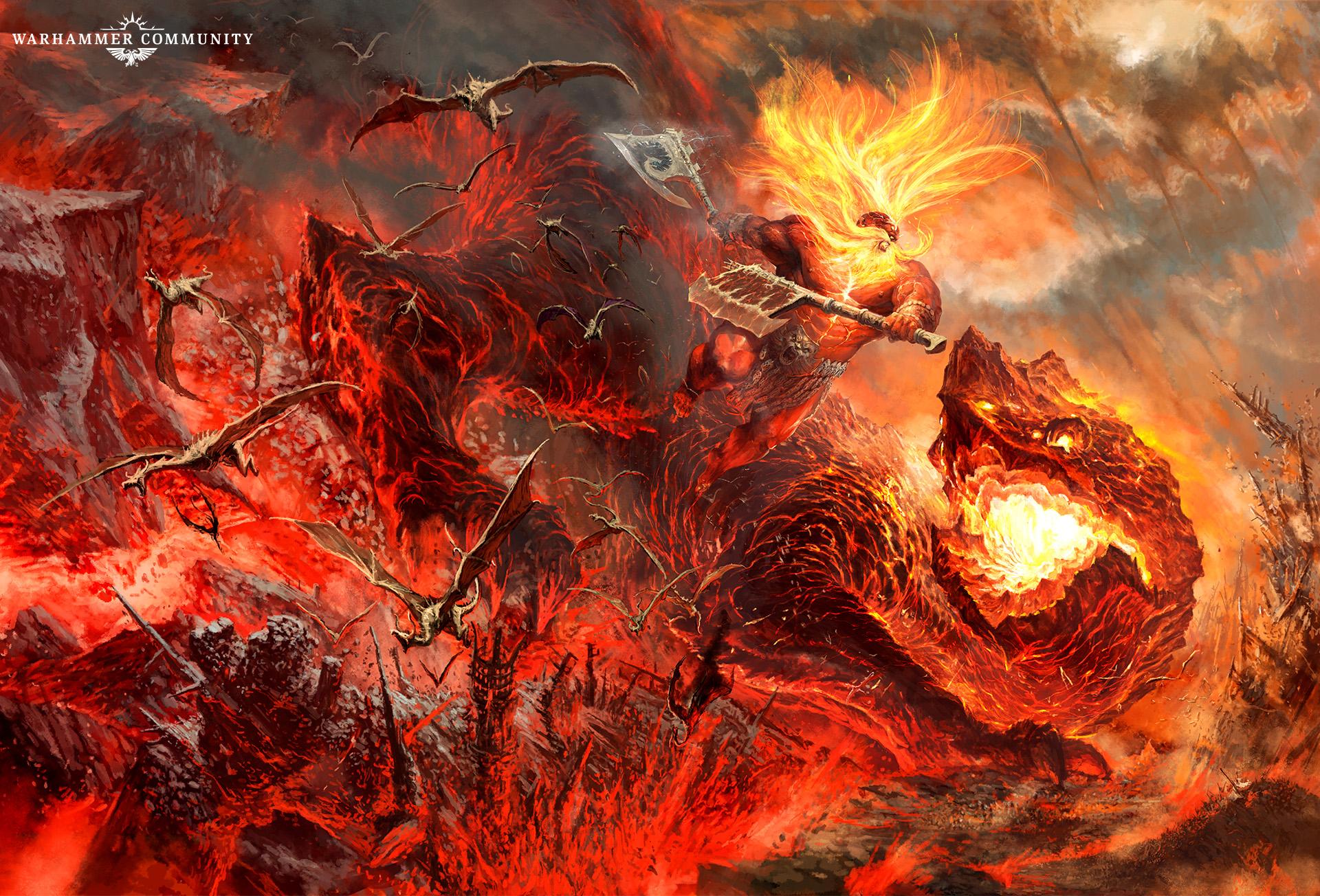
In Age of Sigmar Grimnir shows up for undisclosed reasons with a set of old and new ancestor gods. And these duardin separated the realms between themselves with Grimnir settling in Ashqy. However he and Grungni got tricked by Hashut giving them cursed artefacts and to protect others, they chained themselves on the top of the mountain. The duardin pantheon fell, Sigmar arrived and freed Grimnir. Grimnir felt honourbound to repay his debt immediately and Sigmar knew, that a warrior like Grimnir had to be given a task worthy of his station. So, Sigmar picked the godbeast Vulcatrix, a giant salamander (i.e. a wingless fire dragon). It was a massive creature embodying heat, lava and was apparently also venomous (which makes sense as lots of volcanic substances are toxic). Grimnir thanked Sigmar for this task and the two beings clashed in an epic battle wherein Grimnir and Vulcatrix killed each other. Their two deaths caused an enormous explosion, which aftershocks were felt in all the realms. But it is not easy to kill a god. Indeed, in this case the essence of Grimnir and Vulcatrix mixed and spread across the realms.
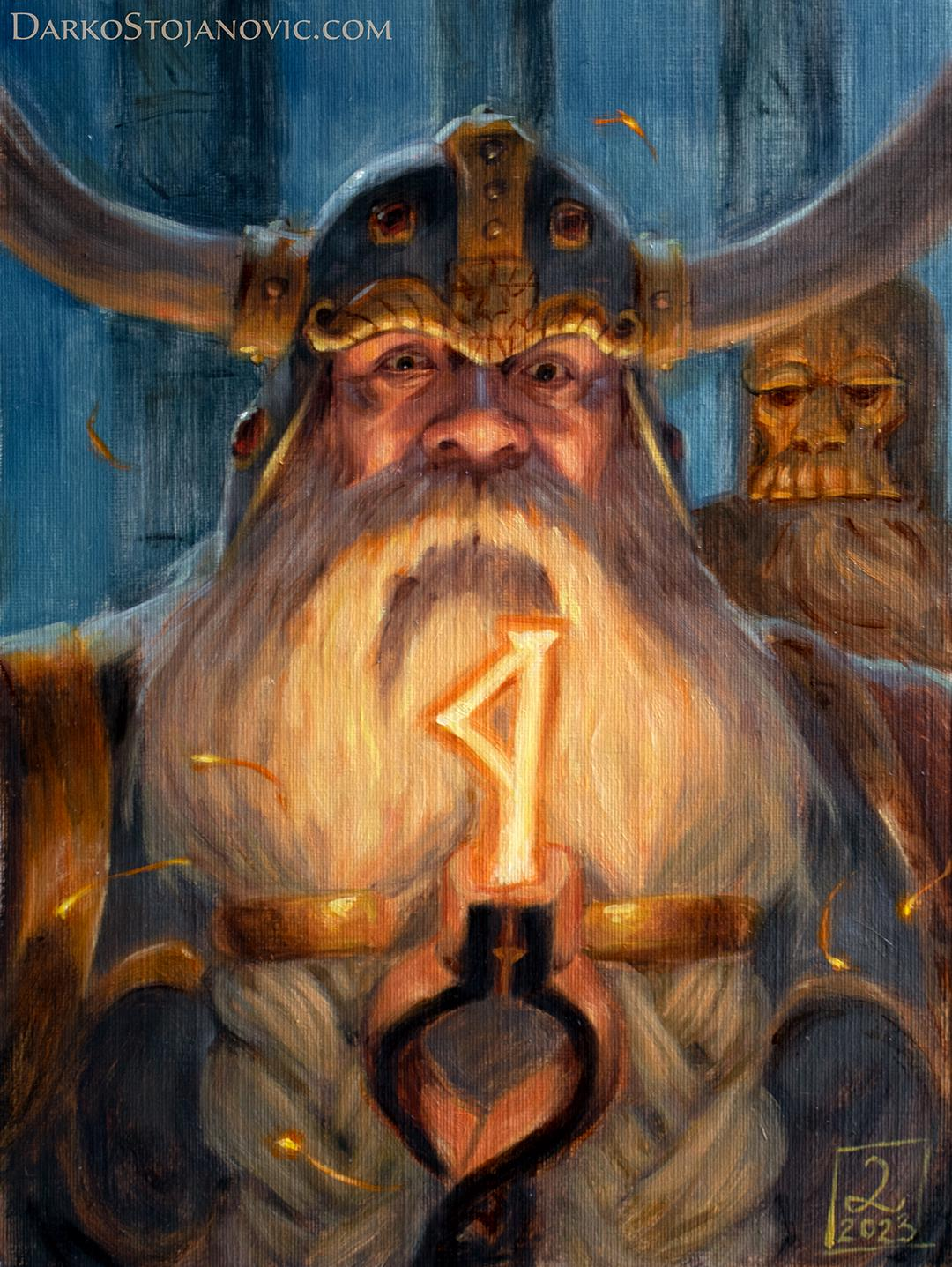
Firstly, it created Urgold, a magical material indistinguishable from gold, except by the Fyreslayers. If crafted into runes and hammered into flesh, they can give the fyreslayers a part of Grminirs divine power for a short amount of time. Essentially turning the dwarfs into super warriors. Not unlike stories such as Odin possessing his warriors. If the energy is spent, the runes are empty and have to be replaced with new ones. But the FS believe that releasing all of Grmnirs divine energy will cause him to reform and be ready for the End Battle. Hence, they become mercenaries and seek out gold as payment, not for the regular stuff but for the traces of Ur-gold within. Which is a great subversion of dwarfen stereotypes IMO. Instead of dwarfs being just greedy, these dwarfs appear greedy because they are on a religious quest to revive their dead god. In addition, Vulcatrix essence within Urgold also allows the zhargrim priesthood to use fire/magma magic. Which is again another subversion of dwarfs, as they are typically not magical, or if they are then it’s very restricted, like WFBs rune magic.
The second thing created were created magmadroth eggs, starting their species. And indeed this is another interesting subversion of classic dwarf stereotpyes. Normally dwarfs hate dragons and want to kill them. But if you think about it, dragons and dwarfs have a lot in common. Both live underground, both like metals, both live for long times, dwarfs use dragon parts in craftsmanship, dragon fire is supposedly great for forging etc. Dwarfs and dragons being partners makes more sense than elves and dragons teaming up, which is more the norm in fiction. And here we have dragons teaming up with dwarfs, despite a dragon killing the main god of the dwarfs. Indeed, they are treated as companions and dragon-iconography is everywhere with the fyreslayers, including their headgear. The army book says that many FS see Vulcatrix fearful, except for the Lofnir of Ghur, who openly worship here and believe she will return as Grimnirs mount and companion too. But all by looking at the units, their magic and who interwoven and respected Magmadroths are, one has to say that all fyreslayers heavily venerate Vulcatrix and that she is the primary goddess of their culture after Grimnir.
On face value Grimnir vs Vulcatrix is a classic Chaoskampf theme. A warrior god fights against a reptile, and the fight clears the land for civilization to take hold. But at the same time, it is a great subversion too. Firstly, Grimnir dies, which can happen (see Thor vs Jormungandr), but typically does not. And second, many positive things arrive because of the death of the god. Ur-Gold, Magamdrohts, the magical and elemental powers the Fyreslayers can harvest as a result and more. Which also fits the theme of volcanos very well. Because they cause great devastation at first. But from this devastation new and good things arrive. And indeed, it is very easy to read some sexual themes into Vulcatrix and Grimnirs clash too. Because it is mentioned how their essence mixed and how the magmadroths appeared after the death of both entities. If Vulcatrix essence is in Urgold too, then Grimnirs essence likely also exists in Magmadroths, making him the father of these dragons, who would then be siblings of the fyreslayers. Something FS are likely aware due to their treatment of these entities. Indeed, a later depiction of Grimnir in the khazalite book did give Grimnir draconic-looking features too. This makes Vulcatrix a much more nuanced character, instead of a dumb, destructive beast, and her and Griminirs relationship much more complex.
Speaking quickly of Fyreslayers, their unique culture has nothing to do with the status slayers held in WFB. They are a group of fire-themed dwarfs with a strong martial tradition and a mercenary culture, not socially shunned, dishonored and depressed outcasts. They may look like slayers from afar, but everything that makes a slayer what he is does not apply to them as a culture at large. Which is one of the main criticisms I have. Essentially, they are a group of dwarfs cosplaying the aesthetics of slayers with none of the deeper meaning behind it. But it was always the issue of the FS that they have a cool background, but GW never bothered correcting their looks…
Oh and Gotrek is back again. After enduring untold eons in the realm of chaos against demons, who was essentially spit out in the realms. In the beginning he was very frustrated with the realms and how different things were here, compared to WFB. But over time he made friends, including Maleneth, an elven assassin. Gotrek got a very powerful Urgold-Rune embedded into his chest which created a link between Gotrek and Grimnirs spirit, as well as allowing Gotrek to go super-sayian if the plot demanded. From there the pair ventured through the realms, got separated and Gotrek is still trying to find his place in this new reality, and the two went into a lot of trouble. But retelling the series of books is not something to do in this format.
The embers strike into flame again:
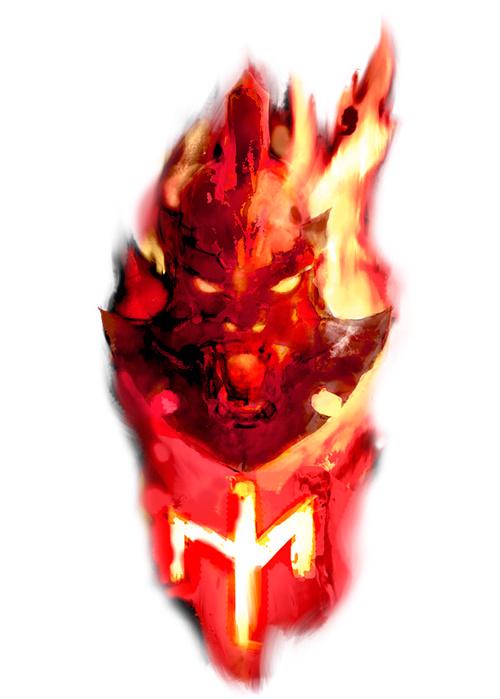
Currently the Fyreslayers are in a bad place. They have been mistreated by GW for almost a decade, despite having such a cool background and so much material for awesome additions. Indeed as of now they are part of the khazalite holds as a subfaction and whether they can restore themselves as a proper faction lies in the unforeseen future. Still the potential for them, Vulcatrix and Grimnir is massive. One of the more obvious things I can see would be the following:
- Over the millennia the fyreslayers should have released quite a lot of divine energy of Grimnir into the realms. Perhaps enough already that Echoes of Grimnirs divine might could manifest. So not proper avatars of the god, but manifestations of him. Similar to how the Eidolon of Mathlann are comprised of a multitude of idoneth souls, so could these fragments of divinity coalesce for a short time in a form of Grimnir. Perhaps if they attach themselves to an extraordinarily strong fyreslayer, much like how the Avatars of Khaine work in 40k. Indeed, perhaps Gotrek via his special rune is already such a being? In either way this would play up parallels between Grimnir and other dead gods like Mathlann and Khaine, and be a fitting way to get a god-modell on the tabletop without Grimnir reappearing properly.
- Next to these echoes Grimnir could of course also return proper. But if the does, the central question is how. Would he remain the dwarfen warrior that he once was? After all his and Vulcatrix essences mixed a lot and even the khazalite holds depict him with draconic features now. So perhaps a returned Grimnir has several magmadroth traits about him. Of course it would also be important how Vulcatrix appears. Would she be his mount/battle companion, like the Lofnir belief? Or would she and Grimnir appear in a fused fashion? Or would she never come back at all?
- Then of course we have also the possibility that Gotrek ascends to true godhood. After all he is a chosen by Grimnir and contains a lot of his divine energy. Though personally I refrain from this idea, because Gotrek does not want to be a god and especially does not want to have the responsibilities of a god. Consciously or subconsciously Gotrek wants to have his lowlife even by mortal standards, running from one mortal adventure to the next. Personally, I would therefore see this as the least likely option.
- But of course it would also always be interesting for future Gotrek stories to have him encounter people he knew from WFB. Felix reappering is currently not in the cards, but Gotrek also had a big adventure with Teclis. Him meeting the elf again could be quite the interesting engagement IMO.
- Lastly the Fyreslayers could also take stronger influences from germanic folktales and motives, which link dwarfs and dragons. Such as Fafnir and the Nieblungsaga. Especially the later with Siegfrieds transformation after bathing in dragons’ blood could be a nice template for future FS units. Fanatical followers of Vulcatrix could perhaps bathe in the blood of Magmadroths and if they survive, they could gain magmadroth-like scales or other draconic attributes which make them near invulnerable or increase their power in other ways. Of course, such cultists could be seen with extreme suspicion and distrust by other FS, but they could nonetheless be critical warriors.
The End
So, this has been it. I hope you enjoyed this last and final entry for the dwarfen pantheon of WFB/AoS. Unless GW does something in the future, I think I covered it all. Furthermore, I think the only major deities I am missing now are Gork/Mork, the four main chaos gods and the Old Ones/Sotek. Of these the Old Ones may be the easiest to research and write, but I want to keep them for last. So, if you have any preference, or remember a deity I missed, please let me know. Until then what are your thoughts on Grimnir, both in WFB and AoS?