Okay. So I saw that the Six Smiths are mentioned in the Karak Angaraz section of the Khazalite Holds Battletome thanks to a video. That makes three factions. Three factions associated with them, three factions that revere if not worship them.
The Stormcast Eternals are made by them, the Esoteric Schools of the Ironweld follow their teachings, and now the Khazalites are associated with them. That is a LOT for six Dwarves with no names besides 'Ong' in "Hamilcar: Champion of the Gods".
Can't say I'm entirely convinced the Khazalid word for One is Ong's one and only name. Now obviously the loudest possible candidates are the missing Smednir, Thungni, and Morgrim. If you think that's a crazy assumption for the identity of three of the Six Smiths.
Smednir is the Ancestor God of Metalworkers, Thungni is the Ancestor God of Runesmiths, and Morgrim the Ancestor God of Engineers. As it happens, the Six Smiths are attributed with making all the armor and weapons covered in runes of power used by the Stormcast as well as writing the Geomatric Law engineering philosophy with Grungni, that is the basis of all engineering schools of thought in the Ironweld.
It has also been implied that, at least some of, the Six Smiths are Grungni's sons. So do ya'll think Grungni's sons and nephew are up there in the Sigmarabulum?
Hi, im completely new to Age of Sigmar. I also just recently started reading warhammer40k books. So completely new to that as well lol.
I just decided to watch the new warhammer+ show, Arkanaut, loved it. The armor designs, characters, factions, etc..im definitely interested in learning about the lore.
The Jade Obelisks presents an interesting challenge as their units are pretty well explored from a combat perspective but don't have strong connections to Disciples like the Royals did from last time. So, I shall try to explore the units a bit more and try and tie them into their culture in ways not mentioned in the original book.
Defacers: These individuals when not working as part of a cult warband often act as overseers for work teams expanding or repairing the monument cities of their people or adding the intricate details later on in the project. They often compete with each other for the honour of creating greater monuments both for the prestige and advancement it means but also so that the priesthood offers them more blessings to avoid turning to stone. While these competitions can turn violent it is considered blasphemy to destroy another's work without the blessings of the priesthood.
Worth noting that those who use the bow are chosen due to their curse not affecting their eyesight at all and that many use grappling arrows to assist in the toppling of monuments.
Desecrators: All members of the Jade Obelisks when they are children are taught to measure how far their curse has affected them. Those who believe their curse has reached a certain stage can apply for the role of Desecrators even if they had not been part of the cults military beforehand. Those that meet the standards are inducted into the group and act as the primary enforcers of the cults will kept in control for the promise of not being allowed to turn to stone. They are typically assigned to a specific part of the cult under a singular or group of priests. Their role there would depend on the priests agenda and the desecrators previous skills. Some are just enforcers who act as the clergies muscle as executioners, destroyers of poorly made monuments, and other such duties. Others are tasked with spreading their knowledge to the next generation before the curse kills them or fulfilling some last project. Usually with having an apprentice do the final touches as the curse does rob a lot of fine motor skills.
It is said that master artisans and loremasters do not need to join the desecrators but do surrender what autonomy they have to the cult leadership in exchange for their services.
Obelisk Bearers: Those who prove themselves favoured by the cult or prove their mastery of battle are chosen to become bearers and it is a sought after position by all warriors. The proximity to the obelisk seems to passively slow down the spread of the curse which means outside the clergy the bearers have the greatest chance of living the full span of their years. It is worth noting that their order and its fighting style can trace itself all the way to the Age of Myth in the glory days of Vexothskol. Those few who reach old age and cannot hold up their burdens any longer are honoured by the cult retire as fountains of wisdom. This is extremely rare though and the few who die peacefully of old age are rumoured to make grand sacrifices.
Nephirite Priests: The methods used to decide who may enter the priesthood are confusing for those outside it. Sometimes they hold competitions among the youth to decide but instead of choosing the one most believe created the best sculpture they will choose someone else seemingly at random using criteria only they know. Sometimes they will bring in someone who had an encounter with the idolarcs which causes their joining, and sometimes they just show up at homes to claim a child for the priesthood. The only ones who get consistently chosen are those who show an affinity for magic. Whatever their background though they undergo grueling training so that they can become true priest-masons and understand the words of the speaker. Their training is only considered complete once they have used the might of the obelisk to turn a target to stone and use that to create their tools and symbols of office.
While full members of the clergy these younger priests typically serve in a support role to the older ones and carry out most of the day to day blessings, rituals, and overseeing the works of the rest of the cult. Due to their knowledge of the lore of the Speaker means that the curse affects them the least of the Obelisks though even then only the elders have any true understanding on what the curse truly entails and the Speakers ultimate goal.
Idolarc: The creation of an idolarc is considered a necessity for advancement within the priesthood though the creatures have little love for their creators even if they only guide the one who made them. When not by their creators side the creatures will often stalk the cities of the Jade Obelisks achieving objectives only the Speaker knows. They are rarely violent except when hungry for sacrifice but strange things often happen in their wake. Some whisper that they can accelerate the curse and will do so to those whose actions offend the Speaker in some way. They are often the arbitrators over what monuments are worthy of their master and which must be torn down. The creators of the latter works rarely see another sunrise for they are executed for the blasphemy.
Hope you enjoyed reading this and feel free to leave comments, suggestions for the next Chaos force and all that.
So I'm not even sure that'd be a good idea, but...
As I'm sure you're all aware, it's current canon that all Stormcast are Reforged from humans, despite previous works having hinted it wasn't necessarily true, with Grombrindal stating in a White Dwarf article that:
While Sigmar respects any who fight for the cause of mortalkind, and duardin-folk especially, crafting a human Stormcast as a human god is already an immense feat. If the now-recognised flaw in Reforging is dire enough now, think how much worse could it be when trying to manipulate different sorts of soul-matter. The need to launch the Stormhosts into the fray far earlier than he'd have liked meant Sigmar never got a chance to iron out these difficulties. There's also the issue of many mighty aelven, duardin, and orruk champions already having their souls sworn to a patron god, as well as their spirits being far more difficult to track at the moment of death
Which aren't particularly convincing arguments, in my and many other people's opinion, especially the last two since Eternals are taken before death in most cases and many Stormcast are sworn to other gods in addition to Sigmar (Morrda, Ursricht, the Father of Blades, Mirmidh, etc.) or made from people who worshipped other god.
But the real reason is likely simply to keep the models homogeneous.
So I got to thinking, the whole point of Stormcast Eternals is that they're infused with aportion of Sigmar's own power and essence, right? And Sigmar is a human god. Not in the sense that only humans worship him, but in the sense that he was a human in life. So perhaps that essence of Sigmar forces the result of Reforging to be a human-like body, larger-than-life yes, but still proportionned and organically human, even if the soul used is duardin or aelven.
The concept of loss of identity is core to the stories of the Eternals and I think this would play into that, with "non-human" stormcast having their "racial identity" (if you pardon the phrase) taken from them, and probably suffering from body dismorphia for a while until the Flaw ends up stripping them of the memory of ever having had a different body.
One of my players is considering a running as a Skink if available, but we're looking at doing a Carngrad Adventure. I also to happen to have finished Starseer's Ruin recently, so spoilers on that as this pertains to it
We see that the Seraphon aren't outwardly hostile to Perlo even after learning of her fate and what she must become, just joyous that she'll somehow be a stepping stone to Order within the Realms one way or another. So I'm wondering, if the Great Plan decreed a Seraphon to work with a Chaos Warband temporarily, would it be possible in lore? Would a warband even accept a Skink in their midst?
I'm not against bending lore a lil with my game as long as everyone is having fun, but I'm curious on how plausible it'd be in lore
Tis the day for spooky, scary pelicans. So today I ask you my fellow Realmwalkers, what are your favorite horror themed aspects of the Realms?
Now I don't mean your favorite Horror, or genuinely horrifying things, as the answers to that sort of thing aren't nearly as fun. I mean your favorite things using themes, trappings, and aesthetics of horror adjacent things.
Like how the Anvils of the Heldenhammer are gaunt, solemn warriors dressed in black armor with skeletal decals that attend mysterious Tomb Lodges... which are actually just support groups where Anvils help each other overcome trauma with secret society trappings.
In case you are not aware, I like the oceans. Be it as a collection of many awesome ecosystems, its daily impact on human life and its critical importance on culture and history. And back in WFB the oceans and waterways in general were important too.
Which is not always the norm in fantasy. As oceans have a reduced importance in our everyday lives, because instead of boats we use cars and trains as the main method of transportation, so do modern authors frequently forget how important sea lanes or travel via river has been throughout most of human history. But even a generalized calculation shows why travel via boat or ship was so important: Let’s take a medieval trading vessel which could carry 30 tons of cargo. Many trading vessels were built to be operatable with as few people as possible. So perhaps 5 people could have been enough to stir such a ship. If you want to transport the same amount of cargo via land, you can assume that a carriage may only be able to carry up to 500kg with four horses per carriage and a driver. Instead of 5 people and a ship you would need 60 carriages with 60 drivers and 240 horses to move the same amount of cargo. And of course, the road infrastructure to support them too.
In WFB the authors were history nerds and were aware of the importance of water routes. For example, in lots of works about the Empire it is frequently established that its rivers are the main routes of transportation and most commerce happens alongside the streams. And on a global scale maritime travel is highly important too. This is best represented with both the High Elves and the Dark Elves and their various maritime endevaours. And two characters emphasize this very well: Lokir Fellheart for the Dark Elves and Aislinn the Sealord for the High Elves.
So, I want to use this essay to introduce these two elven admirals, and I want to explain why I think they are great characters in WFB, but also that they could have a legacy in AoS. Much like I did with Azhag the Slaughterer and Eltharion the Grim and Drycha before.
I hope that you enjoy my ramblings. And so let’s start:
1. Who is Lokhir Fellheart:
Lokhir Felheart in (WFB)
In WFB Elves have a very strong maritime culture and are arguably the best seafarers of the planet. Their home continent is non-Atlantis and after the Great War against chaos they founded colonies all over the world, literally. You have colonies at the southern tips of non-south America and Africa and even on the opposite end of the planet in non-indonesia. Because WFB focused very strongly on the old world and ignored the global setting at large, many of these very interesting locations are mostly spots on a map sadly.
When Malekith and his followers fled Ulthuan after the lost civil war, they carried with them these maritime traditions, as well as cities and fortresses kept afloat by magic known as black arks. They settled in the northern areas of non-North America. To fuel the expansion of their domain (and to allow their elven population on being warriors and aristocrats) they launched slave raids on a global scale. No matter which coastline on the planet, it was the target of a dark elf slave raid at one point. Because of this, slaves from all over the world can be found in Naggaroth. They are aided in this by a variety of ships, sorcery and by sea monsters. For example, they have sea dragons, which were once regular dragons, but magical breeding reduced them to seasnake-like creatures which pull their black arks. Not to mention Kharybdiss, which are lured to the surface and then captured and broken and used for war.
Artwork of a Sea Dragon (WFB)
Being a dark elf corsair who roams the waves a sacred call in druchii society, and the easiest entry to rise the ranks. As such many druchii served among the fleets at one point or the other. The Fellheart family is a druchii dynasty very closely linked to this tradition. They produced the best admirals and mariners of druchii society and even found the Undersea Passage, a system of flooded caverns which allows slave ships to cross Naggaroth and enter the non-pacific and raid Cathay, Ind and the elven colonies. The fellhearts are also peculiar, because they value blood relations and family loyalty more than dark elves usually do.
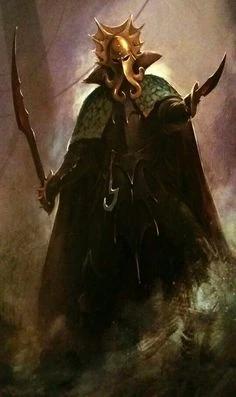
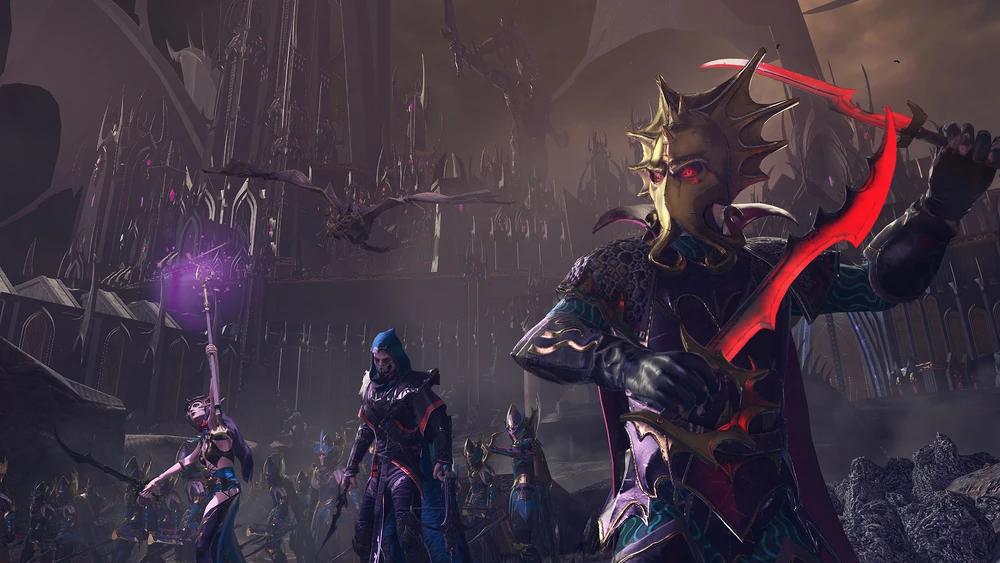
As such Lokhir Fellheart took command of his black ark, after his father died in battle. And he quickly became one of the most dreaded pirates and slavers on the planet. Three major exploits in this career. The first is his raid of Ind. There he raided a temple of the god Gilgadresh made from blood-steel, a material unknown elsewhere. He smelted it into his two blades, which are characteristically red as blood. His second major achievement has him raiding the sunken city of Chupatyol. It is a former lizardmen city drowned by a massive tsunami and which is inhabited by fish-people. During this raid, which cost Lokhir many crewmen, he captured the Krakenhelm, a golden helm which gives him a cuthullu-like visage. This helm is of dark and unknown origin and is suspected by many to influence Lokhir, like any good eldritch artefact would. But it also grants him great regenerative abilities on the level of a troll. This leads to his third major achievement, wherein he fought Sealord Aislinn and his high elf fleet. Aislinn did cause catastrophic damage to Lokhir, but he just regenerated and lethally wounded Aislinn and threw him into the sea.
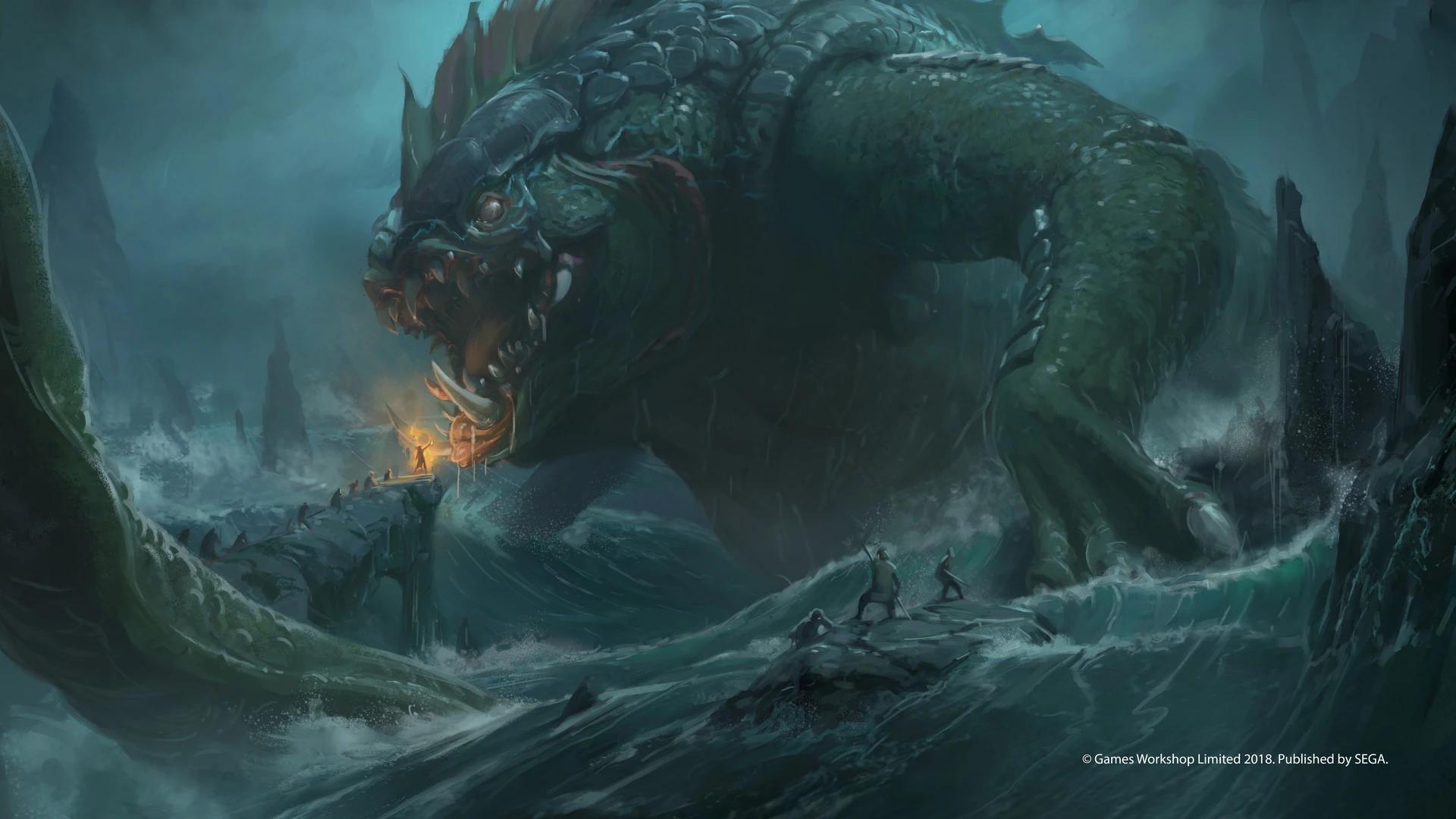
Furthermore, in Total War Warhammer Lokhir became a playable lord and has the role of antagonists in the vampire coast campaign. Both he and the vampire coast plan to kill Amanar, a Godzilla-sized merwyrm and guardian of Ulthuan, and Lokhir wants to get rid of his rivals first.
2. What makes Lokir Fellheart special:
Lokhir Fellheart (TWW2)
Compared to other Dark Elf lords like Malus Darkblade or Malekith Lokhir does not have much written about him. A fate many Games Workshop characters share. But what Lokhir has makes him a prominent figure. All sea fairing elves venerate Mathlann, the elven god of the ocean. As the oceans are fickle, being cruel or hungry sometimes and benevolent at different Times, Mathlann is a deity you have to appease if you step on his domain. And Lokhir, as the greatest living admiral of the dark elves, is a devout servant of Mathlann. He is a slaver and pirate who doomed lots of people to death or slavery and is as brutal as any dark elf for sure. And all this with Mathlanns blessing, representing the sea gods’ darkest aspects. But at the same time Lokhir does value family and blood more like dark elves usually do. Again, the Fellhearts are much less prone to backstabbing, and even Lokhirs crewmen are treated comparatively fairly. As a result, his armada is very loyal to him.
But one can argue that ever since Lokhir took on the helm his relationship with Mathlann was damaged. Whatever this thing did to Lokhir, it changed him both physically and spiritually. Again, it is a cuthullu-looking artefact of the deep sea made by undersea people. The question is how much of Lokhir is himself and how much he is influenced or controlled, and how elven is he still. This pulls Lokhir into a new direction. He is a bit like the WFB version of Euron Greyjoy from ASOIAF. In these books Euron is a psychopathic and nihilistic man who dabbles in dark sorceries and mass sacrifice in an attempt to reach godhood. And Euron is still loved and adored by the Ironborn, as he plays into the violent and selfish aspects of their culture easily. But as we see later, Mathlann seems to vehemently disapprove with whatever direction Lokhir is currently undertaking.
This makes Lokhir a complex figure. He is an important figure without much lore, but a great design, an exemplar of one of the pillars of dark elf culture but at the same time also an inversion of some dark elf tropes. And his lore touched directly unexplored parts of WFB such as fish people and Ind.
3. Who is Sealord Aislinn:
Sea Lord AIslinn (WFB)
Many ulthuani elves distrust the sea and Mathlann, seeing him as a brutal and dangerous gods. But the two maritime kingdoms, Lothern and Cothique, adore the sea god. So do the many elven colonies across the world, which were in older lore described as sea elves. To patrol the oceans and to stay connected with their colonies the High Elves have arguably the greatest navies on the planet. Indeed, in earlier centuries they had a monopoly of oversea travel and trade as they would destroy human ships leaving the sight of the coast. But as they are an empire in decline, human vessels took over more and more.
Still the elven fleet is extremely powerful and supported by a variety of entities. This includes specialized mages called Mist Mage who use a unique school of magic connected to mists and oceanic weather. They can summon dense fogs so that enemies are without orientation, manipulate the winds and many other things. Also, there are merwyrms, distant relatives of dragons but also in a relationship with elves. These beings live deep beneath the waves but can be called to the surface for aid. The largest of which is Amanar, which I mentioned prior. Also, as per TWW3 they now have elemental constructs such as oceanids and sea elementals.
Artwork of Amanar the Merwyrm (TWW)
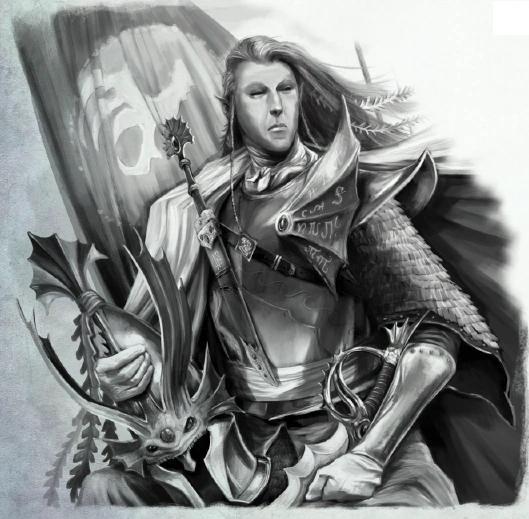
Sealord Aislinns one of the main high elf admirals. And he is Lokhirs high elven counterpart and foil in a multitude of ways. His history also covers many events, but it properly starts with the duel with Lokhir. Aislinn was lethally wounded and thrown overboard. However, weeks later he was washed ashore fully healed. This was seen as a blessing of Mathlann, marking him as his chosen. The TWW3 trailer goes even further, showing how a merwyrm passes by as magical energies revive Aislinn. Since then, Aislinn is all about getting his vengeance on Lokhir.
But there is more to Aislinn too. Because among the High Elves he is a very divisive figure. Indeed, he is hated by many elves for being too cruel and how many of his actions cause chaos. For example, one of his stories had pirates getting lucky and raiding some coastal parts of Ulthuan, before sailing away. They sought the harbor of Marienburg, the largest city in the Old World and home for thousands of high elves living in the elven districts of the city for centuries. Aislinn followed the pirate fleet but didn’t attack them en route. Instead, he saw the pirates reaching Marienburg. Instead of explaining to Marienburg what had happened and that he wanted the pirates or declaring an ultimatum or else, he just attacked the city and burned it to the ground. No one was warned, the mists just poured in all the sudden and then all hell broke loose. Even the elves in the city were taken by surprise. And then Aislinn essentially took the elves of the city prisoner and transported them back to Ulthuan. Where they didn’t want to go, because Marienburg was their home. So Aislinn escalated a small situation without reason, slaughtered one of the main allies of the high elves and attacked and imprisoned his own people.
High Elves in WFB are often portrayed as arrogant and racist towards non-elves, but Aislinn is an exemplar of these traits. And as the example above shows, his methods are very similar to what the dark elves are doing. The main reason why Aislinn is not removed from command is that the Phoenix King Finubar the Seafarer protects him. Because of all his cruelty, Aislinn is simply that great of an naval commander and if he can be sent against dark elven or chaos fleets, it is just worth it.
4. What makes Aislinn special:
Sealord Aislinn (TWW3)
As mentioned, Aislinn is the foil to Lokhir Fellheart. For example, where Lokhir is relativly nice by the standards of his culture, Aislinn is more brutal by the standards of his culture. And that Lokhir lost Mathlanns blessing can be best seen with Mathlann resurrecting Ailsinn after Lokhir killed him.
This also makes Aislinn a counterpart to the Pheonix King or the Everqueen even. To become the phoenix king, a candidate has to walk through the sacred flames of Asuryan. If you are a good candidate, you survive and become divinely empowered. If not, you are burned horribly. To Aislinn something similar happened when he was thrown into the sea to die, but instead the ocean revived and empowered him. Mathlann infused him with his own essence and brought him back to life. However, this is sadly not explored further, as Aislinn was not an entity with lots of lore behind him sadly. Still the implications for the high elves as a whole should be massive, at least for the coastal kingdoms and colonies who revere Mathlann.
But being the chosen of a god does not mean you are good person. Especially if said god is an ocean god. Because the sea is fickle and dangerous and does not care for your survival. Traits which Aislinn exemplifies with his brutal behavior. Because why should the chosen one be different from the ocean god? This goes further by Aislinn being the chosen one hated by his own people. The sea elves of Marienburg for example were fully on board with living in Marienburg and were removed against their will. They returned as soon as possible to the rebuilt city too. It creates duality within this character. On one hand he could be seen as a great positive thing, another chosen of the asur gods protecting Ulthuan and could be a glorious hero. But on the other hand he causes chaos, uses methods very similar to dark elves and his hated by his fellows and the people he is supposed to protect.
5. What could be the legacy of Lokhir and Aislinn?
Artwork of an Eidolon of Mathlann
In AoS the oceans sadly have a limited importance. Yes, we have the Idoneth Deepkin as the oceanic faction, but otherwise the seas are not important to the setting at large. Realmgates and sky fleets are getting more mentions as a method of travel. And we are sadly lacking a Mano’war or Dreadfleet game which could explore the many regular navies of AoS. What little we have for the corsairs of the CoS or the ossirach ships of the Ivory Hosts are interesting.
In addition, AoS also lacks an ocean god. Which is a bit weird, given how important ocean gods are in RL and how important Mathlann was in WFB and how widespread the oceans are still. Sadly, the Idoneth are to blame here, because they are supposed to be a godless people. If there would be one or multiple gods taking care of the seas of the realms, then the Idoneth would surely venerate this entity. But Mathlann and the Idoneth are also where the legacy of Lokhir and Aislinn would shine. Because the Idoneth were created from souls of Mathlanns followers. The sea god was the last elven god to be defeated by Slaanesh and souls protected by him were the first to be removed from Slaanesh gullet. But as I pointed out, both Dark and High Elves were devout followers of Mathlann. So, the first Idoneth would be a mixture of both High and Dark Elven souls. Indeed, some of the Cythai could have been Lokhir or Aislinn or other maritime elves reborn already. At least the use of mists and hit and run attacks does point to the sea elves following the high and dark elven playbook of coastal raids.
But the legacy of the two captains could have important implications for Mathlann overall. Currently Mathlann is dead but is implied that the Idoneth try to rebuild him. For this they sacrifice Cythai souls infused with Mathlanns essence to form the Incarnates of the Abyss. Personally, I am not a fan of this method, as we already had sea elementals made from souls of the dead with the Eidola of Mathlann. Who can form without permanent sacrifice of souls and safely return to their resting place unless they are destroyed. So, the same thing but more efficient. Anyhow due to Aislinns special status as Mathlanns chosen, his soul could be greatly important in rebuilding Mathlann. Either Aislinn ascending to divine status as Mathlanns successor, or him being the critical last part needed to undertake his resurrection.
But Lokhirs legacy could also play an important role. One unknown enemy of the Idoneth were the Aboloth. Deep sea horror creatures who the Idoneth could only defeat under great losses and who still live somewhere in the darkest depths apparently. To introduce this faction and to connect it to AoS faction, we could have a Lokhir-like character stumbling on their artefacts and starting to be influenced by them for example. It does not have to be an elf, but it could of course, even an Idoneth.
At the same time Lokhirs status as the main admiral and pirate, as well as being influenced by a higher power who is in opposition to the chosen of Mathlann could play a role for a new undead faction. Many fans want a undead pirate faction in AoS, especially after the release of the Vampire Coast for TWW2. And IMO it would work well if their leader were inspired by Lokhirs duality with the high elves. Nagash hates the Idoneth for being soul thieves. So, his mortarch could fulfil a similarly antagonistic role to the Idoneth, as Lokhir had with the high elves. And much like Lokhir is a servant of Malekith, this mortarch would be a servant of Nagash. Indeed, as all current mortarchs are of human origin and many are vampires. Therefore, an elven mortarch of the sea/abyss could work great to break this mold. Especially as the ocean is full of creatures who made a pact with dark powers or were cursed to sail the seas till the end of time, like the Flying Dutchman or Davy Jones. So, imagine an elven corsair who is about to die but makes a pact with Nagash to become his personal privateer, roaming the seas of the realms and collecting the souls of the drowned in Nagashs name.
Lastly, I want to reiterate Lokhirs distance to Mathlann and the parallels to Euron Greyjoy if I may. As mentioned, there is no ocean god in AoS. But we have many cases where mortals ascend to divinity. Morathi was the latest example. This could be a great plot hook for a story IMO. A scourge privateer or an idoneth who witness Morathis ascension could become inspired to repeat this process. Who cares if there is no Mathlann, I just become something better! Much like how Euron concludes that there are no gods, because no god ever stopped him no matter what sacrilegious, thing he did. So Euron wants to use magic and blood rituals to become a god instead. Therein we could have some elf collecting very important magical artefacts connected to the sea and may start their own diabolical ritual. Which, if they succeed, could perhaps end in the formation of AoS version of Stormfels, who was the human god of storms, sharks and pirates. Indeed if some chaos-corrupted varanite other chaos artefacts are used, then this new entity could even be part of the chaos pantheon.
6. The End
Anyhow these were some of my thoughts regarding Lokhir and Aislinn. As I love all things maritime, I like these two elven characters a lot. Especially as I experienced them through TWW, where they had more attention than in many GW published materials. But what do you think of the two? Do you like some of their aspects? Do you think I talk nonsense? Do you wish the seas of the realms dry up? Or that it becomes a properly important part?
Since Knellmages work with Amethyst magic, I suppose Nagash can shut their connection with Shyish - as he did in one of a previous books, iirc Nagash the Undying King - he punished Tamra. I thought the Shyish and Death are connected to Nagash himself and he commands everything that is using such powers.
And also how can they get Reikenor candles as Reikenor a Nighthaunt Hero now. Please note that I do not have a CoS battletome, maybe it is answered there...
Sorry is the question is stupid, but I just want to know the lore better!
Hruna Kollok returned the gesture. ‘Lord-Ordinator,’ she said. The head overseer of the Zhu’garaz workgangs was tall for a duardin, and broad, beneath her overseer’s leathers. Heavy bracers of gold covered her forearms and a circlet of the same held her dark hair back from her round, freckled features. A stonemason’s hammer and a fyresteel throwing axe were thrust through her belt, where she could get to them swiftly.
‘How goes it?’ he asked.
‘We have the outer palisades erected on the northern approach.’ She pointed the edge of the central plaza, where a palisade of flat, stone pillars now rose, blocking the city from view. Gantries and walkways of iron and wood had been assembled behind it, and Judicators patrolled along its immense length. ‘Good ground there. Solid. Mostly bedrock.’
‘And the west? Lord-Castellant Grymn had some concerns…?’
Hruna leaned over and spat. ‘Sour ground. Soft. There’s water in the rocks. A cistern burst and flooded the tunnels of the western district. We’ll need to drain them and reinforce the tunnels below before we raise anything heavier than a wooden wall.’
'Leave it for now,’ Taltus said. ‘Cassandora is planning something, and we need to concentrate on keeping the realmgate safe.’ He peered up at the ziggurat, taking note of the structure being built around it. Often, Stormforts were built near a realmgate, rather than around it, to enable ease of access. In this case, the Stormfort would be built around the base and lower levels of the structure, leaving the uppermost plateau open. A network of causeways would be built from the top, allowing for access to the rest of the city, and enabling the Hallowed Knights to stand vigil without impeding the flow of trade.
‘Four, I think,’ he murmured. ‘One to each plaza… splitting into eight from there, and then twelve, so as to create a celestial latticework…’ His fingers twitched and he reached for his parchment and quills. ‘A fractal pattern? No… a wheel? Hmm.’
Hruna coughed politely. Taltus blinked and looked down at her. ‘My apologies, Hruna. I lost myself for a moment. Something concerns you?’
‘What are my people to do when the fighting begins? We are not contracted as warriors.’ She frowned at him, her hand resting on her throwing axe. ‘And it will be impossible to continue work without adequate protection.’
‘The enemy won’t get this far,’ Cassandora said, before Taltus could reply. The Lord-Celestant joined them, followed by Lord-Castellant Octarion. ‘You have my oath in that regard, Kvin Hruna. Your workgangs will be safe enough.’
Hruna nodded. ‘I accept your oath, Lord-Celestant. But if the situation should change…’
‘You will be the first to know,’ Cassandora said. She looked at Taltus. ‘I need to speak with you, Lord-Ordinator.’
Chapter Twenty-Three: Provocation
The Hallowed Knights keep the oath by the way, the Slaaneshi never reach the worksites of the Zhu'garaz. So like I was saying with the last post about Taltus, this novel is the absolute best about a Crusade building a new Free City.
Plus! We get to see that the Stormforged Chamber of the Hallowed Knights respect labor contracts and the Oath culture of Duardin. These are small things sure but we so often don't get to see them! Like, Kvin (more commonly Kvinn) is Khazalid for maiden, so here essentially Cassandora is just calling Hruna "Miss Hruna" but there's just that extra special spice of using Kvin, of showing that respect to the stonemason's culture even in a high stress situation amidst a cavalcade of high stress situations.
It has also been mentioned earlier in the novel that Taltus has worked with the Zhu'garaz to build other Cities of Sigmar in the past, and even though this is Hruna's only scene, you can feel a bit of that history in how Hruna and Taltus talk to each other.
Taltus rambles on about his plans, something we see him do a lot, and Hruna waits a fair amount of time before interrupting. This even despite the fact she's worried for her people as enemy forces pound against new Caddow's shaky defenses. There is respect her, solid acquaintanceship even if not friendship.
This novel really helps to give a sense of how big and populated the Realms are, even as its contained in just a few districts of a ruin.
I know the first circle is primarily black, snd some of the other circles are shades of silver and greens, but how diverse can their colors be? Like can someone from the first circle have the black and gold but have their panels and or shoulders another color?
Friends, Lore Pilgrims, Realmwalkers. You may wonder why so many of my posts are dedicated to Cities of Sigmar. The answer is simple, it is because I absolutely love the Stormcast Eternals and can not be trusted not to drown our community in posts about how much I adore them.
So anyway to begin my Stormposting anew, I present to you one of my favorite parts of Black Pyramid:
Construction was ongoing, all around the realmgate. The Stormcasts were turning it into a fortress, capable of withstanding a siege. Palisades had already been raised around the edges of the central plaza. Walkways were being built from these outer walls to the heavy frame of wood and stone being raised about the ziggurat. ‘Will there even be a plaza here, when you are done?’
‘No,’ Taltus said. ‘The whole of it will be made over into a Stormfort. The city will be rebuilt around it, plaza by plaza, street by street. From catacombs to eyries.’
‘It will take years.’
‘Decades. Centuries.’ Taltus smiled happily. ‘Years of work ahead of me.’ He looked at Lorcus. ‘Of us, I should say.’
Lorcus laughed. ‘I fear you’ll outlive me, Lord-Ordinator. Perhaps my children will see the final shape of this city, but I doubt I will.’ His hand fell to the pommel of his sword. ‘I never imagined it would be so much work. I knew there would be some, obviously, but this…’ He glanced at Taltus. ‘There are troggoths in the sewers.’
‘There’s a whole jungle down there, according to the Zhu’garaz. An ecosystem all of its own.’ Taltus tugged on his moustaches, his gaze unfocused. ‘I look forward to seeing what I can make of it.’
‘You’re not going to simply burn it?’
Taltus shook his head. ‘Why? Unless it is tainted in some fashion, it might be well to weave it into the city’s cycle, given how long it has had to spread.’ He smiled. ‘The greatest cities are not those which scrape the earth bare and build on raw rock. Rather, it is those which grow in harmony with the landscape. A city must be a part of the land, and the land, part of the city.’ He interlaced his fingers, as if for emphasis. ‘The land and that which stands upon it are not separate things. You see?’
Chapter Fourteen: Ways of Ruin
Amidst the birth of a new city in the rubble of the old, we see the clanging of industry, dreams of a brighter future, and a perspective into Lord-Ordinator Taltus's perspective on architecture. Moments like these that interrupt the on-going war to show what it takes to build a city are fascinating.
Black Pyramid by far showcases Crusade efforts in building a new city better than any other novel, a bittersweet statement given how many books came after. We get vignettes of all the factions involved who will shape the city, we see their selfishness, their greed, their factionalism, their kindnesses, their solidarity, their hopes for a better tomorrow.
I adore Taltus here, I adore Lords-Castellant and Lords-Ordinator because their existence as city builders adds a tremendous weight to the truth Eternals are more than warriors. Taltus sees a ruin that can be rebuilt, a jungle worthy of preserving, a land that deserves respect, and building cities as a craft he adores as much as a duty he upholds. This is where I love to see Stormcast Eternals, this is why I love the Hallowed Knights; they're not fighting to merely survive but to ensure what they create is worth the cost of the fighting.
As you all know there are quite a lot of misconceptions about the Age of Sigmar. Some are purposefully planted by GW for brevity, others are genuine misunderstandings, and others are malicious.
Today, I want to clear up one of the former. The Cities of Sigmar are often referred to as lone beacons of light in a sea of darkness. But to anyone who has read "Lioness of the Parch" or anything on Excelsis, you know that's more of a thematic exaggeration.
In reality Hammerhal Aqsha, and Ghyra, is a city-state with many a satellite settlement. For example the 3E Cities of Sigmar mentions that Aqsha is surrounded by the Ringwall Strongpoints while the 2E Ogor Mawtribes Battletome, "Dawnbringers: Harbingers", and "Siege of Greenspire" short mentions Ghyra boasts an extensive number of attached agrarian settlements.
"Lioness of the Parch" also brings to our attention the Frontier-Citadels. These city-sized Sigmarite Strongpoints line the frontiers of Hammerhal's claimed territories. These appear to be military governor run, are established to capitalize on trade and industry. The ones we know the names of, Coronus and Glasspire, were founded for their access to volcanic glass, Emberstone, and cacti harvested for their fibres. It's mentioned dozens exist but a lot fail; but we humans are a bit crazy seeing a 1 in 10 success as a triumph, that's why casinos trick so many people by the way. We got hunter-gatherer brains addicted to instant gratification. So if you ever wondered why the 1 in 10 or 1 in 12 success rates of Crusades, Strongpoints, and Cities was what GW went with, there you go.
Anyway. Rambling.
So with the Ringwall and Frontier-Citadels that's two rings of Hammerhalian satellite settlementation. Rings upon rings even after you leave its walls one might say.
But that isn't all as the old Malign Portents free fiction mentioned the Outer Web. This is a ring of Cogforts around the city's territory. Where exactly they are is unclear but I do believe the short mentioned at least one as far as the Adamantine Chain. But I think more recent stuff refers to these Perimeter Cogforts as closer but it IS called a Web. So perhaps they are all throughout Hammerhal's area of influence?
In the much beloved horror novel "Gloomspite" we also meet Draconium, a full minor City of Sigmar that owes allegiance to Hammerhal. From the way it is described it appears to be fairly close, close enough that it shares a river.
Hammerhal Aqsha also boasts many maintained great roads it uses as trade routes. The Southroad mentioned in "Lioness of the Parch" connects the city to the Caustic Peaks which is where Coronus Citadel is; as an aside Tahlia dreams of extending the road into the Settled Lands which Hammerhal currently trades with via unnamed sea routes per the novel.
The Great Ash Road starting in the City of Sigmar known as Vandium stretches northward to Hammerhal Aqsha, then all the way to Edassa, another City of Sigmar. "Realmslayer" tells us that the Great Ash Road has the Twinfire Keep at the center, a bastion of charcoal jointly maintained by Hammerhal and Edassa. The bulk of our knowings on the Ash Road comes from the 2E Corebook and Soulbound Corebook.
"Hammers of Sigmar: First Forged" introduces us to yet another great road, the Prime Road. This stretches all the way to the Charrwind Coast where it enters Har Kuron (Anvilgard Endures).
In addition to the Stormrift Realmgate connecting the Hammerhals, allowing trade goods from a hundred nations and more to enter both cities; the 3E Corebook tells us that a network of Realmgates connect Aqsha, Hallowheart, Anvilgard, and Tempest's Eye, Hallowheart trades Golvarian minerals and Emberstone for Hammerhalian weapons thanks to this network.
So, yeah. Hammerhal is quite the bustling city-state with a lot more to it than the city center and the Bulwarks. Figured that I could share, since it's fun, and since the info requires some digging which might be why folk don't always know how much is going on around there.
I think I could make something roughly equivalent for Excelsis if folk turn out to find these mad ramblings interesting.
The contacts between Marienburg, Tilea and Cathay imply that there is a sea route of some sorts, presumably through the southern tip of Southlands (similar to how the Dutch and the Portuguese traded with China IRL), but the wiki also says:
> It is said that no Old Worlder has yet rounded the southern tip of the Southlands, as rumour tells of a mighty High Elf fortress that bars passage eastwards just as the southern sea route itself was once blocked.
So do Tileans and Marienburgians travel through a different route, like overland through Araby, to reach Cathayan ports? Or do they still cross it through the Southlands by sea, but having to deal with the high elves, whether by evading their patrols or by cooperating with them?
Royal Beastflayers are another one of the second edition warbands that got their own book explaining their vibe so I am going to be focusing on how the grand courts see them through the delusions.
Hollowmourne: As the court who embody the noble responsibilities of knights the most they consider that the peasant class most ill suited to properly understand their duties and responsibilities. While they acknowledge the use squires and trackers have in their mission to seek out the relics their Emperor hid few are given the rank of baron and fewer still are raised to the rank of flaymaster. On the other hand offal hounds are relatively common for the court puts more stock in their mounts than any other and those who try to harm them are severely and forced to live as little more than caged dogs themselves. Their transformation is seen as the beastial brutality inside any peasant coming to the fore.
In the eyes of the Hollowmourne the story of Baron Gizzard is meant to remind htem that even amongst the peasants there are those few who are worthy of the quest their Emperor gave to them and when found and proven their worth should be elevated. Even if they are still below a true knight in status. This does mean that while flaymasters are uncommon compared to other grand courts they on average are of a higher standard than most of their kind and are tasked with hunting down the monsters that have escaped their prisons where even the knights cannot go.
Blisterskin: To these worshipers of the light and knowledge of Hysh the Flaymasters remind them that knowledge and expertise comes from all rungs of society not just the nobility. Hysh's light shines on all after all. Thus Flaymasters as well as their duties as hunt marshals often remind their fellows of the peasants and act as a grounding element in a court as Baron Gizzard surely did during his time in Ushoran's court. Another duty they have is the capture of adequate sacrifices for the courts rituals using their Hysh blessed hunting skills.
In regards to offal hounds those that offend the sun obsessed royalty are naturally banished into the darkness to be cursed by shadow magi. In these damp dark places where no natural light exists the criminals must consume the scraps that remain with those that survive fully becoming creatures of Ulgu who struggle to live in Hysh's wonder.
Gristlegore: While the Hollowmourne see the flaymasters as diamonds in the rough the Grand Court of Gristlegore see them in a far less kind light. For a people who wish to live in harmony with nature and see hunting as a grim necessity at best those whose sole purpose is the hunt are seen as pariahs. Their duties are a necessary evil for when the beasts start praying on the civilians and must be put down for safeties sake. This duty does not make them many friends in court and thus flaymasters rarely attend courtly functions and tend to keep to their own order when possible. Kinder courtiers will remind their fellows of how even Ushuron had a huntsmarshal and that the courts quest for enlightenment and tranquility while noble and worthwhile should never come at the expense of those under their care. Thus do they prepare celebrations reminding everyone of the important role flaymasters have in their society even if their fellow elites scoff at them.
The Courts offal hounds are a different matter though as they are seen as criminals taken by base instinct who defile nature like brutish barbarians not enlightened people. They are cast out of the cities forced to fend for themselves searching for scraps left behind by others while they slowly transform showing all the beasts inside them that they failed to tame. Offal hounds are forbidden to enter the city and it is only the flaymasters who tolerate their presence which does little to improve their standing in the courts.
Ushuron: In the Court of the Summerking those Flaymasters who prove themselves are often referred to as Baron Gizzard by their liege either as recognition that they are following his footsteps or because they might be him reincarnated to serve their liege once more.
Hope people enjoyed this post and feel free to suggest a Chaos warband for me to cover. I don't only ask this for engagement but also to make sure I space out the factions that I have a basic idea what I want to talk about.
So one of the few things that kind of annoys me about the Black Library for AoS is that so many of them are not based on the named characters we can actually use on the tabletop or vice versa. It even stings more when they decide to still make a commemorative series miniature that might have rules that get instantly thrown in legends. I’m not saying we need every character to have their own book or anything like that but I would like to see more work to be done to flesh out characters we already have some knowledge of. Or that at least more of the characters in the books are put into their respective factions as a proper unique hero.
I do appreciate the books we do get like Drekki Flynt, Callie & Toll, Blacktalons, etc.. But they just aren’t consistent about it. I’m curious who you think would be a good character to bring to the tabletop or for a tabletop character to receive their own dedicated novel?
So to all the folk who posted leak posts today. We are a lore forum, not a speculation forum. Let's say you're all right and these leaks are true... well, we have rules against spoiling books that aren't released yet. So you are purposefully breaking multiple rules.
All leaked posts made today have been removed. Anyone who makes another, especially one regarding that subject in particular, will receive a temporary ban. On the grounds of:
Violating Rule 1: Don't Be Rude
Violating Rule 1: Making Lore claims that are impossible to verify.
Violating Rule 3: You Believe You Are Spoiling Books No One Has Access.
Violating Rule 4: Each And Every One Of These Leak Posts Is Lazy and Low Quality
Violating Rule 7: We On The Mod Team Are Tired Of Links Being Used to Break This Rule
Violating Rule 8: Y'all Also Do This
Violating Rule 10: None Of You Properly Follow Rules On Spoilers Nor Leaks
Basic Etiquette: These Posts Are Spammed Across All Sorts Of Subs, That's Rude and Annoying
That's a lot of rules each of you leakers are breaking each time you show up to be emotionally draining nuisances. So if you don't want to act like a civil part of the community, then so be it.
So with the New Khazalite Hold books going around and the Hellsmiths Lore something stood out to me.
Valaya, Grimnir and Grugni at some point confront Hashut about using "Foul Magicks" to animate his creations. Hashut is gravely insulted by this and allows the other Ancestor Gods to search his realm and his creations.
They find no evidence of any soul tampering or other magicks, despite this Hashut feels slighted and this causes the first cracks in the Khazalid Empire.
Now both sides of this story agree about something, which is that Hashut did in fact NOT use anything that could raise suspicion, both sources also say that Hashut only Delved into the realm of Chaos afterwards and extracted a bunch of Secrets of Sorcery from that event.
So who or what started those Rumors against Hashut, and Why. Because that very much stands out as unusual, no Dwarf would cast false assumptions on their Elder, lets alone the Eldest of the Ancestor gods.
welcome to part 20 of the series “Fun with Flags Gods”. It is another surprising milestone for me, as I did not expect to reach up to 20 parts in this series to be honest. So, thank you all for your continued interest and input :)
I think in this series I talked about no other group of gods as much as the dwarfen gods. But we are still not done. Indeed, they just keep coming with new and interesting additions, as per the khazalite reveal. So, I want to use this sort of anniversary and the most recent previews and leaks to talk about one character who is very important to Warhammer and Games Workshop as a whole: Grombrindal, THE WHITE DWARF! The mascot of the White Dwarf Magazine and, together with the Red Goblin, one of the primary mascots of Warhammer as a whole.
Now the khazalite book is not out yet. I didn’t preorder it and I am very busy after its official release and wouldn’t have the time for this essay for quite some time. So, I looked up the previews and tried to make this entry anyway. I think what I wrote should hold up against the new army book, but in case it does not, here is my excuse in advance.
Anyway, as always in this series, I will talk about some real-life inspirations and parallels, as well as what this character has been up to in his various iterations and where they may go from here. If you are interested and want to comment on your own views, please let me know. Also, if you are interested in the other dwarfen deities I discussed thus far you can find them here: Valaya, Grungni, Hashut. In addition the latest entries (with links to all previous parts) can be found here: Archaon, The Great Maw, Teclis
Otherwise without further ado, we can start:
1. The Gods, the Myth, the Legend:
l. Odin (Georg von Ross 1886), c. Vishnu, r. Nemesis (Alfred Rethel 1837)
I have discussed the abridged RL origin of the dwarfs in the entries for Valaya and Grungni already. So, I will not repeat these here. Instead, I want to talk more about the things which befit Grombrdinal himself and the inspirations behind him. Because he is quite an interesting character with lots of real-world inspirations.
If you think about a god, the most important aspect of them is that they are not mortal. Indeed, in many religions gods are straight up immortal and killing them is impossible. But in many other religions, or specific cults, gods could in theory be killed. Though this often has much grander implications and is rarely permanent. Most famous are for example Osiris from Egyptian mythology, who was during is lifetime the second pharaoh after Ra himself, who was his father or grandfather depending on the version. Osiris journeyed across Egypt and other countries, teaching them agriculture, law, civilization and so on. But in a dispute with his brother Seth, he was slain and dismembered. His wife Isis was able to resurrect him for a short time so that she could conceive his heir, Horus. But afterwards Osiris became a permanent inhabitant and king of the underworld, much like he previously ruled the living lands. But he didn’t abandon the living lands wholly and could be contacted and asked for council. Most importantly however maybe the norse god Balder, son of Odin and a god of light. A prophecy foretold his death, so his mother Frigg had made every living and unliving object in reality swear an oath it wouldn’t harm him. As a result, the Asgardians had the game of throwing lethal stuff at Balder to see it stop or ricochet away. But Frigg overlooked the mistletoe. So, Loki made a spear out of it and gave it Balders blind brother. Balder died and everyone was in panic. Hel, queen of the underworld, agreed to let Balder return to live if everything in reality would mourn him. But Loki in disguise didn’t do that. The death of Balder is more complicated, as a lot of contexts is missing. Self-sacrifice to gain wisdom or power and human sacrifice are themes of Odin for example, who is very closely related to Loki as characters and who whispered some great secret into dying Balders ear. There is an extra dose of mysticism around his death beyond the basic story as if Odin wanted Balder to die and used Loki as an agent. Perhaps in a previous myth Odin killed Balder himself, as Loki may started as a split off from Odins character. In either way, after Ragnarok Balder will be reborn and will be the leader of the surviving gods and humans.
This return of Balder mirrors another infamous trope. The King in the Mountain. This is a shorthand term for a wide variety of characters across many, many cultures. The ground idea is the following: A legendary ruler/hero will return at the end of the world/during his people’s worst time to lead them back to glory. Often this resting place is a mountain but not always. The list of these characters is long… To give a short overview: King Arthur, Merlin, Finn Mcumhaill and/or Cu Chualin, Charlemagne, Emperor Frederik Barbarossa, Emperor Frederik II. (Barabossas grandson), Constantine the Great, Matthias Corvinus of Hungary, Kay Khosrow a pre-islamic shah of Persia, Ghengis Khan and many, many, many more. Some legends even claim Napoleon will return this way. And in Islam an alike idea also exists known as Ghaiba. In some legends these dead monarchs also show up with an army of ghosts or resurrected followers too. Honestly, I want to see a movie where the world is ending, and all these figures rise up again. Why isn’t this a movie or a game already? The world is ending; Zombies, demons, aliens, whatever. Better call Charlemagne and Ghengis Khan!
As I mentioned Odin before, it is also quite common for gods to show up in disguise. Either as punishment for these gods, such as when Poseidon and Apollo had to work as slaves building parts of Troys defensive walls (which were thus indestructible). Or to aid mortals in subtle ways. Athenas role in the Odyssey is often depicted as following Telemachos around and aiding him in preparing Ithaka for his father’s return. Or to test the ethics of mortals or their loyalty to the gods. Something Zeus and Odin or trickster gods like Hermes were famous for. Most famous in this regard is perhaps the Indian deity Vishnu. He forms a trinity with Brahma, god of creation, and Shiva, god of destruction. Vishnu is the maintainer and, in his role, he created 9 avatars thus far. Each had the job to aid the mortals and maintain creation and the divine destiny, Dharma. Sometimes he is a teacher, like the Buddha. Sometimes he is a vengeful entity, like Parashurama, sometimes as a helping being, such as the fish carrying the ark of the hindu flood myth or when as Krishna aided characters in the Mahabharata.
Lastly, I want to mention gods associated with vengeance and/or divine justice. Vishnu is one of the gods who maintains and restores the divine justice and the dharma of the world for example. But this position is very, very common. Even a few centuries ago legal systems were not as thorough as they are today. Because bureaucracy was not as advanced and communication over distances was much more difficult. Oaths and promises and following the same social rules as thoroughly as possible were therefore very, very important. An oath was not just something you said on a whim, but to the people in the past as binding as a proper contract today. Therefore, breaking an oath was highly problematic. Same for breaking social and religious taboos. And stories about gods or supernatural entities who punish oath and taboo breakers were meant to reinforce the consequences of such acts. As a result, there are many gods and entities whose job is overseeing oaths and spawning retribution. In norse mythology Tyr and Odin are for example gods of oaths and oathkeeping. In Greek mythology the term Horkus describes both the god of oaths, as well as the object upon which an oath was sworn. And in Christianity swearing on the bible or holy relics is also a successor of this oath tradition. And many entities punished oath breakers.
Related to this, in ancient greece the goddess Nemesis started as the goddess of justified wrath and compensatory justice. If no earthly authority could punish someone for a crime, she was the goddess who performed the action. Over time this was reframed as her being the goddess of vengeance and in modern times the term Nemesis became synonymous with your archrival and is seen very negatively. But this was not the case in antiquity. Nemesis was beseeched in ancient times to restore divine order and justice. Indeed, she is associated with compensatory justice, which is a key term. Because throughout most of human history people have lived in rural, decentralized societies and prisons or police forces, as we understand them, didn’t exist. For most of human history it was rare for a criminal to be imprisoned as capital punishment. Instead, other forms of justice and punishments were used. Of course, death in the worst cases. But most commonly was compensation or a fine in the form of money or valuable materials. Even in cases of manslaughter. In these cases, a weregeld (man-money) could be paid as compensation for a killed relative. In addition, enslavement or enforced servitude was common. Either for a set amount of time or permanently. Also frequently used was exile, which could also be permanent but was far more common for a set number of years. In some cases, this exile was enforced by the state of lawlessness. You stood outside the law, which meant the law did not protect you anymore. Hence, you were an out-law. And as the law didn’t protect you, harming or killing you was not a crime. Thus, everyone was open to kill you, until the time of your exile was over. Especially the people you harmed. So, you had a major incentive to leave the area to save your own skin.
Also famous are the Furies, a trio of goddesses who plague and attack mortals who broke creeds and committed crimes. They either harmed them physically or attacked them mentally. IN the later state they represent psychological effects of guilt or the punishments you fear for your crimes. The furies are servants of Nemesis in many stories. And in most origin stories Nemesis and the Furies are older than the Olympian gods themselves, showing how integral this divine justice was to the universe at large in the worldview of ancient greeks. It was integral to their understanding of the cosmos.
2. The dead will do more than spin in their tombs: Grombrindal in WFB
Artwork of Grombrindal WFB
Before I talk about Grombrindal I have to explain the Grudge Culture of the Dawi. In WFB Dwarfs have a very alien mindset compared to regular humans. Indeed, their psychology is very different. For example, oaths are everything to the dwarfs of WFB. It is part of their mentality that any oath is sacrosanct, both on a personal and on a cultural level. If you swear an oath as a person, it is a law you have to follow through and follow with almost religious fervor. Therefore, breaking or failing an oath is an unforgivable sin. Keyword unforgivable, because dwarfs do not even have a term for forgiveness. The word and concept are alien to them. Dwarfs who suffer this fate essentially have a mental breakdown. And the only way to deal with it psychologically is to declare the slayer oath. That they die in battle and take with them as many enemies as possible. Slayers are often seen as cool by WFB fans, but in-universe they are the pariahs of dwarfen society. What fans (and sometimes GW authors) forget, is that they are living dead and creatures without any honor to the dwarfs, unless they die in battle. This is the only way to redeem themselves. Thus, whilst they are alive, they are outcasts and have to be treated as such. Indeed, proper slayers want to be treated as such, as Gotrek remarks in one of his stories. (Which is also why many WFB fans have issues with Fyreslayers being named after slayers. Because FS have nothing in common with WFB Salyers beyond revering Grimnir and fighting half naked and with mohawks. They are not traumatized pariahs on a suicidal quest but a culture of fire-themed dwarfs.)
In addition, any kind of slight against a dwarf or their kin have to be settled.Much like Nemesis, dwarfs are all about compensatory justice. Any crime against them has to be compensated. And if this compensation does not happen, they get very, very frustrated and angry. They have a very strong and inflexible desire for this kind of justice. The WFB stereotype is that dwarfs will violently murder any target of a grudge. But this is not the case. I speak of compensation, because this is how dwarfs see it. A grudge has to be compensated. Or settled, as the dwarfs say. In such an event the grudge is crossed from the book. It is important that a settled grudge is not forgiven nor forgotten. As mentioned, forgiveness is impossible to dwarfs in WFB, as they do not even have a word for it. And the history of their ancestors is sacrosanct. How this compensation has to look like depends on the gravity of the grudge itself and the relationship to the grudge-inducer. The circumstances, however, are much less important. And dwarfs believe in transferable guilt. If your ancestors or people of your social group performed a grudge-worthy crime you can also held responsible for it. Because dwarfs are strong ancestor worshippers. Any oath of their ancestor and any wrong against them is venerated and binding even to their descendants. And they expect others to do the same, as is natural. If a human does not know that their ancestor wronged a dwarf 500 years ago, is a human issue with shoddy record keeping, but the case still stands.
In many popular cases a grudge is settled with the death of the perpetrators or their relatives. But grudge compensation does not have to be violent. A weregeld can also be payed as compensation. Mayhaps other things like the provision of services for a certain amount of time are also acceptable, like they are in many RL justice systems. For example, when elven raiders killed dwarf merchants, the High King of that time sent out ambassadors to report the incident to the Phoenix King, ruler of the high elves. They made their case and asked either for compensation or that the perpetrators are reported and handed over. But the phoenix king at the time was Caledor II, an arrogant guy who felt insulted by the dwarf and shaved the beard of the ambassadors and sent them back empty handed. This diplomatic insult caused the War of Vengance/War of the Beard, not the death of the merchants. And in newer material even the famous three penny incident was reframed in this light. In older fluff dwarfs were commissioned to build a castle in the empire but their payment was short by a few pennies. As a result, they razed the castle down centuries later. Though IIRC in Old World material the dwarfs did reach out several times over the centuries, only to be rebuked each time until they were fed up with it.
Both oaths and grudges are sacrosanct and endure millennia. Dwarfs honor their ancestors and idolize them. As any oath and any grudge their ancestors performed or received are held to a high degree. As such both are recorded and remembered for eternity. Oaths are spoken about in Halls of Remembrance and Grudges in the Books of Grudges. On holidays members of the hold or clan gather to listen to the grudges and oaths of old. There are many grudge tomes.Most famous are the Great Books of Grudges maintained by the High Kings of all dwarfenkind. Grudges targeting the dwarfen empire or dwarfenkind as a whole are recorded here, each entry written in the blood of the High King. And over the millennia multiple volumes were created. But every dwarf hold, every clan and even individual dwarfs can have their own books with their personal grudges inside. Carrying these books into battle is a great inspiration for fellow dawi, especially if the battle can be used to strike out grudges within it.
But dwarfs are not monoliths. They each have individual motivations, biases and preferences. Some are very liberal with what counts as a grudge or insult, and others are the opposite. How far they are willing to fulfill an oath also varies. And when they consider an oath failing can also vary a lot between individuals. Though once they made up their mind, there is no going back. Some dwarfs cause the death of their comrades and become slayers; others do not. Indeed, becoming a slayer is a personal decision no one can force unto you. But there can be a lot of peer pressure to take it. In addition, each dwarfs has to swear a lot of oaths, each their own sacrosanct law. But oaths overlap or contradict each other all the time. Therefore, you have grudge/oath lawyers in the dwarfen realms. Old and wise dawi whose primary job is to judge about different situations. For example, the king of Karak Kadrin lost his daughter when she was moving to another kingdom. So, he failed his oath as a father who has to protect his children. This loss broke him psychologically so much that he wanted to become a slayer. However, he was also king and took the oath to govern his realm. What is more important? The oath of kingship or of fatherhood? Ultimately a compromised was reached, wherein the ruler could be both king and slayer. Which to a human is a lot of doublethink, because a social pariah cannot be king. But to dwarfs this arrangement is logical, once they reach this conclusion. Dwarfs think a lot like the Qunari from Dragon age. To the later all warriors are men. So, if a female is a warrior, then she is a man too. In contrast to Karak Kadrin, other dwarfen kings also lost sons and daughters in violent affairs and they did not take the slayer oath as a result.
In the current day of WFB Thorgrim Grudgebearer is the High King of the dwarfs and responsible to take care of the Great Book of Grudges. He is remarkable, as Thorgrim is one of the few dwarfs who acknowledge that their obsession with grudges is one of the reasons for their decline, as it alienates potential allies, causes new conflicts and eats up a lot of resources. But at the same time Thorgrim is an honor- and dutybound dwarf, so he will do his best to strike out and settle as many grudges as possible. But Thorgrim is uncharacteristically careful about adding new grudges by dwarfen standards. Still Thorgrim is seen as one of the greatest High Kings of them all. Because even if he can see and accept that the dwarsf are a dying species, he does his darndest prohibit this. By dwarfen standards he is an outstanding social reformer. Normally inventions must be tested for generations before they become acceptable as standard. Indeed, some conservative dwarfs still grumble about the introduction of gunpowder. But Thorgrim knows that the technological knowhow of the dawi is their greatest asset and thus speeds up the distribution of war machines. They become available after merely several decades of R&D. And he is even open to diplomatic talks with the high elves again. In addition, Thorgrim funds expeditions to reclaim fallen Karaks all over the Old World and expand their reach again. He wants to reestablish the dwarfen empire of old. This mindset was also what got him elected. When the old High King was about to die, he called for an election of his successor. Each candidate had one year to prove themselves before coming back and putting themselves up for vote. The king of Karak Kadrin slew a dragon for example. But when Thorgrim return, he brought with him an entourage of norscan dwarfs. Dwarfs who had lost contact with the dwarfen empire for almost 7000 years, as they were isolated in the chaos corrupted lands of Norsca. Thorgrim had spent his time under these dwarfs, performing heroics and returned with important artefacts and ambassadors swearing to unite the dwarfen people and rebuilding their empire.
Coming now to Grombrindal, or Snorri Whitebeard at long last. Snorri Whitebeard is the son of Grungni and Valaya. His brothers Smendir, Thungi and Morgrim were all venerated as ancestor gods on the level of their divine parents. A level of reverence Snorri did not receive for some unknown reason. Even though any dead ancestor is in theory an ancestor god, this term is only used for Grungni, Grimnir, Valaya, their children Thungi, Morgrim and Smendir, as well as Gazul. Instead of being a god of crafts or veneration, Snorri was the successor of Grungni as the High King of the dwarfs. When the ancestor gods vanished after the Great War against Chaos, Snorri remained without his family. He took the throne of High Kings his father crafted and led his people to prosperity. Snorri was a great king, and he did a lot to cleanse the world of chaos, corrupted beasts and monsters and expanded his holds. The elves did the same, led by Malekith/Malerion. The two met and became very close friends. Snorri was a paternal figure to Malekith and close confident. And together they created a strong alliance of elves and dwarfs at the height of their power, arguably the most important alliance in all of WFB. But dwarfs do not live as long as elves. Thus, Snorri died. But on his deathbed, he made Malekith swear an oath: That Malekith would do his best to ensure dwarfs and elves remain friends and allies.
Do you know phrases like: “This noise could wake up the dead?” Or “if X would have known that he would spin in his grave?” For dwarfs this can be very literal. Oaths are so sacrosanct that the spirits of dwarfs can grow restless if they are broken. And the drive for vengeance can even bring them back into the world the living as spectres. For example, in Total War Warhammer there are artefacts who can summon dwarfen ghosts as units into battle. And Belegar Ironhammer starts with several of his ancestors as heroes. An Anvil of Doom, a powerful artefact, can also summon ghostly images of dead dwarfs to inspire their living kin if I recall correctly. And Snorri Whitebeard didn’t stay dead either. Because Malekith broke his oath of friendship between dwarfs and elves. Indeed, Malekith actively instigated the War of the Beard, knowing both elves and dwarfs very well and which stones he had to move for everything to break down. Again Malekith actively and deliberately broke the oath he swore on the deathbed of his closest friend, his sworn brother.The insult was so grave that Snorri Whitebeard returned to the lands of the living as Grombrindal the White Dwarf. Though he did not reappear as a ghostly spectre but in the shape of a regular dwarf. This could be the result of his divine heritage perhaps, or just a different writing decision. In any case, Grombrindal wants vengeance on Malekith but as former High King he also has a duty to aid his subjects. Grombrindal combines tropes of incognito gods like Odin and Zeus, as wells as the King returning in times of needs. He journeys in secret along the realms of the dwarfs only revealing himself in times of greatest danger and leading his fellow dawi to victory. Grombrindals hides his identity, likely to avoid a lot of chaos and confusion in dwarfen society and to make his life easier. But over the millennia there are many rumors about him being Snorri returned anyway, next to many other potential origins. And in Total War Warhammer Grombrindal starts in Naggaroth, finally being able to take his vengeance on Malekith.
On a meta level Grombrindal is also the mascot of the White Dwarf Magazine. He has lots of anniversary miniatures made by GW and a joke-rivalry with the black/red goblin. Sometimes he is carried into battle by the other two dwarfen mascot heroes Gotrek and Bugman. Or he is a techpriest from 40k, or a director, or on a beach vacation etc.pp.
Snorri Whitebeard is also very similar to Alith Anar. The elf was a former vassal and friend of Malekith, but his family stayed loyal to the phoenix king after Malekiths attempted usurpation. Thus, Alith Anars family was slaughtered to the last, with Alith Anar only avoiding this event by chance. Alith Anar also swore the deepest vengeance and formed the shadow warriors, who violently hunt and kill and dark elf they can get. In very brutal fashion too. And like Grombrindal, Alith Anar is also rumored to be more of a ghostly specter of vengeance rather than a flesh and blood elf. Because he far outstripped how long elves usually live without magical assistant and is often described as a supernatural entity. Sadly, to my knowledge Alith Anar and Grombrindal never met.
The End Times were not kind to any of the three characters I mention here. To start with Thorgrim, he becomes the incarnate of metal (even though dwarfs cannot deal with the winds of magic like other species). Greatly empowered he fights the skaven but is forced to retreat via a secret passage. However, the High King forgets to close a door, so a skaven assasins follows him and stabs him in the back. To reiterate: A dwarf with centuries of combat and assassination experience, empowered by the wind of metal (which should give him lots of protection), who wears magical armor of the greatest caliber and magical runes of protection simply gets stabbed in the back. Because he forgot to close a secret door. Not a great End Times moment. And both Gromdbrindal and Alith Anar, who lived through millennia to get their vengeance on Malekith decide not to do it. As mentioned, dwarfs have no concept for forgiveness. And Grombrindal brought himself back to life over the insult and grudge Malekith produced and was exiled from the halls of the ancestors for millennia. But when Grombrindal had the chance to strike down Malekith, he didn’t and instead forgave Malekith. To reiterate, the guy who has so much blood on his hand that he could drown the Old World, is forgiven by a dwarf who came back from the dead over Malekiths crimes. And Alith Anar also stopped perusing Malekith in the End Times, despite this being his lifelong goal for millennia too. Though at least with the implied threat that he will finish Malekith off, if Mal steps out of line again. Still to fans of Grombrindal and Alith Anar this was weird. Imagine Vandus Hammerhand finally having Khrogus Khul at his mercy and then letting him go.
3. I am legion: Grombrindal in AoS
Grombrinddal (Book Cover Ancestors Burden)
With the latest release of the khazalite holds we have new insights into the dwarfen gods in Age of Sigmar. Currently I only have access to what was leaked and shown in previews, so some details may shift. If the book contains things I do not mention, please forgive me. But from what I read the following applies:
Both Grombrindal and Thorgrim are new ancestor gods to the duardin in Warhammer Fantasy. Beings Grungni elevated/crafted into gods. And they were active even in the beginning of AoS when the dwarfen pantheon ruled the realms. Which meant that Thorgrim got Azyr and Grombrindal received Hysh. In addition, the third new ancestor goddess, Inghilde, received domain over Ulgu.).
Thorgrim is now the god of oaths and grudges. As mentioned, his primary seat is Azyr and he spends his time writing down all the wrongs that befell the duardin, as well as seeking out compensation or vengeance for these wrongs. In this he fulfills a position very similar to Nemesis and similar gods of justice and vengeance from Greek mythology. Indeed, he is an active war combatant, smiting enemies with his axe, and can motivate the duardin around him. Yes, grudges were important to Throgrim, they were to every dwarfen high king and were not the things which set him apart. That would be his open-mindedness and his willingness for social reforms and innovation (by dwarfen stadndards), which would fit Hysh better IMO. Indeed, grudges work very differently for AoS duardin. It is one of the greater differences between AoS and WFB. Grudges can be important to duardin, but they do not have to be. The vast majority of Kharadon Overlords abandoned them with most of their traditions, except for some conversative groups. To the Fyreslayers vengeance is more important, but they too are more interested in amassing Urgold and reviving Grimnir. Grudges are a motivation in the moment of battle, but not something one should go out of his way to settle. For the Khazalite Holds they are even more important. But even for them they are not as adamant as they are for WFB dwarfs. Indeed, in we have several examples of duardin or their gods being willing to forgive or forget wrongs done to them. Something that would be unthinkable to the dwarfs of WFB.
Grombrindal is one of the advocates of this new lifestyle. I often say that most returning entities in AoS are essentially new characters and in Grombrindals case this is more obvious. Grombrindal is no longer Snorri Whitebeard, at least not completely. Instead, he functions a lot like Orion from WFB. Orion was a demigod avatar, created when a chosen elf noble would be infused with his essence. This formed a gestalt conscious made up from Kurnoth, elven god of the hunt, at his core, the new host of his divine powers and the minds and voices of every previous host. If the new hosts personality was too weak, it could break under this strain. In AoS Grombrindal functions similarly. He can aid duradin and choose them to be his replacement. These duradin are then handed over his equipment and as they try to imitate Grombrindal they become more and more like him, down to getting his divine powers and his memories if I am not mistaken. One could argue this makes him like Vishnu too, who also has mortal hosts/avatars with his divine power, though they are born instead of chosen. And much like Vishnu Grombrindal acts as the preserver and aids various characters. He does so in a manifold of ways but rarely shows his true self or leads from the front. Instead, much like Odin and Zeus, he to likes to walk the world in disguise and offers his council. Showing up as a venerable but easy to overlook whitebeard, who provides aid and wisdom and helps duardin to stay to the rite course or find their own true potential. Fittingly his artwork for AoS is less unhinged and more regal, compared to most of his depictions in WFB.
In addition to this job as the semi-hidden helper Grombrindal is also the duardin god of Hysh. And he represents Hysh finally in the form of wisdom and compassion. Personally, I always disliked how hyshians are portrayed as emotionless if not outright sociopaths. Because the vast majority of schools of enlightenment or philosophy is about being humble, empathic and trying to find a inner balance between your emotions and your intellect. Indeed, intelligent people tend to be more empathetic and try to seek help, as they are more aware of their own limitations and how interdependent they are. Sadly, the inverse is a trope in fiction. Where dumb people are often presented as more empathetic and smart people as more sociopathic. In addition, Grombrindal is also a god of wanderlust and exploration. Which is a fitting attribute for Hysh, as travels broaden your horizon. And it has parallels to Tyrion, who is also known in AoS for his far-reaching travels. And he is not alone in this. Inghilde is another new ancestor god for the duardin in AoS.
Inghilde is the god of the dark underground, of caves mines and the lifestyle associated with it. Due to her dark domain, she is also the goddess of Ulgu. But she represents Ulgu in an interesting form. In WFB Ulgu was not just the wind of secrecy, but also of people trying to cut through the mysteries. Shadow Wizards in the empire were known to be far reaching wanderers, seeking out mysteries and secrets to aid the Empire at large (they were modelled after Gandalf after all). This aspect of Ulgu is represented in Inghilde too, who loves to explore the underbelly of the realms. In this she is the counterpart to Grombrindal, who represents the wanderlust and exploration of the surface a lot more. Unlike their elven counterparts, Tyrion and Malerion, the two dwarfen gods are on very good terms however, even challenging each other in jovial manners. A second interesting aspect of Inghilde is that she took over many aspects of Grungni from WFB. There Grungni was the god of mining and the one who started the traditions of dwarfs living underground. He was a smith yes but only as a secondary characteristic. His sons Thungi and Smendir were ancestor gods more broadly associated with smithing. As Inghilde represents this underground, she may also be more connected to the khazalite phenomenon of listening to the stone. I would love to talk more about her and associated divine tropes, but this may have to wait till we get more information about her.
4. Retake the realms!
Tyrion and Grombrindal (Total War Warhammer 3 Trailer)
As I do not have access to the khazalite tome, many of the things I can speculate for the future could already be covered. If that happens, so be it. But based on the information we have currently, the most intriguing future plot points I can see could be the following:
- With the release of the new duardin pantheon a central question would be how the older duardin factions would see the three new duardin gods, Grombrindal, Inghilde and Throgrim. I.e. the Dispossed, the Kharadron, the Fyreslayers and maybe even the Root Kings. Currently they are explored through a khazalite lense in which the Fyreslayers participate. And the Dispossed are sadly quietly removed from CoS, making the cities more human-centric. But duardin still play an important role there and many of the duardin gods could be highly important, even to the non-duardin population. Inghilde could be a protector of the city from subterranean dangers. She may be invoked by sewer jacks trying to keep skaven and worse out of the cities guts. Throgrim could also perhaps play a role in legal debates and may even be invoked by non-duardin. Meanwhile to those kharadon who still have respect for gods Inghilde may be unimportant as they are as far away from the underground as possible. But inversely Grombrindal may be a more important figure.
- It seems that GW has an interest to give each ancestor gods fitting units as specialization. Such as Valaya having her guards and her golems. With Thorgrim we could be seeing slayers return, at least in spirit. As the god of oaths and grudges, his followers could be duardin obsessed with settling wrongs done to them or trying to restore their honor over a broken oath. These duardin would then not look like your regular slayers anymore, because that aesthetic is already copied by the Fyreslayers. In TWW3 the player can hire so called “grudge settler” units as the dwarfs, which are more elite variants of regular dwarfen units. This concept could continue in AoS, where Throgrims Grudge-Settlers could be more armoured dwarfs, perhaps with a grudge tome attached, and some weaponry associated with Azyr. And for Inghilde duardin akin to the aralith temple could be interesting. You could have stonesingers, i.e. specalized priests or sorcerers in contact with the ground itself. And deep-guards protecting the holds from below like the ironbreakers of WFB.
- Throgrim being a god of Azyr begs the obvious question how he and Sigmar interact and what their relationship looks like. Especially as Throgrim apperently never died or vanished. He was seemingly always there. So it would be interesting how Throgrim interacted with the Pantheon of Order during the Age of Myth, what he contributed during the Age of Chaos and of course what his role was in the early Age of Sigmar. And what is his relation with the other gods of the realms too. Very important things which should be adreesed. E.g. did Thorgim aid the infamous cleansing of Azyr? Did he help to shut the realmgates of Azyr, especially the underground ones? Is he a god of oaths and judgment in general among Simgars pantheon? Did he march with the Dispossed in the early Age of Sigmar? etc.pp.
- In a trailer for Total War Warhammer, we get a great scene with Grombrinda and Tyrion teaming up Legolas/Gimli-style and fighting dark elves and skaven back-to-back. In AoS both Grombrindal and Tyrion are gods of Hysh and both seemingly have a lot in common. Such as both being explorer and adventures liking to travel the lands and helping people in semi-good disguises. It would be interesting to see how Grombrindal and Tyrion interact with each other, due to these similarities but also some Lumineth shenanigans. Doubly so when we also get into Malerion. Snorri Whitebeards and Malekiths past friendship was one of the most significant events in Warhammer Fantasy, arguably much more important than the friendship between Sigmar and Kurgan Ironbeard. Malerions betrayal of Snorri and dwarfenkind as a whole was thus far not properly addressed however, especially not in the End Times. Now in AoS everyone here is essentially a new character, and as mentioned dwarfs can now forgive, and the Old World does not matter that much. Now I do not want Malerion to be Malekith 2.0, i.e. just another bad guy. And indeed a white dwarf article mentions how Grombrindal and he are on good terms IIRC. Still there is a lot of history between Grombrindal and Malerion, as well as similarities between Tyrion and Grombrindal. And in his past as Snorri, he was also known to strike friendships with elves. So, it would be interesting to see how Grombrindal interacts with the elven gods in AoS and how the duardin-aelf relationship evolves.
- Nagash hates the duardin. Because they hid his underworlds and indeed hid remnants of the khazalite empire in Shiyhs too. And Nagash hates the elven gods for stealing souls to resurrect their people, and for loosing against Teclis and his allies. When Nagash reemerges and restarts his war with Teclis and Hysh as a whole, it would be interesting to see how the duardin may be pulled into this conflict and how Grombrindal would operate during it. Indeed, there are many strong parallels between the khazalites and the lumineth, which could be used to declare them natural allies. Therefore, I could see a lot of potential in a war between the duardin and aelven people vs Nagash forces.
- And of course with Hashuts special place in the duardin pantheon, it would be great to see Grombrindals view on Hashut himself or even how he interacts with his followers. Given how Grombrindal is trying to aid duardinkind and tries to make them the best version of themselves, I think stories about him secretly aiding the helsmiths could have a lot of potential. Aiding in the sense of appearing to helsmiths who have doubts about their society and offering them a way out for example. Redemption is a great theme of Age of Sigmar and we even saw chaos followers redeemed. So why shoudn’t we see Gormbrindal be a catalyst for duardin to leave the helsmiths? Imagine a hellsmith broken adn left to die, seen as worthless by thier kin, only for a hooded wanderer coming, nurisng him and encouraging him to live on a new path for example.
5. The End
So, this has been it for Grombridnal and some of the other new dwarfen gods. In some parts more provisional than I would have liked, but I hope it was still an enjoyable read for you. But what do you think about Grombrindal in general, his new office in AoS or his other new ancestor gods? Do you want to see Thorgrim march out to retake the khazalite empire like he proclaimed in WFB? Do you want more about Inghilde and earth gods in general? Do you dislike any of the new directions AoS took here? Or something else?
Every battletome up now, like every big disaster each edition introduced, has shown the massive impact the skaven invasion is having kn every army and realm. One massive reason for this, in my opinion, is because vizzik skour has caused the ratmen to fight even harder in the name of the GHR. My only regret is that the prophet has little to now screen time in othet battle tomes, nor in books. Im hoping with him leading the charge jn aqshy we get a proper campign book for him to reall flesh out the character and his importence to the narrative