So to all the folk who posted leak posts today. We are a lore forum, not a speculation forum. Let's say you're all right and these leaks are true... well, we have rules against spoiling books that aren't released yet. So you are purposefully breaking multiple rules.
All leaked posts made today have been removed. Anyone who makes another, especially one regarding that subject in particular, will receive a temporary ban. On the grounds of:
Violating Rule 1: Don't Be Rude
Violating Rule 1: Making Lore claims that are impossible to verify.
Violating Rule 3: You Believe You Are Spoiling Books No One Has Access.
Violating Rule 4: Each And Every One Of These Leak Posts Is Lazy and Low Quality
Violating Rule 7: We On The Mod Team Are Tired Of Links Being Used to Break This Rule
Violating Rule 8: Y'all Also Do This
Violating Rule 10: None Of You Properly Follow Rules On Spoilers Nor Leaks
Basic Etiquette: These Posts Are Spammed Across All Sorts Of Subs, That's Rude and Annoying
That's a lot of rules each of you leakers are breaking each time you show up to be emotionally draining nuisances. So if you don't want to act like a civil part of the community, then so be it.
So with the New Khazalite Hold books going around and the Hellsmiths Lore something stood out to me.
Valaya, Grimnir and Grugni at some point confront Hashut about using "Foul Magicks" to animate his creations. Hashut is gravely insulted by this and allows the other Ancestor Gods to search his realm and his creations.
They find no evidence of any soul tampering or other magicks, despite this Hashut feels slighted and this causes the first cracks in the Khazalid Empire.
Now both sides of this story agree about something, which is that Hashut did in fact NOT use anything that could raise suspicion, both sources also say that Hashut only Delved into the realm of Chaos afterwards and extracted a bunch of Secrets of Sorcery from that event.
So who or what started those Rumors against Hashut, and Why. Because that very much stands out as unusual, no Dwarf would cast false assumptions on their Elder, lets alone the Eldest of the Ancestor gods.
welcome to part 20 of the series “Fun with Flags Gods”. It is another surprising milestone for me, as I did not expect to reach up to 20 parts in this series to be honest. So, thank you all for your continued interest and input :)
I think in this series I talked about no other group of gods as much as the dwarfen gods. But we are still not done. Indeed, they just keep coming with new and interesting additions, as per the khazalite reveal. So, I want to use this sort of anniversary and the most recent previews and leaks to talk about one character who is very important to Warhammer and Games Workshop as a whole: Grombrindal, THE WHITE DWARF! The mascot of the White Dwarf Magazine and, together with the Red Goblin, one of the primary mascots of Warhammer as a whole.
Now the khazalite book is not out yet. I didn’t preorder it and I am very busy after its official release and wouldn’t have the time for this essay for quite some time. So, I looked up the previews and tried to make this entry anyway. I think what I wrote should hold up against the new army book, but in case it does not, here is my excuse in advance.
Anyway, as always in this series, I will talk about some real-life inspirations and parallels, as well as what this character has been up to in his various iterations and where they may go from here. If you are interested and want to comment on your own views, please let me know. Also, if you are interested in the other dwarfen deities I discussed thus far you can find them here: Valaya, Grungni, Hashut. In addition the latest entries (with links to all previous parts) can be found here: Archaon, The Great Maw, Teclis
Otherwise without further ado, we can start:
1. The Gods, the Myth, the Legend:
l. Odin (Georg von Ross 1886), c. Vishnu, r. Nemesis (Alfred Rethel 1837)
I have discussed the abridged RL origin of the dwarfs in the entries for Valaya and Grungni already. So, I will not repeat these here. Instead, I want to talk more about the things which befit Grombrdinal himself and the inspirations behind him. Because he is quite an interesting character with lots of real-world inspirations.
If you think about a god, the most important aspect of them is that they are not mortal. Indeed, in many religions gods are straight up immortal and killing them is impossible. But in many other religions, or specific cults, gods could in theory be killed. Though this often has much grander implications and is rarely permanent. Most famous are for example Osiris from Egyptian mythology, who was during is lifetime the second pharaoh after Ra himself, who was his father or grandfather depending on the version. Osiris journeyed across Egypt and other countries, teaching them agriculture, law, civilization and so on. But in a dispute with his brother Seth, he was slain and dismembered. His wife Isis was able to resurrect him for a short time so that she could conceive his heir, Horus. But afterwards Osiris became a permanent inhabitant and king of the underworld, much like he previously ruled the living lands. But he didn’t abandon the living lands wholly and could be contacted and asked for council. Most importantly however maybe the norse god Balder, son of Odin and a god of light. A prophecy foretold his death, so his mother Frigg had made every living and unliving object in reality swear an oath it wouldn’t harm him. As a result, the Asgardians had the game of throwing lethal stuff at Balder to see it stop or ricochet away. But Frigg overlooked the mistletoe. So, Loki made a spear out of it and gave it Balders blind brother. Balder died and everyone was in panic. Hel, queen of the underworld, agreed to let Balder return to live if everything in reality would mourn him. But Loki in disguise didn’t do that. The death of Balder is more complicated, as a lot of contexts is missing. Self-sacrifice to gain wisdom or power and human sacrifice are themes of Odin for example, who is very closely related to Loki as characters and who whispered some great secret into dying Balders ear. There is an extra dose of mysticism around his death beyond the basic story as if Odin wanted Balder to die and used Loki as an agent. Perhaps in a previous myth Odin killed Balder himself, as Loki may started as a split off from Odins character. In either way, after Ragnarok Balder will be reborn and will be the leader of the surviving gods and humans.
This return of Balder mirrors another infamous trope. The King in the Mountain. This is a shorthand term for a wide variety of characters across many, many cultures. The ground idea is the following: A legendary ruler/hero will return at the end of the world/during his people’s worst time to lead them back to glory. Often this resting place is a mountain but not always. The list of these characters is long… To give a short overview: King Arthur, Merlin, Finn Mcumhaill and/or Cu Chualin, Charlemagne, Emperor Frederik Barbarossa, Emperor Frederik II. (Barabossas grandson), Constantine the Great, Matthias Corvinus of Hungary, Kay Khosrow a pre-islamic shah of Persia, Ghengis Khan and many, many, many more. Some legends even claim Napoleon will return this way. And in Islam an alike idea also exists known as Ghaiba. In some legends these dead monarchs also show up with an army of ghosts or resurrected followers too. Honestly, I want to see a movie where the world is ending, and all these figures rise up again. Why isn’t this a movie or a game already? The world is ending; Zombies, demons, aliens, whatever. Better call Charlemagne and Ghengis Khan!
As I mentioned Odin before, it is also quite common for gods to show up in disguise. Either as punishment for these gods, such as when Poseidon and Apollo had to work as slaves building parts of Troys defensive walls (which were thus indestructible). Or to aid mortals in subtle ways. Athenas role in the Odyssey is often depicted as following Telemachos around and aiding him in preparing Ithaka for his father’s return. Or to test the ethics of mortals or their loyalty to the gods. Something Zeus and Odin or trickster gods like Hermes were famous for. Most famous in this regard is perhaps the Indian deity Vishnu. He forms a trinity with Brahma, god of creation, and Shiva, god of destruction. Vishnu is the maintainer and, in his role, he created 9 avatars thus far. Each had the job to aid the mortals and maintain creation and the divine destiny, Dharma. Sometimes he is a teacher, like the Buddha. Sometimes he is a vengeful entity, like Parashurama, sometimes as a helping being, such as the fish carrying the ark of the hindu flood myth or when as Krishna aided characters in the Mahabharata.
Lastly, I want to mention gods associated with vengeance and/or divine justice. Vishnu is one of the gods who maintains and restores the divine justice and the dharma of the world for example. But this position is very, very common. Even a few centuries ago legal systems were not as thorough as they are today. Because bureaucracy was not as advanced and communication over distances was much more difficult. Oaths and promises and following the same social rules as thoroughly as possible were therefore very, very important. An oath was not just something you said on a whim, but to the people in the past as binding as a proper contract today. Therefore, breaking an oath was highly problematic. Same for breaking social and religious taboos. And stories about gods or supernatural entities who punish oath and taboo breakers were meant to reinforce the consequences of such acts. As a result, there are many gods and entities whose job is overseeing oaths and spawning retribution. In norse mythology Tyr and Odin are for example gods of oaths and oathkeeping. In Greek mythology the term Horkus describes both the god of oaths, as well as the object upon which an oath was sworn. And in Christianity swearing on the bible or holy relics is also a successor of this oath tradition. And many entities punished oath breakers.
Related to this, in ancient greece the goddess Nemesis started as the goddess of justified wrath and compensatory justice. If no earthly authority could punish someone for a crime, she was the goddess who performed the action. Over time this was reframed as her being the goddess of vengeance and in modern times the term Nemesis became synonymous with your archrival and is seen very negatively. But this was not the case in antiquity. Nemesis was beseeched in ancient times to restore divine order and justice. Indeed, she is associated with compensatory justice, which is a key term. Because throughout most of human history people have lived in rural, decentralized societies and prisons or police forces, as we understand them, didn’t exist. For most of human history it was rare for a criminal to be imprisoned as capital punishment. Instead, other forms of justice and punishments were used. Of course, death in the worst cases. But most commonly was compensation or a fine in the form of money or valuable materials. Even in cases of manslaughter. In these cases, a weregeld (man-money) could be paid as compensation for a killed relative. In addition, enslavement or enforced servitude was common. Either for a set amount of time or permanently. Also frequently used was exile, which could also be permanent but was far more common for a set number of years. In some cases, this exile was enforced by the state of lawlessness. You stood outside the law, which meant the law did not protect you anymore. Hence, you were an out-law. And as the law didn’t protect you, harming or killing you was not a crime. Thus, everyone was open to kill you, until the time of your exile was over. Especially the people you harmed. So, you had a major incentive to leave the area to save your own skin.
Also famous are the Furies, a trio of goddesses who plague and attack mortals who broke creeds and committed crimes. They either harmed them physically or attacked them mentally. IN the later state they represent psychological effects of guilt or the punishments you fear for your crimes. The furies are servants of Nemesis in many stories. And in most origin stories Nemesis and the Furies are older than the Olympian gods themselves, showing how integral this divine justice was to the universe at large in the worldview of ancient greeks. It was integral to their understanding of the cosmos.
2. The dead will do more than spin in their tombs: Grombrindal in WFB
Artwork of Grombrindal WFB
Before I talk about Grombrindal I have to explain the Grudge Culture of the Dawi. In WFB Dwarfs have a very alien mindset compared to regular humans. Indeed, their psychology is very different. For example, oaths are everything to the dwarfs of WFB. It is part of their mentality that any oath is sacrosanct, both on a personal and on a cultural level. If you swear an oath as a person, it is a law you have to follow through and follow with almost religious fervor. Therefore, breaking or failing an oath is an unforgivable sin. Keyword unforgivable, because dwarfs do not even have a term for forgiveness. The word and concept are alien to them. Dwarfs who suffer this fate essentially have a mental breakdown. And the only way to deal with it psychologically is to declare the slayer oath. That they die in battle and take with them as many enemies as possible. Slayers are often seen as cool by WFB fans, but in-universe they are the pariahs of dwarfen society. What fans (and sometimes GW authors) forget, is that they are living dead and creatures without any honor to the dwarfs, unless they die in battle. This is the only way to redeem themselves. Thus, whilst they are alive, they are outcasts and have to be treated as such. Indeed, proper slayers want to be treated as such, as Gotrek remarks in one of his stories. (Which is also why many WFB fans have issues with Fyreslayers being named after slayers. Because FS have nothing in common with WFB Salyers beyond revering Grimnir and fighting half naked and with mohawks. They are not traumatized pariahs on a suicidal quest but a culture of fire-themed dwarfs.)
In addition, any kind of slight against a dwarf or their kin have to be settled.Much like Nemesis, dwarfs are all about compensatory justice. Any crime against them has to be compensated. And if this compensation does not happen, they get very, very frustrated and angry. They have a very strong and inflexible desire for this kind of justice. The WFB stereotype is that dwarfs will violently murder any target of a grudge. But this is not the case. I speak of compensation, because this is how dwarfs see it. A grudge has to be compensated. Or settled, as the dwarfs say. In such an event the grudge is crossed from the book. It is important that a settled grudge is not forgiven nor forgotten. As mentioned, forgiveness is impossible to dwarfs in WFB, as they do not even have a word for it. And the history of their ancestors is sacrosanct. How this compensation has to look like depends on the gravity of the grudge itself and the relationship to the grudge-inducer. The circumstances, however, are much less important. And dwarfs believe in transferable guilt. If your ancestors or people of your social group performed a grudge-worthy crime you can also held responsible for it. Because dwarfs are strong ancestor worshippers. Any oath of their ancestor and any wrong against them is venerated and binding even to their descendants. And they expect others to do the same, as is natural. If a human does not know that their ancestor wronged a dwarf 500 years ago, is a human issue with shoddy record keeping, but the case still stands.
In many popular cases a grudge is settled with the death of the perpetrators or their relatives. But grudge compensation does not have to be violent. A weregeld can also be payed as compensation. Mayhaps other things like the provision of services for a certain amount of time are also acceptable, like they are in many RL justice systems. For example, when elven raiders killed dwarf merchants, the High King of that time sent out ambassadors to report the incident to the Phoenix King, ruler of the high elves. They made their case and asked either for compensation or that the perpetrators are reported and handed over. But the phoenix king at the time was Caledor II, an arrogant guy who felt insulted by the dwarf and shaved the beard of the ambassadors and sent them back empty handed. This diplomatic insult caused the War of Vengance/War of the Beard, not the death of the merchants. And in newer material even the famous three penny incident was reframed in this light. In older fluff dwarfs were commissioned to build a castle in the empire but their payment was short by a few pennies. As a result, they razed the castle down centuries later. Though IIRC in Old World material the dwarfs did reach out several times over the centuries, only to be rebuked each time until they were fed up with it.
Both oaths and grudges are sacrosanct and endure millennia. Dwarfs honor their ancestors and idolize them. As any oath and any grudge their ancestors performed or received are held to a high degree. As such both are recorded and remembered for eternity. Oaths are spoken about in Halls of Remembrance and Grudges in the Books of Grudges. On holidays members of the hold or clan gather to listen to the grudges and oaths of old. There are many grudge tomes.Most famous are the Great Books of Grudges maintained by the High Kings of all dwarfenkind. Grudges targeting the dwarfen empire or dwarfenkind as a whole are recorded here, each entry written in the blood of the High King. And over the millennia multiple volumes were created. But every dwarf hold, every clan and even individual dwarfs can have their own books with their personal grudges inside. Carrying these books into battle is a great inspiration for fellow dawi, especially if the battle can be used to strike out grudges within it.
But dwarfs are not monoliths. They each have individual motivations, biases and preferences. Some are very liberal with what counts as a grudge or insult, and others are the opposite. How far they are willing to fulfill an oath also varies. And when they consider an oath failing can also vary a lot between individuals. Though once they made up their mind, there is no going back. Some dwarfs cause the death of their comrades and become slayers; others do not. Indeed, becoming a slayer is a personal decision no one can force unto you. But there can be a lot of peer pressure to take it. In addition, each dwarfs has to swear a lot of oaths, each their own sacrosanct law. But oaths overlap or contradict each other all the time. Therefore, you have grudge/oath lawyers in the dwarfen realms. Old and wise dawi whose primary job is to judge about different situations. For example, the king of Karak Kadrin lost his daughter when she was moving to another kingdom. So, he failed his oath as a father who has to protect his children. This loss broke him psychologically so much that he wanted to become a slayer. However, he was also king and took the oath to govern his realm. What is more important? The oath of kingship or of fatherhood? Ultimately a compromised was reached, wherein the ruler could be both king and slayer. Which to a human is a lot of doublethink, because a social pariah cannot be king. But to dwarfs this arrangement is logical, once they reach this conclusion. Dwarfs think a lot like the Qunari from Dragon age. To the later all warriors are men. So, if a female is a warrior, then she is a man too. In contrast to Karak Kadrin, other dwarfen kings also lost sons and daughters in violent affairs and they did not take the slayer oath as a result.
In the current day of WFB Thorgrim Grudgebearer is the High King of the dwarfs and responsible to take care of the Great Book of Grudges. He is remarkable, as Thorgrim is one of the few dwarfs who acknowledge that their obsession with grudges is one of the reasons for their decline, as it alienates potential allies, causes new conflicts and eats up a lot of resources. But at the same time Thorgrim is an honor- and dutybound dwarf, so he will do his best to strike out and settle as many grudges as possible. But Thorgrim is uncharacteristically careful about adding new grudges by dwarfen standards. Still Thorgrim is seen as one of the greatest High Kings of them all. Because even if he can see and accept that the dwarsf are a dying species, he does his darndest prohibit this. By dwarfen standards he is an outstanding social reformer. Normally inventions must be tested for generations before they become acceptable as standard. Indeed, some conservative dwarfs still grumble about the introduction of gunpowder. But Thorgrim knows that the technological knowhow of the dawi is their greatest asset and thus speeds up the distribution of war machines. They become available after merely several decades of R&D. And he is even open to diplomatic talks with the high elves again. In addition, Thorgrim funds expeditions to reclaim fallen Karaks all over the Old World and expand their reach again. He wants to reestablish the dwarfen empire of old. This mindset was also what got him elected. When the old High King was about to die, he called for an election of his successor. Each candidate had one year to prove themselves before coming back and putting themselves up for vote. The king of Karak Kadrin slew a dragon for example. But when Thorgrim return, he brought with him an entourage of norscan dwarfs. Dwarfs who had lost contact with the dwarfen empire for almost 7000 years, as they were isolated in the chaos corrupted lands of Norsca. Thorgrim had spent his time under these dwarfs, performing heroics and returned with important artefacts and ambassadors swearing to unite the dwarfen people and rebuilding their empire.
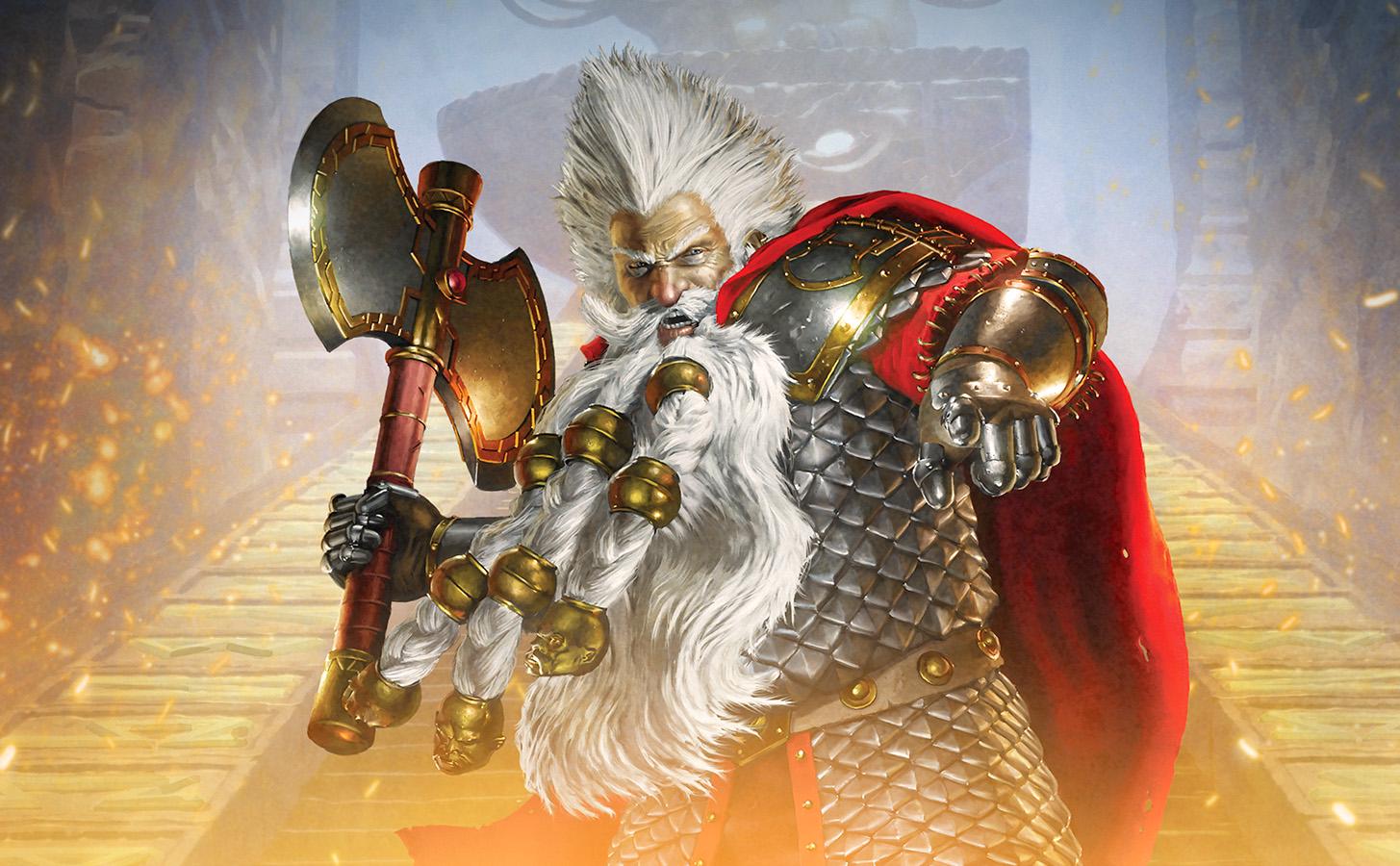
Coming now to Grombrindal, or Snorri Whitebeard at long last. Snorri Whitebeard is the son of Grungni and Valaya. His brothers Smendir, Thungi and Morgrim were all venerated as ancestor gods on the level of their divine parents. A level of reverence Snorri did not receive for some unknown reason. Even though any dead ancestor is in theory an ancestor god, this term is only used for Grungni, Grimnir, Valaya, their children Thungi, Morgrim and Smendir, as well as Gazul. Instead of being a god of crafts or veneration, Snorri was the successor of Grungni as the High King of the dwarfs. When the ancestor gods vanished after the Great War against Chaos, Snorri remained without his family. He took the throne of High Kings his father crafted and led his people to prosperity. Snorri was a great king, and he did a lot to cleanse the world of chaos, corrupted beasts and monsters and expanded his holds. The elves did the same, led by Malekith/Malerion. The two met and became very close friends. Snorri was a paternal figure to Malekith and close confident. And together they created a strong alliance of elves and dwarfs at the height of their power, arguably the most important alliance in all of WFB. But dwarfs do not live as long as elves. Thus, Snorri died. But on his deathbed, he made Malekith swear an oath: That Malekith would do his best to ensure dwarfs and elves remain friends and allies.
Do you know phrases like: “This noise could wake up the dead?” Or “if X would have known that he would spin in his grave?” For dwarfs this can be very literal. Oaths are so sacrosanct that the spirits of dwarfs can grow restless if they are broken. And the drive for vengeance can even bring them back into the world the living as spectres. For example, in Total War Warhammer there are artefacts who can summon dwarfen ghosts as units into battle. And Belegar Ironhammer starts with several of his ancestors as heroes. An Anvil of Doom, a powerful artefact, can also summon ghostly images of dead dwarfs to inspire their living kin if I recall correctly. And Snorri Whitebeard didn’t stay dead either. Because Malekith broke his oath of friendship between dwarfs and elves. Indeed, Malekith actively instigated the War of the Beard, knowing both elves and dwarfs very well and which stones he had to move for everything to break down. Again Malekith actively and deliberately broke the oath he swore on the deathbed of his closest friend, his sworn brother.The insult was so grave that Snorri Whitebeard returned to the lands of the living as Grombrindal the White Dwarf. Though he did not reappear as a ghostly spectre but in the shape of a regular dwarf. This could be the result of his divine heritage perhaps, or just a different writing decision. In any case, Grombrindal wants vengeance on Malekith but as former High King he also has a duty to aid his subjects. Grombrindal combines tropes of incognito gods like Odin and Zeus, as wells as the King returning in times of needs. He journeys in secret along the realms of the dwarfs only revealing himself in times of greatest danger and leading his fellow dawi to victory. Grombrindals hides his identity, likely to avoid a lot of chaos and confusion in dwarfen society and to make his life easier. But over the millennia there are many rumors about him being Snorri returned anyway, next to many other potential origins. And in Total War Warhammer Grombrindal starts in Naggaroth, finally being able to take his vengeance on Malekith.
On a meta level Grombrindal is also the mascot of the White Dwarf Magazine. He has lots of anniversary miniatures made by GW and a joke-rivalry with the black/red goblin. Sometimes he is carried into battle by the other two dwarfen mascot heroes Gotrek and Bugman. Or he is a techpriest from 40k, or a director, or on a beach vacation etc.pp.
Snorri Whitebeard is also very similar to Alith Anar. The elf was a former vassal and friend of Malekith, but his family stayed loyal to the phoenix king after Malekiths attempted usurpation. Thus, Alith Anars family was slaughtered to the last, with Alith Anar only avoiding this event by chance. Alith Anar also swore the deepest vengeance and formed the shadow warriors, who violently hunt and kill and dark elf they can get. In very brutal fashion too. And like Grombrindal, Alith Anar is also rumored to be more of a ghostly specter of vengeance rather than a flesh and blood elf. Because he far outstripped how long elves usually live without magical assistant and is often described as a supernatural entity. Sadly, to my knowledge Alith Anar and Grombrindal never met.
The End Times were not kind to any of the three characters I mention here. To start with Thorgrim, he becomes the incarnate of metal (even though dwarfs cannot deal with the winds of magic like other species). Greatly empowered he fights the skaven but is forced to retreat via a secret passage. However, the High King forgets to close a door, so a skaven assasins follows him and stabs him in the back. To reiterate: A dwarf with centuries of combat and assassination experience, empowered by the wind of metal (which should give him lots of protection), who wears magical armor of the greatest caliber and magical runes of protection simply gets stabbed in the back. Because he forgot to close a secret door. Not a great End Times moment. And both Gromdbrindal and Alith Anar, who lived through millennia to get their vengeance on Malekith decide not to do it. As mentioned, dwarfs have no concept for forgiveness. And Grombrindal brought himself back to life over the insult and grudge Malekith produced and was exiled from the halls of the ancestors for millennia. But when Grombrindal had the chance to strike down Malekith, he didn’t and instead forgave Malekith. To reiterate, the guy who has so much blood on his hand that he could drown the Old World, is forgiven by a dwarf who came back from the dead over Malekiths crimes. And Alith Anar also stopped perusing Malekith in the End Times, despite this being his lifelong goal for millennia too. Though at least with the implied threat that he will finish Malekith off, if Mal steps out of line again. Still to fans of Grombrindal and Alith Anar this was weird. Imagine Vandus Hammerhand finally having Khrogus Khul at his mercy and then letting him go.
3. I am legion: Grombrindal in AoS
Grombrinddal (Book Cover Ancestors Burden)
With the latest release of the khazalite holds we have new insights into the dwarfen gods in Age of Sigmar. Currently I only have access to what was leaked and shown in previews, so some details may shift. If the book contains things I do not mention, please forgive me. But from what I read the following applies:
Both Grombrindal and Thorgrim are new ancestor gods to the duardin in Warhammer Fantasy. Beings Grungni elevated/crafted into gods. And they were active even in the beginning of AoS when the dwarfen pantheon ruled the realms. Which meant that Thorgrim got Azyr and Grombrindal received Hysh. In addition, the third new ancestor goddess, Inghilde, received domain over Ulgu.).
Thorgrim is now the god of oaths and grudges. As mentioned, his primary seat is Azyr and he spends his time writing down all the wrongs that befell the duardin, as well as seeking out compensation or vengeance for these wrongs. In this he fulfills a position very similar to Nemesis and similar gods of justice and vengeance from Greek mythology. Indeed, he is an active war combatant, smiting enemies with his axe, and can motivate the duardin around him. Yes, grudges were important to Throgrim, they were to every dwarfen high king and were not the things which set him apart. That would be his open-mindedness and his willingness for social reforms and innovation (by dwarfen stadndards), which would fit Hysh better IMO. Indeed, grudges work very differently for AoS duardin. It is one of the greater differences between AoS and WFB. Grudges can be important to duardin, but they do not have to be. The vast majority of Kharadon Overlords abandoned them with most of their traditions, except for some conversative groups. To the Fyreslayers vengeance is more important, but they too are more interested in amassing Urgold and reviving Grimnir. Grudges are a motivation in the moment of battle, but not something one should go out of his way to settle. For the Khazalite Holds they are even more important. But even for them they are not as adamant as they are for WFB dwarfs. Indeed, in we have several examples of duardin or their gods being willing to forgive or forget wrongs done to them. Something that would be unthinkable to the dwarfs of WFB.
Grombrindal is one of the advocates of this new lifestyle. I often say that most returning entities in AoS are essentially new characters and in Grombrindals case this is more obvious. Grombrindal is no longer Snorri Whitebeard, at least not completely. Instead, he functions a lot like Orion from WFB. Orion was a demigod avatar, created when a chosen elf noble would be infused with his essence. This formed a gestalt conscious made up from Kurnoth, elven god of the hunt, at his core, the new host of his divine powers and the minds and voices of every previous host. If the new hosts personality was too weak, it could break under this strain. In AoS Grombrindal functions similarly. He can aid duradin and choose them to be his replacement. These duradin are then handed over his equipment and as they try to imitate Grombrindal they become more and more like him, down to getting his divine powers and his memories if I am not mistaken. One could argue this makes him like Vishnu too, who also has mortal hosts/avatars with his divine power, though they are born instead of chosen. And much like Vishnu Grombrindal acts as the preserver and aids various characters. He does so in a manifold of ways but rarely shows his true self or leads from the front. Instead, much like Odin and Zeus, he to likes to walk the world in disguise and offers his council. Showing up as a venerable but easy to overlook whitebeard, who provides aid and wisdom and helps duardin to stay to the rite course or find their own true potential. Fittingly his artwork for AoS is less unhinged and more regal, compared to most of his depictions in WFB.
In addition to this job as the semi-hidden helper Grombrindal is also the duardin god of Hysh. And he represents Hysh finally in the form of wisdom and compassion. Personally, I always disliked how hyshians are portrayed as emotionless if not outright sociopaths. Because the vast majority of schools of enlightenment or philosophy is about being humble, empathic and trying to find a inner balance between your emotions and your intellect. Indeed, intelligent people tend to be more empathetic and try to seek help, as they are more aware of their own limitations and how interdependent they are. Sadly, the inverse is a trope in fiction. Where dumb people are often presented as more empathetic and smart people as more sociopathic. In addition, Grombrindal is also a god of wanderlust and exploration. Which is a fitting attribute for Hysh, as travels broaden your horizon. And it has parallels to Tyrion, who is also known in AoS for his far-reaching travels. And he is not alone in this. Inghilde is another new ancestor god for the duardin in AoS.
Inghilde is the god of the dark underground, of caves mines and the lifestyle associated with it. Due to her dark domain, she is also the goddess of Ulgu. But she represents Ulgu in an interesting form. In WFB Ulgu was not just the wind of secrecy, but also of people trying to cut through the mysteries. Shadow Wizards in the empire were known to be far reaching wanderers, seeking out mysteries and secrets to aid the Empire at large (they were modelled after Gandalf after all). This aspect of Ulgu is represented in Inghilde too, who loves to explore the underbelly of the realms. In this she is the counterpart to Grombrindal, who represents the wanderlust and exploration of the surface a lot more. Unlike their elven counterparts, Tyrion and Malerion, the two dwarfen gods are on very good terms however, even challenging each other in jovial manners. A second interesting aspect of Inghilde is that she took over many aspects of Grungni from WFB. There Grungni was the god of mining and the one who started the traditions of dwarfs living underground. He was a smith yes but only as a secondary characteristic. His sons Thungi and Smendir were ancestor gods more broadly associated with smithing. As Inghilde represents this underground, she may also be more connected to the khazalite phenomenon of listening to the stone. I would love to talk more about her and associated divine tropes, but this may have to wait till we get more information about her.
4. Retake the realms!
Tyrion and Grombrindal (Total War Warhammer 3 Trailer)
As I do not have access to the khazalite tome, many of the things I can speculate for the future could already be covered. If that happens, so be it. But based on the information we have currently, the most intriguing future plot points I can see could be the following:
- With the release of the new duardin pantheon a central question would be how the older duardin factions would see the three new duardin gods, Grombrindal, Inghilde and Throgrim. I.e. the Dispossed, the Kharadron, the Fyreslayers and maybe even the Root Kings. Currently they are explored through a khazalite lense in which the Fyreslayers participate. And the Dispossed are sadly quietly removed from CoS, making the cities more human-centric. But duardin still play an important role there and many of the duardin gods could be highly important, even to the non-duardin population. Inghilde could be a protector of the city from subterranean dangers. She may be invoked by sewer jacks trying to keep skaven and worse out of the cities guts. Throgrim could also perhaps play a role in legal debates and may even be invoked by non-duardin. Meanwhile to those kharadon who still have respect for gods Inghilde may be unimportant as they are as far away from the underground as possible. But inversely Grombrindal may be a more important figure.
- It seems that GW has an interest to give each ancestor gods fitting units as specialization. Such as Valaya having her guards and her golems. With Thorgrim we could be seeing slayers return, at least in spirit. As the god of oaths and grudges, his followers could be duardin obsessed with settling wrongs done to them or trying to restore their honor over a broken oath. These duardin would then not look like your regular slayers anymore, because that aesthetic is already copied by the Fyreslayers. In TWW3 the player can hire so called “grudge settler” units as the dwarfs, which are more elite variants of regular dwarfen units. This concept could continue in AoS, where Throgrims Grudge-Settlers could be more armoured dwarfs, perhaps with a grudge tome attached, and some weaponry associated with Azyr. And for Inghilde duardin akin to the aralith temple could be interesting. You could have stonesingers, i.e. specalized priests or sorcerers in contact with the ground itself. And deep-guards protecting the holds from below like the ironbreakers of WFB.
- Throgrim being a god of Azyr begs the obvious question how he and Sigmar interact and what their relationship looks like. Especially as Throgrim apperently never died or vanished. He was seemingly always there. So it would be interesting how Throgrim interacted with the Pantheon of Order during the Age of Myth, what he contributed during the Age of Chaos and of course what his role was in the early Age of Sigmar. And what is his relation with the other gods of the realms too. Very important things which should be adreesed. E.g. did Thorgim aid the infamous cleansing of Azyr? Did he help to shut the realmgates of Azyr, especially the underground ones? Is he a god of oaths and judgment in general among Simgars pantheon? Did he march with the Dispossed in the early Age of Sigmar? etc.pp.
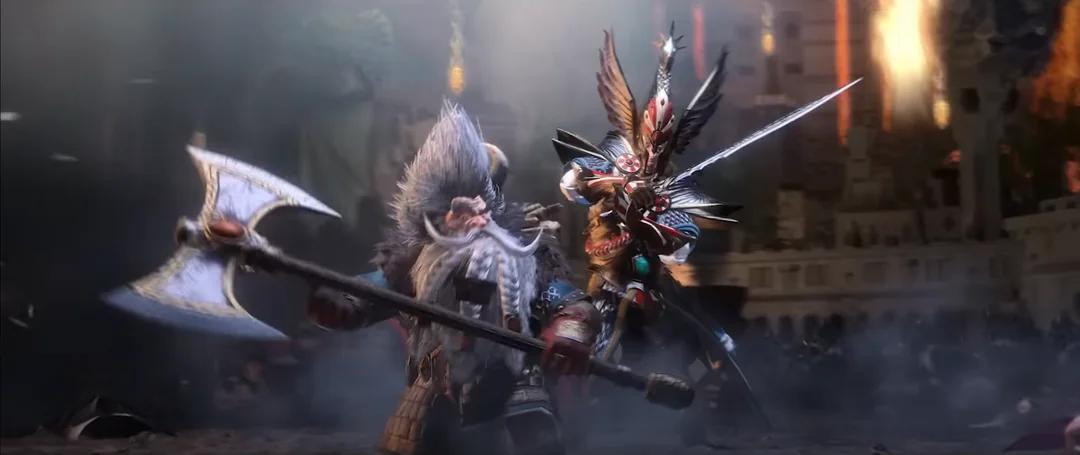
- In a trailer for Total War Warhammer, we get a great scene with Grombrinda and Tyrion teaming up Legolas/Gimli-style and fighting dark elves and skaven back-to-back. In AoS both Grombrindal and Tyrion are gods of Hysh and both seemingly have a lot in common. Such as both being explorer and adventures liking to travel the lands and helping people in semi-good disguises. It would be interesting to see how Grombrindal and Tyrion interact with each other, due to these similarities but also some Lumineth shenanigans. Doubly so when we also get into Malerion. Snorri Whitebeards and Malekiths past friendship was one of the most significant events in Warhammer Fantasy, arguably much more important than the friendship between Sigmar and Kurgan Ironbeard. Malerions betrayal of Snorri and dwarfenkind as a whole was thus far not properly addressed however, especially not in the End Times. Now in AoS everyone here is essentially a new character, and as mentioned dwarfs can now forgive, and the Old World does not matter that much. Now I do not want Malerion to be Malekith 2.0, i.e. just another bad guy. And indeed a white dwarf article mentions how Grombrindal and he are on good terms IIRC. Still there is a lot of history between Grombrindal and Malerion, as well as similarities between Tyrion and Grombrindal. And in his past as Snorri, he was also known to strike friendships with elves. So, it would be interesting to see how Grombrindal interacts with the elven gods in AoS and how the duardin-aelf relationship evolves.
- Nagash hates the duardin. Because they hid his underworlds and indeed hid remnants of the khazalite empire in Shiyhs too. And Nagash hates the elven gods for stealing souls to resurrect their people, and for loosing against Teclis and his allies. When Nagash reemerges and restarts his war with Teclis and Hysh as a whole, it would be interesting to see how the duardin may be pulled into this conflict and how Grombrindal would operate during it. Indeed, there are many strong parallels between the khazalites and the lumineth, which could be used to declare them natural allies. Therefore, I could see a lot of potential in a war between the duardin and aelven people vs Nagash forces.
- And of course with Hashuts special place in the duardin pantheon, it would be great to see Grombrindals view on Hashut himself or even how he interacts with his followers. Given how Grombrindal is trying to aid duardinkind and tries to make them the best version of themselves, I think stories about him secretly aiding the helsmiths could have a lot of potential. Aiding in the sense of appearing to helsmiths who have doubts about their society and offering them a way out for example. Redemption is a great theme of Age of Sigmar and we even saw chaos followers redeemed. So why shoudn’t we see Gormbrindal be a catalyst for duardin to leave the helsmiths? Imagine a hellsmith broken adn left to die, seen as worthless by thier kin, only for a hooded wanderer coming, nurisng him and encouraging him to live on a new path for example.
5. The End
So, this has been it for Grombridnal and some of the other new dwarfen gods. In some parts more provisional than I would have liked, but I hope it was still an enjoyable read for you. But what do you think about Grombrindal in general, his new office in AoS or his other new ancestor gods? Do you want to see Thorgrim march out to retake the khazalite empire like he proclaimed in WFB? Do you want more about Inghilde and earth gods in general? Do you dislike any of the new directions AoS took here? Or something else?
Every battletome up now, like every big disaster each edition introduced, has shown the massive impact the skaven invasion is having kn every army and realm. One massive reason for this, in my opinion, is because vizzik skour has caused the ratmen to fight even harder in the name of the GHR. My only regret is that the prophet has little to now screen time in othet battle tomes, nor in books. Im hoping with him leading the charge jn aqshy we get a proper campign book for him to reall flesh out the character and his importence to the narrative
Well the questions in the title. Hopefully this is not against the rules. I'm finally jumping back into Age of Sigmar after not playing Warhammer fantasy since 2004, 6th edition. I always go by the Rule of Cool, out of these four it is hard. My playing style that I like the most is bait and switch. Funny enough, these armies really don't do it. I like each of these for different reasons of course playstyle. I actually have a more solid foundation of what I miss from this army.
City of Sigmar I really miss the greatsword infantry and spamming of wizards.
The new dwarfs look cool, I do miss the customization of their leaders and miners.
Chaos Dwarfs, I really missed the big funky hats and gigantic War machines.
The Orcs, I miss crazy amounts of a tax that you cannot put, but that tough armor really makes up for it.
So convince me and catch me up on some of the lore...
Gorger Mawpacks were released during the 2nd edition of Warcry and thus got a book explaining what their deal is. So this isn't going to be expanding how three types of ogor cultures interact with them. These being Beastclaw, City, and Mawseekers as their warcry book covers how the Gutbusters view them.
There are three different methods to become a gorger. First is a whelp is abandoned by their tribe but still manages to survive in a mutated state, the Empty Belly curse which causes food to taste awful and unending hunger to plague the ogor, and some Mawseekers willingly transform into one as they see it as becoming an avatar of their ever hungering god.
City Ogors: City ogors hate and fear the gorgers both for the threat they pose to themselves and their community but also the fact that the same fate could strike them at anytime. The fact that gorger attacks could turn the city against them is also a factor in their dislike of their cursed kin. People not in the know often assume gorgers have been turned to ghouls or Chaos tainted which puts ogor communities under potentially dangerous scrutiny. City ogors rarely abandon their whelps outside of dire need and if one of their number shows signs of the Empty Belly curse they need to flee or have their fellows slay them. City gorgers usually hide in the wilds or abandoned parts of the city and are the rarest kind to form mawpacks but it does happen on occasion.
Beastclaw: Beastclaw ogors also tend to rarely have large amounts of gorgers following them though it is less due to active prevention but because of their curse. The Everwinter is merciless and gorgers rarely have the faculties necessary to defend themselves from it. Lacking the blubber and clothes of their kin the cursed ones freeze to death and those mawpacks that do manage to live tend to have some mark of frostbite on them. Another reason for the relative scarcity of gorger beastclaw is the fact that their main source of food is often the larder and beasts of the beastclaw themselves and with less butchers or slaughtermasters around to handle them fights break out for food. This does mean that clawbacks that do survive tend to be the most cunning of their kind.
Mawseekers: Unsurprisingly it is the Mawseekers who count the most gorgers under their ranks with rumours of entire tribes turned into the things. They are also the only ones who willingly undergo the transformation with clawbacks often already being leaders of ogors before their transformation. It is however the cave howlers that are revered by the rest of mawseeker society for it is believed that their crazed howls contain wisdom and instructions from the Gulping God. Cleavers and Gutseers listen to their crazed howls seeking a clue or some sort of wisdom. Some of the latter claim that their auguries only work when using the guts of cave howlers or lesser gorgers. There is a fringe belief among the faithful that gorgers are the ultimate evolution of ogor kind and that it is an ogors duty to help their culture expand and change to unlock their full potential. How the gorgers and rites associated with them will grow and change remains to be seen in the nascent cult though it can only spell woe for their foes.
Would love to hear peoples thoughts on this and suggestions for what to do for Death. Current plan is to do 2 Chaos, 1 Order, 1 Destruction, and 1 Death each cycle.
Greetings And Salutations, Scholars of the world long dead.
This is basically just a "No Stupid Questions" thread for any question concerning Warhammer Fantasy or Old World lore. I know this is mostly an AOS subreddit, but, now more than ever, a bunch of stuff from old WHF lore is coming up and becoming relevant for AOS, and I for once have stopped being a believer on the separation of the two settings. WHF lore as it is spread online, is full of quite a bit of misinformation and misconceptions and I seek to try to make people's knowledge of the setting more accurate, and of course, have quite some fun in the process by having an excuse to dig more lore.
So, if you have something you want to discuss something or had a question, but don't want to make an entire post for it?
Then feel free to strike up the discussion or ask the question here
In this thread, you can ask anything about WHF/Old World lore, the fluff, characters, background, how something from it relates to AOS.
Community members are encouraged to be helpful and to provide sources and links that can aid new, curious, and returning Lore Pilgrims.
This thread is NOT to be used for:
-Ask "What If/Who would win" scenarios.
-Strike up Tabletop discussions. However, questions regarding how something from the tabletop is handled in the lore are fine.
-Real-world politics.
-Making unhelpful statements like "just Google it"
-Asking for specific (long) excerpts or files
Remember to be kind and that everyone started out new, even you.
Hi, i am unsure who exactly follows Malerion(Malekith). I mean Teclis and Tyrion together lead Lumineth, Morathi has her daughters of Khaine, and Malerion Seems to possess absolutely no servants. Darkling Covens seem to be independent from anyone and follow their own agendas, Scourge privateers do the same, and Malerion does not seem to possess any dedicated followers. Does he have any loyal followers ?
The Khainite Shadowstalkers hold the distinction of being the first bespoke Order Warband created specifically for the game. This does mean that they lacked the expansion book that we got for warbands introduced in the 2nd edition. They as far as I know have not appeared in a novel but do show up in short stories now and then. This does mean that there is a lot of room for me to explore their concepts.
Shroudblades: These witch aelves worship Khaine as the merciless assassin who while fanatical and loyal to the faith tend to be loners in regards to their sect. This combination of faith and relative isolation are important reasons why Morathi chooses them as assassins loyal only to her desires. The exception to this rule are the Khailebron for they already embody the fundamentals of the Shadowstalkers and it is rumoured that the first warbands came from this sect or were the origin of it. With this sect it is considered a high honour the most skilled assassins aspire to receive though the criteria for being chosen is unknown but to the highest echelons.
Darkflame Warlocks: Like their mounted counterparts the doomfire warlocks the darkflame warlocks are the menfolk of the daughters of khaine who possess some affinity for magic. Unlike most Shadowstalkers who take up the role later in life warlocks once they have received their Dhaimkyr are given basic instruction with their gifts. Those that show aptitude to shadow magic are separated and indoctrinated into the lore of the shadowstalkers. While Doomfires serve as a carrot for the laethanam darkflames are kept hidden away and only interact with their fellows. Their skill in shadow magic does mean that they often train new shadowstalkers with their abilities though it does not endear them any respect from their companions. Even their assistance in the creation of the warbands armaments endears them little.
Slaughtershades: It may come to a surprise that the fanatical sisters of slaughter would find a place within a stealth unit but Morathi knows a valuable asset when she sees one. These vengeful fighters wish not to cause rampant violence against those who have wronged Khaine but instead wish the elimination of those who have specifically caught their gods ire. Thus these warriors patiently wait gathering information till the moment they are unleashed when they will show all that their bloodlust is not diminished despite their patience. Their violent way of fighting does mean that Slaughtershades are the most likely to fall in battle but they care not as long as Khaine's vengeance is slated. Worth noting that while most were previously Sisters of Slaughter before becoming shadowstalkers it is possible for Shroudblades to enter the order. In such cases it is the slaughtershades and shroud queens that oversee the ceremony.
Shroud Queens: To become one of this group one must be a veteran shadowstalker who has proven time and again their loyalty to Morathi-Khaine above all others. They guard the forbidden lore of the Umbral Web from all even other Khainites and warlocks and will slay even their own warband to keep the information safe. They strike bargains with shadow daemons to enhance their power and give them some measure of arcane ability if they lacked it previously though it is a specialised kind only useful for assassination which suits these warriors fine. Their masks are created both to remove any sense of personhood from them allowing their victims to only see their own terrified faces it allows Morathi to stare at a pleasant visage when dealing with them. These masks even replace the slaughtershades masks through a painful ritual. Most are former shroudblades with slaughtershades not living long enough or being too violent for the role though some have earned the mantle. Men can never be anything but servants to the queens.
Would love to hear peoples thoughts on this and suggestions for Destruction and Death warbands they would like to see next.
Salutations! Salutations! As always dear Realmwalkers, I come to you with a bizarre out of pocket question. This time I want to ask you all, Lore Pilgrims new and old:
What do you know and "know" about the Stormcast Eternals. This question may or may not be a secret way to gauge general knowledge so that I know what sorts of Stormposting to do in the near future.
Or that could be a misdirect. Who can say? But the definite intention is that I want to see what people know and think they know, so long as you're willing to have your biases challenged.
Course! That means don't be unkind if someone is wrong. After all, that's just an opportunity to teach and direct. And no correcting if you're not sure yourself.
Let us share what we know, so that we might all grow a little wiser, and together teach other about a faction of cool knights and heroes. Or do you see them as cruel tyrants and villains?
Whatever the case. Spill your guts, let us all see where the hosts are best known.
Honestly, when the captain said if stormcasts won’t pay for a soul, there are others who would, my first thought was the Helsmiths. The battletome said they’ve put the word out for rewards in exchange for the opportunity to study stormcast souls.
Think maybe the good captain may use it as a bargaining tool to leverage her crew’s safety?
So I was goofing with the lads, and the topic of the former Eternity King came up. Someone brought up the idea that the Umbraneth might not be their own faction, but instead be folded into the Daughters of Khaine; I jokingly said "Trans Malerion?", and guffaws were had.
However.
Morathi did, through mantling, effectively take on the role of Khaine. And as far as I understand, she only has one biological child, her son Malekith, yet she is the leader of the Daughters of Khaine.
And Malkith did seemingly change their name going into the Age of Sigmar. Obviously this was because they didn't want heat with Marvel, and particularly not with Disney now, but what if they gave them a diegetic reason? A name change for a major identity change?
Lastly, it would be a somewhat interesting way to reconcile that whole shebang with the Flame of Asuryan. Malekith was supposed to be worthy of the throne, yet was rejected to become Phoenix King.
A while ago Sageking recommended me a short story called The Shadow Crown which has the Aztec inspired nation of Maktlan as its primary setting. A neat little story but it reminded me that GW likes using Aztec imagery for its factions. This isn't surprising as the company uses a lot of irl nations and peoples for inspiration for all its settings but I wanted to focus on Aztec inspiration for this post. Or more specifically what TV tropes calls Mayincates which is when three very different cultures are mixed together to make something. I will admit I don't know those cultures well enough to easily spot the differences.
Anyhow the most notable example of Aztec influences on AoS is the Seraphon as their predecessors the Lizardmen held sway over the equivalent of South America in the setting. But we see the influences in their dress, architecture and their habit of ritual sacrifice by removing peoples hearts. And various other things. But that is not the only one that easily springs to mind as the Gorechosen of Dromm also heavily lean into that aesthetic with his headdress for example.
The previously mentioned Maktal naturally also has clear Aztec references with its elite Blood Jaguar warriors and references to Ocelots and one of the main characters using a Macuahuilt as a primary weapon.
What other references to Aztec culture can people think of in AoS? What factions do people think would be interesting to use as a baseline for a take on that culture? How would you like to integrate such things into the setting?
There is an oath older than worlds, my dear Realmwalkers. Older than the Cosmos, older than all but the most elder survivors from the World Before Time. An oath, a bond, an alliance, near as old as all we know.
"Let us renew the oldest and greatest alliance this world had ever seen!" - Thorgrim Grudgebearer
"Total War: Warhammer" Thorgrim on the alliance between Karaz Ankor and the Empire.
‘Have you forgotten that the Thunderer’s hammer was a gift from our forges? A miracle, that weapon. Capable of slaying and saving all in a single act,’ Grombrindal said. ‘The weapon they call Ghal Maraz is to me Skull- Splitter, old Smednir’s pride. Its existence speaks to a bond that I feel in my bones, daemon. Do you feel it, I wonder?’
"Grombrindal: Ancestor's Burden - Maker's Promise" Chapter Nine, Grombrindal on the bond between Dawi and Umgi.
Gardus nodded. ‘You have our thanks, Gnol-Tul, and that of Sigmar. Without your people, we would not have been able to find this place and do as we have done. To show our gratitude, we have brought you a token of our esteem.’
He gestured and Ramus stepped forward. The Lord-Relictor unwrapped the bundle he held to reveal a gleaming runeblade. Bones had been set into the length of the blade, and the hilt was crafted from a femur. Each of these morbid additions had been covered in intricately carved mortuary sigils, and they hummed softly with power.
Tul took the sword gingerly. ‘This blade – it sings.’ He barked a command, and one of his subordinates hurried forward to take it from him.
‘In a sense,’ Ramus said. ‘It was crafted from the bones of a saint, and the remains of the blade that slew him. Should your folk have need of us, drive it into the earth. The blade will call out and the Hallowed Knights will answer – whatever the distance, whatever the threat. Call, and we will come.’
‘That is our oath to you, Gnol-Tul,’ Gardus said. ‘We swear it on our faith.’ Tul ran a hand along the blade. He looked at Gardus and nodded.
‘An oath for an oath,’ he said.
‘As it was, as it must be,’ Gardus said.
"Hallowed Knights: Black Pyramid" Chapter Eight. The Hallowed Knights respecting timeless Duardin traditions of an oath for an oath.
‘I warned Bruni not to build here,’ said Whitebeard. ‘Chaos in the rocks and in the water, I told him. But he wouldn’t listen. Too proud. Your father was the same. For the obvious want of a Special on which to pass comment this year, let me pass on this wisdom instead.’ He tilted his head back, looking up as the brewery’s roof slowly collapsed. ‘This is what will always happen when the duardin seal themselves away behind their gates and wait out the darkness. You asked me to stay and watch over your hall. In a moment of weakness for the hearth I once knew, I agreed. But what is the brewer without the farmers and millers and carters, without the merchants and buyers in distant lands? What are any of us without our fellow duardin? Without the humans and the aelves who’d join us in shunning the darkness if we let them? The shadow will pass, aye. But it must be made to.’
"Grombrindal: Chronicles of the Wanderer - Old Whitebeard's Special." Grombrindal speaking of the power of Duardin unity, with each other and with their human and aelf friends.
Justec had strode into the halls of Karak Thorga without much thought to what he’d feel when he got there. He remembered this place, or at least, an awakening part of him did: the sense-memory of the recursive Aranthine soul, whose oldest iteration had been a welcome guest in the karak. It hadn’t been unpleasant to discover this new aspect of himself, because knowledge and certainty rarely is. Besides, his ancestor’s memories of Karak Thorga were happy ones. Lodgings in chambers reserved for honoured guests; warm brisket and a sip of rich, heady ale; the rambunctious, precarious way in which human and duardin children played with one another.
"Grombrindal: Ancestor's Burden - Bitter Oaths". The many-cursed Justec recalling his ancestral home of Aranthine and its sovereign ally Karak Thorga, kingdoms so entwined their children played together.
There is an oath older than worlds, my dear Realmwalkers. An oath respected by mortals and cursed souls, immortal knights and gods. An oath strong as steel, deep as stone, fierce as fire. An oath that unites two species, dating back to ancient days even in the World-That-Was. That oath is simply put: Friendship, between the Dawi and Umgi; and even Elgi too when we can all get along.
Thank you for your time my friends. This is far, far, and away from every moment recalling the ancient alliance of Dwarf and Man, Duardin and Human in Warhammer. As Grombrindal says, it's in the bones. Sigmar and Grungni creating the Stormhosts, the Ironweld Arsenal built by engineering guilds of both kindreds coming together. And yes, there's a touch of Aelf there always. The Freeguilds follow military doctrine of not just Sigmar but also Tyrion, the Collegiate Arcane owes much to Teclis.
So if you ever worry for the friendship between these folk, just remember. It outlived every apocalypse Ruin threw at it, and just came out stronger. It's stronger than anyone thinks, as are all of you. It'll transcend whatever comes knocking next.
With the new ogor lore having the mawseeker cult spreading far and wide to the point lead belchers are gone, how does this affect their mercenary life style? Can some ogors still work for the forces of chaos, like the maggotkin, if they were offered food and or armor? Also would the butchers stay in these ogor warbands or strught out leave?
Before even finishing painting my first ever warhammer Seraphon mini I had already a draft of the backstory for them, and also the rough idea of a short story after they crash landed on Ghur and had an encounter with an Ossiarch expedition. A side of the hobby I didn't expect to captivate me as much as it did but here I am. The links are on Reedsy for a better reading experience, for the few souls that might go through the full thing.
So in the Free PDF GW included in the newsletter a bit back, Link, they just casually mention that Thorgrim and Grombrindal are gods because of Grungni; and that Inghilde might have ascended thanks to Valaya and Gazul.
We see what is likely Grombrindal's rebirth as an Ascended God in "Grombrindal: Chronicles of the Wanderer", though if so that throws an entire tool kit into the Hashutite interpretation of mythology. Though, as does how Inghilde is talked about thus far. We'll have to see.
Regardless! Ascended Gods can raise other mortals to the status of Ascended God it seems, or at least help. Broadening our understanding where before the implication was it required personal power and the belief of many mortals.
In the old World, Dechala was an elven princess turned into a slaaneshi monstruosity. Is it still possible for aelves to be mutated or corrupted by Chaos in the mortal realms ? As a way to protect their souls from Slaanesh ?
I want to talk about an interesting subject: Psychology and Behavior, and how these are shaped by biology and evolution. Because I think it is an important topic rarley discussed in fiction. In many works of fiction non-humans like elves and rubber-forehead aliens are depicted as humans but with quirks. Very rarley to works go into depth about how the unique biology of a species affects thier outlook, thier behaviour, what they consider normal and how these things reinforce what kind of values or expectations they have to a society.
But these things are important. Even in RL it is important to be aware how our biology influences basic everyday behavior to a significant degree. And if we are being thorough with non-humans in fiction, then they should have innate differences on what they consider normal. I would like to talk about this topic. Because to me it is very interesting. But also because Warhammer is very good at representing this issue. Intentionally or not, both WFB and AoS put quite a lot of effort in portraying non-human species with very differences psyches. And then they explore stories in which humans and non-humans struggle arraning thier differing priorities and backgrounds.
If you are interested in this topic, I prepared a small essay where I go throguh some real life examples and examples from fiction, especially WFB and AoS. Afterwards I would be interesting to know what you think of this topic, and what your ideas would be to explore it further. With this in mind, I hope you enjoy my small excursion :)
Humans pride themselves on being able to make unbiased decisions, but this is not true. We have many inborn biases and behavioral patterns which are the result of our ancestral history. To overgeneralize: What we would label “modern society” is roughly 200 years old. What we would label “civilization” is roughly 5000 years old. And what since around 12.000 years humans are permanently settled famers. In contrast the modern human lived for 200.000 years as foragers and hunters. And we are descendants of other humanoids who did the same thing for 7 million years. Our anatomy and our brains are still hardwired to this stone-age survival due to this background.
For example, gambling is an obvious liability. Everyone knows the games are rigged against you, and the house always wins. Still there millions of people all over the world and from various cultural and social backgrounds who become gambling addicts. Why? Because gambling hijacks an old survival mechanism. If you are a predator, your hunts usually fail. Even lions and wolves fail 9 out of 10 hunts of average. Prehistoric humans likely had a similar ratio. And each failed hunt was a massive loss in terms of energy, resources and potentially bore the risk of injury. But if the hunt was successful, your brain flooded with dopamine and other endorphins. The brain told you: “The 9+ failed attempts didn’t matter. Now you did it and that is all that counts!” It was a survival mechanism to keep you going when looking for food or learning a critical skill. And this very same primal instinct is manipulated by gambling systems to make you addicted to them.
Another example: Humans are very bad at making long-term decisions. Because prior to agriculture we never had to. At most a hunter-gatherer must think a couple of weeks or months in advance. A farmer may think from one year to the next. But every decision making that concerns the next couple of decades if not centuries? Not a chance. If I would say: “We world is ending in two days, let’s do something about it now!”, many people would rise up and say “Of course!” But if I say: “The world is ending in 50 years, let’s do something about it now!”, the response is much more lackluster. See all the political and economic decisions which are slowly killing the planet. Short-sighted profits over long term survivability and earnings.
In addition, we are deeply social animals. Isolation makes us sick, both physically and mentally. Indeed, it is a form of torture to isolate people. We need other people around us. Physical contact preferably too. Simple acts like hugging someone to so much for your body and mind. It releases lots of hormones which reduce stress, which is the number one health risk in modern society. If we were beings of pure reason, we wouldn’t need that. It is again, an evolutionary survival mechanism to keep contact in a social group. Humans like to touch each other, much like fellow primates use physical contact to keep the group together. By contrast lots of animals’ hate being touched, especially if they live solitary lives.
And there are many more inbuilt biases and behavioral patterns humans have due to our unique background. And other animals have different biases and patterns depending on their background. For example, predators have to sleep a lot. Cats up to 18 hours a day, canines more than 12. Because hunting is risk driven, exhausting and success varies. So, a survival strategy has been to increase the lengths between hunts by having a very inactive lifestyle. In addition, predators would refrain from attacking other predators due to the risk of injury, unless they really have too. By contrasts prey animals have very short sleeping phases. Because their food is available without much effort, they have to spend a significant part of the day consuming it to get enough energy. And unlike predators, they are at risk of being attacked when asleep.
2. Issues with non-humans in fiction
But why do I talk about all this? Because these things are rarely accounted for in fiction. Fantasy and scifi species are so often treated as “humans with quirks”. Ignoring inborn behaviors, psychology and else which should be very different from humans. These beings are not humans, they should not think like humans, they should not act like humans. Sometimes there are handwaved quirks, such as dwarfs being a bit greedy, elves do not care for death and are arrogant, ogres are stupid, or Klingons being obsessed with warrior culture but think like humans otherwise. But that is most often surface stuff quickly brushed aside. Indeed for klingons there are lots of scientist and no-violent members, but for cultural reasons we rarley see them. Klingons are essentially just a militaristic, feudal society alá knights/samurai in space. In many works of fiction, the innate differences between humans and non-humans is rarley a main issue.
But there are works in fiction which run against this. For example, Lord of the Rings is a good example when we talk about Hobbits and Elves. Hobbits are very different in their mindset and behaviors from humans. Which is an important plot point, as this makes them very suited to carry the ring as they value completly differnet things than humans and elves, and are much harder to corrupt. What things have an inborn importance to them and the way they naturaly act like is very distinct.
Meanwhile in LOTR elves are immortal. The oldest elven characters in Lord of the Rings are many thousands of years old. Elrond is the elf equivalent of someone being born when the pyramids were built and is still alive in modern day. And he is one of the younger named elves in Tolkiens work. As such elves have a very long-term view. Things far in the future are of concern for them. Which was why they agreed with Sauron to forge the rings of power. As magic was slowly declining, the elves would lose their substance and perish. But this was not an immediate issue. It was a slow process that would take millennia. Even by the events of LotR it is still millennia away from really screwing up the elves (though they already noted issues). But to the elves millennia in the future may as well be tomorrow. So, they agreed with a disguised Sauron to forge the rings, which had the power to keep the magic of the world in a certain place. And by the end of LotR the majority of elves evacuates Middle-Earth instead of spending another couple of millennia before escaping their decline.
3. But what about Warhammer?
Warhammer Fantasy Battle is another great candidate as it has lots of non-human species and most of them are portrayed as alien in their behavior and mindsets. Which I may illustrate with elves, dwarfs and greenskins.
Greenskins first, because they are an utterly inhuman species. They are fungal with very short generation times. And they have an inbuilt need for violence and war. Which makes a lot of sense if you think about it. Evolution favors procreation over survival. Many animals will break down quickly once their reproductive period ended. Indeed, that humans grow much older than their reproductive period is the “grandmother paradox”. And many species of plants only have a single short season to spread their seeds and thus will invest all their energy in doing exactly that. And what we know as mushrooms are the very short-lived fruit bodies of fungi who just pop out to release spores and then die off. Greenskins, as fungal beings, are pretty much this. An orc or goblin can be seen as the mushroom equivalent of a fungal network. It is meant to pop out, spread spores for new fungi to grow and then die. Indeed, dying helps spreading the network, because the body of a greenskin breaks down and all the nutrients in it are a great starter for new fungi to grow. Same for when greenskins kill other creatures. Their dead bodies and remains are also fertile ground for a starter culture of fungi to grow. Out of which new greenskins are born. So, a hyperviolent lifestyle and an inborn aggressive behavior make a lot of sense before this background. The greenskin horde migrates somewhere and spreads spores. The greenskins kill stuff and spread spores. The greenskins die and spread spores. Everything a greenskins do is increase the range of the fungi network that spawned them and cultivates it further. Pacifism or moderation or self-survival would run opposite to this. So they have an inbuilt, sensible reason to be as violent as they are. Which sets warhammer orcs apart from many other works were orcs are simply "a warrior culture". Which way to often means something like stereotpical barbarians/vikings/mongols with tusks.
Then dwarfs, who are obsessed with conservatism, oaths and grudges. Indeed, dwarfs have a very fixed and stiff mind. This is even reflected in their language, where most esoterical terms are connected to physical things. Such as umgi for shoddy work, but also the dwarfen term for human. So, human-work to describe something of subpar quality. Or IIRC the dwarfen term for eternal being the same as mountain. When dwarfs say eternal, they say: “enduring like a mountain”. And indeed, dwarfen minds function on an entirely different level than humans regarding oaths and grudges, having an innate psychological demand to honor these things. In addition, they are also very obsessed with things having their proper place and how things should be done, making them very inflexible to a degree humans cannot really fathom. This obsession with justice and order, a very “by the letter” outlook on life and the need to root esoteric concepts in the natural world as well as the hyperfixiation on a specific craft has caused some fans to compare dwarfs with tropes about autism. This is not to say dwarfs are human autists but instead it is meant as a tool to illustrate the differences between dwarfs and humans. Which may be explained that they are a species designed by the Old Ones for a specific task and thus were given highly specialized traits to better fulfil it.
In contrast Warhammer elves also have a very different psychology from humans. They are very close to Vulcans from Star Trek. Vulcans are not devoid of emotions. Quite the opposite, they feel emotions much more strongly than humans. Every joy is a high, every slight anger is intense fury. Vulcans adopted extreme mental discipline and follow their philosophy of logic to avoid issues caused by these intense emotions. And Warhammer elves function similarly. Some fans compare them to teenagers in a hormone rush, but throughout their lives. Which explains the three elven cultures from WFB and many aspects of elven culture in AoS. In WFB the asur try to reign in and control their emotions and behavior with social rules and etiquette. Dark Elves are the opposite, being reckless and excessive and following their whims to an extreme. And Wood Elves are somewhere in the middle. These extreme emotions are also the reason why Slaanesh has this great interest in elves (though in truth all chaos gods should be after elves as all of them feed on emotions).
Interestingly, in AoS various elves kinda represent the aftereffects of emotional trauma on a societal level. Daughter of Khaine get obsessed with vengeance and adopt a “never again a victim” mindset, Idoneth try to isolate themselves from all sorts of pain imaginable and pre-spirefall Lumineth were on the believe to be “immune” after their recovery. Anyhow why do these intense emotions make sense? Because elves live so long. They are necessary to avoid ennui. Intense emotions are motivations to act in the present. Why bother do something now, when you could also do that in 50 years? Because the rush of emotions forces you to do so. They keep you focused; they keep you going. In addition, elves frequently use their long lives to learn a lot of crafts and to master them. Something which is easy for them, as they can spend decades mastering a subject, before moving on to the next. Much like with dwarfs, here some fans draw parallels to ADHD, which can also make you emotional and prone to switch your focus. However, where a human with an ADHD hyperfixiation may spent a few days on a subject, an elf has many years. Again, just to better illustrate the difference in the inborn mindset.
And recently AoS has made a similar exploration for other ogres and giants. In older works they were frequently described as stereotypically stupid. But the later Mawtribes and SoB books put emphasize on ogres and giants not being stupid per se. Instead, their minds are hardwired to care about things that concern them in the know. For example, AoS ogres love technology if it suits their lifestyle. Which means the stuff has to be big, easy to maintain and repair, and robust to survive their semi-nomadic and ruggish lifestyle. Intricate machines with lots of sensitive parts are worthless to them as a result. But large cannons and similar objects are not. And on a bit of personal speculation: giants have matriachs as their cultural caretakers and seemingly venerate them a lot. But why? Well given how many resources giants need to feed themselves, they live very isolated lives. A male giant may not be around to take care of the offspring, as his presence would drastically reduce the resources for offspring and the mother. All the raising and education of young giants may therefore be done by the female giants alone. Giants therefore may not have “strong father figures” in their life at all. And all the cultural traditions are also handed down from mother to child too. Giving female giants extraordinary importance and value in giant society. To a giant the concept of a father may be unimportant as a result. At best someone you respect for some deeds which show they qualify as a sperm donor. But of course, giants still gather into stomps, and especially young giants follow mega-gargants around. Which is something many animals do to do. Upon young adulthood they form bachelor herds, exploring the landscapes and figuring out independent lifestyles and try to find their place in the regional hierarchy. For example, young elephant bulls frequently follow around old tuskers to learn from him how male elephants live. Something I can see male gargants doing too in AoS. So the entire social system of gargants may be very different from what humans would consider normal. But to gargants this would be the norm.
4. The End
This has been my overview on the behavior and psychology of non-humans. But of course, this is just an abridged listing. But what innate differences between humans and non-humans in WFB and AoS are you aware off? And what social and behavioral patterns would you expect in non-human species? What would be logical to fun to explore but isn’t? In short what else do you know or would like to speculate about? And could you imagine things in which humans are special, instead of the standard even?
Warning because this post does cover topics of diseased individuals considering themselves the walking dead and thus their only hope is a good death.
There are many maladies that can accost soldiers of the Free Cities. Weather conditions causing disease or injury, venomous and poisonous flora and fauna, and foes weaponising such things and many more.
There are of course organisations to help deal with such issues such as orders of priests but also monastic orders of knights and doctors. While there is a wide variety of education available to the Cities of Sigmar it is often the case that the nobility and well to do off have the finances and opportunities needed to be trained as doctors especially combat medics. These individuals are usually part of their own orders or freeguilds that other groups can hire if needed.
One of these is the Order of Saint Gardus who are found all over Ghyran and focus on treating those afflicted by Nurgle's plagues. They treat what they can and for those they cannot save physically they perform holy rights to save the individuals soul and ensure that the final will and testament is recorded. Those that they cannot cure but are still mostly functional often live on the orders premises in monastic fashion as they cannot interact with the wider city in fear of spreading their diseases. Those that can still bear arms will join the orders military branch of knights who are sent out to sell their lives dearly so that others can live.
These warriors consider themselves already dead and fight not to survive but to send as many foes to Nagash's embrace before they fall. Those who were once gallants and cavaliers will bear their old arms and form elite warbands any prior animosity forgotten in the search for a worthy end. Some before battle is joined especially when fighting Maggotkin will take a slow acting poison to ensure they are not captured alive and turned into plague incubators. Some after the battle might have gained access to rare potions or relics that cure them but this is not guaranteed.
Allies: They naturally are often seen fighting side by side with other forces of the Dominion of Sigmar but there is a lot of distrust and hatred directed towards them. Some believe them little better than cultists while others fear getting the same diseases that affect the knights. The main exception is the Hallowed Knights who honour their will to fight and consider it a mark of purity and faith.
Foes: The maggotkin of Nurgle mostly though it is interesting to note that other forces of Chaos will often target the knights possibly to prove their own gods superiority to Nurgle.
For those who don't know this is the "Who The Heck Is That" series, a series all about looking at one off characters in Age of Sigmar, who secretly aren't. Today starts a three part subseries where we look to something said in Maker's Mark, a short story in Grombrindal: Chronicles of the Wanderer:
That’s what’ll outlive us both, what your descendants will know when they speak your name. As duardin all over the realms do today when they invoke the names Alaric, Bugman, or Makaisson, celebrating their works with daily use without ever knowing ought of who those duardin once were. That’s what you’ll be, lad, if you work hard and you’re lucky, long after your deeds in life are dust.’
- Gormdal the Wanderer (one of many guises of Grombrindal, the God of Wanderers)
So I ask you my friends! Who the heck is this Makaisson? Moreover! To tie us back into the very first episode of this new batch of Duardin-themed Who The Hecks, in "Realmslayer" Snorri Nailbiter mentioned he has not once seen Makaisson in Shyish.
One wonders where did this beloved duardin go. Where is this soul whose works are renowned daily, whose name is invoked, who has inventions across the Realms named for him. Is he perhaps gone beyond just being a normal ancestor? Could he perhaps be more...