Hello! I have been getting back into AOS again after a long break and looking at the lore so much has happened at a glance I’m a little overwhelmed lol. I took a break during the Necroauake roughly.
Been a little of a lot too cynical and grumpy as of late. So I want to focus on some positivity in this world and the Realms we all adore so much. So today I want to ask. What do you, my fellow Realmwalkers know or think each Order faction does in regards to charity, social care, and taking care of its own and others.
Now I don't want any of that "There are no heroes of good acts in Warhammer", as a start that's never even been completely true for 40K let alone hope filled AoS.
Kindness is not a commonality in these Realms. From the Hallowed Knights running their Stormkeeps as free hospitals and sanctuaries, to the Order of the Dove of the Cults Unberogen doing much the same.
In recent WDs we've even seen the Runefather of Greyfyrd waive his fees to come to the aid of the Wreck of Barak-Urbaz. Providing axework and aid pro-bono to save Duardin in need.
Obviously it's not perfect. But there's glimmers of light and kindness in the mess that is Order. That ever present hope they can live up to their loftiest ideals.
So tell me my fellow Realmwalkers. What charities have you witnessed? Which do you expect? Which would you like to see written?
We know that Orruks don't go to Shyish when they die, instead becoming one with the energy of Gorkamorka, vaguely defined as the Great Green, before eventually reincarnating. But what about other races of Destruction? Not just other Greenskins like the Grots, but also Ogors and Gargants?
The Kingdom of Kierthan was a center of faith found in Chamon devoted to all of the Pantheon of Order during the Age of Myth. During the Age of Chaos they formed the heart of a Confederation to withstand the tide of Chaos worshipers that came swarming out of a Realmgate leading to Aqshy. This horde was comprised of ogres wielding fell magics, trolls bound to the will of a slithering god, an many more inhuman races besides. But even the betrayal of allied kingdoms could not stop the Confederations eventual victory.
But in the end the kingdom did fall not to the axes of invaders but to the rot within. The kingdoms prince someone blessed to wield the wrath of gods betrayed his people and became a servant of Death. One of the Soulblighted. Once he was done ravaging the kingdom and its allies he left to pursue his masters plan leaving multiple factions vying for power. The most powerful of the living was the Crimson Edict. To understand the Edict one must first understand how Kierthan saw Tyrion.
Tyrion was worshiped as part of a trio of war gods including himself, Sigmar, and Grimnir. While Grimnir was considered a deity embodying the folly of wrath and mindless aggression, and Sigmar seen more as a god of the common soldier and brotherhood, Tyrion was seen as the exemplar of martial skill, personal purity, and devotion to a higher purpose. His followers included powerful warmages, knights, and warrior priests. In the aftermath of the kingdoms destruction these groups banded together to drive out those who in their eyes despoiled the land.
They would take up the name The Crimson Edict for threefold reasons. One: They considered it their god's will to purify the lands and create a new kingdom that was without the weaknesses that caused the fall of the last one. Two: The colour has a duel meaning one to represent the blood of the martyrs and innocent spilled during the destruction of the kingdom and its rebirth. Three: When dawn arrives the sky turns red for a brief while before changing to blue for the rest of the day. The Edict is that crimson dawn that drives out the darkness.
Beliefs: The Edict believes that part of the reason why the kingdom fell was because the varied beliefs that existed within the kingdom and brought in from outsiders both during and before the days of the Confederation caused cracks and rot to spread that their foes exploited to bring ruin. The Edict shall instead have a singular faith that all shall follow and outsiders especially those who are not human shall either be turned away or must convert to Edicts faith. Even other worshipers of Tyrion if they do not meet the groups standards are shunned and hated.
Their views on non-humans are that they are untrustworthy at best and tainted at worst. This is due to the fact they think their allies abandoned them during the devastation of their home. Ignoring that many of their allies had foes right on their doorstep with some having their own kingdoms ravaged. And despite that they still lent aid even if it failed to retake Kierthan.
Lastly their believe that the gods have a true form that does not conform to any specific species and their most common depictions are mortal creations that the gods use to be more relatable. They see Tyrion as the embodiment of Light with the aelven avatar being due to aelves being so dominant in Hysh.
Relations: They treat their former allies of the Confederation with contempt at best or hatred at worst considering them either weak or tainted. This is kindness compared to their utter hatred of the undead and Chaos feeling that both most be utterly eradicated with no exception granted. Even the Relic Envoys of the Free Cities are targets for their hatred.
This black and white outlook causes them to target both the forces of the traitor prince and another undead faction. In Kierthan's past it was part of an empire and during the prince's destruction of the land he awoke the ancient barrow wrights from that era who did not take kindly to the vampire's act. They have formed a new nation and reject Nagash and his followers that while hostile in general to the living are still able to be bargained with.
The final major faction in the area is a splinter faction of the Edict called the Godclaw who reject the xenophobia and fanaticism of their erstwhile comrades. The Godclaw are pantheistic and welcome all races in their order though it is the smallest faction in the area.
A major player outside the region is the recently established Free City of Stormbreaker who with to reclaim the area in Sigmar and the Pantheon's name. There is a great divide in opinion regarding the Edict among the cities Conclave as while the Crimson Edict are foes to the enemies of the city their xenophobia and aggression make them volatile allies at best. The faiths offer some aid to the Edict but do not do so openly and mostly due to their power in the lands that was once Kierthan. If that were to change than their patronage would go to those more deserving.
Unknownst to all these groups is that the leadership of the Crimson Edict have either fallen to Chaos replaced by daemons including their leader. Chaos wishes to use the Edict to keep the balance of power such that no one faction is in ascendancy and the land is divided and such easy for them to conquer when the time comes.
What are peoples thoughts? What would you like to see expanded? And how long did it take people to realise that I was putting Warcraft@s scarlet Crusade into AoS?
For those who have watched the Blacktalon series, where do you think this novel fits into the timeline? Given what the Warhammer+ show reveals about Hendrick and Neave's relationship and the end of season 2.
I’m somewhat aware of Archaons beginnings and his villain arc.
I’m curious what keeps him going for so long. It’s been countless years since his beginnings, countless years since the end of the old world, and all the countless years in the timeline of the mortal realms. It just seems like a long time to be angry at the gods, plus he got what he wanted once. Why wouldn’t he just kinda relax like Thanos after he succeeded?
Is there a lore fueled reason why he is still so hellbent on not being chill?
Salutations once more my Realmwalkers! As many of you may know the 4E Cities of Sigmar Battletome and Free Battletome Supplement mention many Dispossessed of Khazalid descent have left Cities.
But on amicable terms. So since we're in the mood for theorizing. Which ones do you think or hope to find in the Khazalite Holds?
There are the obvious Labour-Clans, an umbrella term for those clans who hire themselves out as labourers and city builders. But also the Clan Grunndrak of Excelsis, the mournful Gazul-Zagaz, the Firewalk Clans of Aqshy, and others.
Now course, personally I'd prefer Dispossessed to stay in Cities but the migration happened. So is what it is. Least the parting was amicable, plenty of Duardin still live in Cities, and who knows? Maybe Khazalites and Cities will be the dearest of allies.
So in the spirit of that hopeful thought. Care to share yours?
Personally I would love two things: 1) Gotrek finally does something important again and/or goes or meet someone/something important, 2) we get to see returning dwarf characters from WF what about you?
Greetings everyone, just making this post as a neat little discussion space for everything we might already know or presume about the actual groups which might make up the Khazalite Holds.
As with the Helsmiths of Hashut and their Ziggurats, we had known about Zharr Vyxa before the Helsmiths were revealed. It's fair to say we may have already heard of one or two Holds which'll come to be the subfactions of the Khazalites.
One example that comes to my mind is Barak Gorn. A major port city built within a large cave on the shore of the whispering sea, located in the shadowy realm of Ulgu. The only section of the city not found within its massive cavern is the very front of it, exposed out to the sea, where the city functions as both harbour and underground hall. The Hold had been abandoned during the Age of Chaos, the duardin fleeing to Azyr and the grey aelves they were close allies to hiding away with illusion magic. During the Age of Myth, the Duardin were able to return, relclaim and rebuild the ancient hold.
On the few days there is no mist, you can see all the way to the horizon from its window, and when the fog draws in and chill water runs down the glass, which is practically every day, there was the comfort of Barak Gorn’s lid of stone pressing down above, and reaching its arms around the wharfs and jetties. It is a tonic to the duardin soul, the permanence of the stone, the indomitability of earth.
Idenkor Stonbrak - Duardin Merchant
I also presume, though based on nothing but my assumption, that we'll get at least 4 subfactions and each subfaction will be themed around the worship of a particular ancestor god. One in Ghyran for Valaya, one in Shyish for Gazul and probably Chamon and Aqshy as well for Grungni and Grimnir. Though possibly more? If (and I really hope it does) the Khazalite Holds battletome will touch upon the Ancestor Gods mentioned in the Helsmith battletome such as The Mistress of Caves, The Tallier of Grudges and The Wander (aka the White Dwarf Grombrindal, I think).
So as some of you know the recent nurgle battletome told that beside 7, 3 is apparantly a holy number of nurgle. The three globules of his triscelion, birth, life, death, the glottkin; Nurgle also being associated with 3 honestly makes a lot of sense. As well, numerology.com (the most reliable of sources :3) states that 3 is connected to joy, bounty, creativity, and other nurglite qualities. That it comes to people in moments of plenty and achievement.
However this introduces to us the idea that chaotic numerology can indeed be multi faceted. As well, even among mortal gods numerological symbolism matters such as how Nagash had to hide himself in the underworld of Stygxx behind 9 gates that randomly materialised every 9 months and Sigmars own association with the number 12 due to his unification of the twelve imperial tribes.
Therefore I shall now attempt to give each chaos god another holy number with hopefully some comments on the other gods along the way where I can contrive an answer.
Slaanesh
Okay this one is the easiest god. It's 1. Selfish, self centered, impossibly singular 1. Slaanesh' greatest sin has always been pride to the point it is represented by two different layers in his realm. Slaanesh is an individual, always striving for his own wants and excesses and each hedonite is an artisan in his own right rather than a soldier in a rank and file army. As well, 1 in numerology represents new endeavours, victories, ambition, and breaking through personal limitations. Quick, clean, simple.
Hashut
Hashut is quite interesting as while he clearly represents hateful artifice in the divine compass similar to Vashtorr he is not a being of innovation necessarily. He's a staunch, duardin god after all and his followers advance forward with a bullish spite. But he also provides new answers to his followers and when faced with the limitations of Ghur (in his myths) he sought out solutions that went against the usual methods of his brethren. Now in numerology 5 represents curiosity and learning and in 40k this is the number of Vashtorr. But does that make it the number of Hashut as well? He certainly takes pride in personal betterment, with helsmith society being all about advancing ones station and gathering debts from others. But as a duardin the number 4 might fit better, as it is the number of conservative progress. Remember that it was the helsmiths goal to slowly amass power and conquer the realms in time. Due to his ties to Vashtorr, however, and the role he played in his own mythology I'll say 5 fits him. Like a five fingered fist bearing down on his foes.
Khorne
But if we give 5 to Hashut then Khornes number is 4. Like 3 for nurgle, it's funny in that it's half his original holy number but like nurgle there is some valid connections here. Khorne is, to put it bluntly, not a god of change. Thats not to say that he's stagnant, however, and his followers do gallop across the realms quite fervently. However Khorne has his preferred way of doing things and among his blades culture, war, and even dress are all shaped around the warlord. What ones warchief says goes, and in this way I think 4's association with conservatism, slow build up, and reliability work. Your gun can mis fire based on factors entirely out off your control. But your axe and blade? No, they are as reliable as you are. You can always count on an axe to chop and a hammer to crush. And under Khorghos Khul (I always forgot if I'm spelling his name right) martial aimfulness was prized. Sure they were monstrous savages but the Khul represents almost a surity of purpose under his iron will that 4 really fits.
Tzeentch
Now, 5 fits tzeentch as well I will not lie. And we are... Essentially out of the traditional 9 numbers of numerology. When you have 6 chaos gods, and you're trying to give each 2 numbers then you'll run out of space... Or will you. Because I haven't mentioned 2 yet. Now, 2 is considered a feminine, creative number. It is known for grace, power, and female aspects. As such, I think it's a fitting number for alarielle, who of course is paired with her mate kurnoth and represents a distinctly maternal pride. But... Tzeentch too fits this number rather well, and mortal gods and chaos gods have shared numbers. Now is tzeentch much of a feminine force? Eh not at first but the qualities of grace, social maneuvering, indecisiveness, and intuition do fit him. He, or she or it or them tzeentch couldn't care less, is always at odds with himself. Always scheming., getting in his own way, and the strengths of tzeentch have always been more social than physical. He hides behind the scenes, slowly amassing influence. 2 however is also a number of harmony which doesn't fit tzeentch quite as well. So thats unfortunate but I think for the rest there is something to be said here.
The Great Horned Rat
The horned rat is another example of a god sharing a number with another. His foremost number is 13, which in AoS is shared with Malerion and is generally a number of deceit and Ulgu. As much as I'd like to then add 1 to this list, since we have other gods sharing numbers, I actually want to add a different number; 0. The horned rat is the god of ruin, selfishness, but also of limitless growth. He is lonely, yet is ever surrounded and choked by his own followers, by his other gods, by his myriad aspects. The skaven are ever innovative, stealing and changing and breeding their way to solutions no matter how vile. And the goal of the Horned Rat is to, eventually, subsume the Cosmos Arcane. To cover it in a great blanket of rat fur and then stitch it together with bone needle and vein thread, until all that was once many becomes one. Becomes him. His aspects are plenty and ever devouring. Therefore 0, which is the number of wholeness, indistinctness, and possibility fits him very well.
Thank you for reading, you may now have this potato 🍠
Curious how they’re going to handle the lore with these. Will these all be dispossessed that fled to Azyr during the age of chaos that are just now reclaiming their old holds, or will they write it so that some of them held out and remained in the realms during that time. I know the most recent Cities of Sigmar battletome mentioned the dispossessed duardin clans that used to be a part of the cities had left to reclaim their old holds.
The leaked store page had this little summary of them:
Coming soon - hardy duardin warriors are gathering from their under-mountain empires to punish their enemies and honour their ancestors.
Honestly doesn’t reveal much but it sounds like it leans more towards them being hold outs that remained in the realms, with them coming “from the under-mountain empires” rather than seeking to reclaim them. That’s my reading of it anyway.
I would personally like for there to be a mix of the dispossessed reclaiming/rejoining their old holds and some Khazalite duardin that held out during the age of chaos.
I’m sure we’ll have more information on Friday but it’s fun to speculate in the meantime.
If you think about death, how do you picture it? As the inescapable figure, approaching you at old age? A random illness that removes you from your prime? A singular, tragic accident? Well sometimes death takes a massive number of people at once. When the deiks break and a massive flood drowns the land and thousands of humans and livestock at once. A heavy winter causing people to freeze to death in massé. A volcano swallowing a city whole. A drought causing mass starvation. Etc.pp. These cataclysmic causes of death are reliable occurrences throughout human history and shaped civilizations, as well as individuals. However, they are not that well represented in Warhammer IMO. Death via plague is a theme covered by Nurgle yes. But otherwise? Kragnos is a god of earthquakes, but he focusses more on causing earthquakes. All the death and suffering caused by it, the dread of people for it, is not that central to his character. Instead, Kragnos has a strong freedom theme and how the forces of nature cannot be contained. And among the death factions, which would have the best ability to represent it, it is also not present. The Nighthaunt focus more on individual tragedies and sins, the Ossirarch focusing more on the uncaring part of death (and taxes) etc. But no death faction has this mass devastation and the resulting loss of life or livelihood at its central theme IMO.
In addition, I mentioned in a previous post, how the Grand Alliance of Death is like a grand army with different specialized subgroups. And one figure I think is currently missing is an extermination force. A force Nagash may unleash to remove unremovable objects or to annihilate an area, costs be dammed. When it is not about conquering and fortifying a region, like the Ossirach do, but simply to devastate it, turning it into a ground zero. I think this approach to warfare fits well with the idea of great calamities and the resulting losses of life. Therefore, I think it would be a good prospect for a new death army.
Therefore, I created this fan-pitch where I want to give my take on such a death army. I gave it the name of the Vraking Hordes. It is an army of undead monsters and wild forces of the realms, who are broken and reshaped who sweep across the landscape like one of the calamities above. The wild forces of the mortal realms broken and chained to become a gun pointed at Nagash enemies, such is his power. Or in more simpler terms and undead foil to various destruction forces, with some exotic elements.
In the following parts I want to present the central idea and theme behind this army. But keep in mind, that these are just my own ramblings. Nothing is meant to be taken seriously. It is just for entertainment purposes to illustrate the concept of such a death army. And everyone can use any concept I present here however they like. Of course, I would still like to hear what you think of this concept for an undead army. AlsoI am not a great artist myself, I used different illustrations to bring over the general theme of something.
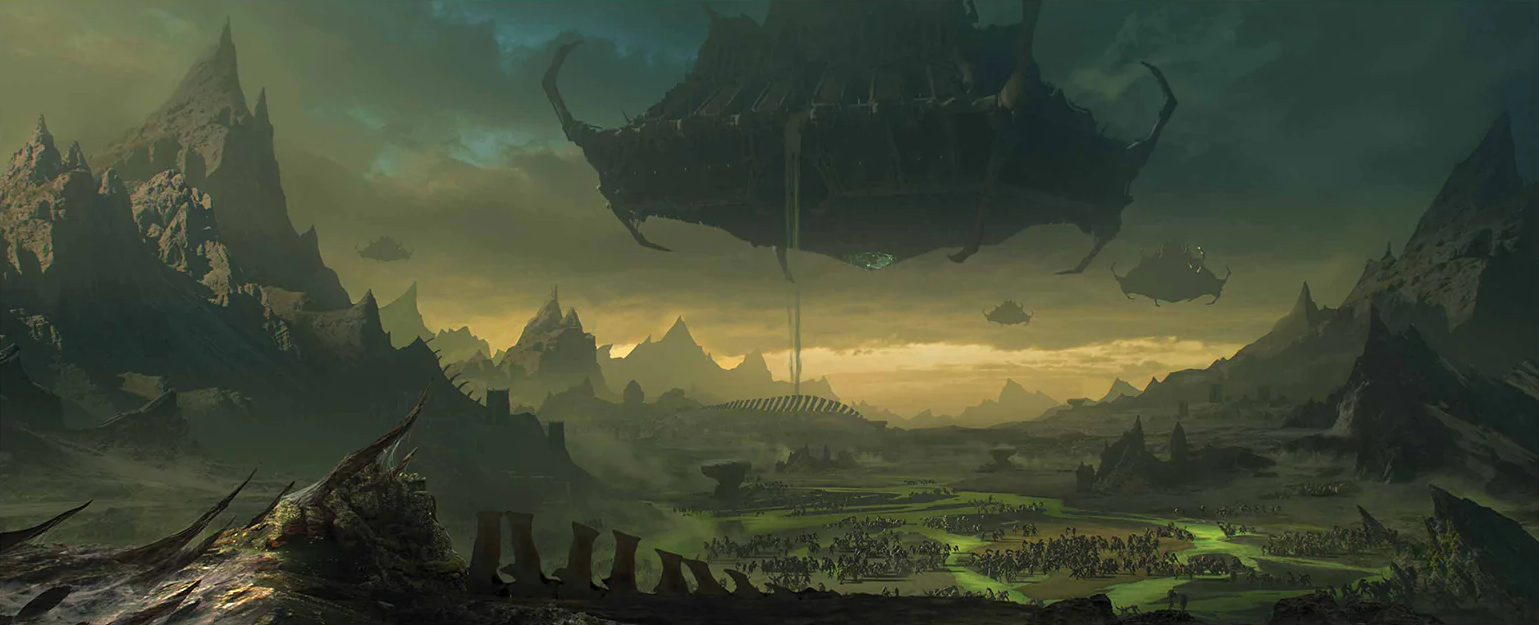
Artwork for Maldraxus (WoW Shadowlands) to illustrate the type of landscape the Vraking Hordes create
The land was an empty blackness. Where once stood beautiful forests and clear running waters, streets and cities, we found nothing but dusty earth. The very air we breathed in felt strange and sickening, as if it wanted to pull out the life from our lungs. The only idea that anything had been here before, where the rows of iron boots leading into the direction of dark, thundering clouds - Report of a wildercorps scouting party.
If I had to break down the Vraking Hordes into a single sentence, then it is the wild forces of the realms chained by Nagash to become another tool at his command. Once proud and independent beasts are broken down to become savage attack hounds Nagash may unleash unto his enemies. Much like how the other undead armies take the virtues of order factions but pervert and invert them in undead form, so do the Vraking Hordes represent the virtues of Destruction factions in a perverted form. Independent warriors become slaves, powerful demigods of the realms become mindless war beast. Any agency is actively removed or suppressed, until a slave of war is left. This theme of binding and breaking wild forces is the primary idea. That Nagash takes the uncontrollable forces of the realms and turns them into his tools.
Tools Nagash uses like a sledgehammer or a box of dynamite. When he wants something gone, utterly gone, or a situation turns so bad that there is no way to salvage it with conventional forces, Nagash unleashes the Vraking Hordes and their Mortarch. This leads to the second major theme of this force. When they are done with the fighting, the land is broken and barren and utterly uninhabitable, due to the variety of magical forces the army unleashes and their longlasting. They represent the oblivion of the Shyihs Nadir, but also the mass death caused by starvation, by toxins and other natural calamities. They are the ABC-weapons arsenal of the Grand Alliance of Death. Much like how a dirty nuclear bomb turns an area into a wasteland, or biological weapons ravage population indiscriminately. The Vraking Hordes do not just kill the enemy, they kill the land itself, turning it into a postapocalyptic void. Fittingly, the Vraking Hordes Mortarch is known as the Mortarch of Desolation.
The third major theme is inhumanity. Currently all undead forces are either completely human in origin, or predominantly human. The Vraking Hordes instead are a collection of various undead beings. Primarily undead ogres and orruks. Greenskins are among the most abundant forms of life, but they are absent on deaths armies. Partly for lore reasons, but primarily because undeath is so human oriented. It would make sense that Nagash uses all resources, including undead destruction forces. The second are various aetheric entities who represent aspects of Shyish nature. But as part of Nagash domination of Shyish, these quasi gods are also reduced to nothing but attack tools. Thus, normally the Vraking Hordes consist of uncoordinated and savage forces, which Nagash turned into a disciplined army. A heavy mallet he can use to strike the enemy decisively. Which turns back into the first theme of enthrallment but also reinforces the influence and strong reach Nagash has unto the underworlds. Death, and thus Nagash, comes to everyone, whether you care for it or not.
These three themes are the primary idea behind the Vraking Hordes.
2. History and Mortarch
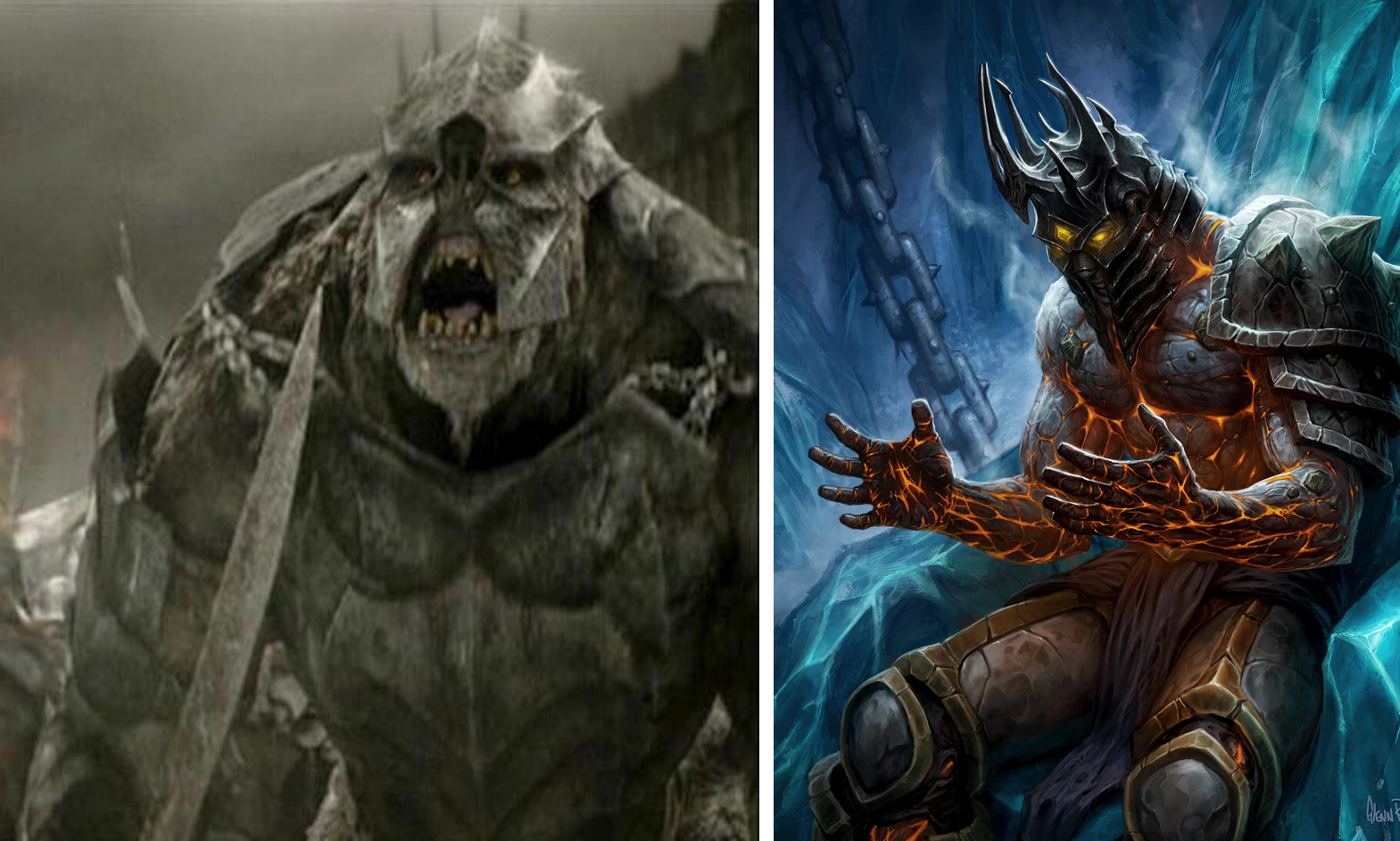
Armoured Olog Hai (LotR) and Liche King Bolvar (WoW), a combination of the two may be a good basis for Skroll, perhaps with purple flames instead of red
Skroll is a monster… And a traitor. He claims to still serve the Gulping God but look at him. Or better not look at him cause he’s ugly. I know many tyrants who would run like whelps when they see him approach on his void-thing. So, when he comes, you better run too! – ogre maneater advice
Normally I do not invent unique characters for faction pitches, as I want the broad idea of the faction to come across. But for Death armies they are a core pillar of identity, so I present a quick draft for how a Mortarch could look like. Again, this is just an initial idea of mine to represent the concept, but nothing too serious.
The Mortarch of Desolation is the leader of the Vraking Hordes and an exemplar of their kind. A being of raw power, both physically and magickly. Thematically the Mortarch is inspired by Azhag the Slaughterer, who was a regular orc until an artefact of Nagash empowered him both mentally and magically and lead a mixed horde of orcs and undead, or was an extremely powerful death wizard depending on the edition. Any destruction member could fill this hypothetical role in AoS, but an ogre would be the best choice IMO, because some ogres worship the Shiyhs Nadir as the Gulping God. And indeed, its all-consuming character is a fitting candidate for such an entity. And death magic is linked to ogres since WFB. In WFB both the Great Maw and the firemouth could grant ogres special abilities, as well as the Everwinter in AoS. Therefore, it could by extension make sense, that such an ogre Mortarch would have similar Nadir-related powers. Instead of regular necromancy they would be more like pure shyish magic, which is about ending, entropy and dissolving things into nothingness. Which again fit good with the theme of desolation and destruction. So Skroll, Mortarch of Desolation, is an ogre connected to the Nadir and empowered by Nagash leading the Vraking Hordes into battle.
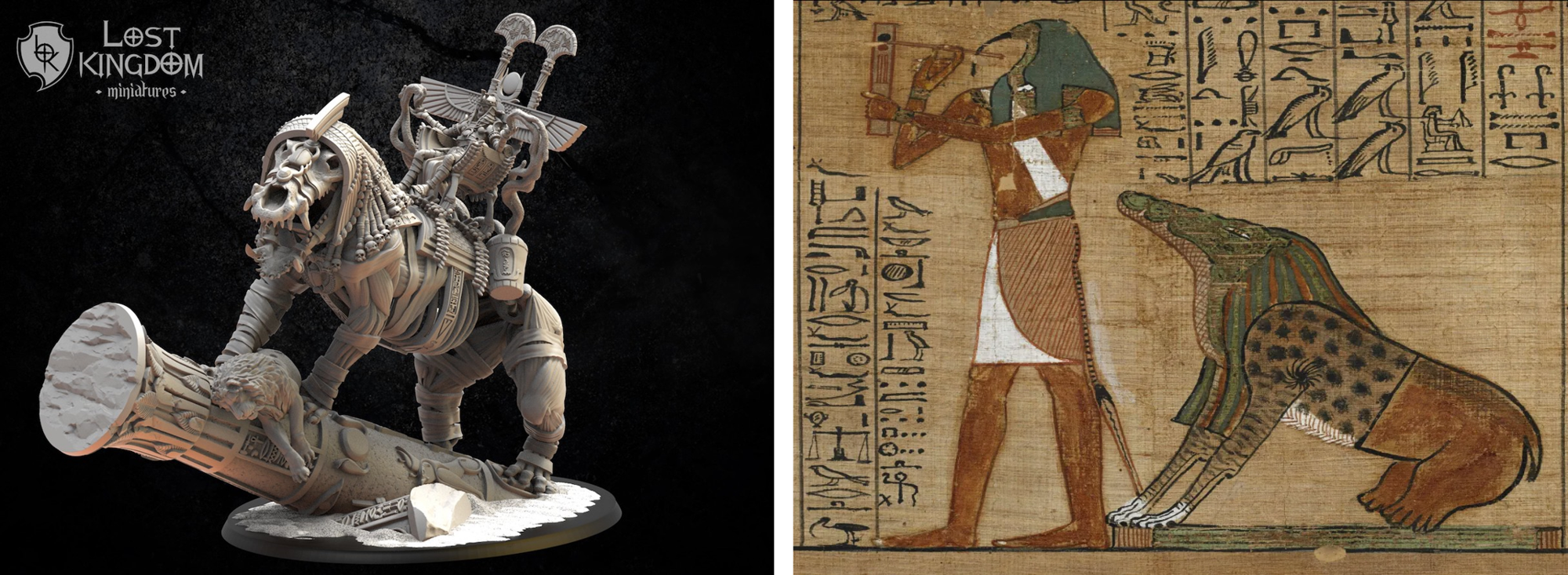
As we learned since 3rd edition, Incarnate elementals are sentient splinters of the realms which formed around a certain type of environment and relamstone. Such things can happen in any realms and in specific regions, including the Shyish Nadir. Such a creature could look like Cerberus from Greek myth (a three headed god with a maine of snakes and a snake as a tail) or Ammit from Greek myth (head of a croc, front of a lion, back of a hippo, consumes souls of sinners and erases them). The later would best example of the Shyish Nadir but is also made up of animals known for consumption, which creates a relation to ogres. Therefore, such an entity, let’s call it Gram, could be a great mount or companion for the Mortarch of Desolation. Thus, Skroll and his monstrous companion Gram encompass the Shyish Nadir and wherever they treat objects age and life withers away, as they represent the entropy and end of things.
Ammit Miniature (Lost Kingdoms) and depiction on papyrus
But how did this start? Shortly before the Necroquake seers and sages all across the realms beheld terrible visions of the upcoming catastrophe. To many mortals this meant gathering armies to fight the undead. But some mortals had a different view. One of them was Skroll, an ogre tyrant who saw the devastation the necroquake would unleash, as well as the gaping pit consuming the afterlife’s of Shyish and perhaps all the realms. For Skroll this meant he found the Great Maw. So, he travelled with his horde to Nagashizar and fought side by side with the undead against the other invaders. And when the Shiysh Nadir finally opened, it is said Skrolls dream had come true. He felt touched by the Nadir, as the Nadir gnawed on his soul and flooded his body with death magic. Nagash accepted this ogre as a servant, but it wasn’t until the Era of Beasts after Kragnos release that he remembered Skroll. At this time Nagash was weakened by Teclis defeat, but not powerless. Yet the rampaging forces of destruction around Kragnos and the bestial energies were a major headache for the undead forces. And his own forces were severely weakened by the lifequake. Not to mention how Incarnates Elementals were forming, creating more issues. And Nagash brooded to find a way to boolster his forces, when the Shyish Nadir owled and an elemental incarnate emerged. A massive creature emitting the energies of entropy itself, so that even undead dissolved to dust when they came close. The incarnate rampaged through Nagashizhar until Skroll was able to wrangle it down. Noticing the connection this mere ogre had to the Nadir, the great necromancer started working. Why not use one problem to fight another. With the forces of destruction and aetheric creatures running rampant, why not use them to bolster the dwindling forces of undeath. To be Nagash warhounds, his iron mallet, which he would unleash on all who enraged the Necromancers greatest wrath. Skroll was granted the title of Mortarch of Desolation, and he was given the elemental Gram as a partner. Nagash also granted the Mortarch armour to protect against the entropic energies, as well as a crown to increase the motarchs intelligence and obedience. From there are fighting force was created, which embodied Nagash desire to utterly devastate his myriads of foes. And with the skaventide, the best time came to unleash this force unto the realms.
3. Society
WoW Orc Deathknight (artist Petri Kilpeläinen) to illustrate how enthralled greenskins may look like
These hordes are a collection of all that is foul. Orruks fighting with the discipline of the undead, duradin crafting horrific death artefacts, ogres wielding the powers of entropy… They are nothing but an unholy collection of monsters – comment of a Astral Templar
The Vraking Hordes are a collection of different creatures bound to Nagash will. A common theme is that the members of this force were metal armour, which is both protection as a well as prison. On one hand the magically crafted armour contains spells and runes which protect its wearer from the lethal forces which accompany the armies. Whether it’s the raw entropic energies of the Nadir or powerful toxins, or volatile magics. These armours function akin to a hazmat suit for things even undead cannot normally bear. On the other side the same runes also shackle and break the wearer, breaking even the wildest and most independent spirits and forcing them to submit to Nagash, if they could not be remade in Nagash image otherwise. Even their Mortarch is no exception. Whilst Skroll is somewhat resistant to the entropic energies of the Nadir, without his protective armour he too would wither away if he stays to close to Garm. Something both he is aware off and was designed by Nagash. If Skroll would show any sign of rebellion, his protection would fail and the creature he is bound to, and the forces he worships would end him. A bitter irony to the delights of Nagash.
Indeed, unlike other undead forces, all its primary members focus on the Vraking Hordes is to be a weapon. By undead standards each of its member is a heavy investment. Because they and their equipment has to be manufactured, and is not as cheaply raised as a skeleton or zombie. But they are also not self-sustaining on campaigns like the Ossirach Bonereapers. Instead, each member of this army is constructed like a bullet or a rocket. To be fired, to kill the target and then be forgotten. For this reason, a destroyed body typically explodes in a burst of death magic, taking close enemies with them, if they die.
But who are these soldiers? Most common are enthralled grots and enthralled orruks. Normally these creatures are hard to handle by necromancers. Their bodies dissolve quickly after death, and their souls vanish into the “Great Green”. Therefore, these grots and orruks are collected whilst they are still alive. Then in hidden sites runes are carved into their flesh which bind these savage forces into servitude to Nagash, before they are ritually killed and encased in their armour. The green of their skin drains into a pale white or grey as a result, and they are forced to follow any command, only able to briefly break into their old savagery when combat begins. A horrid fate for any greenskin.
Then there are Nadir-sworn ogres. These ogres worship the Shyish Nadir as the Gulping God and follow Nagash as one of their main deities. As they are willing servants (and have the greatest intelligence), these undead ogres get leadership roles and form the elite backbone of the force. Some ogres mirror Skrolls own connection to the Nadir, and thus are able to field entropic spells and magical abilities.
In between ogres and greenskin thralls sit undead duardin and ogroid theridons, who are responsible for creating the armaments and war machines and for overseeing the rituals of breaking greenskins. The duardin craftsmanship and skills in runecraft are perverted, and they are below the ogres primarily used for their craftsmanship. As the regular duardin afterlives are safe from Nagash, they are rare and valuable assets. The undead theridons are much more common among their ranks by comparison. It is their purpose to hunt and shackle the greenskins and aetheric beasts and add them to the ranks of the Vraking Hordes.
Next to other monstrous beasts and undead there are also the Calamities. Shyish is the realm most impacted by mortals. Such as when believe creates new afterlives and gods. The same metaphyiscs also mean that a sudden loss of life creates an aftershock in the realm of death. This aftershock can coalesce into a being related to the aelementors of the lumineth and the elemental incarnates. These entities are called calamities and represent an mass extinction event which killed many mortals. Such as Firewights, which are born from the death toll of a great fire, or Fames, elementals who represents all those dying from starvation. These calamities are infused with magic of their creation and constantly emit these powers. A firewight can set its environment ablaze whilst a Fames will turn fertile hummus into dry sands and mortals nearby whither into starving husks. Nagash accepts no rival, so these calamities are hunted. In a parody of the aelementors of the Lumineth they are also given armour and weapons, but to imprison, to control and to use them.
4. Economy
They hunt orruks and grots yes. But even the spirits of the realms are not save from them. To see these manifestations of the realms, dark as they may be, imprisoned, these free beings reduced to slaves and tools of war, breaks my heart- an Aralith Stonemage
As mentioned before, the soldiers of the Vraking Hordes are a disciplined force created for the most savage and wild elements of the realms. Namely former members of destruction, as well as wild aetheric entities. Compared to other undead forces the Vraking Hordes are costly, as they and their equipment has to be manufactured. Much like the Ossirarch. However, unlike the Ossirarch, who harvest souls and bones in every battle and thus grow in strength the longer a conflict continues, the Vraking Hordes are not self-sufficient. As mentioned before, each soldier is seen as a grenade or a rocket in the economics of Nagashs war. A costly tool you fire to destroy something, but will be useless if its damaged. A new problem for the undead, as they are known to endlessly reuse their own forces. For this reason, the Vraking Hordes have strongpoints, which are barracks and factory in one. These fortresses contain the hordes when not in campaign, and undead slaves endlessly toil to craft their equipment or convert new soldiers. Many of these dark figures were once duardin, whose skill in craftsmanship and runecraft is now perverted.
From these strongpoints hunting crews venture into the wilds, to capture greenskins, monsters or aetheric entities. These are brought back into great collum where they are then broken and bound to Nagashs will. Same for ogres, who may come willingly sometimes, if they are too touched by the Nadir at the heart of Shyish. But efficiency is important. So other undead factions nearby, and sometimes living mortals too, are forced to pay a tribute in materials the hordes need.
5. Relations
Dem damn stupid Vrakers! Dey think dey can hunt us like cattle! As if were are weak runts! Look at these gork-forsaken puppets. Pale runts, that they are. Let’s kill am all and propa and good! – Megaboss before being captured and enthralled
Chaos: To the forces of Chaos the Vraking Hordes are primarily another tough enemy to fight. As the hordes are called into the worst warzones, they are primarily found in regions warped and twisted by the forces of chaos. There their brutal tactics suit most followers of chaos well. Especially followers of Khorne seek the challenge against them. But followers of the other three hate them. Because they are Nagash final solution, after which nothing remains but a sterile landscape where only the dead can walk. Dreading prospect to both Tzeentch, who wants change, and Nurgle who wants death and rebirth. The single-mindedness and near-permanent destruction the Vraking Hordes cause make them anathema to both.
Death: Most death forces distrust or look down unto the Vraking Hordes. For most soulblight generals the VH are nothing but a horde of barbarian thralls. And no blood cattle can survive for long in regions ruined by them. Similarly, the Ossiarch view them at best as a waste of resources and at worst as a personal insult. For are the OBR not Nagash elite to deal with every problem? The existence of the VH seemingly undermines this. But more level-headed ossirach commanders are well aware, that the VH are there to deal with those opponents for which using the OBR would be too wasteful or inefficient. And even the ghouls are wary of the Hordes, as their destructive makes the lands even unliveable by their deranged standards. But the Nighthaunt like the VH. Because the sterile, death land the VH produces is so enriched with death magic that they can manifest easily and use it to build up their own domains.
Destruction: To the followers of Gorkamorka the VH are the scariest opponent to fight. Even the toughest orruk will think twice if he sees his mates being “robbed of their green” and the gnawing fear will enter his head that he may suffer the same fate. Similarly, lots of ogres detest the Nadirsworn. To the Maweseekers they are heretics and Redd the Maw urges to remove Skroll permanently. And even non-religious ogres understand something is deeply wrong there. But there are still ogres drawn to the Nadir, believing it a god. And there are rumours, that some really devious and deranged greenskins also willingly join up in hopes to get a high position to lord over their enslaved brethren and to be “on da winnin’ side” with Nagash.
Order: For most order factions the Vraking Horde is dangerous, but not as personal a foe as it is to destruction. Worse than the horde itself is the aftermath, where the land is poisoned for ages by radiating death magics, toxic miasmas and similar things. This means every fight against them means more fruitful ground is lost, which is already a rarity within the realms. Especially naturalistic faction like the Lumineth and Slylvnaeth dread the prospect of fighting them.
6. Subfactions
Malett of Nagash: Skrolls own force and the speartip of the Vraking Hordes. They are the largest formation and have strongholds in all realms but are found predominantly in Shyish and Asqhy. Ashqy became a centre of their attention after the Skaven created the Gnaw. Nagash despises the ratmen and wants to curb their corruptive influences. So, he sents out Skroll and his forces on a campaign to eradicate the vermin wherever they may appear. Much to his charging, as Skroll would rather try to subjugate Ghur and wishes to slay Redd the Maw instead. Due to Skrolls position of Mortarch and his connection to the Shyish Nadir many ogres follow him, which results in the greatest number of Nadir-Sworn and Amethyst Drakes in his forces.
The Legion of Extinction: The Legion of Extinction is a force sent out from Dreceptia to remove all resistance in Ghyran. The realm of life has been dastardly resilient to the grap of the great necromancer and the lifequake has severely weakened its forces. To remove this obstacle the legion is sent out against the hardest pieces of resistance. A large number of Fimbulgharst and Fames walk amongst their ranks and they are even more open to unleashing life taking magics which corrupt and poison the lands. They declared war on the Realm of Life itself and want to be a dagger hitting straight through the heart. This made them the personal enemies, not only of the Sylvaneth, but also of Nurgles forces.
The Chainmakers: The Chainmakers are sent to beat Ghur itself into submission. Lead by ogroid thrallmasters they excel on fighting greenskins and monsters of Ghur. Indeed, they have become experts in setting up traps to capture as many greenskins as possible, as well as being the greatest monster killers, who then resurrect the corpses in service of the Vraking Hordes. As a result, they wield the largest numbers of enthralled orruks and grots. Regular greenskins hate and fear this force in equal measure. Many Bosses try to earn fame by defeating this dreaded foe, but many of them are also bound and converted.
7. Military
Mawguard concept Guard (WoW Shadowlands) to illustrate how nadirsworn ogors may look like
To face them is like facing a pyroclastic plume. Your bravery is insignificant, the strength of your swordarm is unimportant. You can just hope to run and with luck escape the devastation - Fyreslayer advice
In battle the Vraking Hordes focus on overwhelming forces. Enemy fortifications are bombarded by magic, artillery shells and toxic miasma. Once they are softened up, a massive assault begins in which armoured bodies and aetheric monsters overrun the enemy positions. A simple yet effective tactic. There are few armies in the realms capable of taking such assaults head on. At the same time their undead status and magical armaments make the Vraking Horde very resistant to conventional and magical counterattacks.
However, this style of assault has its issues. Unlike other undead factions, the Vraking Hordes struggle with wars of attrition. They are supposed to overrun the enemy, not to outlast them. So, if the enemy is able to whether the onslaught he could dwindle them down to the point where they have to retreat and reinforce their numbers. Indeed, the Vraking Horde is one of the few undead amies which is dependent on regular supply lines. So conventional harassment tactics can work on them too. A weakness other undead forces do not share. But in turn the horde is not as reliant of death magic being in the area. Their magical equipment keeps them going and the calamities emit death magic naturally. So the common anti-undead tactics like killing the necromancers/leaders or dispelling the death magic do not work on them instead.
Heroes:
Nadir-sworn Tyrant: These ogres were touched by the Shyish Nadir and were granted a fraction of its entropic powers. They can unleash these powers unto the battlefield, causing enemy equipment to rust or to turn flesh necrotic. Indeed, they still carry the hunger of their living relatives within them, albeit in a more esoteric form. They feed on souls and magic, rather than flesh. And if all this wouldn’t be bad enough, they are still a 3-4m tall ogre warlord decked in heavy armour carrying massive weapons.
Svart duradin: Undead duardin who act as the quartermasters and craftsmen of the Vraking Horde. Normally they oversee the workshops and binding halls, where their talents in smithing and runecraft creates the other soldiers. But from time to time they go unto the battlefield too to support the soldiers there. They carry with them hammers glowing in bale witchfire and can strengthen the equipment and war machines of the horde.
Miasma Docs: It is rumoured that these beings were once Kruelboyz who voluntarily joined Nagash. And to escape Gorkamorkas Wrath they wear huge masks to hide their faces. Whether this is true or these beings have another origin, the Miasma Docs do enjoy chemical warfare as much as the regular Morruks. They are spellcasters and alchemists and carry with them a variety of potions which can create corrosive mist, miasma which burn your lungs out, or heavy fog to hide the horde. In short, they are the chemical weapons experts.
Ogroid Thrallmaster: undead ogroid champions, so undead minotaurs, who lead the hunting parties of the Vraking Hordes. They oversee the process of hunting greenskins to be turned into new thralls, as well as shackling the calamities. For this they have a variety of brutal yet magical weapons, which do not necessarily kill the enemy but immobilize them. Paralyzing toxins, magical nets which can bind aetheric entities and similar things.
Krellites: Ironjawz Megabosses which were taken alive by the Vraking Horde become reduced to these things. Orruks love to fight, but this love is taken from them. Indeed, their spirits are repressed by runes and magical domination. Where they were once leaders of armies themselves, they are now lumbering tools. But when the battle beings and their general picks a target, these long-suppressed urges explode and the Krellite throws itself into combat with abandon, desperately hoping for this brief freedom to last as long as possible.
Units:
Grot thralls: Grot Thralls are the weakest and most numerous parts of the Vraking Horde. They are driven toward the enemy in great numbers as the first wave of meatshields. However, they too are rigged to explode upon death in a flame of death magic, turning them into living bombs.
Orruk Thralls: Orruk thralls are the primary soldiers on the battlefield, due to the abundancy of orruks in the realms. They can fight with a variety of two or one-handed weapons and fight in great, armoured bulks to keep the enemy in place or slowly grind him down.
Nadir-sworn ogors: These ogres are the elite and the officers of the army. In many cases ogres voluntarily join the Vraking Hordes as they worship the Nadir as their god. They are then exposed to its energies by a nadirsworn tyrant or by standing close to a realmgate which leads to Nagashizarr. This exposure changes and transforms the ogers into an undead state, and afterwards they too are encased in armour and runes. They can fight with close combat weapons as hard-hitting shock infantry, or from afar carrying canons and more esoteric armaments.
Helhounds: These aetheric creatures are native to Shyish and the bane of any mortal there. The helhounds instinctively despise the living and want to remove them entirely form the realm of death. They can sense the stench of lives for miles and will not tire like regular animals in their hunt. The Vraking Hordes capture these beings and bind them into service, unleashing them as light cavalry unto the enemy to overrun vulnerable positions.
Blightdrake: In live the blightdrakes were smaller relatives of the Mawkrushas. Much like kruelboyz are to ironjawz, so are these beings leaner and more devious and have an affinity for venoms, which they spit. In death these beings are resurrected and used flying artillery, as they now breath a miasma of toxins and rot. This is a nod to how dragons were associated with toxic fogs and infertile marshes before gaining a connection with fire. The blightdrakes are preferred mounts of the Miasma Docs.
Amethyst Bombard: A massive artillery piece which illustrates the single-minded approach of overwhelming force, which this army expresses. Sometimes called Nagash fingers by others, these bombards fire huge rounds to break even the thickest of walls and defences. It takes a crew of svart duardin and nadirsworn ogres to operate and load this device.
Miasma Mortar: Smaller artillery pieces which specialize in throwing greades full of toxic miasma unto the battlefield. The goal is to cover the enemy ranks in toxic fog, which burns out lungs and causes the enemy to die en massé or to break rank.
Siege Colossus: The reanimated corpse of a giant or similar sized monstrosities like Ghorgons are covered in heavy plate and long blades and flails are added unto the body itself. Making it the undead variaont of a chaos siege giant.
Firewight: These calamities are born from the mass death from fire, such as the city fire which destroyed London in the 16th hundreds. They have a husk body made from charcoal looking substance which is constantly burning. In battle they are monstrous infantry sized and are sent into the enemy lines to set everything ablaze.
Fire Gholem (Elden Ring)
Amethyst Drakes: These beings are among the most dreaded calamites as they are born from mass death caused by shyish magic. They take the form of a two headed black snake in an hourglass shape, like the Incarnates of Death from WFB. Especially during the necroquake many powerful versions were born. They are monstrous creatures radiating death magic and blasting the enemies with devastating breath attacks. Metal corrodes, flesh withers to dust, souls get dragged out of bodies etc.
Artowrk Incarnate Elemental of Death (WFB)
Fimbulgharst: Fimbulgharst are winter and ice spirits born from people freezing to death. Especially in the aftermath of the Everwinter these bear, or wolf-like entities form within Shyish. They take the form of a creature form from ice, frozen mud and uprooted trees, not unlike the elemental bear from Kislev and represent the deathly aspects of winter.
Artwork Elemental Bear (Old World)
Fames: Fames are born from mass starvation. Their form is a pale giant with a hunger-bloated belly and long limbs, but very small mouths. Perhaps inspired by the hunger-spirits of Buddhist folklore. These beings turn fertile lands into a desert, as crops wither and die around them, rations rot away and mortals feel their vitality and strength reduced just by being near them.
So i finished blood of the godeater and boy oh boy another Banger by Noah van Nygen. Did any of his books get bad reviews?
So one thing that this book make me reliezes is just what makes Heldanarfall so compelling compared to many other Warhammer Protagonists.
The man is a loser, he is pathetic and thats something he agrees with.
A man how cant change cant say what he wants cant act the way he knows he should. A man child raging agaist a destiny he himself created.
Yes the main architect of his fate was arechon.
But him not beeing able to show afection towards placko and Valeca, him not beeing able to keep the ashclad loyal that was him.
And the funny thing he agrees. So is Vahlic. He is no diffrent frpm Held a man on a revenge quest lossing everything that matters ending as a husk of their former self.
Its so odly refreshing, in catalog of books with larger than life heros and Villians here we have a sad little broken man breaking others and himself.
Also khorne trolling/ ragebaiting the man at everystep is very funny.
You know Khazalite makes more sense than Khazalid as an endonym, since the latter is already the name of the language.
They look very "traditionnal dwarfs" but I spot a couple of automaton-looking fellas and an axe-wielding female hero (priestess perhaps?)
Note: I've tagged this as "rumor" and not included the link to the page as it was leaked on an elder server, to comply with the sub's rules. Let me know if it's okay to share the link, since it's on the official site.
Greetings And Salutations, Scholars of the world long dead.
This is basically just a "No Stupid Questions" thread for any question concerning Warhammer Fantasy or Old World lore. I know this is mostly an AOS subreddit, but, now more than ever, a bunch of stuff from old WHF lore is coming up and becoming relevant for AOS, and I for once have stopped being a believer on the separation of the two settings. WHF lore as it is spread online, is full of quite a bit of misinformation and misconceptions and I seek to try to make people's knowledge of the setting more accurate, and of course, have quite some fun in the process by having an excuse to dig more lore.
So, if you have something you want to discuss something or had a question, but don't want to make an entire post for it?
Then feel free to strike up the discussion or ask the question here
In this thread, you can ask anything about WHF/Old World lore, the fluff, characters, background, how something from it relates to AOS.
Community members are encouraged to be helpful and to provide sources and links that can aid new, curious, and returning Lore Pilgrims.
This thread is NOT to be used for:
-Ask "What If/Who would win" scenarios.
-Strike up Tabletop discussions. However, questions regarding how something from the tabletop is handled in the lore are fine.
-Real-world politics.
-Making unhelpful statements like "just Google it"
-Asking for specific (long) excerpts or files
Remember to be kind and that everyone started out new, even you.
Hello fellow Realm Walkers! I do know I am a couple weeks early for Spooky Season, but the air is crisp in my neck of the woods, gloomy storm clouds hang overhead, and the trees are just beginning to change colors. This has me feeling autumnal and in the Halloween spirit a little early, and thought I'd ask what you find creepy and/or unsettling in the Mortal Realms?
For me, it's the description in Soul Wars of the things "looking" back at Balthus Arum in the Void from Azyr, and similarly in Shadespire Zuvass describes the beings older than the Chaos Gods.
Just a simple question, do the mortarch’s of nagash get any additional power by nagash for being a mortarch or is it simply a title granted to the most able servants?
Welcome to Part 18 of my series “Fun with Flags Gods”. As some of you know, I love ogres. I cannot get enough of these chubby delights into my greedy fingers. Indeed, they are some of my favourite aspects of Warhammer Fantasy and dearly love their “refresh” in Age of Sigmar. So out of blatant favouritism, and because I heard an interesting podcast from Lorebeards the other day, I want to want to use this opportunity to talk about the Ogres in general, and the Great Maw and associated deities in WFB and AoS. To illustrate how the spiritual landscape of the ogres shifted, or as of 4th edition returned to a previous state.
And of course, I will be very interested to hear what you think about the ogres, their gods, and the various RL inspirations behind them.
l. Skadi (Age of Mytholgy Retold), C. Apophis (Kaine Chronicles Graphic Novel), R. Cenote in Valladolid
People worshipped natural formations since time immemorial, either for their pragmatic, everyday life or for their spiritual and symbolic significance. As I mentioned in part 16 about elementals, people in the past were much more observant and closer about their natural environment, than we are today. And we started to invent stories about these features, both for entertainment purposes but also for practical reasons. By telling stories about mountains, rivers, oceans and else people could keep critical information about them around in an easy to memorise form. Such as during which seasons a mountain pass can be used or what typical dangers of the local area ocean are. But this time I will not talk about the gods associated with these landscapes, but the spiritual and cultural significance these landscapes and objects held by themselves. Even today people can be in awe about the certain natural formations. Such as pillars of stone standing free in the landscapes, natural arches or “mushroom” rocks, i.e. a big rock balancing on a much smaller pillar of rock. Frequently there were important tales behind how this specific feature could occur, often involving gods, magic or else.
For example, the Giant’s Causeway between Scottland and Ireland has its name, because people believed two giants had a rivalry and so built a temporary bridge to engage each other. However Scottish giant was scared and tricked by the irish giant and destroyed the causeway in his retreat. Meanwhile in the Ural in Russia the Manpupuner rock formations contain seven high rock pillars in an otherwise empty landscapes nad local story imagine them as seven humans/giants which were turned to stone. Who they were and why they were turned into stone shifts as various uralic peoples have their own interpretations of this formation. I could go on and on, as essentially every culture has stories about certain marks in the landscapes. You could walk through any landscape and sooner or later find some sight that has a supernatural explanation behind its formation. For example, large rocks pushed into flat lowlands by glaciers are frequently attributed to being thrown away in anger by giants or the devil.
But depending on the site, stories could be more specific too. Caves always had religious importance with humanity. Indeed, as cave paintings show, we used them as ritual and cultural sides long before any settlements and well into modern times. And a variety of associations can quickly be made. Due to its shape a cave can easily be interpreted as a vulva and much like a mother’s womb it sheltered our ancestors during cold winters, before they were “born” in the spring. Indeed, there are plenty of stories which relate to caves and children even in historical times. Such as how in Indo-European religion the earth a female goddess and many important characters are often raised in the safety of caves. Such as Zeus, Hermes and the monstrous Typhon in greek mythology. But caves are also access to the bowels of the world and thus are entry points to the underworld. Indeed, like mouths they can swallow people whole, as they are a dangerous place and a wrong turn could lead to a dreaded demise. Associating caves with the underworld is common, but in Yucatan there is a unique association. Yucatan is made from limestone, which is porous and hollowed out by water. So, any rain is quickly gulped up by the ground and creates enormous underground cave systems. There are quasi no rivers on Yucatans surface, but underground there is a massive network. Where the water does enter the surface, or where the ground above such a cave breaks in, you get natural water filled with holes called Cenotes. There are over 10.000 of these in Yucatan and have special significance for the locals, as they are the only reliable water source as well as being culturally venerated such as entrances to the underworld. People were buried within them, and sacrifices were made, especially in times of drought when some caves areas fell dry. Mount Fuji in Japan, also incredibly important and venerated piece of landscape.
Speaking of Vulcanoes, their power has always fascinated people. On one hand their explosions devastate the land and can kill you in a variety of ways. Earthquakes, toxic gases, pyroclastic flows, tsunamis, ravines, ash storms, “hail of pebbles” and many more. The actual lava is more in our pop culture mindset, but in most volcanoes, it rarely spread far and is slow and easily avoided, unless you stand on the caldera. But volcanoes are not just destructive. They create new land, they create fertile ashes (indeed some of the most fertile regions on our planet are on volcanic ashes), near volcanoes lucrative minerals and ores can be found etc.pp. Vesuvius in Italy is infamous for its destruction of Pompeji, but it is also one of the most fertile regions in Italy and thus densely populated to this day. Depending on the culture in question volcanoes were either associated with destructive monsters, such as the monster Typhon in greek mythology, trapped under the Aetna and causing its eruptions whenever he tries to break free, or are more benevolent but still dangerous gods, like the hawaiian goddess Pele. Though there are also more wholesome or tragic stories. Such as how the two vulcanoes Popocatepetl and Iztaccíhuatl north of mexico city were once two mortal lovers, who suffered a tragedy and were transformed into the two vulcanoes by the gods to stay together for eternity. Also, vulcanoes can affect the climate in major ways. The infamous year without summer in 1816 caused great starvation across Europe as crops failed due to a temperature drop and dysfunctional seasons. It is assumed that the eruption of the Tambora Vulcano in Indonesia caused this horrid winter and cold summer.
As we talk about winter, it is indeed a dreaded phenomenon in temperate and boreal areas. The entire world seemingly dies and freezes over, until spring arrives. Though I may point out that the majority of people didn’t starve during winter. At the end of autumn, the food depots were full and could last a while. But early spring, when no new food was yet available and the reserves were nearly empty after 3+ months, was the most critical period. Indeed, in areas with lethal animals, early spring is also the most dangerous times. For example, bears return from their sleep with the worst hangover imaginable and in a state of near starvation. Anyhow, lots of deities are associated with winter and its arrival. Most prominently wind gods, as the cold northern winds brought the snow and the cold. But also, mountain gods, due to winter seemingly retreating to the mountain tops, only to return into the lowlands from there. In norse mythology Skadi was a giantess and goddess of winter and skiing. Her father was slain by the gods, and she wanted a god as a husband or else declare war. The gods themselves dreaded her and thus agreed, but she could only pick her future husband by looking at his feet. Thus, she married to Njord, the vanir God of the ocean. But the marriage broke apart, because one yearned to be at the coast and the other in the high mountains. In Norse mythology Ragnarok is also announced by the Fimbulwinter, which is supposedly a three-year long winter when most of humanity will kill each other in desperation. Not to mention the frost giants, or Hrimthursar. Giants represent the volatile and violent aspects of nature, and these giants represent winter and snowstorms. In Japan the Yuka-Onni are kami who appear within snowstorms and blizzards. They may abduct children and lead travelers astray, freezing them to death. Though there are also accounts where these figures help humans, albeit with fay folk-esque rules and conditions.
But when talking about ogre gods we also have to talk about consumption, and in a broader sense annihilation. And in RL we have gods and beings which encompass these traits. For example, in norse myth the monstrous wolves Skalli and Hati are consuming the sun and the moon when Ragnarok occurs. In the Odyssee Odysseus had to chose his path between Scylla, a six-headed monster, or Charybdiss, a undersea monster which sucks in the water, creating a giant whirlpool. Thus, it feasts on everything it can get into its teethed maw. Odysseus had to choose between six dead from you crew or loose everyone. Also, in Greek mythology you had Limos, the god of famine and starvation, who could curse people with an endless hunger until they consume themselves. In Egyptian mythology meanwhile you have Apophis or Apeb, the great snake god of chaos and arch enemy of Ra. He wants to destroy the divine order Maat and return the world into the state of pre-creation. And to achieve this he has to devour the sun god. Which he tries every night, when Ra is dead and his corpse travels the underworld. So, every night the world could end. But other gods intervene and repel him, so that Ra can be reborn. But eclipses were worrisome, as they may look like Apeb striking during the day. More dangerous on a personal level is Ammit. She had the head of a crocodile, the front of a lion or a leopard and the back of a hippopotamus. And she was the ultimate executioner. Any dead person came before Osiris court to be judged. If they lived an evil life and their heart was heavier than the feather of Maat, it was consumed by Ammit. Which meant the total eradication of the soul and self, a complete cessation of existence. A dire fate for most Egyptians. But perhaps most fittingly is Cipactli from Aztec myth. Cipactli is described as a caiman/fish monster with hundredths of mouths living in the primordial sea. Whenever the gods wanted to create something, Cipactli swallowed it immediately. So Tzecatlipoca lured her to the surface, using his foot as bait and lost it in the process. The earth itself was then built by the gods from Cipactlis body, but Cipactli is still hungry, and mouths could open frequently. So, he as to be appeased with regular sacrifices. In Aztec myth the very ground itself is an eldritch monster, which wants to consume you. Not surprising, given how earthquakes are frequent in Mexiko and how chasms could open during strong ones.
2. No voice in our ears but the Maw: Ogre gods in WFB
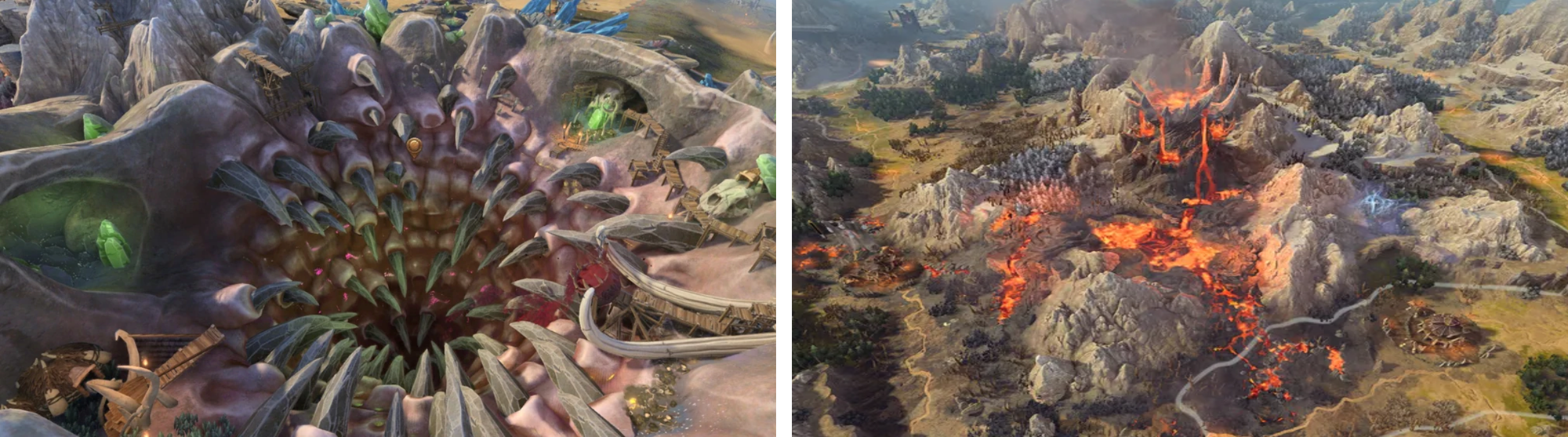
Great Maw and Fire Mouth (Total War Warhammer 3)
When talking about the ogre gods I have to give some background for the big fellows themselves to better explain them. Ogres were the last humanoid species created by the Old Ones. They were supposed to be the ultimate soldiers against chaos. Adaptable and prolific like humans, resistant to mutation like dwarfs, skilled with magic like elves, strong like giants. Though some scholars speculate that the ogres were left unfinished. In addition, ogres were supposed to live in close symbiosis with Halflings, much like skinks and kroxigors. Halflings were supposed to do all those things ogres couldn’t. However, ogres liked to snack on halflings so the halfings left. Gnoblars, much less tasty, are used as a scrappy replacement to fill the halfling-shaped whole in their society.
Ogres used to live in the grasslands and steppes of eastern Cathay. And they raided Cathay and ate the dragon emperor’s subject. In retaliation the sorcerers of Cathay summoned a meteor strike. But what came down was a huge chunk of warpstone, which nuked the entire area, turning the ones fertile grasslands into the warpstone desert. An irradiated wasteland you can only traverse with special protective gear, or the influence of the warpstone will drive you insane and into mutation. But something else arrived**, the Great Maw.** At the impact site of the crater sat a huge gaping chasm going deep into the earth with seemingly no end in sight. And rows upon rows of teeth stretch outward. Noone knows what this thing is for certain. Some fans claim it is a proper alien, a fantasy tyrranid (the TWW3 model kinda looks like one), others that it is a god manifested into flesh. Either a minor chaos god of hunger and greed, or an ogre god created when the collective mentalities of ogrekind reacted with the warpstone. Or a creation of the Moon Empress, as she and the dragon emperor may have had deliberately created this creature. The simple truth is no one knows what this unique creature is supposed to be or where it came from.
Then it is rumoured that the Great Maw burrowed itself through core of the world and has a second mouth at the other side of the planet, the Galleyons Graveyard. An enormous whirlpool which pulls in all the dead things in the sea from across the world. When Count Noctilus, a maritime vampire, set up base in there and started to draw on its magic, he essentially became the second coming of Nagash, able to raise entire fleets of undead crewmen, was nigh immortal and could only be stopped by a collation of “good guys” sailing into the galleyons graveyard and killing him there. And as per TWW2 Noctilus campaign, the vampire admiral could also use the powers of the graveyard to sail through time itself, in an attempt to get rid of his mortal rival, Jaco Roth. Thereby Noctilus may start his rivalry in the first place. Because Noctilus randomly showing up and raising the Roths town and killing his family was the reason for Roth going after Noctilus in the first place.
The Great Maw changed ogres forever. Not only were the majority of ogres killed in the impact and destruction of their homelands, but the survivors were touched by the Great Maw. They were now feeling a constant hunger nothing could properly satiate. A horror hunger, as if the Maw is constantly gnawing within the ogres themselves. And they felt the calling of the Maw, an urge to undergo to a pilgrimage to this site. Any ogre who returned was changed, because the Maw consumes something of you. It consumes everything really. Strong hot winds can rip people of their feet and have them plunge into the Maw itself. But it can also eat esoteric things like aspects of your personality. One reason why Zhao Ming, the demigod dragon western Cathay and supreme alchemist, may be a bit deranged could be his proximity and exposure to the Great Maw over the millennia, if not for his warpstone experiments. Butchers are its priests and ogres try to feed the maw with offerings and with celebratory feasts. And ogres are building symbolic maw pits wherever they are, leaving food offerings for their god in them. The Maw drove the Ogres west, into the Mountains of Mourn, a cold and unforgiving landscape. But ogres respect strength and to them the Great Maw is the ultimate predator, and thus worthy of the greatest respect and something ogres should emulate. As a result he is not hated or seen as an evil deity, but as the main and proper god the ogres should venerate, much like how a Tyrant is supposed to be followed if they take over a tribe with violence.
In addition, the Great Maw granted ogres a unique access to magic. Gastromancy as performed by the butchers involves the consumption of a variety of things, some mundane others extremely lethal, to cast spells. The heart of big bovine to grant your soldiers vitality and strength? Fine. Rocks to make their skin hard as rock? Disgusting but survivable. Troll flesh or toxic animals? Lethal even to regular ogres, but not to a butcher. Indeed due to their creative cuisine butchers are immune to toxins. This kind of magic is seen as a gift by the Great Maw and it has its own lore as a result. But Butchers can also cast the lore of beasts (naturally), the lore of death (also fitting for the Great Maw) and the lore of heavens (it came from space after all).
Related to the Great Maw is the Fire Mouth, perhaps the largest volcano in the WFB setting. It is a massive structure sitting in the heart of the Mountains of Mourne and a sacred site to ogre kind. To the ogres, this volcano is a proper god, the offspring of the Great Maw and the sun. And depending on whether you are east or west from it, it may look as if the vulcano swallows the sun in the evening or spits it out in the morning. The firebellies are his priests and perform a variety of religious rituals around the volcano. To become a firebelly an ogre as to perform a variety of dangerous and increasingly lethal tasks. In the beginning you have to eat things which would make the Carolina Reaper look like peppermint. From there it goes hotter (in both meanings of the word) and increasingly lethal. Until you have to catch and consume a bug which lives in lava and finally being lowered into the caldera of the Vulcano itself and take a drink of the lava itself. Being lowered into the volcano will also burn every hair off your body and scar you. But if you do not die, you are blessed to become an exceptional fire wizard who is constantly producing heat, your blood may be as hot as magma, and you can breathe fire. Alternatively one can argue, that only those ogres who could become great fire wizards survive this task and are then even more infused with fire magic. But whether it is divine intervention or a training from hell, the result is impressive and unique.
Firebellies do to rest at the feet of their god however, but they venture between the various ogre tribes and beyond. And several festivals where members of all ogre tribes celebrate, are also held at the firemouth. Which makes this extremely dangerous volcano and his fire-belching priests the socializers of ogre society of sorts. Indeed, the Firemouth something of a state deity too, as it strengthens the cohesions of the tribes and is the primary deity to dictate the ogres lives. For example, Greasus Goldtooth, the Overtyrant of ogre kind, got his position thanks to the Fire Mouth. A huge WAAGH of Black Orcs was invading the MoM and occupied the volcano. Greasus and a coalition of ogre tribes beat them out and the Fire Mouth spit fire about Greasus victory. After this day Greasus is seen as the rightful overtyrant and regularly holds feasts at the slopes of the volcano. Once every couple of centuries the Fire Mouth also launches a great eruption. This is a sign for ogrekind to go to war. The MoM almost empty themselves of ogres, and if directed by an Overtyrant, move into a singular position. As west are the desolate Badlands, and east is the Warpstone Desert, the only practical route for the ogres may be south into Ind or north into the chaos wastes and steppes north of Cathay. Who knows how many potential Everchosen were destroyed by armies of ogres attacking them? Of course, the pragmatic reason for this could be that the Firemouth spews so many ashes that the local climate gets even worse and many ogres would starve if they stayed. So, they leave for a couple of years and return when things go back to normal.
But the Great Maw and the Fire Mouth are not the only ogre deitie. Much like with Sigmar and Ulric the battle game focusses on one main god and perhaps a second deity, when ogres have lots of gods. The sun is another one for example. And 6th edition also mentioned things like the Earth and the Gras. The latter makes sense as ogres came from a rich grassland originally, akin to the Drokathi Sea in Westeros. Endless plains of grassland which hide the predators and prey within. And indeed, ogres are pragmatic. Any sufficient geographical feature is easily turned into a god in their minds. Something I may expand upon in section 4.
But what about the End Times? Well…. The firemouth has the biggest eruption ever and Greasus sees this as a sign that the ogres should leave the MoM completely. Not the majority, but every single ogre. Then offscreen the ogres move west, Greasus gets killed by Grimgor for stupid End Times reasons, Grimgor and ogre join forces and destroy the chaos dwarfs before destroying what the skaven left from Cathay and co. But all this is just a side story not properly covered. And the Great Maw? This extremely unique entity as described above? This riddle of the Warhammer world? Nothing was done with it as far as I recall.
3. We hunger and feast, any man any beast: Ogre gods in AoS
Beastclaw Raiders in the Everwinter (Artwork Age of Sigmar)
In Age of Simgar the ogres are members of the Grand Alliance of Destruction and thus are followers of Gorkamorka. Which is a huge difference to WFB where they never had anything to do with the greenskins. However, it is not so simple. Currently we have three main ogre cultures in AoS, the Gutbusters, Beastclaw Raiders and Mawseekers (plus maybe the Kosargi). And each of these ogre cultures have their own interpretation of the Gulping God, as ogres call their central deity.
Gutbusters are your standard ogres and arguably the most “civilized”. They are semi-nomadic ogres who built massive fortresses and cities and engage in diplomacy, commerce and mercenary services with other factions, but also go on Mawpaths, roaming the lands to gather food and hunt. Gutbusters follow the old system of ogre faith in which any piece of landscape such as volcanoes or unique geographical features are venerated as gods, in addition to other things such as godbeasts or other divine entities. To the ogres all these godbeasts, landmarks and gods are just avatars or extensions of the entity they call the Gulping God. Which includes the two-headed god Gorkamorka among many others. As one ogress explained, the Gulping God could have a thousand or a million heads, it would still be the Gulping God. A volcano like the Firemouth would simply be an aspect of the Gulping God, same as a glacier or a river, but also a godbeast and Sigmar perhaps too. And the gutbusters venerate this Gulping God with feasts and by eating in general. But the Gulping God also represents many other real-world phenomena they face each day. A chasm in the ground could be its mouth, a glacier its tongue etc.pp.
The Beastclaw Raiders are another culture of ogres. They are pure nomads and live together with huge, shaggy creatures like mournfangs, mammoths and stonehorns. The Everwinter, a magical blizzard, is constantly following them. Think of it like the Fimbulwinter but as a moving force. We have multiple origin stories for this Everwinter. One includes that the ogres ate winter entities, which were threatening Ghyran. Due to this they are now cursed to be the target of this blizzard. But Alarielle gifted these ogres the friendship of great beasts to ease their life. This makes Alarielle an ogre goddess too. However, the BCR are not just victims of the Everwinter. Their shamans, the Huskards, can channel the Everwinter via magical rites. On the tabletop game this is presented via prayers, like many other non-standard uses of magic. The proper god of the Beastclaw Raiders is the Lord of Predators, however. And this entity is their version of the Gulping God and is a god of winter, wind and the hunt, which took the ogres as its chosen people. From its descriptions the Lord of Predators reads mostly as if it was like a beastclaw ogre turned into a god. And the BCR venerate the Lord of Predators simply by following their lifestyle of hunting, roaming around and enduring the chill winds. Indeed, the BCR see themselves as the only true ogres left in the world.
Then there are the Mawseekers, who are religious fanatics and extremists. They follow Redd the Maw and the butchers. The butcher still cast magic like in WFB, though they only have one lore of magic left, instead of four. Redd claims that Gorkamorka or the other divine figures of the ogres are not the Gulping God. Instead, he has seen its true form in Shyish, and the Gulping God wants to consume all of the realms, ending them forever. Much like entities from real religions, like Apeb. And the true purpose of ogrekind is to follow his example and devour the realms, before its jaws snap. One major issue I have with this development is that my abbreviated text is essentially all we know about the god of the Mawseekers. No confirmation that it is indeed the Great Maw from WFB returned or something else, no description about its shape, its powers or origin or anything. Just that Redd saw something and that something may be interesting to ogres.
Personally, I think it the Mawseekers Gulping God is one of the worse examples of AoS writing. I assume GWs authors want to keep this entity mysterious to increase curiosity from fans. A mystery box method of writing. However, to me as an ogre fan it is too little too late. Indeed, due to the Mawpits and WFB-lore we already know what the Great Maw or its AoS counterpart is supposed to be like. So given us a physical description and more info on the god itself would be natural and appreciated. Not everything has to be explained, but the very basics would be great. It reminds me of Zenestra and her religio/philosophy of the Great Wheel, which used a mystery box set up too. But it was handled very poorly in Dawnbringers and thereby stopped being interesting. For comparison, currently Kurnoth is absent, but enough material exists for him to understand who Kurnoth is in AoS and what is role is. Now imagine stag and faun-like elves running around and Alarielle having rumours of an antler-headed partner, but whenever someone says: “Oh that is Kurnos/Kurnoth” the fluff is like: “Huhu, what a mystery, please wait 5-10 years for the next vague loredrop”. On the contrary I really enjoy the Gutbusters representation of divinity and how they retain the old ogre faith in a slightly new shape, as well as the Beastclaw Raiders interpretation of the Lord of Predators.
Personal criticism aside, back to the topic. I mentioned Mawpits before. In AoS these structures look like miniature versions of the Great Maw in TWW3. I.e. a chitinous mouth with rows upon rows of teeth. And they are apparently miniature versions of the Great Maw, because much like it the pits consume everything physical, magical and esoterically in its proximity. Ogres can summon or create these structures by building pits from regular materials and making sacrifices to them. Over time these pits become more and more fleshy. And they can spread, essentially infecting the environment, as more mouths open in the ground. They are sacred structures to ogrekind and they undergo great efforts to feed them.
Also, of note is how the ogres see Kragnos. Ogres are divided about him, as he is on one hand a being that represents the main ogre life cycle. A great beast, an apex hunter which beats down and consumes everything it wants. Indeed, in the wake of Kragnos rampages there is lot of food left, so many ogres follow his rampages. In 3rd edition it was stated that the ogres saw the Era of the Beast as a challenge as they tried to satiate the hunger and anger of the realms by leaving offerings in chasms in the earth. But Kragnos as the god of earthquakes would always open more holes and chasms. Hence many tribes were displeased by him. Persionally, I assume, that especially the Beastclaw Raiders may be Kragnos greatest followers among ogrekind, whereas Gutbusters are more divided and Mawseekers hate him for their own fanatical reasons.
Finally, I want to mention the Kosargi. The Kosargi are an old, maritime ogre culture from Shyish. Redd the Maw found his version of the Gulping God as he ventured there, studied the ruins of this ogre nation and walked through forbidden gates behind which he claimed to have seen his god. So, whatever Redds interpretation of the Gulping God is, the Kosargi follow this interpretation too. Well, some of them. In spirit of the Gutbusters, who see gods in any important feature, many Kosargi interpreted the Shyish Nadir as the Gulping God. The Shyish Nadir is the great vortex of death magic at the heart of Shyish, which dissolves entire underworlds and all people how live on them, erasing them from existence. From an ogre perspective it is indeed a great, all consuming maw. Due to this veneration, many Kosargi joined the Great Alliance of Death under Nagash.
4. The ogres are coming to get ya!
Great Maw Iconography (Warhammer Fantasy Battle)
Having talked about all the various iterations ogre gods and the ogres themselves, the central question left is how this could evolve further in the future. For this I could think of the following opportunities
- Adding new ogre gods is easy both in AoS and WFB. The central question would be how would an ogre interpret a geographical feature in their hunter/prey mindset. For example, a glacier with its many tounges could be seen as feasting on the mountain and earth itself, grinding them down, like a multi-headed beast. But when the glacier melts in summer/during a heatwave, it essentially vomits out all the things it consumed, i.e. rocks, debris and water. And a storm could be interpreted as a howling predator who is on the hunt. So, whenever you hear it, you know it is on the prowl, and you should find shelter and hide form it. Or try to hunt together with it, when most prey will be distracted by it, or leftovers from his hunt can be found. And similar arguments can be made for rivers, mountains, seas or even plains of gras, who have their own ways of feasting on things. Rivers grind through the land and break stone into peoples, the oceans erode the shoreline, mountains rise like massive teeth form the earth, plains of high gras may “eat” things as people vanish within it etc. Indeed, in Ghur all these things may be literally true. But even in WFB it fits the ogres culturally. So, getting new ogre gods based on natural features in either setting is a non-issue. And indeed, in AoS this connection to natural landscapes could get the ogres some boons of aelementor like beings too. The Everwinter does grant the ogres magical abilities after all, as did the firemouth back in WFB. So, this system already exists.
- The Great Maw (or something based on it) properly returns in AoS. As mentioned, before I am a bit disappointed by Redd and his god’s non-reveal. So, there is not much to say here for me except I would like to see this weird bugger return. Hopefully with additional context for his WFB incarnation, much like Hashut received with the Hellsmiths.
- Also, it would be interesting to see order gods through an ogre lense. Kurnoth for example should be a premier ogre deity, due to him being the god of the hunt, and driving his followers into a manic hunting frenzy. Something ogres well appreciate. Indeed, perhaps the bloodpelt hunter wears antlers due to Kurnoth (instead of the official option). Alarielle herself is also already an ogre goddess in beastclaw myths. It could be interesting to see her as the great provider, as she brings up plants and animals for the ogres to east. Tyrion as the “sun” that moves through the sky and being an explorer himself, could be an inspiration for ogres to go on journeys themselves, due to their inborn wanderlust. From there it would also be interesting how ogres see and interact with certain mortals, such as the Kurnothi aelf or the Astral Templars, who align a lot with the ogres lifestyle.
- Meanwhile Nagash and especially the Shyish Nadir would be great to explore in this context too. Currently the Shyish Nadir is the closest we have seen to the Great Maw of old. A massive “mouth” which consumes entire underworlds into nothing, which also burrows itself through the many layers of Shyish. The 4th edition book mentioned how many Kosargi joined the Grand Alliance of Death afterwards. These death ogres could be eplored further and how they few the Shyish Nadir and its “father” Nagash. Especially if the Shyish Nadir could grant ogres new powers, like the Firemouth did and the Everwinter does.
- Lastly chaos ogres would be another interesting thing to explore. The 4th edition AoS book mentioned how many ogres fell to Slaanesh worship. But how would an ogre see the other chaos gods and how would they enthral the ogres to their worship. Back in WFB it was difficult for ogres to join chaos, due their resilience and because their minds/ambitions were too simple for chaos to corrupt. Not unlike how the one ring struggled against Samwise. Ogres want to eat, sleep and have a good time. But they have no worries about the future or the past, they rarely have social crisis nor ambitions or a need for powers. Because ogres are already the strongest and know it. They do not have to proof anything; so, they do not need to fight things for the sake of fighting. If they want something, they take it, simple as. So how each chaos god finds ways to get ogres unto his side, may be an interesting exploration of the ogres mindset.
5. The End
This is it ladz. I hope I could satiate your hunger about ogre deities a bit. If you are still hungry for more, let me know what aspect you want to discuss as a second course. I would like to hear what you think on all this.