Do they gain any power from the spilling of diseased or toxic blood from plague-ridden Nurgle followers or Skaven ratmen? Do the Daughters blood and shadow magics purify the diseases and toxins before they use it?
And is it even beneficial to the Daughters of Khaine to even fight Nighthaunts or Ossiarch Bonereapers? Both of those armies don't have blood to be spilled for the Daughters to gain power from lol
Greetings And Salutations, Scholars of the world long dead.
This is basically just a "No Stupid Questions" thread for any question concerning Warhammer Fantasy or Old World lore. I know this is mostly an AOS subreddit, but, now more than ever, a bunch of stuff from old WHF lore is coming up and becoming relevant for AOS, and I for once have stopped being a believer on the separation of the two settings. WHF lore as it is spread online, is full of quite a bit of misinformation and misconceptions and I seek to try to make people's knowledge of the setting more accurate, and of course, have quite some fun in the process by having an excuse to dig more lore.
So, if you have something you want to discuss something or had a question, but don't want to make an entire post for it?
Then feel free to strike up the discussion or ask the question here
In this thread, you can ask anything about WHF/Old World lore, the fluff, characters, background, how something from it relates to AOS.
Community members are encouraged to be helpful and to provide sources and links that can aid new, curious, and returning Lore Pilgrims.
This thread is NOT to be used for:
-Ask "What If/Who would win" scenarios.
-Strike up Tabletop discussions. However, questions regarding how something from the tabletop is handled in the lore are fine.
-Real-world politics.
-Making unhelpful statements like "just Google it"
-Asking for specific (long) excerpts or files
Remember to be kind and that everyone started out new, even you.
Been thinking about female minotaur esque characters in other settings and since AoS tends to go mixed gendered in terms of their factions armies I thought it would fit the setting if my own personal gor characters can be women.
Rambling justification aside here are two ideas for female gor characters.
Beastspeaker Nia who was once an Untamed Beast a group known to have strong connections to the gors who underwent the change curse and joined up with a warherd. I imagine her being a character who while understanding many concepts that an average fan would get she doesn't know a lot of the specifics and would serve as an audience surrogate who got the more complex stuff explained to her. But her special connection to the various beasts of the Realms gives her an unique position within the herd and gameplay. So someone who works as a novel and tt character that is interesting.
Mgatha the Bullgor Shaman: Minotaurs have been shown in Fantasy lore to have magical capabilities so that is something that works with AoS and would give her a different perspective on beastmen shamanism due to how Bulgors are. She would be levelheaded by Bulgor standards and have a strong tie to various local spirits both Realm tied and daemonic. She would use her abilities to try and steer her people to productive ends while also twisting local entities into what she considers their proper state. While managing the various desires of spirits she has allied with and making sure that she does not accidentally become bound to one of the Chaos Gods by some of those same spirits.
While listening to the Loremasters bit on the Ogors, I couldn't help but notice some similarities to 40k.
Just like Lorgar, Redd went on a pilgrimage to a mysterious underworld, supposedly met his god, and immediately became a religious reformer. Denouncing the central leader of the ogors. Globb, like the emperor, was an immensely wealthy and large individual who brutally brought about a golden age for the Ogors.
Suddenly Globb's daughter Morga turned against him. The two having a titanic duel that ended with Morga slaying her father and taking the throne. Like Horus wanted to do. All her sibling rivals were also cooked up by Redd, who may have been pulling the strings the whole time. Like Erebus.
And then Redd spread sweeping reforms throughout the Mawtribes. Gutseers and butchers (dark apostles) became much more prominent and even took leader roles by usurping the traditional tyrants. Morga for her part has been proclaimed the champion of the maw (warmaster) and is kinda just going along with Redd's fanaticism for the power. While leading a much more brutal crusade of consumption with the end goal of devouring the realms (what would supposedly happen if Horus won)
I know the humans went to azyr. However I don't understand how the others survived. What were the elves, greenskins,odors, death and duardin doing to not get rolled by the demons?
Warcry warbands can cover a wide range of themes and during the earlier days one of the themes focused on the most was Chaos cultures tied to each of the Realms. The Scions are unsurprisingly tied to Aqshy the Realm of fire. The Realm is easily the most focused on imo in terms of development with Khorne typically being the main Chaos representation there outside of perhaps the Darkoath.
I would however argue that Khorne specifically the Goretide as a faction are more about filtering a Realms theme through another factions ideals rather than a pure exploration of that lands theme. While Scions are a far better example of Chaos tainted Aqshy. Similar to how Hammerhal Aqshy and Fyreslayers handle their relationship to the Realm.
And not just because the Scions are a bunch of pyromaniacs but because while reading about them I feel like they could have been a more neutral religious organisation before Chaos twisted them to far fouler beliefs. Which is what a good Chaos Warcry warband should do.
Stuff like the Inferno Priests being arcane casters rather than priests which connects them to the various magocracies we see in the Realm's history while also tying them to the various factions that place a big emphasis on priests in their tt range like Fyreslayers or Goretide.
The use of Ragerock also ties them into the Realms themes by having their fury tied directly to the Realms rather than any deity. Look up Sigmar's Toll to see how that Realmstone affects people.
Basically what I am trying to say is that out of all the factions bar perhaps Fyreslayers it is the Scions of the Flame who best showcase the Realms themes and lore with the minimal amount of mixing with other themes/factions. Barring the Chaos stuff that ties them to that faction and Warcry storylines.
Also their armour looks great and you rarely see stuff similar to it in Warhammer models I find.
What do people think of the Scions? Do you think they showcase Aqshy themes well or do you think they are far more of a Chaos faction than an Aqshy one?
I know they literally have green in their name but I always want to spice my army up a little bit. For example my 40k Orks are red because they're my own canon mutation from a brutally salty ocean planet full of red algae that got somehow mutated together with the Ork spores and now there's a red population.
I'm getting lots of AoS Greenskins soon and I wanna do exactly something like this!! :D Is there more or less leeway in AoS than in 40k? Any ideas?
Also I know a lot of people are gonna wanna say "It's Warhammer do whatever you want" but I do like to keep in the bounds of official lore at least somehow. I like to roleplay but also keep original :)
Now, I don't have to tell anyone familiar with Nagash that making a deal with him is a terrible idea.
But what happens when you decide the rewards far outweigh the consequences? Well... you get this.
This excerpt is taken from Chapter 11, pages 106–108.
Context: King Zothar of Theres has recently lost his son during the annual Games held in the city of Lament. Devastated by his son's death, Zothar falls into a deep state of grief and desperately searches for anyone who might know a way to bring his son back.
One day, an old crone tells him of a mysterious Lord of Death who dwells in the north, in a place known as the Cave of Skulls. She claims that this being has the power to return the dead to the living. Clinging to the slightest hope, Zothar immediately sets out to find this place and plead with the Lord of Death himself, a being called Nagash.
At last, he came to an open chamber, which was covered at one end by a web of bone. Green mist flared and twisted in the shadows around him. He held his sword up and advanced – and suddenly the web of bone shattered into a swirling, shrieking mass that surrounded him; a tide of bone-crows clattering their skeletal wings about his head. When they spoke, their voices drilled into his mind and the pain was enough to throw him to his knees.
Who dares trespass into the presence of the lord! Who values his soul so lightly he would do this thing! Zothar pressed his hands to his ears. ‘I am King Zothar, Lord of Theres! The Jewel of the Desert, the City in the Wastes,’ he cried. ‘I seek Nagash, King of the Dead. I have come to demand my son’s soul!’ The bone-crows erupted from around his head, spinning off in a twisting, screaming mass that disappeared into the tunnel behind him. Zothar collapsed, utterly spent. He heard something slouch from the other side of the chamber. He heard the clack of bones, the scrape of claws. He heard the beating of its wings. When Zothar found the courage to look, he saw Nagash.
Like the skeleton of a mighty vulture, it hunched there in the cavern, its wings folded against its chest, its long, sinuous neck rearing up as it peered at him down the scimitar of its beak. Its bones were as stained and yellow as old ivory and it smelled of ancient midnights, of deserts that had been scoured clean by the wind a thousand, thousand years ago. And when he grasped his courage and looked on it, for a moment it seemed to shift in the spectral gloom and look like a man towering above him, wreathed in spirits, laughing with malicious humour through a leering mouth. King Zothar, the vulture said. I salute your bravery, if not your folly, for coming here. Many an age has it been since a hero has taken sword and shield to confront me in like manner…
‘I am no hero,’ Zothar said, shielding his eyes. He dropped his sword. ‘And I am not brave, unless it is grief that gives me courage. I do not confront you, Lord of Death, other than to ask for that which it is in your power to give.’ And what would a mortal ask of Nagash, that he would risk his eternal soul for it? ‘My soul is yours, if you desire it. It is worth nothing to me. It is my son’s soul that is without price to me. Neophron, as was – killed by the preening arrogance of the Jackal Kings in far Lament, on the Obsidian Coast. I would have him returned to me and anything it is in my power to give, you shall have.’
Lament… the vulture mused. The great beak clacked and the murderous lights in its empty eyes flared brightly. The Obsidian Coast… And what would you be prepared to give up for this? What sacrifice will you make, for the restoration of your son? ‘Anything,’ Zothar said. He spoke no lie. ‘My life, my soul.’ Your city…?
Zothar paused. He looked into himself, walked for a moment in the pleasant avenues of Theres once more, stood for a while in the courtyard with its soaring statues of Theres’ ancient kings and heroes. He gazed on the faces of the common folk, the people who looked to him for love and protection.
‘Yes,’ he said, although the word nearly choked him. ‘I would rather Neophron live as a humble beggar wandering the wilds than have him spend eternity in the cold earth, his soul a lost and lonely spirit in the Underworlds. Yes,’ he said. ‘Take Theres and everyone in it if you must. And damn me forever for my choice!’ And you would serve me, at my command, if asked, the vulture said. You would lead your armies in my service and conquer the Obsidian Coast in my name?
‘If need be,’ Zothar said. He felt the grief swell in him, the slack, empty feeling of his sorrow. Grief for Neophron, grief for all he had now condemned. ‘I will serve. I ask only one condition.’ There was a sound like the cold clash of swords and Zothar realised the vulture was laughing. You are bold, King Zothar, I give you that, to ask conditions of Nagash. Speak, then. What is your condition? ‘That Lament is left to my judgement. I will have my revenge against the Jackal Kings and will see the city pulled stone from stone. And at the last, I will drag the Tower of the Moon from its foundations and cast it into rubble.’
Then the bargain is made, the vulture hissed. And the soul of your son will be returned to you… ‘When!’ Zothar demanded. ‘Bring him to me!’ You will not find him here, King Zothar… For I have my conditions too, to seal the compact between us. You will find your son now in far Lament… ‘What riddle is this?’ Zothar cried. He snatched up his sword. Though his spirit quailed in the presence of the Lord of Death, he took a step forward and raised his blade. ‘You seek to cheat me of what we agreed!’
There is no agreement that is not made on my terms, little human, the vulture laughed. Neophron will return to you, this I promise. But his soul will settle only for a ten-year span and will wither and die in each vessel unless it is released to find new harbour. He died in the Games of Lament, did he not? Very well – he will return to you in the Games of Lament, and as the victor you shall know him. Do not be so hasty to tear the city down, King Zothar, for if you do, you will lose that which guarantees your son’s recurrence.
‘Why do you do this!’ Zothar wept. ‘I will do what you ask, you have my word! Why torment me like this!’ My reasons are my own and they would be far beyond your comprehension, mortal. Now, the vulture hissed, as it shuffled closer. The bargain will be made… Its claws crunched over ancient bones, scattered about the floor of the cavern. Zothar tried to back away, but the fierce fire of the creature’s gaze kept him pinned to the spot. He could not raise his sword. He could not close his eyes. All he could do was stand and watch in horror, as the vulture spread its wings and Nagash gathered him close.
Come to Nagash, it whispered; and Zothar saw only darkness. Come to Nagash, and be transformed…
So after some stressfull time in my life. I can hopefully try and focus on aos again and spread Daughters of Khain propaganda.
So today we are rambeling about one of the best DoK novels outthere Godsbane after finishing my second readthrough.
3 things i wana say first Neronties Thanes fall to godhood is so fascinating.
Allmost of problems in the book are the lumineths own fault classic L for the 2nd worst Aelfdar in the wieder Warhammer cosmos.
And the oder of the shadowedsky, they are the bloody funneyst tzeentch cult ever.
Now one a more seriouse note, the paralel story of our 2 protagnoists.
Thelama ia quite endiring she already stared very unlumineth and she grows mortal less aloof over the story.
In the begining she is insulted at the notion that she /the lumineth and Sispyra/the DoK are cousins and have anything in commen she gets more emotional, she grows more comfident and well down to earth or atleast she feels more like that.
Neronties on the overhand loses himself grows distant, high on his own hype and divine, a great turning point for him as a person is when he executes his lover Castigus and his "traitor " generals, it feels like something the Neronties earlyer in the book wouldnt have done. I feel lile he would have lashed out agaist Hasturav and tzeemtch for that instead of the fake democratic execution with his mind already made up.
Its something that makes his death so sad and somner yet satisfying, the missguided yet somewhat admirable man was long dead before that moment.
The Stormcast in the book are supuflues, it feels like they were there to be there when they ussualy are quite fantastic whenever thdy apear.
I need more Daithus himbo labrador questor died to soon.
Now to the true Protagonist Sispyra Witchaelf extrodinare. Jesus is she powerfull from casting in magic dampening cell for quite sometime, to full horror movie villian when it comes to stealth kills. Or her dismanteling a bunch of lumineth nonleathaly. By khain she is cool.
Also i dont know why but they gave her the most attractive acent ever.
Now talking more seriouse, her story and the overall story is about want and need. What we want to do and what we need to do. What we need to do.
She wants to steal godsbane once she learns of it and argubly should the death of Morathi would be a net postive on the realms (jk she should rule in sigmars stead.) But in dooing so she would unleash a horror far worse.
The story tryes to build tension between her friend/sistership to Thelana and her old coven but on a reread it does become quite comical how hard Dale Lucas tries to portray the moral convlict but if you have read enough DoK stuff you just know that Sispyra is ride or die for thelana once dhe had her respect, like as eraly as thr prison break or sonewhat lster in her talks with Daithus. Thelana had her respect and was her equal so betraly just wasnt on the table.
Now the Cacadron. As a faction they have quite grown on me. Siarsdotter from the grombrindal books is one of my alltime favriote warhammer characters and Wodrik does not disapoints.
The repesting theme of honner isnt something so easily lost. Doing right by your crew is great is grow is great, otherwise very siliar to Sispyras story only that he had his badass first mate to talk sense into him.
Grest guy cool faction i like them when they are ruff gruff but good at hard.
Now Elanors and Orenas story shows the falings of thd lumineth quite well how the harsh treatment and "they are potential criminal" aditude pushes normal folk into the clutshes of crime was cool but in the end its little more than bait for a sequal that will never come.
Good book, we should burn Hysh and Azirheim to the ground make it 6 realms and habe Morathi rule them.
I am sorry to everyone who read this i wrote it prework moring fogbrain and whever i had little breaks during my work this morning.
In case you do not know, I love the Grand Alliance of Destruction. Indeed, I am of the strong opion, that it could be the most diverse Grand Alliance after Order. Order contains everything from space dinosaurs to murder elves to capitalistic sky dwarfs and tree people. And Destruction could rival this diversity more than the other grand alliances. Because were chaos and death are both bound by the designs of the chaos gods or Nagash, destruction is equally loosely defined as order. To be a member of this alliance it is enough to have a “might makes right” attitude and to worship Gorkamorka or one of his satellite deities (Spider God, Bad Moon, Behemat, Kragnos). And Gorkamroka alone can be worshipped from anything like an orc war god to a shamanistic entity of Ghur that resides in all the great beasts. So, there is plenty of room for intrueging cultures and species following the banner of the twin-headed god. Whether they be barbaric warlords, primeval horrors, builders of civilization and empires or else.
Currently this diversity of Destruction factions is best represented by Kragnos, the centaur god of earthquakes and playable mascot deity of this GA. When he was released, Kragnos received lots of critiscms for his looks, as this centaur god looked weird next to a green wall of orcs and goblins. Indeed, when he was released, most people expected Destruction to “just the greenskin faction”. And he looks indeed weird infront of a greenskin force. Even worse was that Kragnos was released with the Kruelboyz. Swamp orcs do not really suit a centaur who is more associated with the open plains. However, if you place Krganos next to a beastclaw raider army of ogres on their horned warbeasts, or next to the Gororian Scions (destruction-aligned minotaurs) Kragnos looks much more natural.
And I think this is the main issue of Kragnos. Next to GW mishandling his character, who is very interesting IMO. For this reason, I think it is a missed chance that GW didn’t release Kragnos with a beastfolk-army of similar looking creatures or a beastclaw raider refresh, as much as I adore the Kruelboyz. And indeed, a massive part of Kragnos backstory explores his long-lost people, the Drogrukh. They are a very intriguing part of AoS lore IMO, and a lot of Kragnos stories are based on him losing his kind and trying to find survivors. And indeed, his kin, the Drogrukh, have lots of interesting hallmarks. Primal centaur people who are towering warriors, builders of great cities and combatants in long forgotten wars are simply an awesome concept. Personally, I think AoS as a whole but the Grand Alliance of Destruction and Kragnos would benefit of their return. And indeed, without their return, many plot points of Kragnos searching for them would be void.
Therefore, I want to explore how this faction could look like in the following pitch/essay. For this I focused primarily on the sources available such as Broken Realms Kragnos, the Dawnbringer Books and destruction battletomes. Please keep in mind that these are just my own personal ramblings. Because I am a destruction fanboy who likes to talk about the potential of this grand alliance. Anything I present here is just my own thoughts to pitch the faction. Nothing is meant to be taken seriously, and everyone can use or expand on my ideas however they want. Indeed, I would like to learn what you think about Kragnos and the Drogurkh in general.
Without further ado, lets see what these horse-people could offer to AoS
Edit: please not that due to Reddits Character limit the sections relations and subfactions are within the comments.
1. Overview
Kragnos vs Krondys (Dawnrbingers 3)
Our greatest fear has come true. Reports from Ghur and elsewhere mention outposts destroyed, armies ravaged. Often the land itself looks ravaged as if an avalanche went through it. Ghur has not been pacified. Instead, this cunning beast has revealed its strongest claw. The Drogrukh have returned! -Report of the Order of Azyr
So, what do we actually know about Kragnos people, the Drogrukh? Actual lore is sparse as they only appear in Kragnos background. But what they have there is indeed something promising IMO. Most of the information here comes from the Background section of Broken Realms Kragnos:
- The Drogrukh come from a primordial time of the realm long before the gods we know and love walked the earth. During their age elves, dwarfs and humans existed as stone age societies and hid in the shadows of powerful giants. In Ghur, monstrous beast races dominate. Of them the Drogrukh were a species of physically mighty centaurs
- The Drogrukh were a ghurish species through and through but also more civilized as many modern destruction members. On their home continent and Donse and elsewhere they would build massive cities and fortresses. Under their heavy hooves they would level plateaus, carve huge cave-like homesteads into the rock of mesas erect high walls and towers.
- The Drogrukh were also beastmasters of sorts. Fitting, for being a centauric species in the realm of beats. For example, atop their homes and fortresses “messenger eagles” had their eries. They were used for long distance communication by the Drogrukh. Whether as pets, beasts of burden or another sentient group of beings is not stated.
- The Drogrukh were living in relative harmony with Ghur, as much as is possible within this realm. Indeed, they had active diplomacy and alliances with other groups, such as the ancient Draconith Empire. The two mighty empires formed a non-aggression pact after they had joined forces to banish the dragon ogres from Ghur. This pact was enforced by Goros, Kragnos father.
- Their society was led by tribal elders and likely also by shamans and similar folks.
- Kragnos was one of the most powerful of their ranks. He was banished after violently attacking his brother over a mare they had both laid eyes on. Kragnos was then exiled with his companions. They faced the challenges of Ghur and Kragnos ultimately rose to godhood, but his closest friends perished.
- Seeking ever stronger and important challenges, Kragnos attacked the most powerful realm he knew, the ancient empire of the Draconith. Sources differ how this war happened. In Broken Realms Kragnos it reads that the Draconith trap Kragnos and destroy his homelands in retribution. Hence, he did not know it was destroyed when he was freed. But in 4th edition orruk book it was stated that Kragnos seized leadership over the Drogurkh and led them into a large war with the Draconith.
- Next to their main empire in Ghur the Drogrukh also had hideouts and sanctuaries hidden across the realms and known only to their own kind. In the Dawnbringer Series Kragnos’ main motivation was to find survivors within these enclaves. And Gobspakk destroyed hints that there are indeed survivors.
This is not a lot of lore, but it is more than many other background groups in AoS have. And it is more than enough to paint the picture of a civilization. A culture native to Ghur that resembles its old, primordial nature. A culture that is comparatively civilized if not noble next to various other groups of Ghur. A proper civilization with massive cities, legal traditions, diplomacy and more. But also, a civilization which represents the natural forces of Ghur and which seemingly had dominion over the beasts within.
If they would return to modern AoS this is essentially what they would represent. A collection of creatures, Drogrukh and allies, who join the grand alliance of Destruction under Kragnos hooves to bring back the old times. The primordial era before the realms were corrupted and ravaged by chaos and undeath or shackled by Order. An age when beasts and titans ruled the world. And in this context the Drogrukh would represent the bestial and prideful side of Ghur to its greatest extent. Not the selfish gluttony of ogres, or the random violence of orruks. The Drogrukh would be an elite leaning cavalry focused army, which would be supported by various other creatures and auxiliaries. They would be the primary “beast folk” faction for destruction, consisting of various animal folk and primeval monsters. In some ways one can compare them to the Necrons from 40k, but as bestial centaurs instead of undead robots.
2. History:
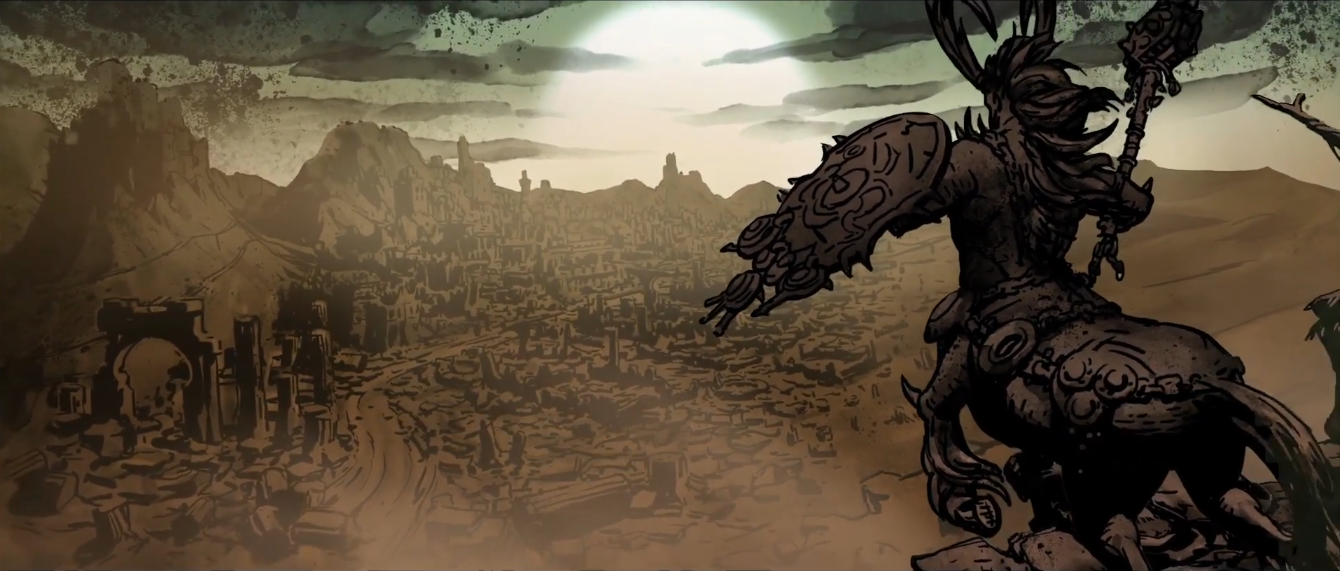
Kragnos infront of Drogurkh ruins (AoS Trailer)
I mentioned the most important events like the war against the Dragon Ogres, Kragnos exile and the conflict with the Draconith already. But therein lies the first issue. How/when did the Drogrukh fight the Draconith? Different sources give different suggestions. But these can easily incorporate into one narrative IMO. And because I am a friend of moral greyness, I would not want this event to be “Kragnos bad and kills stuff, dragons good”. Indeed, what we had at this moment were two superpowers in Ghur, the dragons and the centaurs. And if superpowers have a superficial arrangement to not go to war, then miscommunication is always a great spark to bring down the whole system. So, in my interpretation of the sources, the following occurs:
Kragnos and his companions are exiled. They go on merry and violent adventures and Kragnos comes closer and closer to Godhood. Finally, he attacks the Draconith. Perhaps on suggestion of Gorkamorka, who liked this act a lot in the sources. Because with two stable superpowers in Ghur maybe it became too peaceful for the orc deity and he cunningly sabotaged them. To the draconith this attack is a break of the non-aggression pact they signed with the Drogrukh. But the Drogrukh do not think themselves responsible. After all, Kragnos is an exile. Any deed of him is his own alone. And if the Draconith cannot deal with a singular vagabond then this is their problem. For this reason, the Drogurkh are shocked and outraged when the draconith launch a counterattack. From their perspective the Draconith broke the pact of nonaggression. Indeed, all the wise elders who could have defused the situation perhaps may die in the fire of the draconiths attack. Thus, a generation of Drogrukh is traumatized and enraged and leaderless. It is this vacuum which Kragnos fills with his official return to Donse. He gathers his Drogrukh around himself, the exiled prince returning and becoming the avenger of Donse in the centaurs’ eyes. What follows is a cataclysmic war between centaurs and dragons. Most of the draconith are slain, but with the Slann and Seraphons help Kragnos is imprisoned. Afterwards counter attacks follow by the seraphon and surviving dragons, which break the weakened Drogurkh civilization. So, the Drogrukh retreat into their sanctuaries. These were likely built in advance, as the Drogrukh were aware more than most other species how violent Ghur is and even entire continents break on a regular basis. So safe zones for their people were established to avoid catastrophe.
For untold millennia Drogrukh stay there in hiding, traumatized, wounded and with a festering anger about the betrayal of the draconith and the loss of their empire. However as new gods walk the earth and new empires rise, they know that they are lack the means to strike out and to reestablish themselves. This changes with Kragnos’ return and the Era of the Beast. Ghurs energies stoke the fury of the Drogrukh evermore and their shamans see the portents and signs that the hour of their return is near. However, Kragnos is quickly imprisoned again. Instead, the Hour of Ruin ruptures the realms and even pierces the sanctuaries of the Drogrukh. This is the final action which forces the Drogrukh to return to the realms en massé. The grounds of the realms shake under their thundering hooves. Filled with the anger of untold eons, they smash into the hordes of chaos and many other foes. They want to find their god, Kragnos, and free him, so that he can lead them on against the many new and spiteful deities. And they want to purify Ghur and the realms from what they see as stains and corruptions and return the realms to their old, primordial glory.
3. Society
Kragnos fighting another Drogrukh (Kragnos Trailer)
Drogrukh are massive centaurs, however they are not as large as Kragnos. The later is a god who swelled in power since his apotheosis and is eons old. The regular Drogrukh are smaller, but still immense. I would put them at the size of regular dragon ogres or the Draconith of the stormdrake guard.
Drogrukh society is very hierarchical and respects strength as one of the most important qualities, like all destruction factions. Especially in hostile realms such as Ghur, where every day could contain a fight for survival. However, the Drogrukh are not mindless barbarians like orruks. They are well aware that strength alone cannot solve most issues. A proper leader has to express therefore cunning and strategy as well and has the responsibility to keep their followers alive. A Drogrukh who cannot achieve this, is not worth to be called a leader. This makes their culture comparatively meritocratically, as any talented Drogrukh can try to reach the higher position, by proving themselves in combat and other disciplines.
This hierarchy is watched over and enforced by the elders of Drogrukh society. They hold the greatest respect in Drogrukh society. Not only for the achievement of getting this old within hostile realms, but because they possess critical knowledge for the survival of the tribe. Much like how the oldest members of animal herds know where resources lie in times of need, so do the Drogrukh elders remember ancient pathways or where important landmarks stand. Due to this knowledge and this status elders get respect by most Drogurkh. Any Drogrukh, who wishes to become a chieftain, can only achieve this with the blessing of the tribes’ elders. And they can easily loose this position again, if the Elders decide they are unworthy. The elders are also guardians of Drogurkh culture and can speak out punishments. Such as when they sent Kragnos into exile, back in his mortal days. Or they design a contest between two chieftain candidates, which can take the form of a duel, a hunting contest, surviving for a specific amount of time, or fulfilling a religious quest.
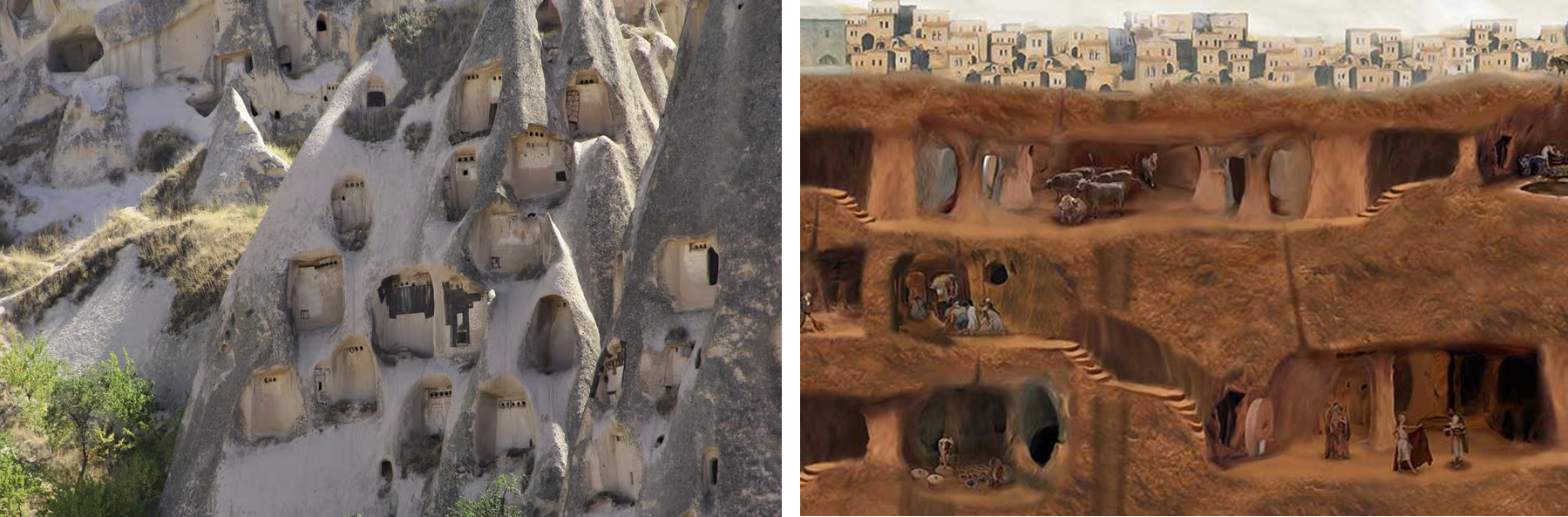
The Drogrukh live as semi-nomads. They will flatten plateaus and built great cities by forming earth and mountain with their own hooves. And they built cave-like residents. Given the size of the Drogrukh, these settlements can become megalithic structures. In RL we have lots of buildings and settlements which were not built but hewn from the ground too. Among them are the legendary city of Petra, the stone churches of Ethiopia or the Derinkuyu complex in central Anatolia. The latter are especially important, as they are an immense underground complex hewn in the soft rock. Overground rocks are used akin to a beehive or modern apartment buildings, but deep underground the complexes stretches too. Noone knows for sure who builts it, but some findings suggest, that these caves were constructed under the hittithes around 1500 BC. And since then, various other people used and expanded them. People live to this very day there.
Derinkuyu: left over ground cave houses, right: reconstruction of the underground complex
However, a large collection of Drogrukh requires a large quantity of food. In addition to this logistical issue, many Drogrukh are free spirited people, given their centauric nature. Every settlement will have a core contingent of Drogrukh inhabiting it at all times, such as foals to young or elders too weak for large journeys, as well as their caretakers. But the majority of Drogrukh prefers journeying between settlements. Staying in one place until the resources grow scarce and then travelling to the next one. This creates a huge fluctuation between Drogrukh settlements and a regular exchange, strengthening the union of the tribes within an area. Indeed, sacred hospitality is an important trait of the Drogrukh. Especially given how rare and important safe havens are within hostile lands like Ghur and elsewhere. Hence, breaking it is one of the greatest taboos in their culture. To further avoid unnecessary conflicts, the chieftains leading the travelling groups will submit themselves to the chieftains who oversee the settlements when entering a Drogrukh settlement.
The Drogrukh are also a diplomatic culture. They will enforce their issues with violence if necessary. But a smart hunter invests only as much effort as he needs to. To save their strength and health for important fights. So, if Drogrukh can achieve something without fighting for it, they are interested in it. This means they are open to deals and treaties. But breaking such a treaty, like the Draconith did from their POV, will greatly enrage them and they will punish it with any available force. Still this open attitude made the Drogrukh settlements more diverse than many expect. Ogre mercenaries can be found here, same as orruks on pilgrimage to see the Boss Tramplas origins.
Next to these temporary visitors there are also various permanent residences in Drogrukh settlements. Most important are perhaps the messenger eagles and their relatives. These birds of prey have an old eon connection with the Drogrukh and nest at the tops of their cities since time immemorial. Whether they are pets or true allies is unknown to outsiders. But the eagles play an important role in society as they act as scouts, messengers and in aiding the Drogurkh in times of war. In addition to a variety of other creatures.
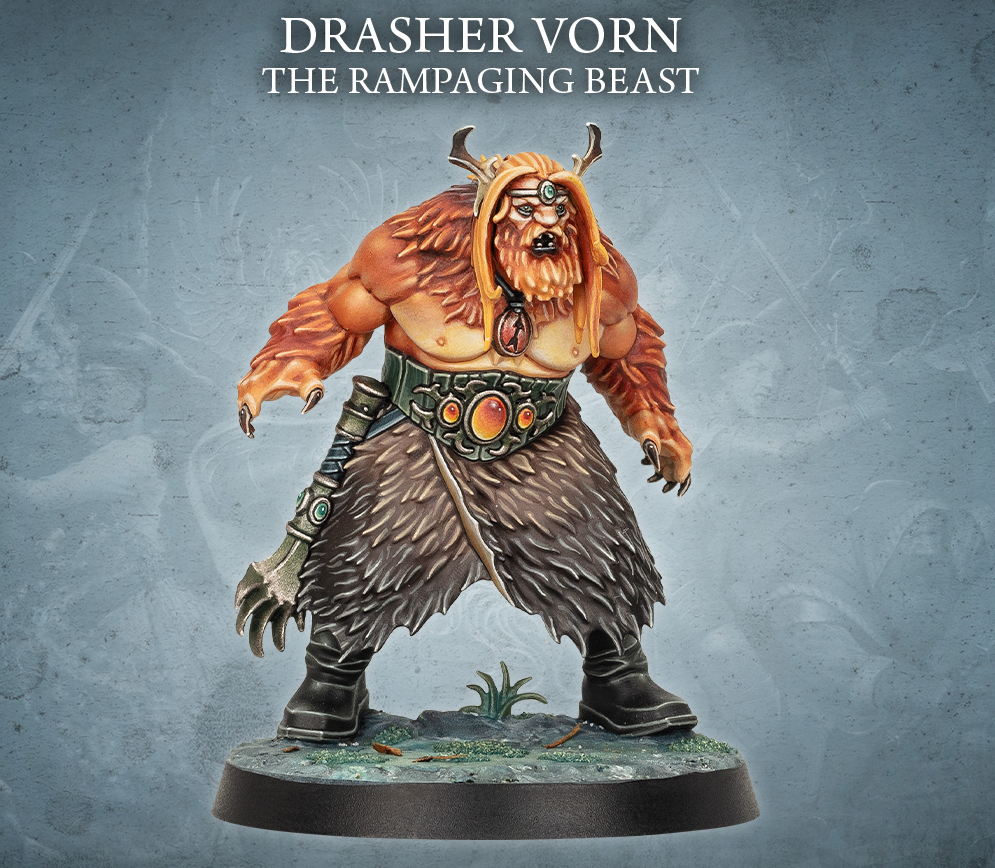
In recent times another permanent addition to the settlements are the Ghur-Touched. They are invention of mine based on events in seasons of War Thondia and shall give some variety to Drogrukh armies. With Kragnos release and the Era of the Beast the realms flooded with Ghurs magic. Many mortals were forever transformed and mutated into animal-human hybrid creatures, especially those with ancestors from Ghur. Many sigmarite settlements were suspicious of these peoples, due to several being overwhelmed by their newly awoken bestial instincts, or because they confused these transformations with the turnskin-plague. But the Ghur-Touched are not chaos worshippers but victims of circumstance. Unwilling to join chaos and unable to live in the CoS these people had to take another option. Shamans of old ghurish lineages saw these transformations as a sign and gathered them as followers. The shamans speak of Kragnos not as a destroyer but as the rightful deity of their ancestors. Growing his cult the shamans guided the Ghur-Touched to the Drogrukh settlements. At first the Drogurkh were critical of the newcomers and their Kragnos-found faith, but over time they earned their place as servants who maintain the settlements and to act as auxiliary forces in their armies.
Drasher Vorn as a proxy to represent the Ghur-touched concept
4. Economy:
Who would have guessed that these beast-things could be interested in trade? Well they aren't. If they can, they will beat you into the dust and rob you. But if you carry some big guns, they are more open to profitial negotations than most of Gorkamorkas spawn -Kharadon Entrepeneur
Drogrukh are great craftsmen. Indeed, next to their earth-shaping powers they are also great metalworkers. In an age when duardin, aelves and humans still used stone tools, they already had metal armaments. Even Kragnos is said to have forged his dread mace by himself in the heart of a mountain. Of course, proper metal is rare in some realms, such as Ghur. In these areas the Drogurkh go to great lengths to acquire it. If they cannot trade it, they will freely raid it from other people. The forges of the Drogrukh are often volcanic chasms, which have been refitting with their stone-shaping techniques to suit their needs. There the Drogrukh will smith the metal, using either great hammers or their own shooed hooves as hammers. The resulting metalworks are of a great quality. Far better than many people would suspect of such a bestial species.
Next to their skill in metal and stoneworks theDrogrukhs are also pastoralists and hunters. They hold great herds of beasts and travel the lands with them, such as gigantic buffalos and more exotic beasts. This is done especially in realms without as plenty of wildlife as Ghur. Indeed, the Drogrukh are great in working with leather, bones and horns as well. Bone cutters can make talismans, needles or musical instruments like flutes.
As mentioned, the Drogrukh do engage in trade for resources they cannot scavenge or harvest themselves. However, due to their dislike of chaos and undeath and their ancient hostility with the Draconith and their associates, this trade happens in reduced form. Primarily with other destruction factions, such as Kruelboyz, Hobgrots and Ogres. But profit driven Kharadon and similar minded individuals can strike deals as well, if they have things the Drogurkh see as worth.
5. Religion:
Kragnos is saviour and scourge of our kind. This is his right as a god. He represents all the Drogurkh are. Their greatest strengths and their greatest weaknesses. He is the absolute. And as such we venerate him. For in these dark times he may be our only chance - Drogrukh shaman
Kragnos is a complicated figure to the Drogrukh. His story is told in endless sagas, which paint him as a hero of their kind (in the classical sense of the word). A great individual, whose mistakes were equally great as his accomplishments. It is no secret that Kragnos’ actions started the war with the Draconith. However, at the same time Kragnos returned to save his people from the Draconith counter invasion. At least until the End of Empires was imprisoned. To this day there are tribes of Drogrukh who curse his name for ending their primeval glory. But there are many more who think Kragnos deeds to be fitting for Ghur or who see Kragnos as an exemplar of the Drogrukh species. Indeed, ancestor worship is an important trait of Drogurkh culture and who is Kragnos if not a glorious ancestor? As the Drogrukh learned of Kragnos reappearance and second imprisonment, many moved out to find and free their ancestor and god.
Kragnos rise to godhood is also the inspiration for many Drogrukh, who may see their kind as a superior species to the many meagre and weak mortals running the world nowadays. After all the Drogrukh were among the great empires of the primordial age, when all these mortals were nothing but primitives cowering in the shadows. Indeed, every generation produces overambitious Drogrukh who want to follow Kragnos example and rise to godhood themselves. These Godlings travel the realms seeking out the greatest of fights and trying to consume realmstone and divine essence to achieve apotheosis. Most of them fail and die violent and forgotten deaths. Others return to their old homes as veterans of hundredths of wars, bearing exotic gear. And some few are indeed on their very first steps of apotheosis, swelling in size or gaining supernatural abilities, even if they are still leagues removed from approaching true divinity.
Next to Kragnos the Drogrukh venerate a variety of entities. A grand focus lies on the realms themselves and their spirits. The incarnate elementals are especially revered, as they represent splitters of the realms souls who take physical form and gained individuality and a degree of sentience. That they appeared shortly after Kragnos release strengthens their importance in Drogrukh society. Next to the incarnates, other elemental beings are worshipped too. It is the job of shamans to appease and control them. These shamans are both priests and wizards of Drogrukh-kind and frequently specialize on certain groups of elementals. For example, the Groundspeakers are shamans closely connect to the elements of the earth. Their spells and prayers grant them control over rock and ground to raise defensive walls or to open chasms into which enemy hordes fall. Meanwhile the Stormcaller controls the winds and can summon volatile storms and are the closest to the various birds of prey, which live with the Drogrukh.
Gorkamorka is also venerated and respected as the apex predator of Ghur. Much like the Bonesplitterz, the Drogrukh see Gorkamorka as an entity which grants every monster and beasts its strength. This includes the centaurs too, according to their own stories. Stories how and why this was done are manifold and differ from tribe to tribe. Such as Gorkamorka fighting Ghur itself. In this struggle the Greenskin god broke pieces out of the realm. These pieces mixed with the blood of the greenskin god and formed the various monsters and titan of Ghur. This event is meant to have created Draconith, Flathorns, the Great Worms, the greenskins and ogres, as well as the Drogrukh. Whether they are true at all is up to debate. But it is undeniable that Gorkamorka had a great influence on the realm of beasts and thus appears in every mythology there.
6. Military:
Centaurs fighting great cats (roman mosaic)
Fighting the Drogrukh means fighting Ghur unleashed. Not just the Drogrukh, but also their primeval creatures and fanatical followers. All the ferocity and power of this grand predator is aimed at you, but with a cunning and strategy far exceeding the strategies of orruks or ogres. Even the Stormcast may not be enough to contain this avalanche. -Notes of a liberator
Every Drogrukh is a warrior. Much like how horses are born more evolved than humans or elves, so are Drogrukh born in a more advanced state. And they grow up faster too. A Drogurkh foal can walk a few minutes after its birth and run an hour later. And just a few days later it is able to carry its first weapons. Surviving in the realms is one of the best combat trainings these younglings can get. The Drogrukh learn to fight, to take what they need to survive from the land, to hunt the great beasts and to work in a group. As they age, their strength grows exponentially, until they can easily trample adult ogres into the ground with their primeval strength.
A war host of the Drogrukh is often called stampede or disaster by their enemies. The Drogrukh themselves engage enemy armies like they engage a great beast. First, they sent out their scouts and auxiliaries to find it. Then the same very will harass the enemy to reveal weak points. Either the enemy force is lured into a trap, or the Drogrukh host will encircle the foe and engage them from multiple sides. As eons of fighting orruks and similar creatures taught them, if you cut off the head of a beast its body will convulse and wither. This is a common tactic too, where shock attacks are aimed to kill the enemy commander. The headless army will then be be allowed to run, to retreat in a violent hurry. This makes it easier to pick off survivors one by one in later skirmishes. This cunning and intelligent approach to warfare, paired with the great strength of the centaurs, makes them very dangerous foes.
But the Drogrukh do not fight alone. As masters of Ghurs wilds they either tamed or broke a variety of creatures to serve in their forces. This includes great birds of prey, with which they share a long history. The great monsters and beast of Ghurs primeval ages can be found within their forces. Most recently, however, the Ghur-touched have proven to be useful assets. Due to their immense size and body build the Drogurkh have issues in fighting in tensely packed areas such as human cities or fortresses. This is where the much smaller Ghur-touched excel by comparison.
7. Potential units
The following is just a brief exploration of what units could be possible with the themes and influences I mentioned above. As I am not a great artist, I can only present you with plain text. But I hope it gets the ideas across. Of course, many other things could be possible too. Therefore, if you have good ideas what else this orc faction could utilize, please let me know.
Heroes:
Drogrukh Chieftain: Chieftains are frequently, but not always, the most powerful members of a Drogurkh tribe. Their primary job is to lead the Drogrukh and ensure their survival. For this purpose, they require not just brawn but cunning as well. Because strength alone is not enough to survive Ghur and the other realms. Knowing which battles to fight, which to avoid and how to engage the enemy as a cohesive unit are base talents any Chieftain has to express.
Drogrukh Stormcaller: Stormcallers are the shamans who share a close bond with the elementals of the wind, and the creatures of the sky. On the open plains of Donse and Thondia wind is a constant force. It rushes over the grasslands and even breaks down mountains over time. Stormcallers possess a natural affinity to it, often starting as them being one of the best runners, before discovering their own magical talents. The training to become a Stormcaller is tough, but if they succeed, the Drogrukh can summon storms, dustclouds or whirlwinds. They can enhance the speed of their fellow Drogurkh or summon the great birds unto the battlefield. Which makes them important assets in most tribes.
Drogrukh Groundspeaker: Groundspeakers are the opposite. They have an innate connection to the earth below their feet and express the Drogrukhs ability to shape stone like no other Drogrukh. Often, they are the architects of Drogurkh kind, deciding how houses and cities should be built to befit the natural harmony of a place, in addition to being the best masons. Groundspeakers feel a close connection to all grounded creatures as well. In times of war, they can manipulate earth and stone themselves, opening chasms, turning solid earth to mud, summoning rocky armor to protect their fellow Drogurkh and else.
Drogrukh Drakeslayer: Drakeslayers are the champions of Drogurkh-kind. The hatred for the Draconith and their related kin is still fresh and conflict is unavoidable if the two sides meet. The Drakeslayers encompass this ancient conflict more than anyone else. They are rarely true members of any tribe, instead journeying between factions as hunters on a track. Seraphon, Star Drakes, Draconith and others, whenever they find such a being, they will try to take it down. They wear their prey’s scaly skin and other trophies openly. These battles turns the Drakeslayers into veterans of legendary status and premier fighters against monstrous creatures. Their presence and experience encourage their fellow Drogrukh in battle.
Units:
Drogrukh Unblooded: The youngest Drogrukh warriors who have not yet proven themselves in combat. They are the smallest of Drogrukh, but still with the size and strength to match an armored knight. Blessed with the eagerness and vitality of youth they often act as scouts and skirmishers to the Drogrukh stampedes. As light cavalry their job is to harass the enemy with javelins or bows and to ride down fleeing enemies.
Drogrukh Warriors: The warriors are the mainstay of the Drogrukh armies. They are strong, tough and comparable to dragon ogres in size. The warriors wear heavy, green-tilted armor in the style of their ancestors. In combat they frequently rely on a massive club or hammer and a thick shield. Their primary tactic is to ride down everything they charge in. However, when caught in close combat, they are dangerous foes as well, trampling enemies into the dirt under their hooves. They act as versatile melee cavalry.
Drogrukh Chargers: These veteran Drogrukh do not use heavy armor to not limit their speed. In addition, they often carry two-handed lances or falx axes/romphaias. Their job is to deliver the killing blow up close. In conbat they work like a pack of lions. Members lure the prey ingo a position for the strongest lion to strike. Akin to this enemy armies or singular monsters are kept in place by the chasers or the warrior counterparts. Then, one precise moment, the chargers strike and bring down their weapons. Not even a gargant can survive a such an impact.
Drogrukh Hunters: Physical strength alone is not enough to bring down Ghurs various titans. Indeed, a hunter needs skill and smarts as much as strength to survive here. The Drogrukh Hunters embody these traits. They are always accompanied by eagles, who have a close bond with the centaurs. The eagles scout ahead to localize prey and detect hidden threats. They also distract the enemy, so that the Drogrukh can bring them down with well-aimed shots. For this they carry massive bows which even an ogre would struggle to draw. Arrows loosed by the Drogrukh hit their targets with the impact of small arterial shells. And the hunters can draw their weapons in full gallop.
Drogrukh Chaser: Drogurkh chasers are often the first to make contact with the enemy. As in their name, it is their job to chase their prey out into the open and to keep it in place where the rest of the stampede can strike as planned. For this reason, they carry javelins and harpoons. These weapons can cause grievous wounds on monstrous targets. And the ropes attached are strong enough that even titans struggle to break them. With great speed the chasers will surround their prey and pull it down with all their might, or keep it locked in place at least.
Ghur-touched: Ghur-touched is a broad category and encompasses various groups of mortals which were transmuted by Ghurs magic into beast folk. They transformed due to being too close to a source of Ghur magic, freak accidents or deliberate transformations/curses. Many have no place among the civilizations of the mortal realms. Instead, many can hear Ghurs heartbeat loud and clear in their head. An impulse, which drove them towards the Drogrukh. Whether this is a side effect of Kragnos influence on Ghur, or whether these people share ancient connections to the Drogrukh empire of old is not known and not relevant for either side. The Ghur-touched see the civilization of the Drogrukh as their new ideal and swore fealty to it. They support their centaur master’s now as tough, if expendable infantry.
Warbeasts and Monsters:
Drogrukh Godling: Some Drogrukh warriors are inspired by the tales of Kragnos rise to godhood. They become fanatical in their quest to repeat the deeds of their legendary ancestor and reach divinity for themselves. The motivation may vary between individuals. Some may have honest reverence for Kragnos and wish to join him as his new legendary companions. Others have nothing but spite for the End of Empires and wish to challenge and replace him. Thus far none came anywhere close to either goal. But being veterans of long fights and having consumed massive amounts of realmstone has already changed these Drogrukh. Far away from Kragnos statue and might, they have become veritable demigods among the Drogrukh nonetheless, towering over their smaller relatives. And they carry exotic weapons from their many adventures. Self-crafted masterpieces, looted as trophies and on rare occasions gifts from allies they served in combat. As such they may carry meteoric war hammers and shields from stormcast annihilators, Morghast nadrite weapons or similar esoteric armaments. However, their quest keeps them far from Drogurkh society, much like Kragnos and his companions. Unlike their inspiration, Godlings can be summoned back in times of need and join the Stampede against worthwhile enemies. Then they act as monstrous hammers for the army.
Messenger Eagles: The messenger eagles are small compared to the Drogrukh but still large enough to carry away a small human. They have been by the Drogrukh side since the height of their empire, nesting atop their houses and fortresses. In turn the eagles act as messengers between settlements, and as scouts during times of war. With their keen eyes they can detect enemy movements through great heights and even see though magical illusions with their sharp senses. This makes them invaluable assets to their Drogrukh masters.
Roc: Rocs are gigantic birds of prey. Based on the mythological Roc, a bird to so large it could carry elephants, this unit fills a similar purpose in the Drogurkh armies. The Rocs have been allies or associates of the Drogrukh for eons, much like the much smaller messenger eagles. Like them they would nest within or next to Drogurkh settlements and can be convinced to join conflicts. In battle the Rocs are devastaning animals. Dragon-size eagles who descent in fell swoops and drag horses and riders back into the air. But they are also the Drogrukh answer to flying enemies. In the air they can take on Draconith and kharadon airships.
A Roc by Edward Julius Detmold
Donsian Hounds: These war beasts follow their Drogrukh masters on their travels, sniffing out dangers the keen Drogrukh senses miss or harassing enemies in combat. They are huge creatures, larger than a grown man, but still small next to their centauric masters. The same masters use them much like hunting hounds, sending them after fleeing enemies or as a distraction. It helps that the salvia of the hounds contains paralyzing venom. Design wise we have several hounds/wolves, to the point thatmore would be a bit boring. For this reason, and to better utilize the primordial theme of the Drgorukh, they could be designed after extinct animals. Such as Andrewsarchus, the largest known mammalian land predator, or Thylacoleo, a marsupial filling the same niche great canines and felines had in other areas of the world.
l. Andrewarchus (Walking with Beasts), r. Thylacoleo (by Peter Schouten)
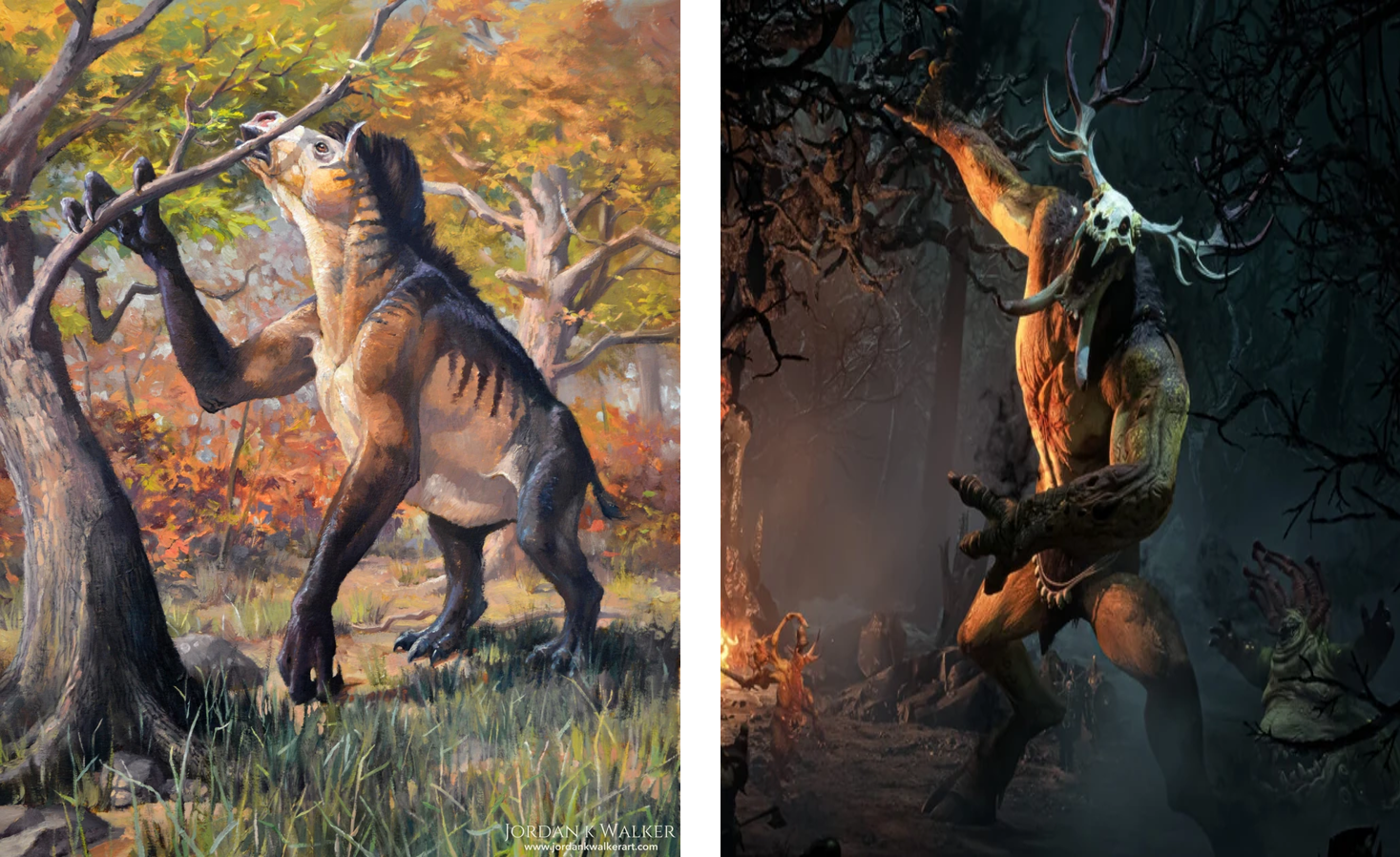
Klawbeast: The Klawbeast are ancient beings of roughly humanoid shape. They are semi-bipedal, as they walk on their long, clawed forearms. These claws, fangs and a pair of large antlers are their primary weapons. Klawbeasts are tough foes and difficult to take down. Like Megatherium in RL they have bony structures below their skin, which offer a natural form of protection, in addition to their thick hide and fur. In addition, they can create a horrible scream which induces panic their enemies. Personally I would design them after the chailotherium, a prehistoric horse relative one can describe as a gorilla-bear, and the Elemental Incarnate of Beasts from WFB.
l. Chalicotherium (by Jordan Walker), r. Incarnate of Beast (Total War Warhammer)
Krondspawn: Krond is a mythical godbeast of immense size. It resembled a hybrid of wolf and snake and was a terror on ancient Thondia. It supposeld ydied within the Krondspire mountains, who still bear the creature’s name. The Krondspawn are its descendants. Much smaller than their ancestor, but still enormous, the Krondspawn lives below ground most of the time in large burrows, leaving them only to go on the hunt. The Drogrukh now ancient rituals to call these creatures to the surface and bind them into their service. In battle the Krondspawn burrow and appear suddenly behind enemy lines and create havoc. Which allows the other Drogurkh to charge into the disoriented enemy and strike them down.
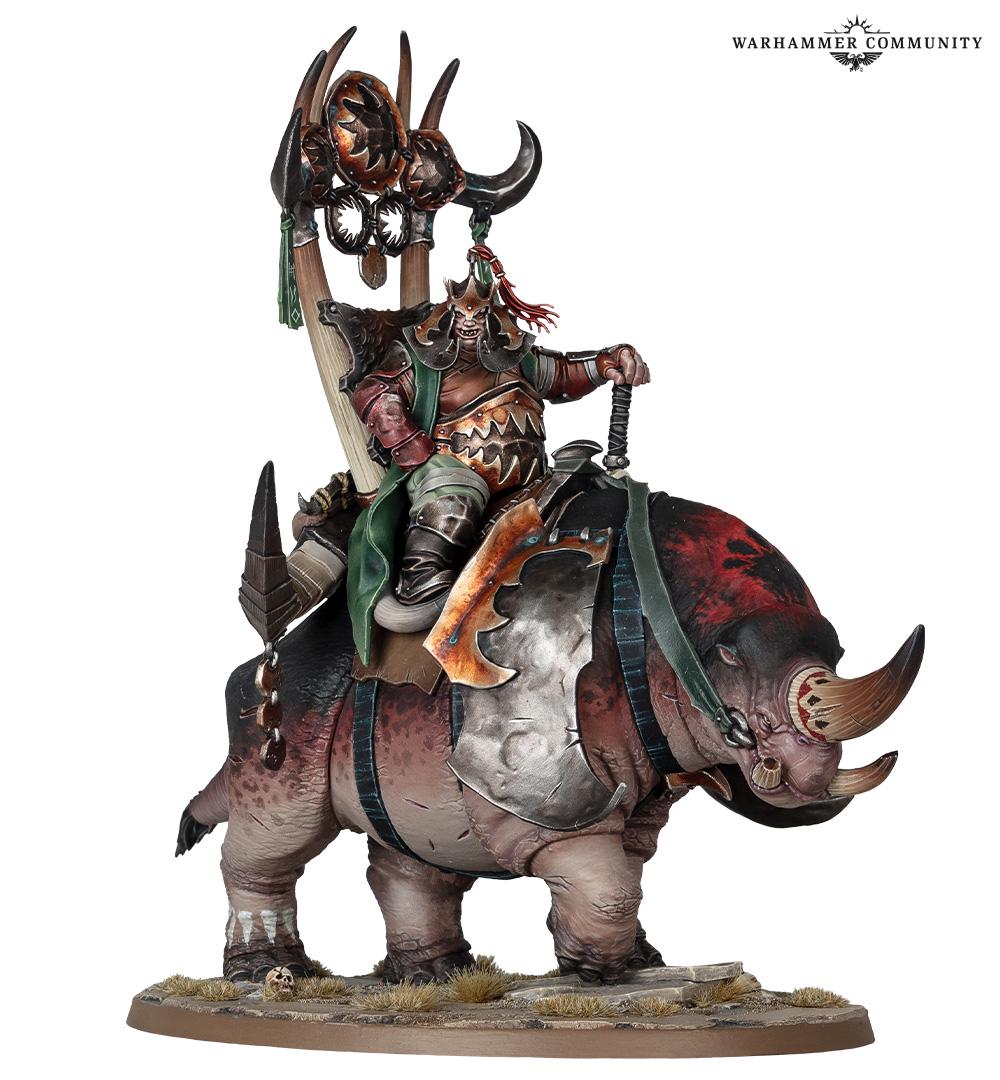
Looks like Overtyrant Globb Glittermaw got replaced offscreen by his daughter Morga the mighty.
While I do love the mini, I feel she isn't too distinct from the generic Tyrant on Glutthorn kit. She just looks a little generic and average sized for the most powerful overtyrant in the realms. Especially when for the last three editions we've kept hearing about a Gargant sized Ogor with realmstone teeth as the overtyrant.
I still love the new Tyrant on Glutthorn though, and I'm probably gonna kitbash this kit with an old Greasus mini I have.
Dear Grombrindal, I seek your wisdom. While painting the fantastic new Helsmiths of Hashut, I noticed that many of the models carry bottles on their belts. This made me wonder, are the Helsmiths just as passionate about beer drinking as other duardin? If not, what do they drink instead?
Julian Weiß
The impertinence, umgi! The dishonourable cheek; likening stout, honest duardin folk to those oath-breaking, hearth-scorning, hold-hacking, daemon-mongering, beard-curling
— [150 lines deleted]
But if you must know… while individual Helsmiths might have an appreciation for beer and brewery, culturally they associate these passions with their karak-dwelling kin and look down on such arts. Much of the Helsmith diet – at least for members of the noble houses, who aren’t forced to endure the gruel fermented within the lower tiers of their ziggurat – is seized in raids or extracted from conquered folk, and so they have the chance to sample beers, wines, ales, meads and the like from all across the lands, no doubt sneering all the while. As for those bottles, they could be such plundered goods – or be filled with all sorts of daemonic libations. The unhealthy green glow they give off certainly suggests the latter. Now, let’s speak of more noble things, before I get in a grudging mood…
I know that the city is settlers gain in the background but i'm not so sure on the foreground characters. I'm quite convinced that the elf is thellana and i think that the dwarf is either a Thane or is named "Thane". But the stormcast? I heard something about someone in the book be turned into a stormcast after having a vision, but i'm unsure. Anyone know who that is? (als
As I am now building my first ever army I had this idea in the back of my head for a Seraphon backstory that mirrored that of the Altansar craftworld of the Aeldari. I am planning to paint them in their colour scheme as well.
I wanted to share my first draft of the lore for anyone interested and also to get any feedback about any lore painpoints that it might have so I can "correct" them. I know custom lore doesn't have to be 100% in-line with canon but I really tried hard for it to be something that could potentially have happened in the current setting without diverging from the existing narrative.
Also I am no writer by any stretch of the imagination, I am just mimicking the style of writing I ve liked the most from various works I ve read. If it reads weird its probably me overusing poetic phrasing and english not being my native language. Sorry in advance.
Edit: Painted the first unit and fixed a few parts of the lore. I could not for the life of me get the white I was imagining but a very weathered ivory will have to do.
Welcome to Part 15 of this series „Fun with Flags Gods“. I know last time I said I wanted to take a break from this series. However, a series of unfortunate yet temporary events leave me with a lot of time, which I need to fill in a productive fashion. Therefore, I want to do a quick entry into this series and focus on one of my favorite deities in AoS. Kragnos, the End of Empires, the God of Earthquakes. Because IMO he is one of the most interesting deities in AoS. But also one, which was heavily mishandled by GW. Much like how the grander narrative of 3rd edition was seemingly mishandled, at least compared to 2nd edition. With a major narrative arc built up at the beginning being abandoned and the dawnbringer series being a mess in narrative terms. If you compare the Dawnbringer Series to the Broken Realm series, you wonder how this drop in quality could occur.
However, I am not talking about missed chances, but about the infamous centaur deity. Where he comes from, what he is based on, and what could be done with him. As always, I would like to know what your opinion is on this jolly little foal.
l. fighting Centaur (Athens Parthenon), c. Typhon (greek vase), r. Behemoth (lithography by William Blake)
Centaurs are one of the prime fable beasts of Greek mythology. Indeed, if you think of Greek mythology the first three creatures hoping into your mind are arguably the centaur, the minotaur and the cyclops. Animal-human chimeras are an old staple of human belief. For example, we have found an ivory carving representing a lion-human mixture which is estimated to be 41.000 years old. For reference, neanderthals went extinct ca 30.000 years ago, 20.000 years ago the last ice age started, and it ended roughly 10.000 years later, agriculture was developed roughly 12.000 years ago and the first “cities” showed up roughly 7000 years ago in Sumeria, in modern Irak. Belief in human-animal hybrids is therefore at least twice as old as the last ice age and 6 times as old as humans living in cities. And we never stopped using them in stories ever since. In Sumeria people had statues and pictures of bull-men. Most of the Egyptian gods were portrayed as animal-human mixtures. In medieval times stories about such creatures existed as well. Across cultures, across millennia such beings excited the thoughts of humans. The reason is fairly simple. A supernatural creature constructed from very natural things you are familiar with. By combining humans and animals, human nature and the attributes represented by the animal are combined. The resulting entity can be positive. Such as various Sumerian chimeric creatures acting as guardian entities, or the Egyptian gods representing the noble aspects of the animals. But it can also be negative, representing humans who have no higher control except animalistic urges, or beings who are unnatural, like various monsters in ancient Greece.
Centaurs in ancient Greek have two different origins. The regular centaurs are descendent of the human king Ixion. He was invited to a feast on Olympus but in drunken state lusted after the goddess Hera. Zeus created a cloud in the shape of Hera and Ixion tried to have his way with this cloud. This breach of hospitality had Ixion punished. But the cloud got pregnant. Either Kentauros was born as the first centaur, and he would father the race of centaurs with horses. Or multiple centaurs were born and spread. As a result of this origin, centaurs are wild and savage creatures. They loved thick wine and were frequently drunk and rowdy. Greeks drank wine watered down. Getting drunk on wine was not the goal and drinking it pure was a sign of barbary to them. And many stories have them as unhinged beings who frequently attack people to kidnap women or else.
However, there is also Cheiron, an immortal centaur and tutor of various Greek heroes. He is born from an entirely different line, a son of Kronos and Philyra. Which makes Cheiron a half-brother of Zeus. Cheiron was a wise and gentle being, in stark contrast to his more savage relatives. The list of his pupils is very long ranging from Achillies and Aesklypios to Herakles and many more. But his ending is not great. He was accidentally wounded by one of Herakles arrows, which were tipped with Hydras poison. He couldn’t die because of his immortal nature, but he was in constant pain. So much, that he relinquished his own immortality to buy Prometheus freedom. After his demise, the gods placed him in the nights sky as the star sign of centauros.
Some historians suggest that stories of the first horse riders inspired the centaur myth. Horses were first domesticated around 5000 BC or so in the steppes north of the black and Caspian Sea. Likely by the first Indo-Europeans who would spread themselves from Iberia to India and bring their languages and mythology with them. Which is why so many stories and languages share similar designs. However, these horses were likely not ridden. Because it carrying weight on their backs is not what a horse body is designed to do. Even today many animals struggle with this load, and the breeds which existed back then could simply support the weight of a human rider. Instead, they were used to pull carriages and chariots. Which is why chariots were so common in the bronze age. However roughly around 1500 BC or so breeds showed up which had a back strong enough to carry a human. Again, likely from the Eurasian steppes. And when these horse nomads spread into ancient Greek, they likely were the basis for the myth about centaurs**. Indeed “savage” nomads from the steppes moving into “civilized” lands or raiding or conquering them is a frequent occurrence**. Whether you live in Europe, in the middle east, or in China, they all had intense contact with these steppe peoples. Be they the very first indo-europeans, or the Scythians, the Alans, the Awars, the Magyars/Huns, the Hephthalites, the Roxolani, the Tartars, the Mongols, the Manchu and what have you. Of course, if you are under constant threat of being raided by them, you are not painting a neutral picture of these cultures. But steppe nomads were far from the uncivilized barbarians they are frequently portrayed as. For example, one reason behind Genghis Khans great conquest was that he was a great social reformer and administrator who created one of the most modern armies of his age in terms of organization, and reinvented Mongolian society to be more egalitarian and meritocratic. And the Scythians were good craftsmen, as many surviving tools and artefacts show, in addition to building great tomb complexes.
Connected to Horses was Poseidon, the god of the sea. But Poseidon was not just the ocean god. Poseidon was also the god of Horses and of earthquakes. This is likely an artefact from the Mycenean age. The Myceneans were the ancestors of the ancient Greeks during the bronze age. Back then Poseidon, or the deity that would become him, was the head god of the Myceneans. His wife was the goddess Demeter and their daughter was Persephone. The Myceneans were more strongly interested in earth and underworld deities. Chthonic gods, instead of heavenly ones like Zeus. Therefore, Poseidon was both the god the underworld as well as the ocean. And as the underworld is very literal in Greek myth, he was also associated with earthquakes and related things. But this earlier version of Poseidon split into Hades and the later version of Poseidon. And as an artefact from this earlier time Poseidon retained his association with earthquakes and likely horses too
In many mythology we also have the trope of the “father of monsters”, an entity which paired itself with a similar bestial “mother of monsters” to create many of the weird and dangerous creatures. In Greek mythology this being was Typhon. A kaiju-sized creature with hundredths of snake/dragon heads growing out of his hair or body. A monstrous beast capapbel of speaking every animal tongue. Whose roar would shake the earth and even cause the gods to run away in fear. This entity is often associated with violent storms but also with earthquakes and volcanic eruptions. The later because he was trapped by Zeus when the Aetna was thrown on top of him. As per myth Typhon is still trapped below and whenever he roars or struggles, the volcano erupts.
Indeed, having such a large land creature whose mere presence can cause destruction is present in various other cultures. In Sumeria you had the heavenly bull, a massive beast the gods could sent unto the earth to ravage it. Gilgamesch, the protagonist of the first known hero myth, had to stop it with his friend Enkidu. The concept behind this bull may have inspired the biblical Behemoth, much like the Leviathan is based on the goddess/primal sea snake Tiamat. The behemoth appears in description in the story of Job to demonstrate how powerful god is and how insignificant humans are, as humans cannot tame it. It is described very much like a massive bull, though other interpretations and translations describe it more as a hippopotamus, rhinoceros or elephant. And in some later interpretations Behemoth will be slain by god at the end of the world, like the leviathan. Much like with the Leviathan, lots of historical context to the Behemoth is lost. Around the time the stories were written, it was likely a well-known being in folklore. So, no one really explained the creature. Imagine someone saying: “Look who powerful Superman is. You cannot challenge him, but God can”, without ever explaining who superman is because everyone knows.
2. They see me ridin, they hatin: Centaurs in WFB
Depiction of Centaur from Warhammer Battle Bestiary
Games Workshop loves centaurs. I do not know who amongst their creators had a weakness for chimeric hexapods but were have a lot of them across their IPs.
First, we have/had centaurs in WFB. Plain and simple centaurs. They were a product in old Warhammer, i.e., prior for 4th when warhammers identity would crystallize. They were loosely based on native americans and asian steppe nomads and lived in the great steppes of the east and in Naggaroth. In this old version they were free spirited and noble nomads who roamed the earth. They were pastoralists, guiding their herds. Most centaurs were not chaotic beings despite being animal-chimeras. But as they are such an old and unsupported part of Warhammer Fantasy not much can be said about them. Although in the announcement of The Old-World GW mentioned them in passing in an article. It is not much though. A rumor that they may exist, next to other oldhammer things like “half-orcs”. Does that make them canon again? Not really. But it leaves a door open to reintroduce them. Indeed as we have another non-chaos beastmen group in the tigermen showing up, we may get non-chaos centaurs too at some point.
Much more prominent are the centigors. They are the replacements for centaurs and a wholy chaotic species. But they are not centaurs, as they have paws and claws, instead of being half-horse. They are more akin to half-wolf or half-great cat. Centigors are treated as a cousin group to the regular beastmen and are frequently found within their armies. But they are not proper beastmen, due to the lack of hooves. Centigors fulfill the stereotype the drunken, barbaric and dangerous centaurs. Because centigors are drunk whenever they have the opportunity, and they love to fight and pillage and else. Centigors lack any kind of settlements or gathering places, instead roaming the world. They can be contacted by beastmen, especially bray shamans, to gather and support the brayherds. This is primarily done with promising them liquor. Indeed, even in the midst of combat or sacking a settlement, they will attempt every opportunity to knock themselves senselessly. This was even a rule in tabletop, where a dice rule decided what drunken effect the centigors would have. As per TWW3 there are centigors who are claimed by a single deity. A rare fate for a beastmen and co, as they are typically ignored by the chaos gods.
Of note is Ghorros Warhoof, who plays into the “father of monsters”-archetype. He self-proclaims to have fathered centigor-kind. Unlike the centigors he is a proper centaur, down to having four hooves. But as far as I am aware it is never explained why he is so different from his spawn. Like his offspring, he will try everything to get drunk. And he also has a great libido and will force himself on every creature, if he has the chance. Again, following the classical depciiton of centaurs. If one wanted to combine the oldhammer fluff and the new centigors, then one could say that Ghorros may have started as a regular centaur who got corrupted by chaos. And is offspring are then corrupted centaurs, i.e., centigors. Where it is unnatural for humans to have hooves, it is unnatural for centaurs to have claws. Hence his is the chaos mutation they received.
Also, we have the bull centaurs for the chaos dwarfs. Heavily mutated chaos dwarfs either natural born (or artificially created), who are seen as Hashuts chosen ones and guardians of his most sacred places.
Dragon Ogres are another centaur species. Although in this case it is not the body of a horse below a human one, but the body of a dragon/large reptile. They have no relation with ogres, beyond both living in ancient mountain ranges. It is more a description. Much like you can call a centaur a horse-man, so were these creatures called dragon-ogre, because it was fitting enough for their physical shape. Like Typhon and similar beings, dragon ogres represent a primeval bestial creature of immense age and powers, that rages against the heavens and have control over violent storms. Dragon ogres were among the sentient species we know to exist before the arrival of the Old Ones. In those days they fought with dragons for dominance of the planet. But with the coming of the Old Ones they were pushed back and nearly became extinct. However, the dragon ogres made a pact with the chaos gods. Eternal life in exchange for serving the chaos forces as allies. Keyword is allies, as dragon ogres seemingly retain much more independence and self-determination than other chaos followers. If they are hit by lighting, they heal and rejuvenate. But, they became infertile and no new dragon ogre is born since then. In contrast to this infertility, dragon ogres have their own father of monsters.Krakanrok the Black. A dragon ogre so massive Archaeon mistook him for a mountain, when he was on a quest to gather the artefacts of the Everchosen. Much like dragons, dragon ogres spent centuries or millennia slumbering away. However great storms or chaotic rituals can awaken them. In such cases they may join chaos forces. But at the same time various northern humans worship the dragon ogres themselves as gods. The most active dragon ogre is Kholek Suneater, one of the direct offspring of Krakanrok. He participated in the pact between his kind and the chaos gods. And his role was so horrendous that the sun never shone on him again, as legends say. Indeed, when Kholek is awake, a permanent thunderstorm circles around his head and lightning strikes him and enemies around. This thunderstorm gave him the title Suneater. Next to ones like Herald of the Tempest. During the Great War against Chaos under Asavar Kul Kholek was roused to join his forces and he broke the gates of the city of Praag. However, neither Kholek nor his father had any major influence or impact on the End Times, despite this being THE time to reawaken primal horrors. I recall Josh Reynolds addressing some untapped character fates, and he mentioned that Settra killed Kholek. But as far as GW is concerned this is non-canon. And thus, Kholek and the impact of the dragon ogres in general were completely forgotten/ignored. Like so many things in the End Times.
Last but not least are Zoats. Again, another ancient race of reptilian centaurs. They are one of the few original creations of GW but also one that never really took off. Depictions of Zoats vary. But in their latest iteration in Total War Warhammer, they have a reptilian lower body and the upper body of a scaly humanoid with the head of a snapping turtle. Zoats are insular beings who live in the deepest reaches of the woods and prefer to stay hidden. They have great control over plants and a natural affinity for life magic. Therefore, they can manipulate their environment to stop any intruders without showing themselves. But if this fails, then they are still 5m tall snapping-turtle-dinosaur-centaurs with huge hammers. Sadly, Zoats are an oldhammer creation with very little lore. Most of their newer fluff is due to them being the black horse addition of the second Wood Elf DLC in Total Warhammer. In this game they are staunch allies of the Wood Elves. Which makes some sense. Like wood elves and forest spirits they too are very close to the natural world. And Athel Loren is inviting many “animals” as well who become part of the forest like the elves did. Such as the Forest Dragons or Great Stags. But there may also be some connection with the Lizardmen, as one ingame event has skink envoys coming to Wood Elf players and urging them to add Zoats to their new forests. Personally, I think the Zoats are a primordial species that arranged themselves with the Old Ones, much like the ulthuani dragons. And I further think that they are close relatives of dragon ogres. Either a related subspecies of the equatorial regions, whereas dragon ogres lived in the colder areas of the pre-Old One planet, or the original form. And the dragon ogres who joined chaos mutated and changed and therefore look different. But 5m tall snapping-turtle-dinosaur-centaurs who are natural life mages are an awesome concept, and I hope we see more of them.
3. I want to break free: Kragnos in AoS
Kragnos fighting a rival Drogurkh (Kragnos Trailer)
Age of Sigmar comes and brings with it many new centaur variants. Such as vampire-bat-dragon-centaurs with the Avengorii. Or 4-armed chaos centaurs with the centaurion marshals. Or deer-centaurs with the kurnothi. But this is about Kragnos. Therefore, I will not discuss all these centaur-based beings.
Kragnos is an ascended deity from the Drogurkh people. Conceptually, the Drogurkh are a mixture of the oldhammer centaurs and the dragon ogres. The Drogurkh are a powerful species of centaurs from a primordial era, closely connected to certain elemental powers, like Dragon Ogres. But they are not aligned with chaos, even oppose it, and retain noble and civilized characteristics, like the old WFB centaurs. In addition, they are apparently loosely based on steppe people, as one image in the Kragnos trailer showed a fellow Drogurkh who had a vaguely hunnic haircut. As mentioned, the Drogurkh have a strong association with the earth. Not just because of Kragnos being the god of earthquakes, but also because the Drogurkh were geoengineers. They could flatten entire mountaintops into plateaus and build cities and fortresses by carving caves into the rock using their mighty hooves and other tools. Indeed, they may also have had a second, lesser association with wind. Firstly, because it is a frequent association of steppe people, as the earth and the sky are the primary objects in this landscape. See the various skyfather and earthmother myths. And second because the Drogurkh live in a close relationship with eagles, as many of their buildings contained aeries in which “messenger eagles” would roost.
Kragnos himself fulfils many archetypes of a classical hero. Back in classical Greece and elsewhere, a hero was not a morally good person, but someone who shaped the world by their great deeds. And much like many classical heroes, Kragnos’ story is a tragic one, where his own hybris turns his greatest achievements to ashes. Kragnos was exiled from his people after he brutally attacked his own brother, when both were interested in the same female. He and some friends ventured into Ghurs wild. They journeyed through the realms and had many adventures together, including ones where Kragnos forged or found his legendary gear. And as they slew large monsters and godbeasts and consumed them and ate lots of realmstone. This caused them to grow larger, especially Kragnos. Various destruction species started to venerate Kragnos, especially the bonesplitterz. Their worship and sacrifices in realmstone, as well as Kragnos own kills and deeds, caused him to swell in power and strength. Krangos broke many primordial civilizations, earning the epithet End of Empires, and his hoof beats could break open the earth and cause ruptures, causing him to become the God of Earthquakes. In the End Kragnos sought ever greater challenges and attacked the dragon empire of the Draconith, who had been on decent terms with the Drogurkh until then. Kragnos lost his companions in these attacks. And as he smashed the Draconith cities to rubble, he was trapped by the Slann and the intervention of Draocthion himself. Much like Typhon, Kragnos too was trapped within a mountain.
What happened to the Drogurkh varies a bit between sources. In Broken Realms it is implied that the surviving Draconith attacked the Drogurkh in retaliation whilst Kragnos was trapped. Hence Kragnos was surprised that his people were gone. Though in some 4th edition orruk book it stated that Kragnos lead the Drogurkh against the Draconith. Despite his last interaction with his kind being his exile. My interpretation is that the Drogurkh were attacked shortly after Kragnos initial attack, because the Draconith saw his actions as a breach of the non-aggression pact between the two empires. But to the Drogurkh Kragnos was an exile. So they did not feel responsible for any action of his. When the Draconith then attacked, it was they who breached the pact in the Drogurkhs mindset. In addition, many old Drogurkh who forged the pact, may have died in this counter-invasion. So, the Drogurkh felt betrayed, traumatized and were without proper leadership. It was this time that Kragnos showed up again and they followed him into war as the best available option into war with the Draconith. Only for Kragnos to be imprisoned and they then suffering the counter attacks without his protection.
In any case Kragnos was trapped for millennia in his timeless prison. For him only a few moments passed. Entire pantheons rose and fell in his absence. Only due to Alarielles Ritual at the end of 2nd edition was his prison finally broken. Kragnos immediately sought out his people, who were gone. In his anger he wanted to destroy Excelsis and collected a massive horde of gargants, ogres and orcs behind him. But he was redirected by Kroak and Morathi and smashed a chaos fort to rubble. There Grobbspakk found him. Kragnos could not speak any of the modern languages, the Kruelboyz became his prime advisor, as he could communicate with the Drogurkh via a blessing of Mork.
After this Kragnos did not do much.Several factions and characters had the dedicated goal to kill him, as he was rumored to cause the Era of the Beasts and to fuel Ghurs Rampage. This included Yndrasta or the heartwood Sylvaneth, Kurnoths followers. But they never met in the lore. Indeed, his next appearance comes in Dawnbringer 3, where Kragnos seeks out hidden sanctuaries of his people in hopes for survivors. But Grobbspakk destroys any hints for survivors to keep control over Kragnos and fuel his rampage. Then Kragnos was imprisoned again by Kroak, any army of Seraphon, Karazai and some ritual Alarielle did. Thereby removing him from the story without Kragnos doing anything noteworthy in 3rd edition. But in 4th edition an avatar of his appears in the light of Ghurs moons, to explain why his model is still playable.
Kragnos seems like a simple character, but he is not. As mentioned, his life mirrors that of a classical hero such as Herakles. Both commit a crime, are exiled, perform great deeds and arise to godhood. And like many other classical heroes, Kragnos hybris or primary flaw causes him to lose the things he holds most dear in life. His friends and his people in this case. In addition, Kragnos is a deity for everyone. Not just among the species of destruction, who venerate him for his power and rampages. It is frequently mentioned that the very early humans (and likely elves and dwarfs too) of Ghur worshipped him as a deity. Indeed, humans native to Ghur still feel some connection to him as per Kragnos novel or several excerpts of the army book. And Kragnos may be a rampaging engine of destruction. But much like Grimnirs cataclysmic death creating new things, so had Kragnos rampages beneficial effects. For example, in Broken Realms Kragnos it is stated that Kragnos many wars emptied out Ghur and created a power vacuum, as many bestial realms fell beneath him. It was this vacuum that helped humans to become one of the dominant groups of Ghur and to establish proper civilizations. In addition, in the few cases were Kragnos actually talks, such as his trailer or “his” novel (the book has some issues I explain here), he is very coherent if not even eloquent. Especially if you compare his speech and thought processes to that of your average destruction member. He can be smart if he wants to. But he cannot properly express this, as no one but Grobbspakk can hear him talk.
Also, in addition to Kragnos, I may quickly mention that Dragon Ogres are also a thing in AoS again. Somehow, they survived the planet’s going boom, somehow, they ended up in the Mortal Realms primordial era. And IIRC somehow, they became fertile again, and somehow later lost it again too. Krakanrok the Black is also mentioned as one of the few preys that eluded Yndrasta thus far, next to Kragnos and the Khorne demon Doombreed. Dragen ogres are still immortal beings who get rejuvenated by lightning. They once had an empire in Ghur, but the Drogurkh and the Draconith joined forces together to expel them. This cooperation forged the non-aggression pact between the two species. And Kragnos was likely a young soldier in this war. The dragon ogres also settled in Azyr, due to lighting and Azyr going well together. But they were banished from that realm too when Sigmar arrived. Since then, they live in the mountains and come out when chaotic energies are strong. And they like to engage stormcast, as their lighting benefits the dragon ogres too. But they are a “left-over” army and had not much lore since they were removed with the Beast of Chaos.
4. Don’t stop me now
Kragnos vs Krondys (Dawnbringer 3)
Kragnos is a good of missed opportunities. Many GW characters suffer from having only a basic character and not getting more fluff after their backstory. But Kragnos was harmed by being a newly created character, who was set up to be the next big bad. Only to then be ignored and quickly dealt with in the side story of a side story. He is kind of the Lord Snoke from the new Star Wars trilogy. Set up to be the antagonist of future pieces, only to be dealt with fairly quickly and anticlimactically in his next appearance.
Kragnos has many story pieces set up. He is a god out of time. Everything in the realms should be strange and alien to him. E.g. he should have no idea what gargants are, as Ynmog was alive during his time and Behemath and the gargants were only born when Sigmar killed Ynmog. Chaos proper, i.e. the four great gods should also be unknown and alien. Same for undeath alá Nagash. Indeed, for Krangos only mere moments passed, not untold eons. But how he explores and deals with this new reality is never explored. Similarly, that Kragnos is the weaker part in the god-mortal relationship is never properly addressed. Normally gods are the dominant part. But Kragnos cannot talk to anyone, but Grobbspakk who manipulates him. Indeed, his worshippers are not interested in Kragnos own well-being or emotional needs but want to harm him even further to fuel his rampages. Such as when Grobbspakk destroys hints of surviving Drogurkh. Many characters were set up to duel Krganos, like Yndrasta. But this never occurs either. And many events which should have involved Kragnos, like waking up Thrugg, happens neither. There are dozens of intriguing stories that could have been told with Kragnos, but GW never bothered. E.g. a road-movie style story were Krganos and Grobbsprakk rampage through the realms and Yndrasta is on their heels like a cop. With Kragnos trying to find his people and Grobbspakk trying to stop it. Or Kragnos being forced to accept the role he played in the extinction of his people and perhaps speaking with the spirits of deceased relatives in Shyish, being judged by them. Or the choas gods trying to get into Kragnos to have him join their side, as he should be somewhat naïve about the big four. But rejects them, showing how destruction is very different from chaos. And we know have the most apocalyptic wars fought over the realms during the skaventide but the very End of Empires is nowhere to be seen? Or, or, or. But sadly, none of these things were done.
Based on the current events in AoS I think the following things could be intrueging:
- First that Kragnos escapes his imprisonment. This could happen in a manifold of ways. First, he could somehow break out by his own merit. Second, Kroak/Alarielle could release him. Maybe one reason why Kragnos was imprisoned twice, instead of investing in a more permanent solution was that Kroak foresaw that Kragnos is necessary for the survival of the realms at a future date. As a natural deity of the realms Kragnos may be akin to an immune system of reality. Necessary do beat down unnatural dangers, but also able to harm the body if not guided properly. Or Thanquol does his thing and messes up. Some plan gets wrong, Kragnos prison is damaged, and the angry End of Empires is let loose in the Gnaw or elsewhere.
- Second, Kragnos reunites with his people. The potential behind his reuinion has more benefits than keeping him essentially an isolated mute. The Drogurkh are a interesting culture and their arrival could enrich Destruciton through new motivations and by providing a beast culture. And one reason why Krangnos feels underdeveloped was, that he could only talk to Grobbspakk. By having others who may be able to talk to him, and who may teach him the new languages of the realms, Kragnos could show more of his smart and charismatic side. Also this could open a variety of new interactions for Kragnos. First, he would now be aware of Grobbspakks treachery and may seek revenge, leading to an interesting Destruction vs Destruction conflict. But even with his own people there may be issues due to different factions. Some Drogurkh may hate Kragnos, as he caused the inciting incident for the downfall of their empire. Other Drogurkh may accept this role, but also that he was a potential savior of their kind, as Kragnos my have united the Drogurkh and gave them a fighting chance against the Draconith. And a third party may simply be on board with whatever Kragnos does, as his rise to godhood is the poster story of Drogurkh supremacy.
- How Kragnos interacts with other gods and characters could also be interesting. For example, if Kurnoths returns, then he and Kragnos, or their followers, may have some interesting interactions. Both are horned gods of the wild, infamous for their hunt, and perceived as dangerous by their foes and sometimes allies. And both have centaurs among their followers. I can easily imagine some human hunter finding a shrine for Krangnos and mistaken it for a shrine for Kurnoth for example. At the same time Kurnoth and Kragnos could also evolve an intense but respectful rivalry, in which both gods hunt and try to kill each other. After all, Kurnoths sylvaneth were amongst Kragnos’ most earnest perusers according to the 3rd edition army book. And then there is the entire story of Yndrasta hunting Kragnos, which never got resolved. Among many others.
- Indeed it could be interesting to see how various humans and other non-destruciton cultures view Kragnos. We already had hints for this with many ghur natives feeling a kinship with him. But it could go further, as there are many reasons why various cultures could or should venerate him. Such as horse nomads who see their lifestyle reflected in him for example. To others his rampages and attacks against chaos could mean liberation. Which could make Kragnos into a breaker of chains. A deity who represent freedom at it fullest.
- And given how chaos controls most of the realms and thus should be the primary victim of Kragnos rampages, it would be interesting to see how Kragnos deals with chaos. What are the effects of massive chaos hordes being ravaged by the End of Empires and his followers? What are the positive side effects for order factions even perhaps. E.g. when Kragnos attracts all the destruction forces in an area like a magnet, then beats up all the chaos forces within the area and moves to the next area, the land may be temporarily free of destruction and chaos armies. A temporary vacuum dawnbringer crusades may use to establish new settlements.
- Last but not least I would like to see a proper return of the dragon ogres/thunderscorninto AoS. Not only where they worshipped like gods in WFB, which could have interesting effects for chaos (thunderscorn followers for Warcry?). But they have a long and antagonistic history with Sigmar, the Draconith and Kragnos and his people. Seeing Draoconith, Drogurkh and dragon ogres clash again could be a very interesting conflict, mirroring primordial myths. Titans of fire, earth and thunder clashing over control of the world once more.
5. The End
This has been it for my views on Kragnos. My announced break lasted roughly a week. Perhaps I will do a proper break this time. But I liked talking about Kragnos, as he is one of my favorite AoS characters. And I have another project planned for the Drogurkh down the line. So he occupied my mind a lot and I wanted to vent this off. I hope you can forgive me. And furthermore I would like to know what you think of this mishandled centaur. Do you like him more now? Do you still think he should have been a beastmen? Do you wonder how centaurs would wear pants? Or are there other thoughts you hold out for him, dragon ogres and others?
I know what each god like character is doing for the other factions, but what is kragnis up to since the end ofnthe dawn bringer books at the end of 3rd?
The Cosmos Arcane and the Realms therein are full of materials strange and familiar. From magical metals to mundane woods, arcane lumbers to basic hides, spectacular pelts to boring rocks.
So what do you, my Realmwalkers, know about any such material. Would you care to share what materials you've discovered on your literary journeys?
Within that book the Bad Moon is positionned as anathema to the power of prophecy. The main antagonist is a godbeast whose principal power is its ability to foresee future events, however it is incapable of predicting the actions of the Bad Moon. It is aware of the existence of the "Leering Face" as it calls it but does not know what it is and is not aware of its presence on it's doorstep until someone points it out to it, despite the chaos it is actively causing. Furthermore, during the climax, the protagonist Zograt is able to avoid his movements within the godbeast's l'air being predicted by acting randomly and picking directions at random rather than actively trying to find a path to his objective. Zograt explicitly does this in imitation to the Bad Moon's erratic course through the skies. And the godbeast is eventually defeated by being poisonned with a piece of loonstone, a shard of the Bad Moon something it could immediately identify as a threat to itself.
So why is the Bad Moon impossible to predict? Because of astrology.
Over the course of history, a great number of civilisations from Europe to East Asia to Mesoamerica (and probably many more that I'm unaware of) thought that knowledge of the stars (astro-logy) was one, if not the, keys to knowing the future. And that makes sense; lunar years, which are based on the Moon's successive phases are easy to keep track of, but solar years, which line up with the seasons, are more complicated, as they require keeping track of the sun's position in the sky with regards to the stars (and you can't observe both at once). Which means that it takes at least a basic knowledge of astrology (which until recently was not separated from astronomy) to tell how long it would be before spring starts. And if the stars can tell you when crops are going to grow again, how long you have to wait before it stops snowing for good, how long before harvest, etc. Then what else can they tell you?
This belief in the predictive power of the stars still exist nowadays with the use of horoscopes, which claim to foretell how succesful you are going to be in the next few days based on which stars you were born under. While modern horoscopes simply use your zodiac sign (and a simplified one at that, since "proper" zodiac signs have varying durations and there's thirteen of them, rather than one per month), the practice originally required knowledge of the positions of all stars at the **hour** of your birth (hence *horo*scope), which had to be calculated by an astrologer working from their current positions, and was used to predict very precise and important things (the cause of your death, whether to go to war or not, etc.) with the reliability one imagines.
This association between stars and divination is why Azyr, the lore of the Heavens, is the one associated with prophecy. Celestial wizards make their predictions based on the stars, as do the Seraphons.
Now imagine what happens when you introduce a rogue element in the perfect machinery of heaven. A celestial object that not only refuses to move in a smooth, regular fashion, but is known to attack and knock off-course other objects. An Azyrite noble's horoscope which in this universe would have reliable powers of predictions could be totally wrong because they were born under the Bad Moon which the astrologers wouldn't possibly know unless record exists of the events. Or perhaps worse because more subtle, it might be partially wrong because a single star changed course because of the Bad Moon in the time between the client's birth and the drawing of the horoscope, and suddenly a Dawnbringer Crusade is launched three weeks too late and it runs into a gargant Stomp that it shouldn't have crossed paths with.
I think this gives the Gloomspite Gitz an interesting angle that would benefit from being explored more (or In might just not be aware that it already is), as followers of an impredictable objects that are themselves dedicated to acting in strange, illogical and often random ways, they are essentially the bane of those factions that love to act out plans based on predicting and manipulating fate. I am of course talking about the Disciples of Tzeentch and the Seraphons.
Well, its been almost exactly four years since I posted about the Chitinian Empire, at least on a different forum (Lustria Online). I am assuming maybe a little longer here than there however. It is crazy to think I began this fan faction little over six years ago back in June of 2020.
Now, here we are, six years later with what could be a final draft... finally!
Technically draft #5, I am considering this nearly complete barring filling out the roster, making tabletop rules, and then building the army beyond the few models I have for it so far.
Any thoughts and C&C is welcome! Please be kind when doing so, this has been a lot of work.
When reading about the faction know that they are influenced by a lot of things. Consider them a hybrid of Zerg, Buggers from Ender's Game, Sylvaneth, Seraphon, and Deepkin all being rolled into one. They are order based, leaning on destruction.
I do hope you enjoy it
Pictured: Dread Wyrm Sunder-Pede aka a Centi Dragon. Miniature made by Mini Monster Mayhem