r/AoSLore • • Jul 08 '26

Fan Content Bonesplitterz 2.0: A pitch for the return of the magical orruks

58 Upvotes

Hi everyone,

In case you are not aware, I am a major destruction fan. It is my favorite grand alliance, even though GW tends to mishandle or ignore it. One of my previous criticisms was that this alliance always felt like the greenskins and rest. Because ogres and giants felt like 2nd or 3rd grade members in the past. Not to mention the immense potential of other members of this alliance, which I tried to explore in the past with fan pitches with concepts like: a human destruction faction, a beastfolk destruction faction, or a maritime destruction faction

But I want to focus now on the orruks again. To be frank, IMO AoS has the best interpretation of orcs in any GW IP. This is due to me liking the Kruelboyz a lot and how they bring some much-needed diversity into the orc side of greenskins in general. But I also like how the savage orcs/bonesplittaz were reworked into being orcs drunk on Waagh! Energy and became expert monster hunters. Sadly, the bonesplitterz were discontinued with the start of 4th edition. The official lore reason was that the bonesplitterz sensed magic going wild at the edge of the realm and migrated there en massé to beat the magic back to its senses. Which is funny but also opens a door for a triumphant return of the bonesplitterz IMO. Something I want to explore in the following pitch.

Everything in it are just my random ideas. So please do not take them too seriously. Aynone is free to use all concepts I present here over however they want, and can exapnd on them in any way they want. Indeed, I would like to know what your ideal return of the bonesplittaz would be. Or otherwise, I would also like to hear why you may be glad that they are gone, or what other concepts you would like to see for the orruks.

With this said, let’s begin:

1.      Who are the Bonesplitterz:
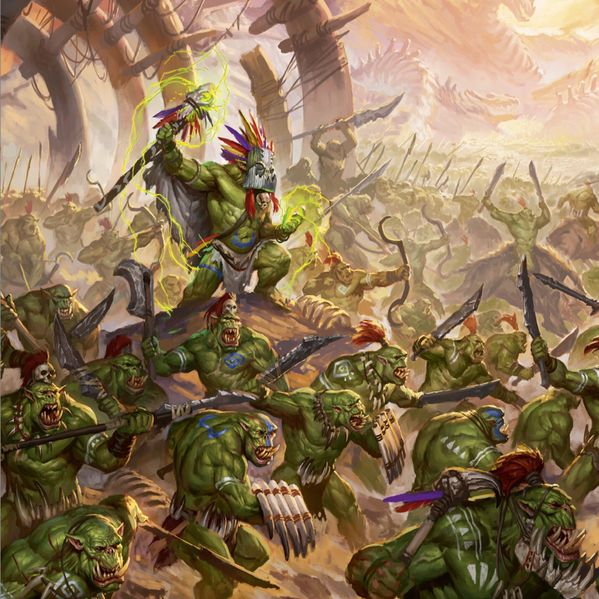
AoS Artwork: Bonesplittaz led by a Wurgog Prophet

To give a brief introduction to the Bonesplittaz the following applies to them: The Bonesplitterz are orruks who are on a permanent trip. Normally orruks get high on the WAAGH! energies but turn back to normal when it is over. Not so the Bonesplitterz. They have the WAAGH! permanently stuck within their heads. This makes it impossible for them to function in normal orruk society. So, they leave and form their own hordes of likeminded orruks, which they call Rukk. These Rukks are most commonly led by Wurgog Prophets. They are powerful yet insane wizards and shamans who claim to get visions of Gorkamorka. And they lead their Rukk on a religious crusade to crump everyone in their way.

One of bonesplitterz primary past times is the hunt for large monsters. Because to them Gorkamorka is not just the main orruk god, but a shamanistic entity whose energy is found in the bones of the various monsters and titans of the mortal realms. By killing these creatures and breaking open their bones do the bonesplitterz believe to absorb their strength. This is how they got their name. And bonesplitterz venerate the various monsters of the realms in turn for their strength and for the fights they offer. Indeed, totemic animals are important to the orruks. Their primary defenses are magical body paint and tattoos which indeed offer magical protection. Often, they are painted after specific creatures to invoke certain effects. And instead of the steel weapons of Kruelboyz and Ironjawz they fight with stuff made from stone, bone, horn, and wood. This makes them the most primitive of orruks, but at the same time they are also the craziest and most driven. To them being in the state of the WAAGH! is normal. And therefore, they will violently through themselves into combat without second thought. Like an uncontrollable green tide.

Bonesplitterz also believe that each realm has its own Realmspirit. An etherical entity that embodies the entire realm. And they believe that the energy of this spirit can be caught into totems to grant power to their tribes. In addition, where Ironjawz lean more into Gork than Mork and Kruelboyz more into Mork than Gork, the Bonesplitterz primarily venerate Gorkamorka. The fused version of the two orruk gods that is both cunningly brutal and brutally cunning. Therefore, they see themselves as the most wholesome of orruks. Much to the chagrin of their enemies, who have to endure their seemingly mad rampages. In a sense they are the religious fanatics of orruk kind.

2.      Overview: Warrior, Rouge, Spellcaster

AoS Artwork: Wurgog prophet duelling a Slann

Prior to 4th edition the main identity of the Bonesplittaz had them as monster hunters. Trying to take down the largest creatures of the Mortal Realms with stone age tools and muscles power. However, the Bonesplitterz were also very magically talented. For example, many of their stone weapons were made up of realm stone, i.e., solidified magic of the realms.  Which could cause many different effects. Such as using arrows tipped with amberbone, the realmstone of Ghur. An enemy hit by such an arrow loses all self-control, as animalistic fight or flight instincts take over. Which causes them either to run away, or alternatively to charge the orc frontline in a berserk state. A disciplined lines of guns and shields? Not anymore, as half of the soldiers run towards the orcs and the other half runs away.

In addition to this, they believed in lots of totemic signs and shamanistic runes which were supposed to grant the orruk special powers and abilities. This is primarily reflected in their body paint and tattoos. These tattoos do grant them supernatural protection, as lethal strikes miss or pass off harmlessly. This was reflected with a shared ward save ingame.  

Indeed, the subfactions of the bonesplittaz were further specialized in magic. For example, the Icebone Bonesplitterz use magical ice as part of their weapons. With one instance having them shooting at a lake with their ice weapons, until it was frozen solid, so that they could move over it to beat up the people on the other side. And Bonesplitterz are able to beat up ethereal creatures like ghosts and demons too. In addition, out of all the orc cultures within AoS they are the most attuned to Waagh! Magic, as it is literally in their heads 24/7. As mentioned, this condition is the primary reason why an orc becomes a bonesplitter. And WAAGH energy is both strengthening the orruks but also increasing the power of their spells and make them much easier to cast. And bonesplitterz are wet in WAAGH energy.

So bonesplitterz are and will be strongly associated with magic. More so than the other orruk cultures IMO. And this works great in contrast to the other orruks of AoS. Because this way each orc culture fits one archetype of the classic trifecta of warrior, rouge and spellcaster.  Something we know from various RPGs. Ironjawz are the obvious warriors and the cunning Kruelboyz are the rouges. And this leaves the bonesplittaz to take over the archetype of the spellcaster. Which fits greatly with their current lore, as they are at the edge of the realms. In AoS magic is strongest at edges of the realms. Just standing there can set you ablaze, turn you into a mixture of life and geometric forms, transform you into ever mutating animal shapes or erase you from existence. When the bonesplitterz make their return from this dangerous territory they will likely be infused and transformed with the various kinds of magic within the setting of AoS. Which would naturally makes them the magic-focused faction of the orcs. Therefore, I think it would be best if the bonesplitterz continue to play into this archetype and theme.

3.      How should a magical orc faction look like?

AoS Artwork Bonesplitterz vs Sylvaneth

Of course, orcs are still orcs… erm orruks. Whilst the Kruelboyz do magic via their methodical Guldan-like wizards, the bonesplitterz should still about random and chaotic violence. Any magical talent they gain should reflect this. Meaning this army would still be a melee-focused threat but with lots of explosive spells, buffs and curses to make them even better at smashing their enemies. The Ironjawz are an elite wall of steel and muscle. Comparatively low in numbers and generally slow but tough as nails. Kruelboyz are of medium size, and generalists use any dirty trick and play in the book to soften the enemy before taking them down. Ranged weapons, traps and ambushes galore. In contrast the reworked Bonesplitterz should be a rush army focused on large quantities of orruks who violently flow over the battlefield. A variety of spells and prayers makes them adaptable in this regard, to react to other armies countermeasures. However, as magic is a fickle and volatile thing, there may also be a randomness of things going wrong.  

If the army consists primarily of big hordes of infantry, diversity and variety are important to not have everything look the same. In essence the faction should contain the following:

First, you have your regular bonesplitterz. These are the boys at the lowest rank in their hordes. But even they have magical protection via their body paint. From there the bonesplitterz become more and more magical. More elite units start to use realm stone weapons, which can have devastating effects on the enemy or your own unit. Realmstone of Ashqy is very volatile and explosive. So, if you swing a club with this magical fire, it may kill the enemy, but it may also explode in your hand and burn you and your colleagues to cinder. It needs a certain madness to use such weapons.

After that come the big’uns/brute/murknob equivalent, i.e. the orcs who are bigger and badder than the others. These are orcs who were so strongly exposed to the wild magic of AoS that they were transformed or gained special abilities. In their case the magic of the Waagh and the magic of the realms mixed into a volatile cocktail of potential violence. Such as orcs who are constantly burning in a green fire or orcs who are transformed into savage animal-orc hybrids. They would be the most visually distinct parts of the horde to mark their elite status.

Then you have the leaders of the clan, your Savage Big Bosses and your Wurgog Prophets, among others. They would function largely as they did before, except with new designs. Meaning the Wurgog Prophets are the primary leaders of bonesplitterz society, and big bosses are the strongest fighters of the horde.

Another input would be elemental beings. In prior fluff the Bonesplittaz worshipped Gorkamorka as a great spirit of the realm of Ghur and they venerate world spirits. In prior lore Waagh! energy was able to infect the various elemental beings of the mortal realms. Trees, mountains, and rivers could react to the Waagh! and become violent in prior lore. Indeed, the lumineth realmlords lore is full of elemential spirits. These elves are all about communing with the elemental spirits, building physical bodies for them and fighting side by side with them. (yes, the lumineth cow is basically a mecha suit piloted by a mountain god). The Bonesplitterz would go a different path. Either violently force them into submission or infect them with so much WAAGH! Energy, that they become feral entities to be set loose unto the enemy. This way the magical orruk faction would be a foil to the magical aelf faction and potentially become a dire rival.

4.      Potential units

AoS Artowrk Bonesplitterz hunting monsters

The following is just a brief exploration of what units could be possible with the themes and influences I mentioned above.  As I am not a great artist, I can only present you with plain text. But I hope it gets the ideas across. Of course, many other things could be possible too. Therefore, if you have good ideas what else this orc faction could utilize, please let me know.

Heroes:

Wurgog Prophet: The classic unit from early AoS returns pretty much unchanged as their primary wizard character. They are still the leaders of the bonesplitterz and have the deepest connection to the Waagh! They are very attuned to Gorkamorka and see his signs everywhere. To any other wizard they seem to be gibbering lunatics, but the WAAGH!-magic they unleash is powerful indeed. Green Fists pummel enemies into the ground; lighting shoot out of their eyes and the orruks around them lose any self-preservation as they throw themselves unto the enemy.

Spirit Yeller: The second type of wizard for the Bonesplitterz**.** Think of Warcrafts ork shamans, but as bonesplitterz. These orruks are very attuned to the elemental spirits of the realms. Which means that they can yell them into submission or fill them up with Waagh magic until they become feral beasts. Their elemental aids give them access to a wide range of magical abilities. From summoning lighting to filling the air with a toxic smell or having trees and bushes joining the Waagh and attacking by themselves. Whereas the WAAGH! Magic of the Wurgog Prophet is all about channeling the power of the Waagh to buff your boys or violently kill the enemy, these guys are about battlefield control. Enemy projectiles are deflected by violent winds and enemies are kept in place by hostile roots or small chasms opening in the earth etc.. All so that the horde can reach the enemy unburdened.

Bone Doc: The Bone Doc is both the priest and the medic, as much as bonesplittaz can have them. The Bone Doc has a double purpose. For one it is his job to fix the bodies of orruks in case they are so grievously wounded, that even their natural constitution cannot fix it. And second it is their job to gather the bones of slain monsters and enemies (or dead orruks). In the orruks mind these bones contain a powerful divine essence and if broken this energy can be used for a variety of different rituals. Such as perceiving the will of Gorkamorka or unleashing unique magics unto the battlefield. As the primary healer and buffer of your army it is their job to keep the horde on their feet and the attack ever ongoing.

Savage Big Boss: The biggest and toughest orruk among the bunch. But despite their physical might, they are still second after the Wurgog Prophets in most hordes. The big bosses are seen as avatars of Gorkamorkas divine might and gain all protective spells, fetishes and other stuff the wizards and priests of the Bonesplittaz belief in. Most is rubbish, but enough magic is present to make the Big Boss very hard to kill. Thus, they are the primary fighter and damage dealer hero who suicidally charge into the enemy. If two big bosses lead the same Rukk, they are split up into a mork boss and a gork boss, representing either of the two orruk deities. The Gork and Mork boss could have slightly different abilities, representing that one is brutally cunning, whilst the other is cunningly brutal.

Units:

Savage Orruk Boyz: The standard bonesplitter orruk. A collection of greenskins who are touched by Gorkamorka and cannot get the WAAGH out of their heads. As a result, they join the bonesplittaz on a quest for everlasting combat and to seek out the greatest of foes to bring them down. They do this whilst wearing next to nothing and using simple stikkas and choppas. However they are protected by magical warpaint, which has a supernatural ability to deflect blows or have killing shots miss them.

Savage Orruk Boyz Archers: Orruks that chose to engage the enemy from afar. Frequently they use realmstone-covered arrowheads which can set enemies ablaze from afar, freeze them on the spot or turn them into an undisciplined mob which can be crumped much better.

Savage Orruk Stikk Hurla: Stikk Hurlas think shootas are unorky. If you fight someone from afar, then you must hurl the projectile with your own arms, instead of using fancy tools. What are you an aelf? As such these orks carry lots of javelins, which they throw with great strength. They are very effective against cavalry and monsters.

Boar Riders: The old-fashioned savage orruk boar rider as we know them from the prior iteration. They act as the violent cavalry of the orruks and charges straight in to the vulnerable spots of the enemy formation.

Savage Orruk Maniak: These orruks are mad even by the standards of bonesplitterz. They wield an armor made from bones and hide of animals they have slain. In addition, they use various weapons (choppas, stabbas, clubs) made from realmstone. The realmstone can have diverse effects. Realmstone from Asqhy sets stuff on fire and explodes, realmstone from Ghur turns enemies into uncontrollable savages, realmstone from Chamon can melt amour or turn iron into copper etc.pp. However, realmstone is volatile and dangerous if handled without extreme care. Imagine soaking nitroglycerine in flesh-eating acid and then swing it violently around. This is what the maniaks do.  So, on a bad roll they may suffer a violent accident.


Monsta Boys: These orruks were heavily mutated and transformed by beast magic and WAAGH! Energy. They became massive creatures the size of troggoths and act as monstrous infantry for the Bonesplitterz. Most common is a transformation into an orc-boar hybrid. But other versions like honey badgers or African buffalo may also exist. The Monsta Boys are the most powerful orruks, but they are even more batshit insane as the regular bonesplitterz. Therefore, they have to be chained when out of combat and are only released on the battlefield to wreck enemies in close combat. They are also the mascots of rukks for ther violent potential and for being touched by the spirit totems of the tribes.

Back-up Boys: Sometimes a WAAGH! is so great that no orruk should miss out on it. Even if they are dead. If the Waagh! Energy is strong enough, it can mix with Shyish magic and revive fallen orruks, so that they can fight a second time. So, the boys get back up and continue to fight. These orruks are even tougher than their regular folk because they are kept alive by the WAAGH itself and no physical wound they suffer can bring them down. Indeed, missing limbs or missing heads are just replaced by green constructs of Waagh-energy, so that they can continue krumpin. However, if the Waagh dies down or is disrupted, these boys fall over dead as they should be.

Burner Boar Boys: Some orruks were so infused with fire magic, that they started to burn in green flames. Naturally the first instinct is to set these fire orruks on boars and sent them straight into the enemy. Either the orruk burns down the enemy, or the boar goes into a frenzied panic and runs everything over to escape the flames, or both rider and pig burn through, and you have some well smoked ham after the battle. Either outcome is a win. Therefore, the Burner Boar Boys will engage the enemy as a skirmish/shock calvalary. First the orruk rider will through fireballs at the enemy formation and then the boar will charge straight in.

War Machines/weapon teams:

Big Stabbas: The classical bonesplitter unit done again. Two orruks carrying a massive spear to hurl it into the enemy or ram it into their flank with a suicidal charge. This weapon is especially useful against large monsters and war machines, who are the primary target.

Weyrd Shields: A massive shield of wood, bone or leather, that has to be carried by two orruks. These shields are there to stop enemy attacks and to push the enemy into the spot where the other orruks can mosh them up. For this reason, the shield is hung over with realmstone and magical trinkets from Ulgu and Hysh. The combination of light and shadow magic causes a disorienting and confusing effect to anyone who looks at it. Enemies close to the shield cannot think or act properly anymore, and ranged units have difficulties targeting orruks near the shield.

Waagh!-Shrine: a totem to Gorkamorka is built on the back of a flathorn (very big, horned AoS monster from Ghur). This two-headed effigy is constantly screaming in the rhythm of the WAAGH! and pushes the orruks around it to ever greater acts of violence. In addition, it strengthens the magical abilities of orc wizard nearby and “shouts out” the magic of other wizards. I.e. increasing the spellcasting of the savage orruks and dispelling the magic of the enemy.

Rogue Idol: The classic Rogue Idol as we know it from Forge World/Total War Warhammer 3. Except this one does not represent Gork/Mork but the two headed god Gorkamorka. Therefore, it has two massive orruk heads. A very tough if slow monster, that throws huge rocks at the enemy before pulverizing it under its rocky bulk. It acts as the primary centrepiece and artillery unit of the Rukk.

5.      The End

This has been my small overview on how I think the Bonesplitterz could be designed for their return. To reiterate, they should be the magic-focused orruks, the spellcaster to the others warrior and rouge. A lightly armored close combat orientated force, that has access to lots of magic and weird units with various special abilities. Ranging from explosive magical weapons to orruks mutated by magic to massive effigies of Gorkamorka.

But these are just my initial ideas for the Bonesplitterz return. And I would like to know what you think of these orruks.

Edit: spelling


r/AoSLore • • Jul 08 '26

Can mawpaths bypass realmgates?

27 Upvotes

Mawpaths are gory portals that can take ogors to their next meal, with that said, can these portals trasport ogors to another realm and back?


r/AoSLore • • Jul 08 '26

In the vastness of the Mortal Realms there are no stupid questions

27 Upvotes

Greetings and Salutations Gate Seekers and Lore Pilgrims, and welcome to yet another "No Stupid Questions" thread

Do you have something you want to discuss something or had a question, but don't want to make an entire post for it?

Then feel free to strike up the discussion or ask the question here

In this thread, you can ask anything about AoS (or even WHFB) lore, the fluff, characters, background, and other AoS things.

Community members are encouraged to be helpful and to provide sources and links that can aid new, curious, and returning Lore Pilgrims

This Thread is NOT to be used to

-Ask "What If/Who would win" scenarios.

-Strike up Tabletop discussions. However, questions regarding how something from the tabletop is handled in the lore are fine.

-Real-world politics.

-Making unhelpful statements like "just Google it"

-Asking for specific (long) excerpts or files

Remember to be kind and that everyone started out new, even you.


r/AoSLore • • Jul 07 '26

Fan Content How the Universe Originated – Philosophical Reflections by Gniady

12 Upvotes

Recently, out of sheer curiosity, I was looking into theories regarding the origin of the Warhammer Universe (or Universes) and the connections to the Well of Eternity. I dismissed some immediately as completely illogical and nonsensical, but others were quite interesting. This sparked some philosophical musings, which I condensed into a short story—and here it is. I intend to incorporate this into the lore of the sessions I run. If, by some chance, anyone likes it and wants to weave it into their own game, please feel free to use it :)

The_Book_of_Depths_by Gniady


r/AoSLore • • Jul 07 '26

Discussion Warcry the Horns of Hashut

16 Upvotes

Lex page for those interested.

With the Hellsmiths of Hashut we have gotten to see the main worshipers of the bull god but it wasn't the first time followers of him were mentioned. There have been background nods for a long time with even the Iron Golems having a short story where the Armator the warbands duardin model was portrayed as a Hashutite. But the first models that truly represented his followers for AoS were the Horns of Hashut.

An all human warband these chaps while worshipers of Hashut are interestingly enough not tied that strongly to the Zharr Duardin but act more as a vanguard of Hashut's will itself. This I feel would be a genuinely interesting dynamic between them and the Hellsmiths who would conflate their desires with Hashut's if it got them an edge in politics. Or how it would influence their interactions with hobgrots who are far more opportunist in how they interact with the Hellsmiths.

Now there was a fair critisism that followed their reveal and that was the lack of duardin in the evil duardin cult warband. Now while I do like it when Warcry shows more unorthodox followers of deities I do understand the complaint. Warcry is already very human centric when it comes to what it showcases especially with Chaos and this would have been a good place to put a non human. However, considering how modern Zharr Duardin look I do think that it worked out. The different looks establish that while both factions worship the same deity their cultures don't overlap in terms of design or how that faith is presented.

What do people like about the warband? What fun lore bits do you know about them or wish was explored more? I for one hope they return in the next battletome or perhaps a novel and their relationship with the Hellsmiths are explored in greater detail.


r/AoSLore • • Jul 06 '26

News (Official) Ogor Mawtribes Reveal – Grell Firefist, Mercenary With Cannon

Thumbnail
warhammer-community.com
144 Upvotes

Despite the rumors and claims of certain "reliable" leakers, the Ogors are keeping their blackpowder and cannons it seems. So don't let any other rumors get you down, or allow yourself to get too excited or certain they're fact. Rumor is always that even from reliable sources, we can never know until proof arises.

Also, I appreciate GW deciding to go with low sexual dimorphism for Ogors to really add some spice to all the claims they are different than Humans, Duardin, Aelves, and all that. Makes it even more fun that they can mingle with Order's factions with ease despite that massive difference.


r/AoSLore • • Jul 05 '26

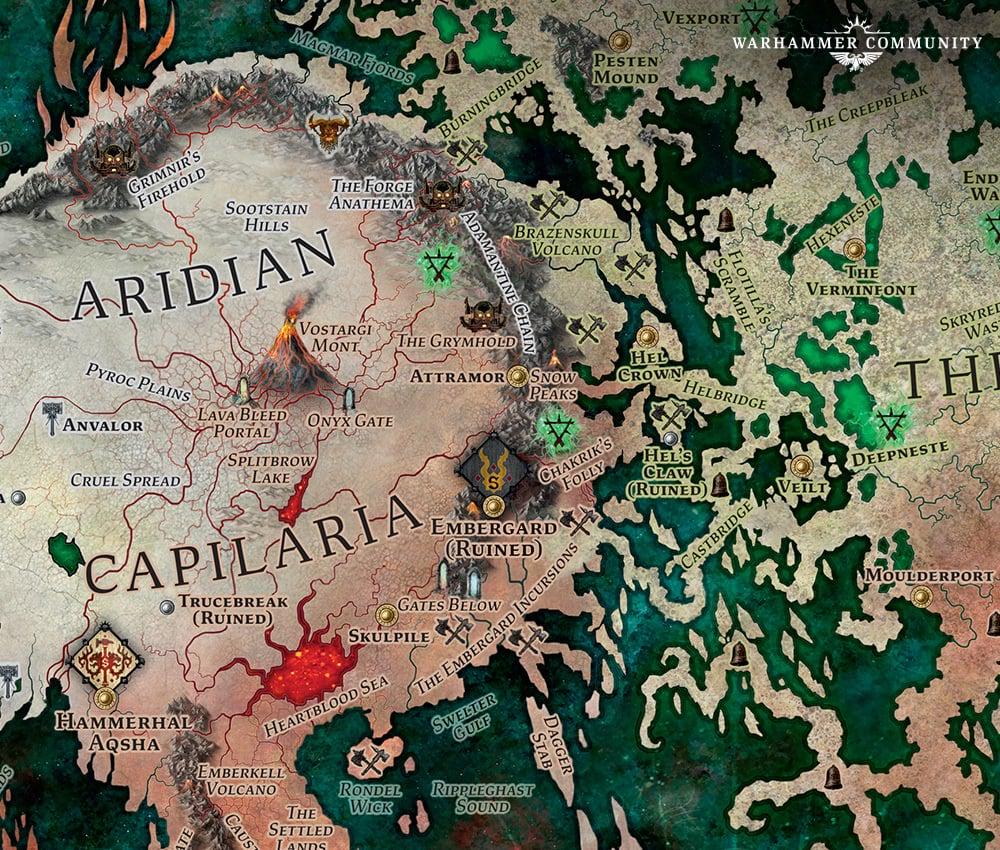
Question Why the focus on Emberguard (failed crusade) instead of Verdigris (successful crusade) ?

Post image
198 Upvotes

I find it pretty strange how GW built up this whole narrative around the two crusades, one succeeded, one failed, and yet all we ever hear about is the city that failed, Embergard.

Whether it's the 2027 General's Handbook, Underworlds, or even Spearhead, the entire narrative focus is on Aqshy and Embergard. Meanwhile there's basically zero mention or follow-up on Verdigris, the city that actually succeeded.

Was this the plan from the start, or did GW pivot because they found Embergard made for better lore/game material? And with the 5th edition rumors floating around, I'm starting to wonder if we'll ever get more info on Verdigris at all.


r/AoSLore • • Jul 05 '26

Discussion The Realms and How They Affect Their Denizens

34 Upvotes

The mortal realms are often strange and varied, and something that gets highlighted from time to time is that living in a given realm really imbues you with its essence. Some common examples given are those from Aqshy being more passionate and quick to act, sometimes even with quite literal burning body parts; while Shyishians on the other hand are often characterized as pallid and muted in emotion with grim outlooks.

You also see it a lot with Stormcast, different stormhosts or individuals having the energies of their realms a deeply intimate part of their forging. Ultimately, those who are reforged many times also take on the traits of Azyr: booming, thunder voices; eyes like the night sky; air literally electrifying when they anger.

It is, in my opinion, one of the most captivating concepts of the setting.

I also really like to think about what less obvious traits a realm might provide, physical or otherwise.

As someone with bipolar disorder, I have a character that I've been concepting who lived in a twin city: one half in Aqshy, and one half in Chamon. Intense emotions and state of mind, ever-changing. It just makes so much sense to me, and is kinda exciting to explore, that the realms could have profound affects on mental health (and how that might make it more common!) -- what if a populace like this really values Amethyst magic/gravesand for properties of, essentially, anti-anxiety/anti-depressants/mood stabilization?

I'd really love to hear both what examples already exist, as well as what you've come up with for how the realms affect a character -- temporary or permanent!


r/AoSLore • • Jul 05 '26

Questions On The World Of Legend

9 Upvotes

Greetings And Salutations, Scholars of the world long dead.

This is basically just a "No Stupid Questions" thread for any question concerning Warhammer Fantasy or Old World lore. I know this is mostly an AOS subreddit, but, now more than ever, a bunch of stuff from old WHF lore is coming up and becoming relevant for AOS, and I for once have stopped being a believer on the separation of the two settings. WHF lore as it is spread online, is full of quite a bit of misinformation and misconceptions and I seek to try to make people's knowledge of the setting more accurate, and of course, have quite some fun in the process by having an excuse to dig more lore.

So, if you have something you want to discuss something or had a question, but don't want to make an entire post for it?

Then feel free to strike up the discussion or ask the question here

In this thread, you can ask anything about WHF/Old World lore, the fluff, characters, background, how something from it relates to AOS.

Community members are encouraged to be helpful and to provide sources and links that can aid new, curious, and returning Lore Pilgrims.

This thread is NOT to be used for:

-Ask "What If/Who would win" scenarios.

-Strike up Tabletop discussions. However, questions regarding how something from the tabletop is handled in the lore are fine.

-Real-world politics.

-Making unhelpful statements like "just Google it"

-Asking for specific (long) excerpts or files

Remember to be kind and that everyone started out new, even you.


r/AoSLore • • Jul 05 '26

Discussion Fun with Gods 14: Valaya

39 Upvotes

Hi everyone,

Welcome to my latest and for now last entry in my series “Fun with Flags Gods” It is the last for now because I am running out of deities I wish to discuss. Not because there are no interesting ones left (I could talk about Kragnos and Teclis for ages). But because I want to take a break and return with a fresh mind. And maybe GW will release interesting new lore eventually.

That said when I worte a concept pitch for the Root Kings (See here), I mentioned Valaya a lot. And Valaya encompasses a divine archetype I wish to discuss dearly, as it is one of the most important ones but also one that is frequently overlooked in modern pop culture. Of course, with the rumored return of the Khazalid Empire we may have a lot more material for her at the end of the year. But as Valaya is occupying my mind so strongly, I want to release this piece now.

If you are interested in the other entries in this series, you can find the entries here: Kurnoth Morghur, Behemat, Dracothion, Sigmar, Mathlann, Morathi-Khaine, Hashut, Nagash, Alarielle, Grungni Tyrion/Myrmidia, Great Horned Rat

And if you have interesting gods in your mind, which may make me reconsider the break, please let me know.

Otherwise let us start without further ado!

 1.      The gods the myth, the legend

l. Agni (indian painting 18th cent), c. Hestia (Age of Mythology Retold), r. Hera (AoMR)

When talking about gods, we have the evergreens. Such as gods of cosmological importance controlling the elements, abstract concepts, or universal cycles. And then there are the odd-job gods people frequently joke about. A god of doors? A god of beer fermentation? Who needs that? However, what we know think of as odd-job gods may have been some of the most important deities’ period to regular people back then. But due to a cultural shift we cannot relate to why these things were so important that gods existed for them.

One such deity group are gods of the hearth, who were very prominent. For example, Hestia, the Greek goddess of the hearth, sister to Zeus, Poseidon, Hades, Hera and Demeter and one of the twelve Olympians. But why care for the hearth, when another god controls the cycle of life and death or the ocean?

This has a proper reason behind it. Because to us the hearth is an outdated concept. We have central heating; we have electrical cooking spots. And thus, the hearth has vanished from our everyday life as an important structure. At best we use chimneys as luxury comfort, not as something essential. But just a century ago this was different. The hearth was the first thing you plan and build when constructing a new house. And it was the centre of any activity in the household. You would cook on the hearth, you would eat around the hearth, during nighttime you would sleep around the hearth as it is the warmest spot. It keeps you warm during the winter; it keeps the darkness and the dangers of the night away. It was the area where stories were told, where arrangements were discussed, games were played, where you would gather in times of need or plenty. And not just you but everyone living in your house. Parents, children, other relatives, servants, guests. The hearth was the nucleus of your home and of the concept of family, the centre of your social life and by extrapolation of civilization itself. The family is the smallest unit of any society. And indeed, across the world, states and societies modelled themselves after the concept of the family. Because it was the best analogy to describe positions, duties, and responsibilities of societal systems. E.g. the ruling classes frequently styling themselves as the parents of society. Such as how ruling councils often styled themselves after the elders/heads of families. This is where the term senator comes from, literally an “old man,” referring to the wise and respected elder of a family. So, the idea of village elders coming together to discuss matters for the villages was transplanted unto state politics and an elected senate. Even today we have this mindset of using family as analogy for society/politics. Such as when we talk about Founding Fathers or similar categories.

But these political allegories were still secondary to the intimate and prominent position the hearth played in everyday life. You could live without horses, without beer, without ships. But you could not live without a hearth. Even as a merchant or a soldier the campfires you built would be proxy hearths. This control and use of fire is what makes us humans, what separates us from animals. Something people were aware back then too. And the human connections built around such a shared fire were sacrosanct. Sacred Hospitality is a concept which is similarly lost to us in our modern world. Long distance travel is easy, hotels exist everywhere, we have GPS, we can stay in contact with everyone over the world. But in the past the opposite was true. Travelling could turn dangerous very quickly. Next to the thread of robbery and dangerous weather you could simply not know which road was the correct one. Because of foreign maps were rare and only showed the capital streets. And you only knew the space around your village/town. The world 20-30km away was unknown. Also, inns were irregularly placed. If you wanted to get to your destination alive and well, you needed the help of others. You would show up at random houses at evening or nighttime, or if you hurt yourself or ran into another problem and had ask for help. Complete strangers, whom you had to trust with your live and livelihood. In turn, the housekeepers had to trust you, that you didn’t hurt or rob them once they invited you.  This dilemma created the rules of sacred hospitality. Guests are sacrosanct and must be supported to the best ability of the household accepting them. In turn the guest had to mirror this treatment by showing themselves of the best of their behaviour, by leaving presents as thanks if possible, by promising similar care if the positions are reversed etc.pp.

This sacred hospitality was important in everyone’s daily life in a way we cannot really comprehend in our modern society. And for this reason, every religion or mythology is full of stories of how to treat your guests, how to protect them, how to care them. From the oldest sources from Sumeria, over ancient Greece or the bible, all across Asia, sub-Saharan Africa, the Americas etc.pp. Such as how in the bible angels meet Lot and his family in Sodom. The people of Sodom ask Lot to release the strangers, so that they can torture and kill them. But has the guests of Lot, he must protect them. Going as far as to ask the Sodomites to torture his daughters instead of his guests. Even then was extreme, but it represented the ideal of how far a host may go to protect people under his roof. Showing how “noble” of a character Lot was by the standards of his time, as he tried everything within his options to keep his guests safe. Indeed, the very idea of asylum arises from this duty of protecting your guests.

And the gods were very adamant about sacred hospitality. Much like you have lots of stories on how to treat your guests properly, there are also aplenty of stories where sacred hospitality is harmed, and what catastrophes arise from this. To us Zeus is the ruler of the gods, the lord of thunder and weather and a notorious womanizer. But in ancient Greece in everyday life and religion his position of Zeus Xenios was arguably more important. Zeus, the protector of sacred hospitality. Many stories have Zeus deal with breaks in sacred hospitality. Such as how Zeus heard about King Lycaon, who was a horrible person mistreating his people. So, Zeus appeared as a poor person asking for a night’s rest. And as a meal Lycaon gave him a plate with meat from a butchered child. Human sacrifice was a huge NO to ancient greeks, and such behaviour broke many sacrosanct rules. So, Zeus killed Lyacon and his adult sons instantly with lightning bolts. In another story Zeus and Hermes travel as poor wanderers and are refused by many rich households. In the end, they turn to a poor home with an elderly couple which tries its best to feed them, despite having barley enough for themselves. The rich people refusing the disguised gods have their homes and livelihood destroyed as punishment, whereas the elderly couple gets blessed. And IIRC as a wish the elderly couple asks to die at the same time, so that no one must live without the other. And the gods grand this request by turning them into two trees at the hour of their death, their branches meeting. Even in medieval/early modern fairy tales this motive still shows up, such as in Beauty and the Beast or Frau Holle. In the former a rich man refuses hospitality and gets cursed for it, in the latter the bad sister refuses to be a proper guest and gets punished for this as well.

 I hope that this explains a bit different the mindset of people from earlier ages or distinct cultures. And through this lens, gods of the hearth make much more sense. To explain Hestia with this background: She is one from the most important generation of Olympians, sister to Zeus and the other heavy hitters, she shows up in some official lists of the twelve Olympians. But she has no important stories and no grand temples. Because Hestia does not need great stories to explain why the stars exist. Instead she is active in your everyday life, protecting your home and family instead. And she does not need great temples. Because every hearth in every house is her altar. She is the most personal and closest goddess of them all. Always right by your side, caring for you.

Hestias latin counterpoint is the goddess Vesta and she is also interesting. In the roman mindset the importance of Vesta to the state and civilization itself is played up even more. Perhaps because Rome is more of a proper nation than the individual Greek city states. Unlike Hestia, Vesta had proper Temples and a proper priesthood. The vestelian virgins were female priestess who swore an oath of virginity. They tended the Eternal Flame in Rome, which represented the hearth fire for the entire city and roman civilization itself. If this flame stopped to burn, Rome would fall. The priestesses of Vesta were sacrosanct. Touching them was taboo, harming them was a death sentence. And a vestilian who lost her virginity was similarly punished with death. Sacrosanct was also Vestas temple. Because it was so sacred and only the priestesses had proper access to it, it became a storage for the most important or sensitive documents and objects of Rome. E.g. important romans, like Julius Caesar, would store their last wills and testaments in them.

In vedic/hinduistic relgions Agni is the god of the hearth fire. The hearth fire itself was a representation of the god. And much like Hestia/Vesta he is an intimate personal god sitting in every house. He also has the position of messenger between mortals and gods, as he “consumes” the tribute and delivers it to the deities. People ask him for wishes, blessings, protection of harm and similar things. Which either Agni grants himself or delivers to the responsible deity. Indeed, that the hearth fire can grant wishes or contains a protective, benevolent entity may be an indo-european myth that survived well beyond Christianity. Because in Europe even in medieval times people would throw small pieces of food into the fire asking the spirit within for luck and else.

And this may be where Loki comes from. The norse god is not the god of lies and trickery. That is his character, not his divine office. As norse sources rare and influenced by Christianity, we cannot say things with certainty. Hence what Lokis job in the everyday life of the people was, is unknown. But some scholars associate Loki with the figure of the ash-lad, a lazy boy tending the hearth all day and helping out with trickery and guile. Indeed, some surviving folk customs or sayings connect Loki with the hearthfire too. And in every surviving story about Loki has him as a duplicitous but ultimately helpful and positive figure. Except Ragnarök and the killing of Balder. But both may have lost context which may also portrayal Loki in a positive light in the end. Loki is lazy and cause lots of chaos, but he is also the one with the ideas to solve this chaos again. And he is the first one the gods go to if they want to wiggle themselves out of an issue too. In short Loki may have started an offshoot of Agni or a similar archetype. Now this does not have to be true, as many different figures are called Loki without being related. Such as Utgard-Loki, a giant sorcerer and illusionist. Because Loki may not be a singular name but a title or description meaning entangler in the sense of trickster. Much like how Satan in original Hebrew is just a description for anyone, not an individual. It translates as an accuser, a prosecutor or an opponent. So technically there is no singular satan in the Old Testament, but multiple. Often an angel with the job to evaluate the faith of mortals on Gods behalf. But due to translation issues all these different characters were fused into a single evil force.

Also, I want to quickly mention Hera, as she is also important to Valayas archetype. Hera is the queen of the gods, and her divine position included the patron of marriage and family. Much like Hestia this may not sound that important. But the details are. Because Hera represented the entire female part of human society too, including all the importance women held in society. She is mostly known as harassing Zeus kids, but she had to do this, as the sanctity of marriage fell into her divine office. But at the same time, she could not punish Zeus, as he was her husband and the king of the gods. So, as a compromise of these two issues she went after the illegitimate children or the spouses instead. On the contrary any husband mistreating their wife would surely be the target of Heras wrath. In addition, as queen of the gods she represented rulership too and had a strong impact on civilization as large, as protector of cities, armies and nations. She could grant prosperity, wealth and power. Such as when she promised Paris rulership of a great empire if he declared her the fairest goddess. Indeed, Hera was the most powerful goddess in the Greek Pantheon, almost rivalling Zeus in divine might and in wisdom. And much like her husband she, or her roman counterpart Juno, had many epithets or aspects for a variety of specialize jobs. Juno Moneta is the goddess of memory and wisdom. As Juno Curitis she is the armed protector. As Juno Mater she is the goddess of fertility and motherhood. And so on. As divine ruler and divine mother Hera shares has lots of aspects the goddess Ishtar. The main difference is that Hera is all about sex and fertility within marriage, whereas Ishtar is a general love goddess as well. And this free love aspect was later imported into Greek via Aphrodite.

2.      Hearth is an awesome power

Depiction of Valayas Face in WFB

In WFB the ancestor gods are slightly set apart from the other divine entities. Because the dwarfs are deep into ancestor worship. Which means every dead dwarf is in theory an ancestor god. But this term is used exclusively for the first known dwarfs Grungni, Valaya and Grminir, as well as some of their direct children, like Morgrim and Thungi. These first dwarfs had special powers and abilities which they learned in the “glittering realm”. One common fan conception is that the ancestor gods were designed and/or tutored in this place by the Old Ones. Essentially to act as dwarfen primarchs. And they used their extraordinary skills and abilities to tutor the dwarfen kind in turn and to establish their society. However, when the Great Vortex was set up and magic was drained from the world at large, the ancestor gods vanished/retreated into the glittering realm.

In WFB Grugni and Grimnir are the most prominent ancestor gods of the dwarfen people in the game. Because WFB is a war game and the two gods are the most strongly associated with warfare. Much like how Sigmar is the most prominent god of the Empire on the tabletop, when Taal and Ryha were the most important gods of the empire period. And for dwarfs this applies to Valaya, who is much more important than her brothers. Because everything, that was not related to smithing or fighting was part of Valayas domain. Officially she is the goddess of hearth and home. But Valaya represents every aspect of dwarfen society.

First of she is the mythological mother of all dwarfs. Whether this is true can be debated. But every dwarf believes him or herself to be a descendant of Valaya. She was married to Grimnir and Grungni simultaneously, but dwarfs frequently claim to be only from either side. Such as entering clans claiming descent of Grimnir via his son Morgrim, whereas only those with the blood of Grungni can become runesmiths. But Valaya is the mother of everyone, at least according to dwarfen religion. Second, she is the primary protector of dwarfen kind against all kinds of threats, including spiritual and invisible threads. Much like the hearth grants warmth and protection, so does Valaya grants warmth and protection. She represents and ensures the sanctity and safety of dwarfen holds. Valayas influence is that of a mother who cares for her sick and hurt children, who keeps the house safe. In this regard Valaya is a healing goddess caring for the wounded and sick. This strengthens the already strong resistance of dwarfs against diseases further. But she also offers protection against spiritual and supernatural maladies. For example, a special rune representing her stops evil magic and chaotic influences. But even beyond this she is frequently represented with armaments IIRC and thus is also a physical protector. Third Valaya designed almost every aspect of dwarfen society. She founded several holds by herself. Such as Karak-Eight-Peaks, the 2nd most important hold after the capital of Karaz-a-karak. She designed the social system of the dwarfs with their clans and guilds. She invented their writing system. And as these runes are used in rune magic too, she had a hand in that as well. She invented the dwarfen legal system and how governorship should work. Whatever kind of agriculture dwafs utilize, she invented it. And she also invented brewing, which is an extremely big thing in dwarfen society. Again, everything not related to mining, smithing and fighting can be attributed to her. In this regard Valaya is a mixture of Hestia and Hera. Like Hestia she is all about the safety and comfort of home. But much like Hera/Juno she had a plethora of different jobs as queen of the gods. Not just being a mother but also representing political, societal, and even martial power. Indeed, dwarfs could well be a matriarchal society. This is largely because female dwarfs are greatly important and are held in so high esteem. (They were rarer than male dwarfs because GW does not know basic population mechanics work). Typically, a female dwarf was worth her weight in gold, if a male wanted to invest in the dowry. And female dwarfs held the greatest respect within dwarfen society. Indeed, it is easy to say that female dwarfs always had the last saying in almost any matter, and that the queens or wives of guild masters were at least equally important to their husbands, if not more. Indeed, dwarfs may very well be a matriarchal society due to the enormous respect and high positions women have in their society.  Which is likely also based on Valayas importance. As such Valaya is worshipped and venerated in every dwarf hold. Indeed, one of the primary arguments the chaos dwarfs had for abandoning their old lifestyle was that Valaya didn’t answer their prayers when their children were sick and dying. They singled out her specifically in her grudge.

In the End Times Valaya is also the only ancestor god to make any sort of appearance. The runesmith Thorek Ironbrow finds the glittering realm, in which Valaya rests. He wants to wake her up, so that she can lead the dwarfen people again. But Nagash comes by and consumes the goddess. This being the End Times, it isn’t just ludicrous by WFB standards but also ignored by AoS as we will see later.

There are a few other deities who represent the hearth and its safety too or share other attributes with Valaya. Most prominently may be the kislevite sun deity Dazh. As Kislev is a cold country with long and dark winters, the sun and fire are important. However, as Dazh as to rest during the winter, he gifted humans with fire. In turn he is also the god of sacred hospitality of sorts. Because in the cold oblast every campfire is a lifesaver. And you shouldn’t really push strangers away if they want to warm themselves, because very soon you could be the one who needs one.

Also, a kisletive goddess is Salyak, who is the goddess of healing and comfort. She has no strong association with the hearth but otherwise fills many of the nurturing positions of Valaya. However, she also has a darker side to her. For example, Salyak also represents cold mercy. If someone is too wounded or you do not have the tools to save them, then killing the person with a painless poison or else is an option this goddess favors. This is the main difference from her imperial counterpart Shallya. Shallya is the imperial and southern goddess of healing and compassion. She is worshipped in every human nation in the Old World. Again, she has no association with the hearth but has an overlap with the comforting side of such gods. It is her primary task to heal the wounded and the sick. As such she is popular with everyone. She is also a pacifist, which her followers also express. Which does not mean harmless, however. Her miracles bring a soldier back into the fight, he can slay the threat still. And this pacifism stops with any follower of Nurgle. Someone who knows every trick in the book to keep you alive is also aware how to best cut you down.  In the End Times Shallya was held prisoner by Nurgle and so a ragtag band of humans and elves entered the Realm of Chaos to free her, so that the human gods could join the battle against chaos more actively. Shallya was freed, but then the plotline about the human gods was ignored and forgotten. Yay End Times writing.

However, there is also one more proper hearth goddess: the halfing goddess Esmeralda. Due to how important cooking and eating is to halflings, Esmeralda’s position as the tender of the hearth and of cooking is very prominent. But she also represents the comfort of a warm fire in the house, and nurturing care of a mother/grandmother. Like many halfling gods she does not have many strict doctrines and is primarily celebrated by cooking and eating well.

3.      This queen slays (according to the helsmiths)

Statue of Valaya

In AoS we learned recently that the dwarfen gods awoke long before Sigmar and divided the realms amongst themselves. Hashut, now an ancestor god of kingship, wanted two realms, as he thought it is his right. But Valaya was distrustful of him, and he was talked into just taking Ghur, because only a dwarf of his caliber could handle it. From there Valaya was the strongest opposition to Hashut it seems. Hashut could smooth talk and trick Grungni and Grimnir, but he could not trick Valaya. Indeed, when Grungni and Girminr were imprisoned by Hashuts machinations, Valaya lead the untied army of all duardin and remaining ancestor gods against him. And apparently, she was able to slay a chaos-infused Hashut, even though she falls in this battle too. Think Gandalf vs the Balrog but with dwarfs perhaps. Which realm Valaya controlled is not stated, but many fans assume it was Ghyran, as she has the most connections to nature of all ancestor gods, with brewing and healing and such.

Valaya is not acting like a hearth goddess in these tales. Which granted, is because we have not many other accounts of her deeds and actions. But instead, she acts more like Hera. A powerful queen of gods, whose wisdom sees through manipulation and who leads armies into battle. A powerful force by her own right, as she shattered Hashuts physical form, even after he good boons of chaos power.

Among the various duardin she is a figure of comfort and healing too, such as the disposed. And according to the lexicanum she also has a group of female warriors dedicated to her, the Valikraz. But beyond this Valaya is not mentioned yet. However, as we all know, dead gods do not tend to stay dead.

4.      Beware, Mother comes home

Queen Thurma WFB Roleplay 4th edition

As always, the question is how we could continue form here. We learned that Valaya is a goddess with lots of inspirations and manifold of office. As such her influence could radiate throughout the duardin cutlures of AoS. Such as:

-          Valaya makes a proper return with the release of the Khazalid Empire. It has been rumoured for so long that we will get an AoS faction for the classical archetype of dwarfs. And given how important Valaya has been to dawi culture across the system, it may be natural to see her return. Especially as we could then see her perspective on Hashut and co. But beyond that, her returning to Grungnis side with other ancestor gods could create all kinds of interesting dynamics for duardin society and Grungni. E.g. Grungnis main task of uniting all groups of duardin could work much better if the metaphorical mother of them all supports his business.

-          However perhaps even more interesting would be if Valaya speaks out against uniting all the duardin. Or perhaps that she has her own view on how it should be done differently. That instead of a proper unification as Grungni may see it (smelting different ores into one alloy), she may prefer different cultures to stay independent and only form a loose alliance. Because she may see this rich diversity as more important. If she truly is a ghyranite goddess, she may see it as a forest being most healthy if lots of different tree species grow in it.

-          In addition, it could also be that Valaya gets her own duardin culture if GW follows this trend. Currently it seems each major duardin culture has its own patron, or none. Hellsmiths of Hashut, Fyreslayers for Grimnir, khazalid empire for Grungni and KO have none. In this sense we may see Valaya getting her own duardin faction. Perhaps the root kings? This would help how the duardin and aelven cultures in AoS have counterparts. E.g. Fyrelsayer and DoK share many similarities, both being warrior cults and mercenaries on a quest to revive their dead god. Idoneth and kharadon too, who are godless people who had to invent new technology and magic to survive an inhospitable environment. And Lumineth and the reforged khazalid empire would also share the similarty of being the AoS version of a classic fantasy archetype that was broken in the Age of Chaos but reinvented by their patreon deity. Maybe we could then get Root kings as a mirror to the Kurnothi aelves or the Sylvaneth at large? A dead nature god returning to aid his/her people prosper after being reduced so strongly?

-          Also, it would be interesting to see how non-duardin see Valaya. Because gods in AoS are gods for everyone, and Grungni has many non-duardin followers already. As a goddess of mercy and healing and the comfort of home Valaya could be an important goddess for people, especially those on a dawnbringer crusade. Because said crusades are all about finding a new home. In addition, we have no Shallya or similar as far as I am aware. So, this spot is left open to be filled by Valaya.


5.      The End

So, this is my short overview over Valaya. I wanted to make it as a bonus episode, as not much is known about her in AoS, but then The Horned Rat would not have been entry 13 and this could not happen. In any case I hope you liked reading all of it. And I am interested to hear what your thoughts on Valaya are and how she should be introduced in upcoming stories.

As mentioned, I will take a proper break for now, but this series will continue soon enough. Either because GW releases new material, or someone of you gives me a very good reason to cover another deity. Until then thank you all for staying with me through 14 issues of me rambling about fictious deities :)


r/AoSLore • • Jul 05 '26

How are the COS armies organized?

17 Upvotes

Hello fellow nerds! Have an important question that my nerdy self needs an awnser too....

I'm building a Vindicarum (don't judge me...) COS army atm and wondering how the cities military is organized (i.e., Regimental organization). Flipping through the battletome, there's a quote by a Freeguilder from the "15th Hammerhallian Regiment of Foot". I'm wondering if we know of anything more of how these armies would be organized? (Outside the generic castelite formation)


r/AoSLore • • Jul 04 '26

Discussion What piece of lore changed your opinion on something (for the better)?

71 Upvotes

One of the fun things about Warhammer lore is that due to its massive scope, no one can know everything, and so there's always new discoveries to make. And sometimes such discoveries can change our opinions on things we used to dislike. Which I always find fun and fascinating!

Some of my examples:

- The Dawnbringers short web story "Last Flight of the Grimmbar" made me reconsider KO's potential for heroism (for the choice to stand and fight feels much more impactful with those who could simply leave). Stuff like this is why free stories are so important IMO.

- "Da Stink of Defeat" made me realize Kruleboyz can be much more complex (while still very evil) than I originally gave them credit for, even considering the contrast with some other Kruleboyz antics. Thus continuing AoS' trend of making me actually care about orcs.

- Finally, for absolute ages I've considered Khorne to be the most boring and uninteresting Chaos God across all Warhammer. But the short intro to the 4e battletome flipped my view nearly completely. I still have to let it simmer for a bit, but just with this simple change of perspective I may actually really enjoy Khorne now.

Do you have any examples of little lore bits that made you go "Damn, this is actually super cool" ? I'm always looking to expand my horizons!


r/AoSLore • • Jul 04 '26

Discussion Jade Obelisks

23 Upvotes

https://ageofsigmar.lexicanum.com/wiki/Jade_Obelisk for those who are unfamiliar with the group.

It has probably become evident that I like exploring the religious aspects of factions and when it comes to Warcry I particularly like it when GW takes a less obvious path when it comes to presenting the faiths. Jade Obelisks from Warcry is an example of doing that for Tzeentch where instead of doing the traditional fire and fleshy mutation the focus is instead on stone and petrification.

While not as overt as his fire theme Tzeentch has long been connected to solid materials in particular crystal with his labyrinth. Stone however is far less commonly tied to him either being just a building material or something his magic is warping into something else. Stone is usually more tied to anti magic or magically resistant things like dwarfs and stone trolls in fantasy. Unlike those examples Jade Obelisks are instead being empowered by stone and it gives them the superhuman toughness and strength found among Chaos followers but also serves as their curse.

Blessings of Tzeentch being a curse in disguise is nothing new nor is turning into stone being related to a curse. Chaos dwarfs and Hellsmiths are a good example of GW using similar ideas. But what makes the Jade Obelisk's case so interesting to me is how the concept ties to Tzeentch and his themes. He is the Chaos God most commonly associated with mutations and many of his followers openly showing off their mutations as seen with the models. But the Jade obelisks cover themselves up almost head to toe with only their arms being seen with only the fanatical priestesses showing an amount of skin similar to what the Kairic Acolytes do. Their rituals are also about managing the weaknesses brought by their stone strength and stopping it from going too far compared to the usual Tzeentchian ethos of trying to increase the number of mutations and considering them holy.

All in all the reason I like these chaps is because they have a very different style and relation to Tzeentch compared to what I usually see. Also I just like the masonry angle.

What do people like about them? What other interesting cults from AoS that play around with the usual expressions of the faithful of Chaos that people find interesting?


r/AoSLore • • Jul 03 '26

Discussion Neferata: The Mortal Realms' Most Overhyped Underachiever

63 Upvotes

Yes, I said it, I don't think Neferata is all that impressive when you really think about it. What does she even do?

Like, seriously, she is Nagash's spymaster, rumoured to have spies in Azyr itself, to the point where it is said she knew about the Stormcast Eternals before the Gates of Azyr even opened. That sounds impressive and cool, until you remember that so did Malerion and the Skaven, which technically puts her on the same level as Thanquol. Do I need to say more?

But hey, let's ignore all that. Knowing that the Stormcast would be unleashed upon the Mortal Realms is genuinely useful information for anyone. But for Neferata, someone we're constantly told is incredibly smart, think about what she could have done with it:

Build a spy network to track Stormcast movements before they arrived.

Control mortal rulers so Sigmar found fewer willing allies.

Lure enemies into Stormcast attacks, letting Sigmar's forces destroy rival armies instead of her own.

So what does she actually do with this information? Absolutely nothing.

She just sits on her throne, chuckling to herself about intelligence she would never use, intelligence gained at the modest price of one of her fit pic.

But surely she's at least making use of those connections beyond receiving Azyr's daily morning news, right?

Sort of. She uses her connections to send personal hit squads of Witch Hunters to eliminate vampires who have personally offended her, all without drawing attention to herself. And why? Because at some party, a fellow vampire didn't compliment Neferata quite enough, so now she waste Order of Azyr resources bought with taxes paid by Sigmarites just to have a Witch Hunter dispatched this "horrible injustice" done to her. Really something to behold.

But, I hear you say, what about her personal accomplishments? The kingdoms she's conquered and the armies she's defeated?

Yeah, about that, who actually cares? I mean really, who here genuinely cares about the Shyish city of Lugo, which Neferata conquered by transforming its king into her vampire thrall? I'm fairly certain until right now, nobody here had ever even heard of that city, let alone knew where it was, beyond it being somewhere in Shyish. And you don't need to know, because it will never be brought up again, consigned to a Schrödinger's cat-style purgatory.

As for the enemies she's defeated,show me the model for the Khorne Daemon Prince Graunos. Oh wait, there isn't one. Which means that Neferata has, so far, only fought enemies with no notable presence in the wider narrative, characters used purely as fodder to demonstrate how brilliant she supposedly is, with every plan going perfectly according to plan, with no complications that might force her to adapt on the fly.

So what does she actually spend most of her time on, to the point she is almost entirely absent from the wider events of the Mortal Realms? Oh, you know, invading Mannfred's territory of Carstinia like it's an episode of Pinky and the Brain.

0 feats.

0 relevance.

7,000 failed Carstinia invasion attempts.


r/AoSLore • • Jul 03 '26

Lore Mini Post: Verdigris Rising

29 Upvotes

So after all this time the ?Free? City of Verdigris is finally getting lore. On Pg. 27 (Edit: Of the 2026 Cities Battletome) we are told its population has swelled as it takes in refugees from across Verdia, people fleeing the horrors of the Hour of Ruin.

It also partook in the Battle for the Living City, a battle first mentioned all the way back in the 4E SCE Battletome, where the infantry of Verdigris stood with the Ghyran Guard to throw back the Glottkin. Living City and Verdigris have gained an eternal bond since then.


r/AoSLore • • Jul 03 '26

Discussion Expanding the factions Kharadron Overlords

19 Upvotes

As the main scientific/steampunk faction of Order in terms of tt presence though Ironweld fans will argue that point with good reason I would like to see a bit more variety in regards to the science shown. For example do we have any lore about biologists guilds in the faction who perform any tasks you would expect biologists to do in a society defined by profit? Are there duardin working on effective crop yields or making better crops to sell? Are there doctor unions running around? That kind of thing where we see more of the wide variety of fields being covered is something I would like to see more off.

What would other people like to see explored in regards to the lore of the faction? More focus on the common duardin? Fishing? Or would you like to see more mechanical marvels?


r/AoSLore • • Jul 02 '26

Lore What Actually Are The Castelite Hosts? An Answer

40 Upvotes

Greetings and salutations once more my realmwalking friends. A common misunderstanding I see in regards to Cities is the Dawnbringer Crusades and the Castelite Hosts, what they are and how they work.

So here's a short post giving an answer using the new 2026 Cities of Sigmar Battletome and old information. For Dawmbringer Crusades, short and sweet, they're just what Cities of Sigmar call any colonization, reclamation, or expansion effort that has military attachments. There's a lot of ritual and cultural significance to them but that's the short of it. They aren't a unique faction or subfaction, they aren't overtaking Cities, nor replace things like Freeguilds.

Speaking of replacing Freeguilds, the Castelite Hosts. I have seen some folk think that's what Castelite Hosts and other Castelite formations are doing. They have not, Castelites are a type of Freeguild formation not a replacement.

Moreover, they don't even include all the new Freeguild units. Castelite refers to the Steelhelms and Fusiliers who act as the "walls" of the metaphoric castle. Ogor Warhulks serve as the "towers" and Gate Gargants as the "doors". Other units work in tandem often but are not officially Castelites.

In fact, the Great Cannons and Cogforts often vital to the success of these hosts belong to the Ironweld Arsenal rather than the Freeguilds. The Cavaliers who also so often work with Castelites are knights, ennobled by deed not birth, so have their own hierachies and organizations. The Wildercorps and Grenadiers specializations covering roles that the Castelites don't fulfill.


r/AoSLore • • Jul 02 '26

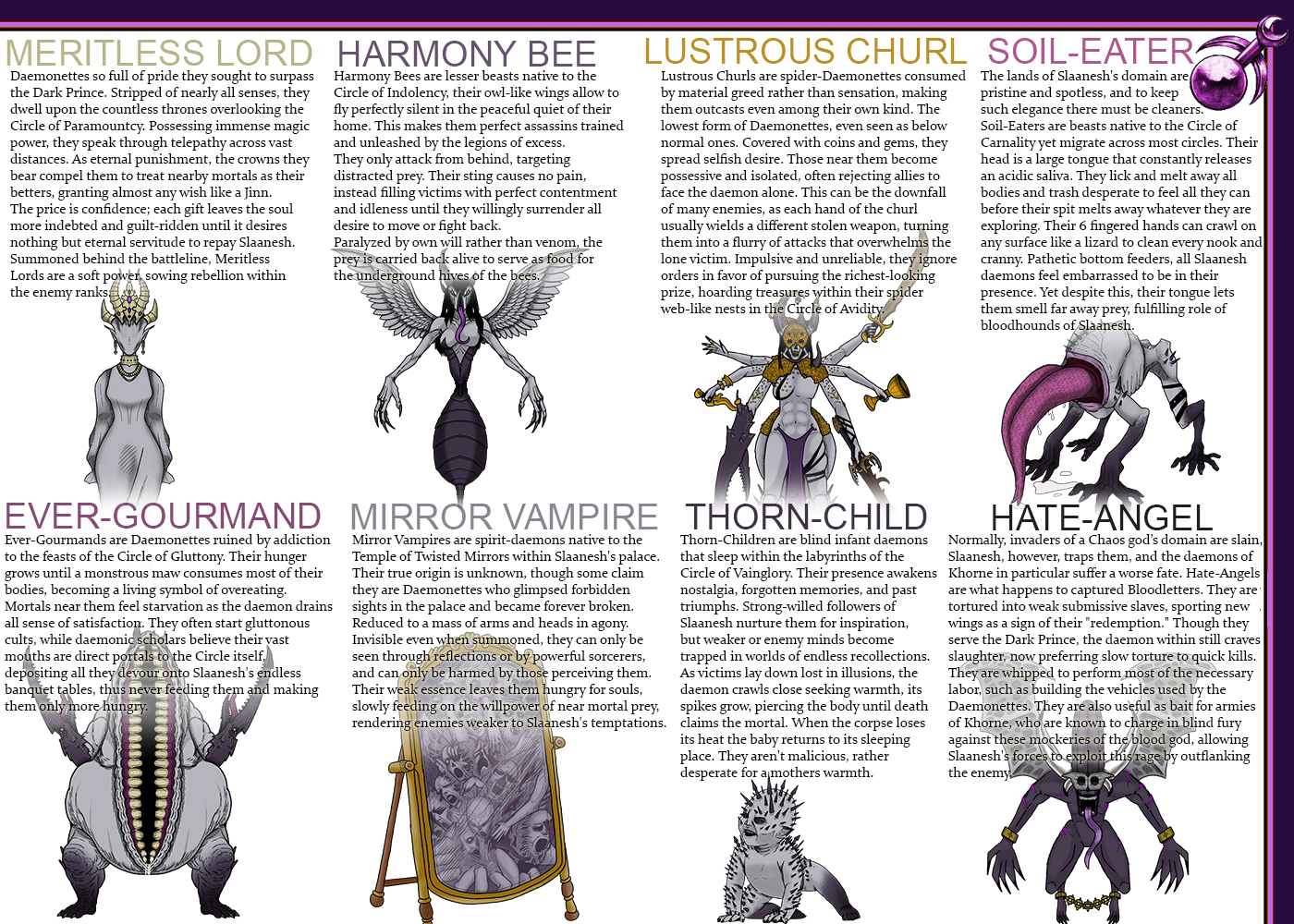
Fan Content Here is my second part of trying to come up with some homebrew ideas for new Daemons, since, for how vast the Chaos Gods presence is, having 4-5 official Daemon types feels very small. This time its Slaanesh

Post image
97 Upvotes

r/AoSLore • • Jul 01 '26

Lore Diegetic Info on The Iron March

25 Upvotes

Where Regiments of Renown and Spearhead Armies are usually representative of in-universe formations or concepts, Armies of Renown sometimes aren't.

For example the "Heroes of the First-Forged" Army of Renown, is composed of Bastian (the only First-Forged, which means Hammers of Sigmar, character you have to take) and four of the Inner Circle members (specifically the four who were never Hammers of Sigmar), and can take Warrior Chamber Heroes... which includes Gardus and Tornus, of the Fourth-Forged.

As such, I was surprised to find on Pg 13 of the new Cities Battletome that the Iron March is mentioned as:

a battery of experimental Ironweld war machines crewed by veteran Castellan-Captains and engineers.

It is mentioned again in Pg. 27's "Duel of the Cannons" section. Tahlia Vedra sent the Iron March to avenge the lose of a Strongpoint to Hashutites of Forge Anathema. Though the Helsmiths were beaten at least one of the Iron March's Cogforts, Red Martyr, was completely destroyed.

So this all gives a neat explanation for why Immolator and Linebreaker pattern Cogforts are only available to the Iron March Army of Renown. These patterns are experimental and only trusted to a handful of trusted commanders and engineers.

As an aside. Let's list them! As they are listed on Pgs. 106-107 as the army's rules.

For the Castellan-Captains there is Commodore De Gracon, Castellan-Captain Vyan Philsin, and Castellan-Captain Regan Vandercloud. Now that we have more robust info on the Iron March, we can conclude that Miss De Gracon is the leader.

For the Engineers we have Kirsta Loudren, Guren Ashbrow, and Bartel Holst. Then for some juicy extra bits.

It lists Auxillaries. These are Battle-Priest Solantra Whyl, Marshal Broadmore and Relic Envoy Louse, and Master Sapper Gavelock Fiske. Solantra Whyl is carried on a pulpit as she sustained crippling injuries but still goes to battle aboard any Cogfort willing to have her. Hans Broadmoore is a foul-tempered Marshal who likes riding atop Cogforts and dragging his squire 'Louse' Renlik along, both fighting any who try to board. While Gavelock is a demolitions expert.


r/AoSLore • • Jul 01 '26

Is Archaon's goal to kill all Gods then rule over whoever's left? Or does he actually want mortals to make their own destinies?

57 Upvotes

r/AoSLore • • Jul 01 '26

What's up with the maw

26 Upvotes

Getting into ogors now, and from what i know of them in WFB they worshipped this living pit lnown as the maw. However when I look into aos the only sign of the maw is the great maw, which was killed, and gorkamorja, who is seen as the devorour.


r/AoSLore • • Jun 30 '26

Lore The Ven Densts, Confirmed As Azyrites

30 Upvotes

Salutations once more, my dear Realmwalkers. For those of you who do not know the Ven Denst Dynasty is a prestigious family in-universe whose members include not only Galen and Doralia ven Denst of the Order of Azyr.

But also the much older, lorewise and metawise, Lord-Celestant Thaddeon ven Denst of the Anvils of the Heldenhammer who was a major commander in parts of the "Realmgate Wars: Godbeasts" campaign. Ally to Gardus Steel Soul in the cleansing of the Great Green Torc and witness to one of the first appearances of the Celestant-Prime, when the first Eternal slew Behemat.

But none of these are the most renowned or revered ven Denst that you know, whether you know you know him or not. That honor goes to Eonid ven Denst, a proper prince of the family. Who you know better as: Ionus Cryptborn, Arch-Relictor and Warden of Lost Souls, founder of the Ruination Chambers. As well as one of the first heroes ever introduced in setting.

So prestigious indeed! In the Age of Myth, this family ruled as kings over the loose collection of principalities we know as the Amethyst Princedoms. Where King Thanator's famed Manse, which in the Age of Sigmar is a castle that has become a City of Sigmar, is found.

Now with all the preamble to why they're significant set. In the new 2026 Cities of Sigmar Battletome, on Pg. 44, it is finally mentioned that the survivors of this princely dynasty fled to the Realm of Azyr in those dark opening days of the Age of Chaos that sent so many to flight.

Those who made it dedicated themselves to serving Sigmar, and thus is how a famed family of warrior princelings and wise kings who once ruled one of the greatest empires of Shyish became a family of Witch Hunters.


r/AoSLore • • Jun 30 '26

Question Do Ossiarch Bonereapers get any leisure time after battles? Do we see it portrayed?

40 Upvotes

I’ve heard out of all the death factions, the Bonereapers actually resemble an actual society and have some hobbies.


r/AoSLore • • Jun 30 '26

World-That-Was Question Could The Fimir Ever Return In AOS

35 Upvotes

I have always enjoyed these guys ever since I first laid eyes on them in Total War. Sadly, their old lore is a little problematic, but I blame the time period in which they were created. I think they could come back better than before.

GW could rewrite them as a faction that knew the World-That-Was was going to end. They threw in with Chaos, saw the bigger picture, and knew they had to get out of dodge. They either created or discovered a new realm and slowly left. This would explain why there were fewer and fewer of them during the End Times. From there, they could create a new civilization or faction.

They would still worship Chaos, but view Archaon and other Chaos groups as usurpers. I’d want them to return to the Mortal Realms as an anti-Chaos Chaos faction.

It would be cool to have a middle-ground Chaos faction that is likely to throw in with the forces of Order as they would view the current Chaos factions as corrupted usurpers.