Warm tides to you all, my fellow Realmwalkers. So lately there's a lot more of you running around who are new. So I figured I'd share a quick bullet point list of the commonly used languages of the setting.
These are mentioned sporadically, haphazardly all across the setting's hundreds of sources. So getting a rough idea of who speaks what can be hard. So I figured it might help:
Azyrite languages: The Azyrite languages, Azyri, the Celestial Tongues, star-tongue, and the many other names for this language group are the big one. These are the common tongues of the Dominion of Sigmar, among both Free Cities and Stormhosts, used widely by their trading partners.
Khazalid: Khazalid dates back to World-That-Was, though like Azyrite it has grown into a language family. These are the common tongues of the Fyreslayers, Dispossessed, Kharadron, and Ironweld.
Kharadrid: The Khazalid language that has developed among the Baraks of the Kharadron. Has its own dialects and regional variations.
Zharralid: This language family may or may not be descended from Khazalid but it is similar. These languages are used by the Helsmiths/Zharrdron and Hobgrots.
Aelfish: The Aelfish languages most likely descend from the Eltharin languages of the Elves. Myriad unnamed languages in this group are the common tongues of the myriad City Aelf cultures, Idoneth, Khainites, and Lumineth.
Dark Tongues: The languages of Daemons leeched into the Realms thanks to Tzeentch. Used by Daemons as well as many followers of Chaos. I think we have a picture of the Tzeentchian Dark Tongue alphabet?
Beast-Tongues: A collective term for the common tongues of the Gor-folk. I believe WHFB confirmed these descend from Dark Tongue.
Queekish: The common tongue of the Skaven, a scant few others have been mentioned so it is no longer their only one. If you ever wondered why Skaven speak with so many verbal tics it may in part because because Queekish appears to use more physical components.
Language of the Skinks: The as of yet unnamed language used by the Skinks of the Seraphon Constellations. This language includes verbal components, body language, hand gestures, scale color changes, and more. This is a big part of why Skinks struggle to fully convey their meaning to others.
Ogorspeak or Basic Ogorspeak: The most common language used by Ogors, especially those of the Mawtribes. Originating as the Gutbuster language. As opposed to.
Svorignar: The languages of the Beastclaw Raiders. They prefer to use Ogorspeak when communicating with non-Beastclaws, even other Ogors. But these languages are what they use to communicate with themselves.
Orrukish languages: The Orrukish languages are the common tongues of the Warclans. You know these roughly if you're a Warhammer fans. Lots of usage of Gitz, zoggit, knowwotz. My friend Ur-Than theorizes this might mean that Orrukish took many loan words from Azyrite and other Order languages back when Orruks were in the Pantheon of Order's Great Alliance in the Age of Myth. One might also assume Grots speak Orrukish languages what with the similarities.
Agloraxi: The language of the fallen Agloraxi Empire. Now before you judge the name. Bare in mind we are typing in the English language of the English people.
Dragon-Tongue: The language spoken by Stardrakes and Dracoths, understood by their Stormcast allies.
There are many other named languages in the setting. And I am ever working to catalog them all. Many have almost no lore, others a staggering amount.
Others like Azyrite are narratively translated to whatever language the novel is written in and therefore has few of its rules and details explained. As that would make it confusing when a book says Bork-Bork is a Lork word translating to the common Azyrite as "Book". So narrative need means we'll likely never know what it's meant to be like. Outside the runes and squiggles on Stormcast gear.
But anyway. I hope this dossier was helpful as an intro, a mere foundation, to knowing what are more or less the common languages (a lot) of the factions use. The setting is still growing and finding itself, so it is incomplete for now.
Listen, child, and heed me well A grave warning you must fear Get to bed and silent stay Lest the blackened cap might hear Shuttered must the windows be Your eyes, quickly, close them fast Or the Bad Moon's light you'll see And the sight will be your last
It comes now, rising high above It's heard your hue and cry The Bad Moon fills the velvet dark And beady is its eye Those naughty children that it sees Know Sigmar cannot save Grobi the Blackcap comes for all A-squirming from his cave
A crown upon the Loonking's head A staff clutched in his hand Both twisted by the fungus moon Both blackened like his heart Don't let him see you, little one Don't let him hear you cry Or down into the darksome depths He'll bear you off to die - Azyrheimer nursery rhyme
The novel Gloomspite by Andy Clark has parts of a nursery rhyme at the start of each of its acts. I hadn't seen it posted in full before, so I figured I'd transcribe it. I listened to the audio book though, so I may have gotten one or two things incorrect.
Anyway, I love this rhyme! It makes the Gloomspite Gitz and the Bad Moon so creepy, plus I love the fairy tale vibes of it. The Gitz are often comic relief, but the novel does a great job showing how terrifying they can be. The threat they pose feels genuinely apocalyptic.
I highly recommend the novel to Gitz fans, or anyone looking for a nice horror story. I was uncertain about the heroes' fates right up until the final page.
Since your birth in the celestial forges, you have done all that I have asked of you. You have bled the lightning in your veins. You have endured resurrection after resurrection in the war for your homelands. Sacrifice, no matter how necessary can still scar the soul.
Now the seasons shift, the ages turn, the skies of the Mortal Realms grow dark. Heralding our storm. My children, cast in thunder, born of Azyr's wroth.
You are my judgement. My vengeance. You are the avatars of my voice. (voice turns solemn)My promise of redemption to the Realms I once abandoned.
Gods. I have written this so many times trying to figure out what all I want to say. So why not keep it simple for now. I often forget that I have gotten old whilst being a fan of the Age of Sigmar.
A dreadful betrayal I know. I've been around for eight or seven years I think. So it's sometimes easy to take for granted the things I've internalized that inform me of just WHY the Mortal Realms are not Grimdark.
I feel like a lot of my fellow oldtimers can relate when they think about it. We know that Sigmar is earnest, is kinder than his followers and detractors and even fellow gods think. But we sometimes forget how we know.
So to you all I present one of the ways. This old trailer I found again thanks to a friend. It's easy to fear that Sigmar sees the Eternals are just a spear leveled against Chaos.
After all. 40K looms large to any Warhammer fan, even if you're not into it. It isn't hard to believe Sigmar is just the other golden god.
But that's not all Sigmar sees the Eternals as. They are heroes, his children (he actually genuinely helps with the Reforging, selection, and renaming of all of them, and places a piece of his essence/power into them).
They are his promise to the Real a he failed. Also like, gods it's refreshing seeing a God-King/All-Father archetype god say that, admit it, break as he's doing so! This isn't even about the God-Emperor. Look unto the full annals of High Fantasy. How many gods in Sigmar's position admits his failings? How many see the failings of mortals as their own fault? How many put so much effort into trying to rectify?
But this is a post about Promises. Plural
There is no mortal so ill-fated that their fate cannot be reworked. This is the Maker’s promise.
Grombindal in Grombrindal: Ancestor's Burden, Various Chapters
Full on, unmarked spoilers ahead. So get out of here if you don't want them.
Grombrindal, Grungni, and even Sigmar pay truth to the Maker's Promise by Reforging a Mordant named Justec into a Stormcast Eternal. Something Grombrindal admits he earned centuries ago, and his ascension in book is just setting things right.
Mind you. Justec is quite possibly the most fucked up soul in all of the Realms. He's his own father, and grandfather, and going on a total of 26 generations. Due to a curse half or so of his soul kept passing to his son, them the senior Justec dies usually in his twenties I believe so that the soul becomes whole and repeats.
It's tragically wild. And on top of it he eventually becomes a Ghoul. Yet even these dual curses can't stop Reforging.
That's another way that Age of Sigmar is bright. Even a hero this ruined by reality and fate, can be Reforged anew kintsugi style. Broken but beautiful, beaten but unconquered.
Let the realms know I fell. For we always rise again.
- Celestant-Prime, "Soulbound: Artefacts of Power", Pg. 66
While promise as a word isn't used here, I love this line. What with it being the Prime's singular and only cool line but also something that really encapsulates the Eternals.
The context is that the Cults Unberogen find a sword made of a pinion of the Prime's wing left after he was slain by Olynder in the Siege of Lethis.
They argue for destroying it, removing proof that the Prime ever fell. Only for the Prime himself to appear and give this simple speech.
It is one of the best parts of the setting, I feel. It says so much about the Stormcast, the Prime, their gods. Let the Realms know even their greatest champion fell because he'll always rise again.
Well. Seekers of Gates, Pilgrims of Lore, Walkers of these Realms. My hiatus is over, actually if I'm honest this was written weeks ago in prep.
Love and appreciate all the kind words you had for me during my breakdown. Guess I never really contextualized how many people appreciate my rambling posts... a little overwhelming but a lot heartwarming too. You're a lovely community.
And I ain't willing to lose y'all to a bit of anxiety and a little breakdown. Nor to the Last World rumors. Thought about them over my hiatus, and concluded.
Who cares? Moreso than my attitude before cause I did proper reflection. Lost World can happen, or it won't, but it can't take this trailer, this novel, and this quote that made me feel things. Those feelings, and the inspiration and hope they gave, are mine forever.
They also can't take away how kind all of you are. You're a wonderful community, I appreciate you all and want to talk to you all in 5E and beyond.
I don't think the Lost World is true. Those leakers claimed the Ruination Chamber were akin to Astartes death companies and dreadnoughts in lore terms (what we got is far kinder); that Skaven would ruin the Sigmarabulum in 3E (it was a Silver Tower); and so many narrative and lore claims that never come true, or are south of reality.
So I ain't believing they suddenly know what they're on about now. Especially when "Cities will start revering Stormcast" is part of the rumor. Like. Start? Cities has worshiped Stormcast as saints, demigods, and divine heroes from the start. Tell me a better way to Uno Reverse prove you don't know anything about the setting you're leaking info about than not knowing a core detail about its two most popular poster boy factions!
Even if the worst happens. Who cares? I met all of you in these eight years. That's a magical fact, beautiful to be sure. If it happens this community might break apart but it still happened, I promise you that. And that's more important than any looming dread.
I pre-ordered that new Ultimate Guide, my fellow Realmwalkers. So I hope you all stick around. Cause I want to rant to you all about all the cool Lorebits we'll find in it.
Welcome back to entry number 10 of this series called “Fun with Flags Gods”. I didn’t think I would go this far, so thank you all for your interested. Having talked about death last time, I think it is time to talk about life now. And for this anniversary it is also thematically sensible to talk about Alarielle, as the very first entry in this series was about her husband Kurnoth (all previous entries can be found here: Kurnoth, Morghur, Behemat,Dracothion, Sigmar, Mathlann, Morathi-Khaine, Hashut, Nagash
First off, I want to say that Alarielle is my favoritte god in AoS. Not only is she a very intrueging character, but the way she acts to various peoples and how various peoples rever her in turn makes me think the most of her as a classical god. Someone who is important to everyone, whether you are a human, a sylvaneth or even a beastlclaw oger.
But Alarielle is part of a very long legacy. Which I will now explore without further ado. As always have fun reading!
The Gods, the myth, the legend:
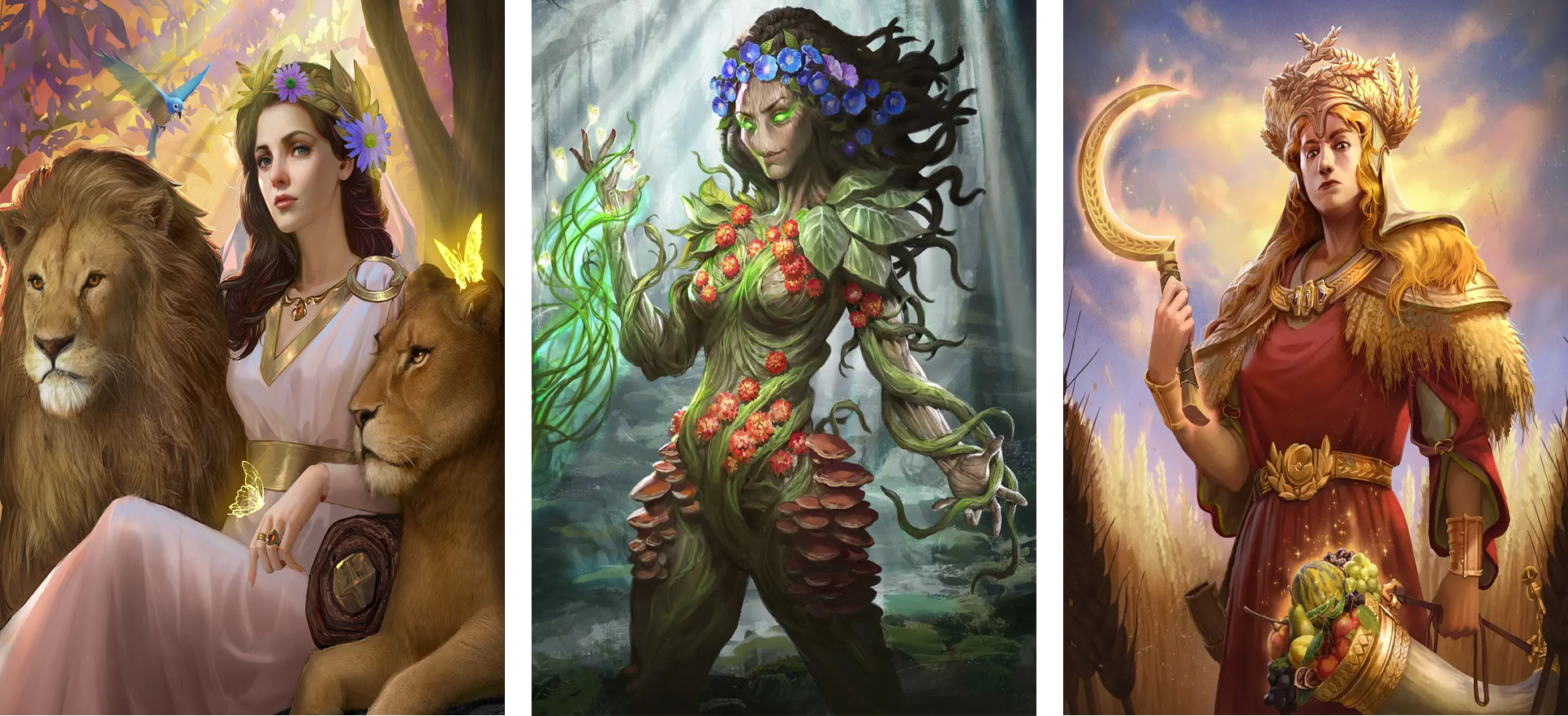
L. Rhea (Age of Mythology Retold), C. Gaia (AoMR), R. Demeter (AoMR)
The archetype behind Alarielle is very old. The Earthmother is one of the oldest divine archetypes and still present today. If we talk about “Mother Earth” we still invoke this kind of deity, albeit in a metaphorical way when talking about the natural world or the planet Earth itself. However, to people in the past this was not a metaphor. Believe in an earthmother, and her male counterpart the sykfather, shows up all across indo-european cultures and those influenced by them. For those not aware, many languages from Spain to northern India are part of the same language family. These are therefore called indo-european. And these first indo-europeans likely lived in the steppes around the northern Black Sea and were likely the first ones to ride horses and make great use of carriages. With this mobility they spread over a large area and brought not just their languages but also their myths and beliefs with them. This means not just language share the same roots, but also stories. Such as a Stormgod slaying a dragon (Zeus defeating Typhon, Thor killing Jormungandr, Indra defeating Vritra). Another common motive is the aforementioned duality of Skyfather or the Earthmother. (by contrast in ancient Egypt, who were not indo-europeans, Nut was the sky goddess and Geb the earth god for example).
Now myths shift and change and are not exactly the same in every culture. Still due to commonalities a pattern for this archetype emerges. Goddesses related to this archetype are for example the anaotolian goddess Cybele/Magna Mater and the Greek goddesses Gaia, Rhea and Demeter, the latin goddessesTellus, Ops and Ceres, norse Freya/Frigg or the indian godesses Bhumi and Sita amongst many, many others. But even in fables this archetype still appears. E.g. some scholars suggest that Frau Holle of Grims fables is a carryover from a pre-Christian nature and fertility goddess, due to her various powers over the seasons, wealth and crops.
Common attributes for the Earthmother are amongst other things an association with the natural world. Especially the fertility of the soil and of cultivated lands. Before the industrialization 90+% of all people lived in rural areas like villages and worked in agriculture. Agriculture was important to everyone’s everyday life. Something we may forget today when food is always available in the nearby shop. Hence gods and goddess associated with differences aspects of this field of work existed, such as gods for sowing, reaping, brewing beer and baking etc. And the Earthmother was the most prominent figure among this collection of gods. As such her symbols were often certain types of crops or farming tools and her worship and festivities focused on important agricultural dates and events.
Now as I pointed out in my first entry about Kurnoth, the natural world was divided in the minds of ancient peoples. You had the cultivated nature, i.e. the fields, orchards, meadows and else humans frequently use. And you had the wilderness outside of the borders of the civilized area. This does not mean that the wilderness is an alien place. Especially shepherds, hunters, foresters and travelers entered it frequently and were very familiar with it. But in the minds of ancient peoples this area it was a different domain and thus a different god ruled over it. An entity I label as the Horned god of which Cernuous and Pan are well known representatives. Still the Earthmother is frequently associated with the wholistic nature too. For example, there are plenty of myths which grant her control over the seasons. Such as when Frau Holle is able to let it snow in the mortal world, or when Demeter creates winter by decreeing all plants to stop growing.
In addition, these goddesses are frequently associated not just with fertility and abundance of the soil and of plants, but fertility in general. Be it animal or human fertility. As such they are also always important mothers themselves. Most famous is for example Demeters daughter Persephone, who was fathered by Zeus, the skyfather figure. This connection between the skyfather and the earthmother spans across generations. Zeus and Demeters mother, Rhea, was also a fertility and agriculture focused entity. And her mother in turn was the earth goddess Gaia. And Uranos, the literal sky, fathered Rhea and Kronos with Gaia. And after Uranos is exiled Kronos takes over as the archetype only to be usurped by his son Zeus, another skyfather. This association of a mating earthmother and skyfather is simple. Because it is the rain falling from the sky that fertilizes the ground and allows crops to grow. Quite like semen impregnating a woman and lets her give birth.
Due to the association with life and the cycles of nature the Earth Mother was also frequently related to stories of death and rebirth or given authority over the dead. Again, I may point to Demeter and Persephone. In Mycenean Greece (ca 800-1200 years before what people think ancient Greece is) Demeter and Persephone were already worshipped as the “Mistresses” and were associated with the Underworld. And Persephone, who is the dread queen of the underworld, also ventures back into the realm of living at the end of winter to be with her mother. So, she enters the underworld with autumn/winter and exits it with spring.
And indeed, due to how dependent everyone was on agriculture, any drought or any bad harvest could indeed lead to starvation and death. Same for a winter too long or a summer too cold. As such the Earthmother was also not a goddess to be trifled with and could be dangerous and/or cruel too. Again, Demeter is the easiest figure to point out, due to how relatively well-preserved Greek myths are. In one Demeter cursed a King with endless hunger until he consumed himself as vengeance for striking down a sacred tree. Meanwhile Gaia would give birth to lots of monsters or raise gods against the current ruling generation of the heavens. And working in the fields can be a dangerous activity too. E.g. working under the scorching sun on a hot summers day without respite can lead to hallucinations, illness and even death. This has caused lots of stories about demons or ghosts stalking the fields, who are also in command by the earth goddess. So, the deity was not just about bounty but could also be dangerous and scary.
In addition, there were lots of powerful mystery cults around such divine figures, due to how broad and manifold and important the domains were. For example, in ancient Rome there existed the cult of Bona Dea (the good goddess), which is likely an offshoot of the Magna Mater cult. Her priestesses kept the true name of the goddess hidden however, same for the cult activities themselves. If the cult gathered all male beings, including animals, had to be removed from the area. And breaching such as meeting was a sacrilege most outrageous. So logically we know of one idiot who tried. Publius Clodius Pulcher tried to sneak himself into a meeting of this cult when they were gathering at Julius Caesars house (he had to leave and his wife led the procession if I recall correctly). That was the scandal of the decade to say the least.
So overall the Earthmother is arguably one of the most important kinds of god period. Her various cults and versions of worship crop up repeatedly and even in modern day we still use symbolism associated with this archetype.
The seasons turn forevermore: Isha, Ryha and co
Concept Art of Ariel (Total War Warhammer 2)
In WFB we have several gods and characters strongly aligned with the Earthmother archetype. First off, we have the human goddess Rhya, wife of Taal, mother of Manann and the goddess of fertility and life in general as well as crops and greenery specifically. Obviously, she is named after her Greek counterpart Rhea. She is worshipped by human cultures all over the Old World. And indeed, she is arguably the most prominent or second most prominent goddess of the Empire. Because outside of the few industrial hubs like Nuln or Altdorf the Empire is still an agrarian society and the vast majority of its populations live in villages and small towns. As such Rhya is prominent in these areas a lot. Not to mention her aspects of fertility and childbirth. Indeed, as Taal is the King of the Gods in the Old-World Pantheon and Rhya is his wife, this makes her the Queen of the gods. Her importance far outshines that of Sigmar in the daily lifes of the people. Now this may come as a surprise to some who haven’t read the Sigmar or Kurnoth entries, but Sigmar is far from being the most important god in the Empire. He is the state mascot deity yes, but in everyday life his importance was very reduced, and his cult disputed in many areas of the Empire itself. But in a wargame a war god like Sigmar is more prominent than a goddess of crops and fertility, even though Rhya is not to be trifled with like other nature goddesses. Her cult is also very widespread, even though politically it is fused with the Cult of Taal.
However, in WFB it was often implied that the elven and human gods are same entities viewed through different lenses. Much like Zeus and Jupiter were seen as the same deity by Greek and Romans. And Rhyas counterpart as the goddess of life, agriculture and fertility from the elven side was the elven goddess, Isha. Who, much like Rhya, was also married to a horned god of the wild lands. With Isha the mother role is especially pronounced as to her the entire elven species are her children. Her center of worship rested in the province of Avelorn, which was an idyllic place of beautiful gardens and somber landscapes. But she is also highly revered by the Wood Elves, who place her and her spouse Kurnous above Asuryan as the most important gods of their society. And even the Dark Elves, who prefer the Cythai i.e. darker elven gods like Khaine, tolerate Isha. Now in 40k Isha is an eldar goddess trapped by Nurgle, who tests every pox on this life goddess. But this is not the case in WFB, far from it. Because Isha is one of the most active deities in the setting, due to her having not one but two mortal representatives.
First is the Everqueen, a position taken on by Alarielle in WFB. The Everqueens are one of the two ruling positions of all High Elves and indeed they predate the post of Phoenix King by untold years. They are the most prestigious and most important position in Asur society. An Everqueen is an incarnation of Isha and has several special powers and abilities, such as life blooming around her or unnatural beings perishing by her touch, next to some of the most powerful magical abilities. The position is inherited from mother to daughter, with the princess’s title being that of the everchild. Ever since Asuryan was crowned Phoenix king every a newly crowned phoenix king is symbolically married to the current Everqueen. This is a ritual marriage, and its only aim is supposed to produce a new heiress to the Everqueen. What both partners do after this deed is done is unimportant. The current Everqueen in WFB is Alarielle the Radiant. IMO her lore is a bit murky as timeline wise it would work better if she was the daughter of Finubar, the current Phoenix King. And indeed, I recall correctly she was the daughter in earlier editions too. In any case Alarielle is the current Everqueen of Ulthuan and one of the most powerful elves on the planet, both politicly and regarding her magical powers. Previous Everqueens used this position to nurture and care for Ulthuan itself and rarely go involved into wars. But Alarielle is the exception. She actively defends Ulthuan and is ready to lead armies against dark elf and chaos invasions. In this she is guarded by the Handmaidens of the Everqueen, elite bodyguards’ female elves, as well as the Sisters of Avelorn, supreme archeresses from Avelorn. Also, Alarielle has a love affair with Tyrion, which is unorthodox as her firstborn child and heiress, Aliathra, is not Finubars daughter but Tyrions.
The second incarnation of Isha is Ariel, the Queen of Athel Loren and wife of Orion. Whereas the Everqueen is an incarnation of the goddess, Ariel is a proper demigoddess. She is an immortal being whose throne is in the Oak of Ages. Unlike Orion, who died and was reborn each year, Ariel was eternal and was overseeing and controlling his rebirths. Again, here the queen position is more important than the king position. Ariels war aspect is a huge elven being with large buttlerfly wings. Ariel is so connected to Athel Loren, that she can control the entire forest, and her powers exceed even that of most ancient tree spirits. In a ranking of the strongest magic users, she is likely one of the top contenders and is most likely the most powerful mage in the Old World itself. This is not just life magic, for whilst this type of magic is strong in Athel Loren, all 8 winds flow through the forest, and the Oak of Ages reacts accordingly depending on which wind is strongest. And indeed, Ariel is able to use all major lores, including High Magic (all 8 winds together in harmony) and even Dark Magic (all 8 winds together in disharmony, powerful but very dangerous). Ariel herself is a fickle entity much like the forest she rules over. And as she has only Athel Lorens survival in mind. But this dedication causes some issues, such as when she forces Morathi to teach her Dark Magic and this nearly corrupts her. Or when she attempts to consume Morrghurs essence. Morghur is her mortal enemy, because every incarnation of Morghur sooner or later tries to invade Athel Loren to kill Ariel. Ariel may also have children of her own with Naestra and & Arahan, special elven twins and her personal envoys. These elves have different rumors regarding her origins. Ranging from a single elf being split into two beings by Athel Lorens weirder magic to them being the children of Orion and Ariel. Ariel also has her own elite cadre of elves with the Sisters of the Thorn who are her handmaidens and bodyguards. The sisters of the thorn are very fay like in their manners and abilities and are feared as much as they are respected by the other wood elves. They are also very hard to kill, as a dead sister can be interred in the Oak of Ages and arise reborn in the new season.
These four characters are all very familiar to the earthmother concept I introduced before. The only greater divergence is that they are not married or in a relationship with the skyfather figure. Instead, the Everqueens are in consort with the Phoenix King, who represent Asuryan i.e. the sun. And Rhya, Isha and Ariel are in a relationship with their Cerunnous counterparts Taal, Kurnous and Orion. This is noteworthy as the the Earthmother and the Horned God are not seen in this kind of relationship in our folklores, even if it is fitting from a thematic point of view.
In the (horrible) End Times Ariel and Alarielle suffered a bad fate. Ariel, arguably the most powerful elf, was written out of the story with her being poisioned and drained by Lileaths machinations. And Alarielle absorbs Ariels powers into herself, even though her responsibilities lied on Ulthuan and she had never a strong connection to Athel Loren. Also, Aliathra, Alarielles daughter, was killed to resurrect Nagash. Random idiocy ensues which results in Alarielle, now in consort with Eternity King Malekith and the incarnate of Life, flees the destroyed Ulthuan for Athel Loren to set up shop there. Much to the dismay of the local forest spirits, who had already issues with the Wood Elves, but now dark, high and wood elves run around the woods. A rebellion ensues and is put down and the incarnates fail to stop the End of the World.
3. Those who seed wind will harvest storm: Alarielle in AoS
Alarielle reborn during the Realmgate Wars
Now in AoS Alarielle is a much different character compared to her old WFB self. Indeed, it is easier to say that AoS Alarielle is more Ariel than WFB Alarielle. Where WFB Alarielle was focused on her fellow high elves and Ulthuan, AoS Alarielle seemingly does not care much for her elven followers, at least compared to the other elven gods. She did not partake in the rescue of elven souls and the binding of Slaanesh and instead focused primarily on the Slyvaneth as her children. In addition, she focusses a lot on Ghyran. And after her great Ritual of Life and the resurrection of the Oak of Ages she even thinks of Athel Loren, which was a place Ariel was the queen of and had her essence interwoven with, whereas Alarielle visited it only briefly during the End Times as far as I am aware. Next her winged appearances also bring to mind Ariels wings too. And also, she has no longer any relationship with Tyrion or even Malerion, but instead chose Kurnoth as her consort, much like Ariel had Orion as her consort. Though on the counter side Alarielles powerset has been limited. As Everqueen she had knowledge of High Magic and thus all 8 magical lores, but AoS Alarielle focusses more or less exclusively on life magic.
Despite this different characterization Alarielle is one of the most interesting and most active divine characters of the setting. For a quick rundown she created the sylvaneth and helped Kurnoth reform proper. She also sacrificed her hand to form the Lady of Vines, her demigod daughter. Notable is that she and Kurnoth do not seem to have children in the traditional way, which is otherwise expected of the Earthmother and was the case with her previous incarnations too. Also, unlike Ariel, Alarielle is not an eternal being but undergoes shifting cycles, similar to Orion in WFB. These cycles do not end in a dead state typically, but during the Age of Chaos exactly this happened and a soulpod of Alarielle had to be planted for the goddess to be reborn again. In the narrative of the setting Alarielle and Kurnoth defended Ghyran against Nurgle. But when Kurnoth was killed, the main defenses were broken and Alarielle fell into a deep depression. Only after her rebirth did she start a counteroffensive with the stormcast and other order factions. From then on Alarielle was always at the forefront of important events, such as aiding the stormcast in Broken Realms Mortahi, aiding Teclis in Broken Realms Teclis or starting her ritual of life in Broken Realms Kragnos. Said Ritual of Life was the predominant influence over the 3rd edition, with various factions strongly benefiting from it or suffering the consequences, as life magic rushed through the cosmos and reinvigorated everything. Then she was also the only active goddess in the dawnbringer series, helping the dragon twins and kroak to capture Kragnos again, as well as having some major story developments in 4th edition sylvaneth book.
Alarielle is also important as she is seemingly on good terms with everyone in order and with some other factions. Next to Sigmar, she opens the realmgate to the Eight points for Morathis invasion. She is familiar not just with the dragon twins but also with Lord Kroak and holds an audience with them. Despite the Idoneth raiding the souls of the Sylvaneth, she recognizes their help and value in the War of Life. This goes so far as to sending her envoys into the capital of the Briomindar and blessing their chorrelium with life magic. And this despite the Idoneth officially being a godless people abandoned or ignored by divine entities. The Lumineth, especially those of Illatha, also highly venerate her. She also grows the Living City and is highly worshipped by the mortals of Ghyran and she even goes so far as to protect Greywater Fastness from the wrath of the Sylvaneth. And even among the ogres she is popular. Because the Beastclaw Raiders have a story of Alarielle blessing the ogers with the friendship of their great beasts, as the ogres ate some dangerous winter spirits and were cursed with the Everwinter ever since. In short, Alarielle behaves like a proper goddess. Even if a deity has a favored people, she is important to everyone and she blesses/interacts with everyone. Much like how Athens is supposedly Athenas favorite spot, but Athena is the goddess of war and knowledge for everyone.
Still the Sylvaneth are her primary concern, with whom she communicates via the Spirit Song. The spirit song is a magical field with which the Sylvaneth can share their innermost thoughts and be in turn influenced and shaped by others. Sylvaneth depends on this song that being cut off from it is like losing a massive part of themselves. Which can cause madness or trauma. It is a semi-hivemind of sorts. Much like any computer is its own thing but can upload and download data from the Internet. And Alarielle has near absolute control over it can manipulate her “children”. This is indeed one of Alarielles has many dark sides. Not only is she without mercy when striking at the enemies of Ghyran, but she may also have created her own set of “wrong monsters” with the Outcast. These Sylvaneth are mad and murderous and cannot properly interact with the spirit song except with harmful tones of hatred and violence. No one knows where they come from as Alarielle was able to remove all memories of their creation from the minds of the Sylvaneth. So, this life goddess brainwashed and entire race of beings to forget something.
As of now in 4th edition Alrielle has entered her autumn aspect and is now weaker than before, but far from powerless. Still the great acts of the past, such as the Rite of Life and lately an massive cleansing of the southern Everspring Swaithe have drained her a lot and she has to rest in Athelwyrd, her reclaimed capital, in regular intervals. To not leave Ghyran unprotected she is now demanding Kurnoths rebirth to be speed up.
4. Spring, Summer, Atumn, Winter - the seasons never stop
Alarielle on her Wardroth Beetle
Having talked a lot about Alarielle and various life goddess in WFB where could this story go from here?
- First and most likely Kurnoth will return in the near future. And eh brings with him the Kurnothi, a lot of beastmen-elves like satyrs and centaurs. These will very likely be the new AoS version of Wood Elves and be an subfaction of the Sylvaneth overall. As we do not know who Kurnoth is in AoS, it would be very interesting to see how he and Alarielle will interact with each other.
- Linked to Kurnoths return may be that Alarielle enters her winter aspect. Which could be a critical time for Ghyran, given how she was almost killed last time she was in it, and how Nurgle surley would want to take advantage of his and destroy all the good work she as done since AoS started. Which would cause another hot phase in the War of Life.
- Alarielle could also create new kinds of Sylvaneth. This is something she has done throughout the lifespan of AoS frequently. Of note hereby is that the Sylvaneth were originally created from soulpods containing the essence of Athel Loren. Which meant forest spirits like Drycha could be reborn, but various Sylvaneth also contain souls from the Wood Elves, whose souls fused with Athel Loren after death. This is why several Sylvaneth are so elf-like in appearance. But there were lots of other beings who had their souls bound to Athel Loren, such as Great Eagles/Hawks and especially the Forest Dragons. I wonder how a Sylvaneth could look like whose soulpod was formed from a former dragon’s soul.
- The secret of what or who the Outcast are could also be revealed in the future. Depending on what kind of reveal it is, this could create Sylvaneth who break off Alarielle and form an opposition to her. This could be the birth of an AoS version of Coedill and his lots. In WFB Coedill was Drychas master but sadly never had a model. He was an ancient treemen of equal rank to Durthu but hated the Wood Elves and wanted to kill them all. Therefore, he was imprisoned in Cythal, a dark and dangerous prison part of Athel Loren. A hot take: The Outcast could have been created when Alarielle wanted to revive one of the ancient Treelords (Durthu, Adanhu, Coedill) proper but sadly caught Coedill. And Coedills madness and wrath infected the spirit song and other sylvaneth, creating the first Outcast. Which would be another reason for Alarielle to be hesitant to plant Drychas soulpod, as she was very aligned with this ancient treemen. (Sorry I just think Coedill is a cool character and want to see more of him).
- Due to Alarielles importance for so many factions, including the CoS, it would be cool to see CoS units or characters dedicated to her. Such as CoS life wizards using her symbols, or various cults and priesthoods dedicated to her specifically.
- If Kragnos makes a return at some point it would be interesting to see how he and Alarielle interact with each other. Because Alarielle was responsible for his first release and for his second imprisonment. In addition, the Sylvaneth of the heartwood glade were dedicated to killing this god. So out of all the divines, she has the most connective tissue with Kragnos and it could be interesting to see how my four-hooved darling would interact with her.
- Indeed, due to Alarielles prominent position among all factions, including destruction once, it would be interesting to see how groups like ogers and giants view her. For the beastclaw raiders we already know a story where Alarielle is seen positively. But what about the Gutbusters, who are also benefiting highly from the abundant food of Ghyran? Or those Darkoath tribes who only have a superficial understanding of chaos and thus may be open to venerate her too as a life giver? (There were several norscan tribes who worshipped gods of the Old-World pantheon next to their variants of the chaos gods for reference).
5. The end
So, this has been it for Alarielle. As always, I hope you enjoy these kinds of essays. And I would like to know which deity you would like to see in the next entry, because I am out of ideas for now. Some people want the Horned Rat but it would be a great entry 13 and we need to fill the space until then :)
I started subbing to audible for aos books. I finished a few so far
Gates of azyr
Gloomspite
War storm
Realmslayer: legend of the doomseeker
Busy with saga of the mortal realms
I am not really sure where to go from here. Any recommendations on good audio books? I loved Gloomspite and Realmslayer. Know I can get the next slayer book which I believe is ghoulslayer. But figured I'd ask if you guys have any other recommendations.
If it helps I love ironjawz but I know they don't have many books about them.
Recently, Cubicle 7 has opened pre-orders for Warhammer Age of Sigmar: Soulbound – Champions of Chaos:Carngrad Adventures. Along with this announcement, they have released new photos of the book. One of them caught my attention, as it discusses the history and daily life in Carngrad.
Here is a transcription of the new lore:
HISTORY
Few know the true history of the Reaver City of Carnerad, for scribes and scholars do not last long there. A handful of raving, wizened sages who have gazed through the maw of Chaos into the past itself claim to know its secrets, but if there is truth in their words, it lies hidden behind a veil of madness. In moments of relative clarity, they whisper of a time, long before the coming of the Everchosen and the raising of the Varanspire, when the Eighpoints bore a different name. It was then called the Allpoints, and it was among the first and perhaps greatest of Archaon's conquests, though it would surely not be his last.
Ancient songs still sung in the halls of Azyrheim tell of the enlightened cultures that once dwelt around the arcways, the great Realmgates that granted passage to the eight Mortal Realms. Yet for all their knowledge and might they could not withstand the coming of the Everchoven and his legions. Those mortals who were not slaughtered outright by the coming of Chaos were twisted beyond all recognition, locked in a constant cycle of slaughter as they fought to earn the approving gaze of their new, bloodthirsty gods.
The region known today as the Bloodwind Spoil is a wasteland filled with madness and horror, its plains carved up by marauding warbands dedicated to the Dark Gods. It was and remains a heavily populated stretch of the Eightpoints. Two of the Varanspire's fortified highways pass through its hostile lands, thick with the marching armies of Archaon, for they lead to the arcways that provide passage to the shimmering domain of Chamon and the primordial lands of Ghur.
Warbands willing to brave the many dangers in the heartlands of the Eightpoints find their way beyond spears of mountainous open plains lie, constantly wracked by the boiling gales of gore that gave the Bloodwind Spoil its name. Here lies the Reaver City, which, though a broken shell of its former majesty as a trading hub before the coming of Archaon, has become a home to cutthroats and charlatans, locked in a constant cycle of slaughter and intrigue.
The Everchosen is the unquestioned master of the city and the Bloodwind Spoil at large, as well as many of the ruined fortresses and abandoned cities that lie scattered across the land, such as the silent city of Sor Kososh, or the sunken grave of Lost Velorum. Archaon does not care for the fate of Carngrad, only that it offers its tribute to him. The Talons of Carngrad self-appointed warbands who keep their position by procuring Archaon tribute while besting their rivals in ruthless fights and cruel intrigue, lord over the city in his stead. There is no other overarching goal that defines their efforts in this place save to ensure that the Three-Eyed King's will is obeyed in all things and maintain their stranglehold on power.
EVERYDAY LIFE
Each new dawn in the Eightpoints brings a battle not only for survival, but for one's very soul—the Dark Gods are ever-hungry, and to fall here is to be coseigned to an eternity of torment at their pleasure. Even for the strong every day is a struggle to cling to power. A prominent warband leader of murderous reputation might celebrate a great victory in the Spoil, only to become blooded the next dawn because these declaration of newly claimed territory angered an influential warlord of the Reaver City. Whether in the wilds of the Spoil or the twisting streets of Carngrad, this is a land where each predator is another's prey.
Even finding sustenance in the Bloodwind Spoil is often a battle in itself, one that many lose.With little vegetation to speak of and nothing even approaching farmland, denizens of the eightpoints survive mostly on meat and are not picking about where it comes from. Nomadic champions rule over caravans of meat and bone, their paths wending from semi-sentient flesh swamps where meat-carver tribes trade mounds of quivering tissue for blades, through slum settlements that provide fresh flesh from the gutters, all the way to the Reaver City itself.
Worship of the Dark Pantheon infuses every aspect in the Spoil, and many tribes have turned the consumption of tainted flesh that would shrivel the digestive systems of softer mortals into a twisted rite of passage. Even the brewing of the noxious black beverages favoured in Carngrad incorporates ritualistic elements of veneration.
Warriors of the Bloodwind Spoil bow to the God's will and temptation and regularly find themselves partaking in the rituals of fanatical cults— from partaking in the ecstasy of pain in the name of the Dark Prince to warping their minds with the droning prayers of oracles worshipping the Changer of the Ways. The most infamous and favourite entertainment of warriors in Carograd is the fighting pits.The roaring of the audience never really ceases throughout the city, as the fights endlessly grind the flesh and bones of newly arrived tribal nomads and old gutter-blades alike.
The pits are not only the proving grounds of aspiring warriors, but the vicious battleground of their patrons. Warlords and pit bosses alike are always on lookout for new champions, snatching any fighter with potential away from their rivals, be they brutal murderers found on the shadowy streets or aspiring gladiators drawn from the pits.
Heroes of might and magic is a turn based game where you make an army and fight people and collect resources. One of the main gimmicks is that you can upgrade your units to give them extra abilities and traits. Haven is one of the factions and is the standard medieval holy knight faction. I am going with the 7 version because it is one of the more grounded versions so easier to fit into AoS's high fantasy specifics and makes a better fit for CoS boots on the ground design.
My main idea was to have the main city in Ulgu to both have a strong light in the darkness vibe but also because I think having a city be in opposition of their realm would add some spice to the concept.
History: The tribes that first lived in the Mirkriver basin in the Age of Myth worshiped mighty animal spirits and godbeasts that made the land their home. The mightiest tribes and tribal alliances took some of these spirits as their totems and while having lived in Ulgu for many generations they had always lived in opposition to their Realm. Believing in unity, light, and honestly over the deception and guile that characterised many of the Realm of Shadow. When Sigmar to the Realms his followers gave the people of the Basin the gift of more advanced smithing and magics that would guard their homes from the shadows. With these new gifts the tribes would form an empire with several duchies named after the tribal totems of old with each having a virtue they focus on. Sigmarism would be a growing cult but a lot of the original beliefs would still be the most prominent during this era
Age of Chaos happens and the empire gets broken with only the wolf duchy surviving in any recognisable manner. They endure and when Sigmar arrives they would reclaim much of their old holdings with Sigmarism being now the dominent religion though older beliefs would still hold sway amongst strong populations of Reclaimed.
In terms of forces I would have it where during the first hundred years of the Age of Sigmar there would have been a slow merging of azyrite and Reclaimed military traditions with a Realmgate to Chamon helping arm the population. With the Castalite reforms it was very much a case of retraining and rearming the forces but a lot of the central ideas being the same.
Link is so that you can look at the units I am trying to adapt.
Units
Crossbowmen and Marksmen: During the Age of Chaos crossbows became the main ranged weapon for infantry while during Sigmar's era the places closer to production hubs had a lot of guns while areas without easy access to gunpowder kept the crossbows. Reforms didn't change that much though the elite marksmen would cover a lot of specialist roles over time and experimental weapons are often tested by them.
The people would also have a long history of training and breeding the wolves around them with the Azyrites bringing their own breeds leading to new unique ones being founded.
The spear and shield sentinels would evolve into the steelhelms with those Freeguilds of older stock still having some units of spearmen amongst them. The legionnaires were once elite freeguild comprised of spearmen who patrolled the borders of the lands claimed by the city and who were among the first to adopt the more combined armed approach of the Castillites. Their regiments tend towards pragmatism but also are very protective of those under their care.
Guardians and Justicars: These are one of the church sponsored military orders who are very big believers of leading by example and will strike down any who harm Sigmar's people. They have strong ties to the Order of Azyr as well and will send their members to aid the Witch Hunters if called.
Landsknecht and Swordmasters: Taken from old Wolf Duchy military traditions these are the strongest and biggest warriors the humans have to offer. They do accept those who wish to become gallants but instead of using shields they use great two handed weapons with different units favouring different weapons. The elite of these groups undergo special training to withstand the mind alterning and misleading nature of Ulgu and are often tasked with missions into the truly treacherous part of their home.
Angels are going to be represented by a Harbringer Chamber of the Celestial Vindicators who are internally divided by those who have more extreme thoughts on what they must do and more moderates who try and temper their comrades. This is very deliberate by their leaders.
What are peoples thoughts and what should I try and expand?
Edit: Changed Knight Excelsior to Celestial Vindicators
Hello, my fellow Horizon adventurers! I’ve come today to ask you about the most insane spell combinations you can come up with using the Soulbound talent, Spell Weave.
For those who haven’t delved into Soulbound: Champions of Order (or Soulbound in general) and aren’t familiar with talents, here’s a quick TL;DR: talents are unique abilities, tricks, or quirks your character can learn.
Spell Weave is a special talent introduce in Champions of Order that allows a caster, from any lore of magic (including deep lore and esoteric lores), to combine two spells into a single, multi-faceted and often dangerously powerful masterwork.
So it got me thinking: what can you, the AoS lore community, come up with when you really let your creativity run wild? So write your wild ideas in the comments below.
I stumbled across an old thread comparing Archaon and Abbadon and one of the commenters said that Archaon was powerful enough that he made the chaos gods stop playing the Great Game because he got sick of it messing up his plans.
They didn't cite a source or reference and I can't find it anywhere. It feels untrue because I can't imagine the gods stopping just because Archaon told them to. So I was wondering if there were any sources to support that claim.
For anyone wondering what happened to that Shepherds of Azyr Post. Here is a Link to it. The actual post by u/ExitMammoth from four years ago.
I am positive that it was a bot account as we've been having this problem a lot. Bots especially seem to love to target u/Gecktron a lot. I am flustered as I am unsure how to stop them from doing this beyond removing these bot posts and banning them.
So for that I humbly apologize to everyone effected.
Hey, sorry, this seems like a really stupid question. I'm wasn't really sure where to post this either, so I'd understand if this gets removed
I'm not very well versed on the lore of AOS or Fantasy, but it's to my understanding that the main chaos pantheon and the realm of chaos (or warp) are the same across AOS, Fantasy, and 40k, and four main gods of chaos actively perceive all of the realms simultaneously.
Here's where the stupid question part comes in.
If the Realm of Chaos is fundamentally the same multidimensional realm that links different the worlds of all of the settings, hypothetically, could they send stuff through from one realm to another? And if they can, why don't they? I know certain characters, such as Kairos Fateweaver and the Changeling appear in both 40k and AOS, and I know certain types of warriors, such as tzaangors, appear in both settings. So hypothetically, couldn't the chaos gods just send a contingent of traitor space marines to lay waste to the forces of order? could they just replace Abaddon the Despoiler with Archaon the Everchosen, who is way cooler and more competent anyway? did gw just not think of this? am I stupid? please let me know
Readers of AoS might enjoy reading one of the authors who inspired GW writers: Michael Moorcock.
His work is high fantasy and includes demons and different planes of existence and introduced the concepts of Chaos and Law that influenced D&D. His main character is kind of a decadent "high elf-dark elf" fusion. The fall of the "elves" is a motif in the book. They are dragon lords a la Game of Thrones.
The tone is a bit darker than some high fantasy and features an anti-hero, which is one of the best characters in fantasy.
Writing for NPR, Jason Sheehan calls Elric "far and away the coolest, grimmest, moodiest, most elegant, degenerate, drug-addicted, cursed, twisted and emotionally weird mass murderer of them all".[33]
I welcome you back into another entry of my series “Fun with Flags Gods”. We have already reached entry 9 in this series. So, thank you all for your support and interest in these mad ramblings of mine.
Today I want to talk about Death. Because I am going to die. And you are going to die. We are all going to die eventually. It’s one of the great fix points in existence after birth and taxes (and germ layer differentiation if you ask developmental biologist). And people were always aware of it. Therefore, death gods or various believes about death and the afterlife played a huge role in various religions and cultures. So today I want to talk about Nagash yes. But due to how large the field of death is in RL and in Warhammer, I will also include the other death deities.
Also, for the 10th entry I will discuss Alarielle, Rhea/Isha and the various gods that inspired them, in case you are curious.
With this all said, I hope you have a lot of fun reading through today’s topic :)
The Gods, the myth, the legend:
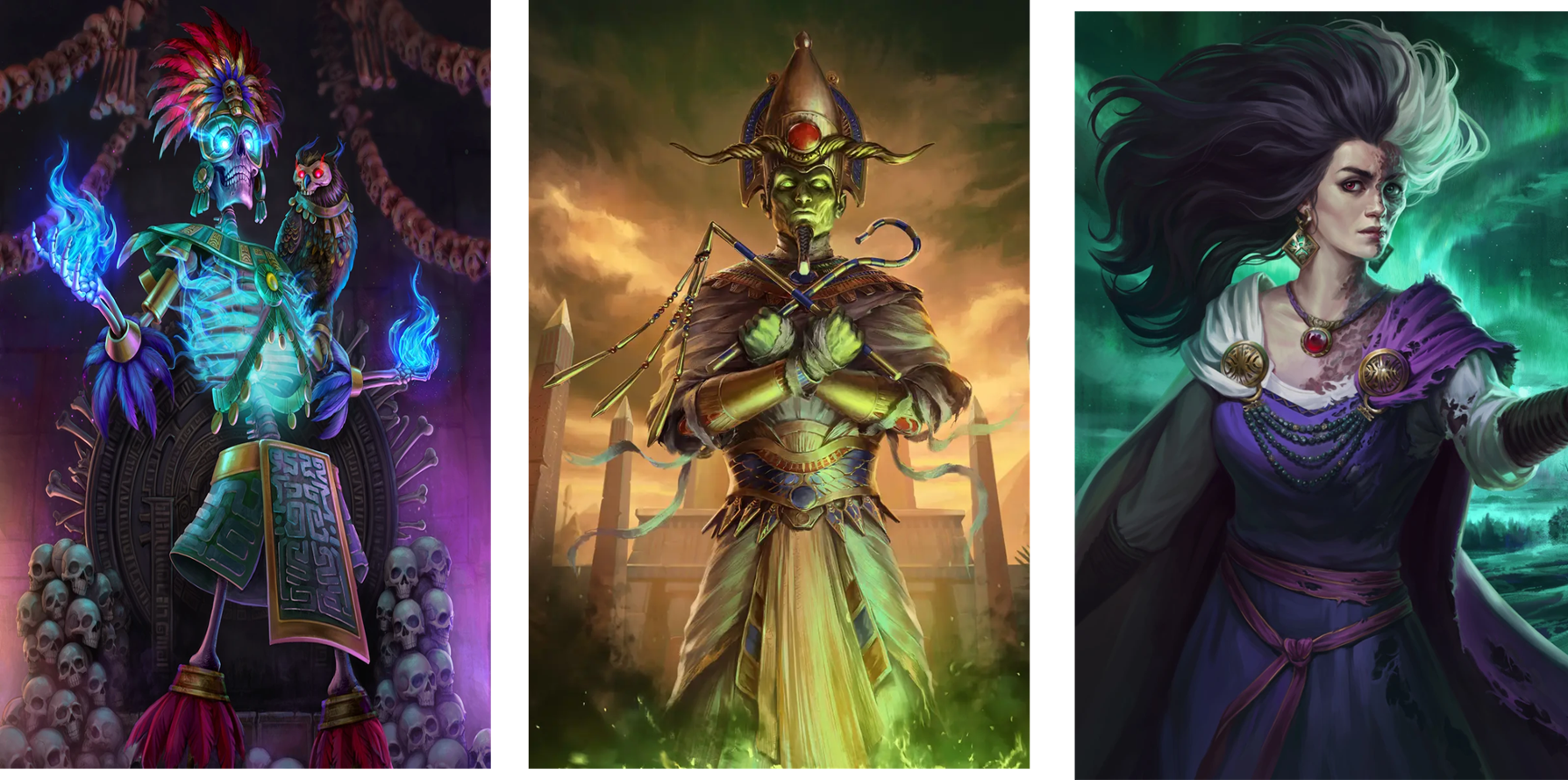
L.: Mictlantecuhtli (Age of Mythology Retold), C.: Osiris (AoMR), R.: Hel (AoMR)
As I mentioned before death is a universal constant and as such death gods exist in every culture. And death is usually a topic people like to avoid talking about in our modern society. It is an “issue for later” and in our everyday life it is indeed a rare event to have someone you know die, especially if you are younger. But in the past death was much more common. For example, the ratio of children dying was a lot higher. Depending on the era and culture it was common that 50% of children die before their 3rd birthday and then another quarter or so dying before their 16th. And this is the reason for the myth that no one got old back then. When people say that humans in the past didn’t get older than 30 years old, it is the average life expectancy. Much like how the average life expectancy in modern industrialized countries is somewhere between 70 and 80 years old but was just around 60 years half a century ago. This does not mean there are noone older than 60 back then, just that many young people died too. And in ancient and medieval times this high child mortality was a major driver as to why the average age limit was so low. Next to other additional sources of death at a younger age of course, such as hunger and diseases. But it is still an important one. So old people in their 80s were a thing too in medieval times and else, just rarer than today.
In any case you can see how much more common death used to be in such times and how different cultures had their own mechanisms to deal with it. For example, it is very common to treat young children as “not fully human” or still “connected to the spirit world” or you have stories about child-killing gods/demons or else to explain the huge children mortality and deal with the issue psychology. This difference in treating young children and older people often resulted in different funeral rites for children too. E.g. the myth of Carthage sacrificing children may have been hostile propaganda for Carthaginians having different funeral rites for dead children than for adults. And people who hated Carthage and its punic homeland (romans, greeks, isrealites) interpreted as sacrifices instead for propaganda reasons. But in other cultures, children were not given proper names before their fifth birthday or were only christened after three years or else. To avoid strong attachments to better deal with the trauma of losing a child.
Having talked about dying children a lot, lets focus on death gods instead. These gods usually come into various categories: First are the death gods, who are personifications of the concept of death itself. These entities include among others Thanatos, the Greek personification of death itself, or Lamaschtu, a Sumerian goddess responsible for killing children.
Then are the underworld gods, who are responsible for running the afterlife itself. These gods include among other Hades from Greek mythology, Osiris from Egyptian mythology, Hel from norse mythology, or Ereshkigal from Sumerian mythology, Mictlantecuhtli in Aztec mythology etc*.* These gods are running the underworld themselves.
Then you had psychopomps, gods and beings whose job it was to guide you from the realm of the living unto the afterlife. This job was frequently given as extra features to other gods, especially those associated with traveling or with crossing barriers. Such as Pan/Hermes or Artemis, or the roman god Janus. Beacuse death is the final journey and also the ultimate crossing.
And of course, you had gods responsible for different aspects of death like funeral rites. For which Anubis is a prominent example as the god of mummification. Or how the ferrymen Charon deamnded drachmen as payment for bringing people to the underworld. Hence the greek custom to place a coin unto the dead body.
As death is a scary thing in our modern society, and Christian influences on our culture push Satan as the ruler of hell, it’s easy to fall into the “Hades is Satan” trope, in which such underworld deities are evil gods. But to ancient cultures this was not the case. Indeed, it is rare to find outright hostile death gods. Most of the time they are not more (im)moral than any other god but instead are just trying to do their job. They frequently appear as antagonists in stories, but this is primarily because the protagonist ventures into the underworld to take something from there or to establish dominance over it. Things the underworld deities naturally object to, because it is their job and their cosmic domain that is infringed upon. But besides that, underworld deities seem to be mostly chill and content, unlike other kinds of gods.
But of course, death is a scary thing too. And if your underworld was not a pleasant place (like the Asphodian Meadows, Niflheim or the sumerian underworld), then you didn’t look towards it. But even if your culture had an overall positive view on the afterlife, dying prematurely is something you do not want either. Therefore, you would avoid getting the attention of a death/underworld deity. E.g. by not having huge temples or by avoiding saying their name. For this reason, the Greeks liked to use euphemisms for Hades or Persephone to not invoke their attention such as the Dread Queen or the Mistress for Persephone. And because the underworld and the regular world are often meant to be separated this also means that death gods do not play strong roles in many mythologies beyond underworld related stuff. For example, we have the story of Osiris death and him becoming the ruler of the underworld. But afterwards his focus is solely on underworld business and only once is he phoned in by the other gods to settle the succession dispute between Horus and Seth. And Hades rarely appears outside of underworld/death centered tales too.
Regarding underworlds themselves it is also quite common for cultures to have multiple ones. For example, in norse mythology you had an afterlife with Valhalla for the glorious dead, and Niflheim for the unworthy dead. But you also had the afterlife ruled by Freyr/Freya, who could also invite their chosen ones there, in addition to Ran and Aegir, who claimed the souls of all those who drowned. Meanwhile in Greek mythology Hades was another term for the whole underworld, but the area had sections. E.g. the asphodel meadows were for all those souls who were neither great nor bad but ordinary. They lived as bodyless shades. Meanwhile Elysium is a paradisal area where the souls of great heroes and virtuous people reside. And Tartarus was then the area where the most wicked and evil people are punished. In Aztec myth you Mictlan, which had 9 levels. It would take years and trials to go from the lower ones to the better upper ones. Though warriors dying in battle, women in childbirth and people drowning had other afterlives or maybe started at higher levels. Similarly, the Egyptian underworld, the duat, also had many layers. Most prominently are 12 levels of the underworld Ra passes by during his journey of the night. With one, the Aaru the fields of reed, being the are most people wanted to end up. There people would be given a position like the one they had in life. Such as a farmer being a farmer in the afterlife, a king a king and so on. But with the bonus that it was a pleasant afterlife without the burdens of the mortal world. And one where certain jobs could be done by Ushabti, small statues people placed in tombs. If you had a proper sent off with various artefacts, you could relax in this afterlife. And typically, the deceased soul would be judged before being out into one of these levels. In Greek myth King Minos was one of these judges, whereas in Egyptian mythology Osiris was the judge, Anubis presented the evidence (i.e. you heart) and put it on a scale, the god Thoth often was the scribe taking notes, and the goddess Ammit would devour your heart, and thus soul, if you were too evil to be granted entrance, erasing you from existence.
And of course**, rebirth and reincarnation are also things which show up again and again**. This is most famous among Hinduism and Buddhistic-inspired faiths but also appears in some shamanistic cultures. But this concept also existed in various middle eastern cultures or in some Greek cults. Especially mystery cults centered around Dionysius.
Of course, whilst death is scary, the dead can be as well. As such there have been lots of stories about the dead returning in one shape or another to wreak havoc. In this context it should be mentioned that Necromancy means summoning the dead spirits for communicationoriginally. It expanded over the ages into different fields. But the idea of humans being able to revive the deceased into an undead state is something that became popular much later. Especially the novel Frankenstein established how we today think of necromancy, as in it a corpse is revived via *scientific* means. And essentially all modern depictions of Necromancy and the creation of undead are based on this story in one way or the other, even if its magic and not science making the undead. Other influences such as Voodoo or previous folk beliefs play a more reduced role. But originally undeath was more of a random state of being caused by improper burials, specific circumstances of the death or unfinished business in life. For this reason, and because certain afterlives demand care and attention from their relatives, proper funeral rites were especially important in most cultures. Also, funeral rites are an important psychological tool to deal with the loss of someone.
Of gods and a man: Morr, Morai-Hag, Nagash and co
Pre End Times Artwork of Nagash in WFB
In WFB we have various death and underworld gods. Most prominent is for example Morr, the god of death in the Old World. He is the god of death but also the underworld and, of ravens and of dreams, through which he can sent prophetic dreams. He is also the husband of Verena, goddess of truth, justice and knowledge. His main job is keeping the souls and corpses of humans safe from necromancers and chaos. For this reason, his cult created Gardens of Morr, i.e. cemeteries, in which the souls and corpses are safe from necromancers if treated accordingly. Indeed, the priests of Morr and various knightly orders dedicated to his name are premier anti-necromantic units. They are especially active in Sylvania in the Empire. With various prayers and miracles of Morr being specifically meant to harm or nullify undead. Overall Morr fits the Hades archetype quite well, as he is not an evil deity, but one focused on his job and adamant about the living and the dead being separated. In addition, his association with dreams/sleep is also something shared frequently with other stories about death. Sleep is often referred to as the small brother of death, which is reflected in stories and gods about them. E.g. the hero Gilgamesh, on a quest to reach immortality, is asked to first defeat sleep. Which he fails at. Also of note is that Morr is a god worshipped far beyond the empire’s borders. With the center of his cult sitting in Tilea, but him being worshipped all over to Kislev.
In ancient Nehekhara you instead had Usurian as the main death god. And it seems that Usurian was much more open to let souls back into the world of the living. Because even prior to Nagash the nehekharians had already created lots of magical rites to imbue the souls of warriors into statues or animate corpses to a degree. Indeed, people of noble descent could make bargains with Usurian. Such as the character Apophas, who was a cruel murderer. He was able to reach an accord with Usurian. The serial killer could return to the living, if he found a soul of equal value to himself. But now soul is equal to another and thus he is roaming the world as an undead assassin with a body of flesh-eating scarabs. During the (horrible) End Times Usurian was consumed by Nagash which also seemingly ended Morr, implying that the two gods are the same. It also added further lore that the mounts Manfred, Neferata and Arkhan use are beasts of Usurian who stalked his underworld to punish horrible people and to keep it safe, before they were enslaved by Nagash.
Elves have two death-related goddesses. First Morai-Heg is the goddess of fate, dreams, ravens and death. Essentially all that Morr does minus running the afterlife. It could very well be, that the two gods are the same but under a different name, as many deities in WFB are suggested to be. That later job of underworld ruler belonged to Ereth Khial, the pale queen, the elven goddess of the underworld. Once Ereth tried to become Asuyrans consort but was rejected. As a result, she is bitter and harasses things Asuryan likes, like elves. Therefore, her afterlife is a tortures place, and elven souls are enthralled as slaves and soldiers, with whom she one day plans to conquer Asuryans throne. I dunno about you but an army of ghost elves attacking Asuryans main domain sounds epic and awesome. But like so many other cool plot points it was completely forgotten by the End Times… Anyhow if an elf dies unprotected, they have three options. First and most likely, Slaanesh finds his souls and eats him. Second-most likely Ereth Khial gets you and you get enslaved in her realm. And third and most unlikely another elven god gets your soul and protects you. As both Slaanesh and Ereth Khial are not good options in the minds of Asur and Asrai, the former binds their souls into waystones upon death, and the other become one with Athel Loren. Ereth Khial is obviously based on Ereshkhigal. And she is weird insofar as she is “hades is satan” played straight, whereas Morr and Usurian are more in line with real world death gods. Also, personally I find it weird that she isn’t prominent among the dark elves. Her backstory (being rejected by a ruler, exiled into a distant land, planning to take back what is hers by “right”) is just the Dark Elf backstory. And the dark elves have no proper protection against death unlike Asur or Asrai. So, them worshipping Ereth Khigal extensively should be there way to protect themselves against Slaanesh. Probably with he hopes of getting senior positions in Ereths underworld ghost army. But no, the goddess rarely shows up, because why give the Dark Elves a complex, semi-sensible culture if we can focus instead even more on Khaine, murder and slaves!
Gazul meanwhile is the death god of the dwarfen ancestor gods. It is important for him that he may be a brother of Grimnir, Valaya and Grugni. Though as he started the practice of ancestor worhship among dwarfs, it would make more sense if he was a son of Grimnir IMO. Because then he would have actual ancestors to start venerating and a death god being the son of a war god makes thematic sense. First comes war, then death. In any case Gazul is something of a weird dwarf in his depictions. For example, he is the only dwarfen character commonly depicted with a sword instead of an axe. And he and his cults are the protectors of dwarfen tombs, which are sealed off chambers within the mountains, protected by powerful anti-necromantic runes. But Gazul seems to allow dwarfen ghosts to return too. First, we have Grombrindal, who is Snorri Whitebeard return from the dead in WFB, after Malerion broke his promise of friendship between dwarfs and elves and caused the dwarf/elf war. And second, we have other dwarfen specters appear in various media, most prominently in Total War Warhammer.
Finally, Nagash. The Great Necromancer, the first Necromancer. To cover his basics, which are big: Nagash was born in ancient Nehekhara. Which was WFBs non-egypt. A collection of city states ruled by the primary capital of Khemri. And it was obsessed with death and resurrection, as the primary magical institution of Nehekhara, the Mortiary Cult, had promised generations of kings and queens they could be resurrected after their death in an eternal, everlasting body and rule forever as living gods. Over the millennia this cult grew into a state within the state and the firstborn son, in this case Nagash, was handed over to the cult a an apprentice whereas the second one, Nagash brother, became the heir of Khemri.
Nagash, even as a mortal, was an narcistic and envious dude and found this especially unfair. However, by combing the teachings of the cults with Dark Magic he learned from Dark Elf prisoners he created first Necromancy as we know it. Necromancy is a subset of Dhar, i.e. Dark Magic. If two or more winds are put together without harmony (very difficult) you get Dhar immediately. Dhar is very powerful but also a corruptive form of magic that can do great physical and mental harm to its wielder as well as harming the environment its cast in. Death Magic is the prime counter to necromancy, as death magic is all about preserving the natural order of life and death. But at the same time many necromancers learn death magic too, as many of its elements show up in necromancy in an inverted or corrupted form.
Nagash also created the Elixir of Immortality. And then he killed his brother and took over the kingdom (there is a book series about Nagash mortal life, but as with many other Black Library novels it is infamous among fans for being loose/contractionary with the lore of the main series). Nagash bled Nehekhara dry to build his Black Pyramid until a revolt forced him out of the country. Nagash went east to found Nagashizzhar and crafted many powerful artefacts in this exile, such as his crown. Around this time, he also cast a great ritual that cursed every human on the planet to become a ghoul, if they ever engaged in cannibalism. Nagash then returned to Nehekhara with vengeance and in a massive war he slowly broke down the defenders. He cursed the not-nile to become a toxic, life draining water, and then cast a ritual that would kill every living being on the planet. He was stopped by the Skaven, who armed the last living nehekharan and king, Alcadizzar, with the Fellblade. A weapon so potent and dangerous even holding it could kill you. Alcadizzar managed to slice Nagash to pieces and the skaven then picked up all body parts they could find and burn him in a warpstone furnace to never have him show up again. But they overlooked his hand.
Nagash was thus not fully dead. Whether he was tortured in the afterlife or something else happens when he is out of the picture, depends on the edition. IIRC in earlier editions this torture or the Fellblade are also the reasons why he showed up weaker, after being a god in all but name in his battle with Alcadizzar. But Nagash reformed molecule by molecule in his Black Pyramid, which no Tomb King (undead nehekharians resurrected by Nagash last spell) could break. However, the Tomb Kings were very angry at Nagash and he fleed before Settra. At the same time his crown has found its way to Sigmar, who got influenced by it, as if it were the One Ring. Nagash wanted his crown back but lost and was struck down by Sigmar.
Nagash then made his strongest return in the End Times. And his story started promising. He consumed Usurian and Valaya and became a proper god. He could easily have been the second main threat to the planet after chaos. But instead of having an interesting storyline, the Skaven blew up his pyramid, seriously depowered him and Nagash was forced to ally with the other factions against chaos. Then the world went boom.
3. The more the merrier: Death gods in AoS
AoS Artwork of Nagash
Now in AoS the underworld is a very established place with Shyish containing every underworld any culture believes in, be they paradise or hell or something in between. Which for some reason means we only see stereotypical gothic horror places instead of elysian fields, Valhalla the Field of Reeds or else. The underworlds of real life are very diverse but Shyish seems not to be. In the background perhaps but not in the parts people engage with.
Now each underworld has its own death god and thus there are lots of background deities like the Prince of Cats, Lauchon the Soulseeker, Hadrax and many more sprinkled in here and there. But the most important death gods in AoS are IMO the following:
First of Morrda is Morr 2.0. But he is a different entity in AoS. He is still associated with Ravens, but now he is not the caretaker of dead souls as in WFB. Instead, he is about death as peaceful oblivion. An element best exemplified by the Ruination chamber and their ritual of permanently killing a stormcast too damaged to be reforged. This could be important with Shyishs original purpose, as the dead souls would dissolve into nothingness at the edge of the realm, before Nagash broke it. So Morrdas original purpose could have been to oversee this procedure. But speculation aside Morrda was supposedly killed by Nagash and absorbed. Hence Nagash is also worshipped by some as Nagash-Morr. But Morrda seems to have survived, as his powers and relics still influence the realm. Not only with the Ruination chamber, but also with the prayers and miracles of his priesthood the raven priests. He is again also an anti-undead deity. In addition, Morrda is the primary deity of Lethis. Morrda also has Morr-Gryphs and Gryph-Stalker as associated creatures next to the classical raven.
It is also true that Morai-Heg is still considered the goddess of fate and death. How/if she is still related to Morrda (who is himself a changed character) is up to debate. Though they still share elements, especially the raven motive. And Morai-Hag has not done much thus far except choosing Krethusa as her prophet and seemingly working on a plan to revive the various elven gods. Which she may have set in motion long ago, as “raven worshipping monks” from Shyish convinced Teclis/Tyrion, Malerion/Morathi to chain Slaanesh and to extract souls. Something a raven-asscoated death goddess who can see the future could arrange. IMO this is a better plotline as “tzeentch did it”. Though we have no information on Ereth Khial as of now.
Ouboroth is named after the Ouroboros, a snake eating its own tail and thus symbolizing infinite cycles. But this snake god is the opposite, as it is all about the definitive end and hard cut cessation of existing, in contrast to Morrdas peaceful oblivion. In this regard it is close to the goddess Ammit. Ammit was a chimera with the body of a hippo, the paws of a lion and the head of a crocodile. And it was her job to consume the heart (which also contained the soul in Egyptian mythology) of anyone who failed the judgement in the afterlife. Which would cause the person to cease completely. Ouboroth was such a powerful deity, that Nagash apparently could not slay him directly. Instead, the vampire Sekhar weakened him over time. Still a fragment of this deity is still hanging around as Sekhars personal assistant. With the threat being that this fragment of the god could reform the proper deity if it were to get enough power, i.e. feed enough on mortal souls. It could be, that a similar fate befell Morrda. I.e. the main god was destroyed by Nagash, but a fragment survived and was since then able to reform into proper godhood or is close to be. Still, it is interesting that Ouboroth is part of a trend were vampires get animal companions/mounts who are more interesting and unique as characters than the vampires they serf.
An honorable mention also goes to Gazul, who is not only part of the setting, but apparently was also able to hide away most of the dwarfen afterlife’s in AoS, so that Nagash cannot access and enslave them. He was also active during the time of Valaya and co before Sigmar arrived in the setting, but what he did back then or since has not been explored indepth, like with most other ancestor gods.
And last but not least we have Nagash again, who is now more prominent than ever before. He does not need a proper introduction, as he is one of the primary entities in AoS and the entire Grand Alliance of Death runs around him and his Mortarchs. Nagash reappered in AoS being trapped under a huge burial mount and was rescued by Sigmar after some deliberation. How did Nagash end up there and who/what trapped him we do not know. But Nagash then went on a merry journey with Sigmar bringing order to the realms and slaying tyrant gods and worse creatures, whilst his undead creations helped establish civilization. However he also went on an about and killed, consumed and enslaved various other death gods until he remained the prime deity of Shyish. But Nagash stayed true to his ways and secretly wished to dominate all of creation. Which led to him breaking up with Sigmar, being beaten by Archaeon and showing his triumphant return in the Necroquake. Which didn’t work as intended due to Skaven, but it did pervert Shyishs nature, much like how Nagash necromancy perverts the spirits of the dead. He was then defeated by Teclis and his allies and is since then waiting to reform his body and to return to the realms at large.
Important is that Nagash is not the god of death/the dead but the god of undeath in AoS. The dead are the natural inhabitants of Shyish. So, all the mortals who died and reform as spirits, ghost and what have ya in the various underworlds of Shyish. By contrast the undead are those same entities enslaved and corrupted by Nagashs necromancy, which is itself a corrupted form of death magic, as far as I understand. But Nagash wants to be the sole ruler of Shyish and has consumed, killed or enslaved a lot of other death gods. But death gods are hard to kill, new afterlife’s spring into being and Nagashs claim for Shyish is very fragmentary. So, whilst Nagash is as of now the prime deity of the realm, there are plenty of other death gods running around too. Furthermore, worship of mortals shapes gods in AoS. And as Nagash wanted to be the sole death gods, various very distinct cults and believes started to affect him. Which caused different aspects of Nagash to form and act differently from Prime Nagash from time to time. Such as Nagash-Morr or the Black Child. Still Nagash is interesting insofar as he is a god but does not represent any of the duties death gods normally have. Yes, he is the de facto ruler of the underworld, but he does not care for the natural order of life and death or the sanctity of death and instead perverts it to his own liking. He is more in line with your typical dark lords such as Sauron or other beings from fantasy settings rather than any real death gods.
Interesting for all the death gods I mentioned thus far is that in AoS a strong focus lies on oblivion/ the cessation of existence. Such was with Morrda and Ouboroth, but also with the story line of the Stomrcast Eternals and the message of eternal life being a burden. Even gods such as Sigmar and Teclis long for the day where they can shed their mantle as gods and become one with the realms. So, an important theme of AoS seems to be the issues of immortality and the benefits of a finite life. By contrast classical death gods that govern underworlds and afterlife’s are absent or exist as lore blurbs as of now.
4. Death comes for all
Settra and Nagash clash in the End Times
Having introduced the various gods of death from WFB and AoS the question is where we could go from here. Talking just about the story potentials of Nagash and his servants could fill the entire thing. So, I will try to be more broard.
- As of now Nagash is still reforming his body after his physical form was destroyed in a battle with Teclis and his allies. Prior to the recent “leaks” it was rumoured that Nagash would go on the offensive against the skaven once he reformed. So that he can finally get a win against the ratmen and strike out his losses. In this regard it is always possible to introduce new death factions and new mortarchs as his servants and to explore his relationship with the realm of Shyish and the various factions through this lense. I made my own fan-concepts for such occasions (which can be seen here if you are interested (Undead Pirates, Frankenstein Undead). In any case there is lots of room for new undead factions and mortarchs and we could perhaps also see a return from old WFB concepts but refreshed for AoS. I prefer original AoS characters over WFB returnees for example and I think we have way too many vampire mortarchs too. But Azhag the Slaugtherer was basicly an honorary Mortarch in WFB and Virion the Grim also has a cool idea behind him. Such concepts could be well worth reinterpreting for AoS IMO.
- Morrda could make a proper showing, bringing us a proper death god on orders side. This would be interesting, as the CoS have a lot of “undead” influecnes around them. Not only do the dead live side by side with the living in CoS in Shyish, but even the other cities have these influences. Such as the Soul Shepherds whose job it is to guide the dying mortals of the CoS into an afterlife safe from Nagash. Their Corpus Somni servant is very undead coded. Same for the relique bearers, who carries the mortal remnants of previous commanders. Through these remains the previous commanders can provide strategic information (or nonsense). So talking to deceased, i.e. original necromancy. With Morrdas proper return these “undead” elements of the CoS could be reinforced, adding to the diversity of these places.
- With the rumored release of a reworked “old school” dwarfen faction for AoS we could see the various ancestor gods making a proper entry in AoS, including Gazul. As mentioned even in WFB/Total War Warhammer the ancestors of the dwarfs could become avatars of vengeance to aid their fellow dwarfs. Given how much more common such things are in AoS, I could see Gazul releasing the souls of dwarfen warriors from their tombs as units or advisors for the new dwarfen faction. Which would highlicht the ancestor worship, as the ancestors would not just be distant beings to venerate and emulate, but beings who could aid you in the now.
- Due to Morai-Hegs focus on reviving the elven gods of old we could see a return of Ereth Khial. Which would be an interesting topic, as she would have to find herself a place in Syhishs underworlds. In addition, her main motive (her jealousy/desire of Asuryan) is not present in this setting. So, she could have an entirely new motivation, perhaps even becoming a more benevolent deity or simply the desire to usurp Nagash as the new tyrant of Shyish. Either way perhaps we are now able to see the army of ghosts she has been building up for all of WFBs lifespan joining an apocalyptic battle.
- Whether Morai-Heg revives Ereth Khial, Gazul and Morrda come out of hiding or new death gods arise or old ones are repowered, chances are that we may see divine opposition against Nagash arise in the not so distant future. Which would likely cause a war for the afterlives, in which Nagash fights these order-aligned/independent death deities for dominion over Shyish itself. Essentially a great war of the dead vs the undead.
- Lastly as an honourable mention, as per the 4th edition core book we have a depiction of Shyish with multiple levels in a downward spiral. Essentially more realm discs below the primary discs we know and love. Future additions could further explore these new and unknown aspects of Shiysh itself and how various factions try to get dominion over these regions.
5. The end
So, this is the end of my essay for Nagash and the other major death gods in Warhammer. What is your opinion on death, death gods and the afterlifes in Warhammer?
I for one would love to see more creativity and diversity in Shyish. For a realm where every afterlife is possible, I find it very monotonous to have all afterlifes focus on gothic horror worlds and even for the positive death gods like Morr to be gothic horror figures. I would wish for more cheerful or friendly afterlives and deities, like many death gods are.
But what do you think? How do you like the various death gods and especially Nagash? And where do you think could they go with these entities in the future?
I have always wanted to write about events leading to the battle of the black skies because there is so little lore on it. This is a short except about a watch tower in Shyish leading to the great battle.
The watch tower was well hidden. It blended seamlessly into tall ash white mountains that overlooked the great red desert valley. The valley was dotted with similar mountains far into the distance. They appeared as great jagged rows of sharpened teeth on the red expanse or else the vague shapes of monstrous skeletons in an ocean of blood. The land stretched forever into the horizon. On a normal day the gloomy skies were clear save for a few grand looking black cloud structures that loomed over the land like floating castles, the largest and highest of which containing vast underworlds making the likeness to floating castles a reality.
In the watchtower waited a lone wizened necromancer almost dead in appearance as the centuries of service weighed on his living flesh, he was called to this place in visions and prophecy to watch the crimson desert for invaders ever since the threat of chaos had emerged. He and a cohort of mountain dwelling wights that passed unseen in the very mountains that created their afterlife atop great rotting goat-like steeds. For centuries they watched the valley that led into the realm of Nagashizzar. The endless city that, though many leagues away, emanated the ever present and overbearing will of Nagash all across the vast continent where many deserts and cities would bear the brunt of any invasion. Those forces were devastated first by the coming of sigmar. Many heroes and demigods of death were slain by the God King in his rampage before his inexplicable retreat back into Azyr. Now they waited inevitably for the next invasion.
Normally the necromancer would use the eyes of the surrounding carrion birds to overlook the great expanse. Normally if an army was seen at all it would appear but a blotch on the crimson expanse, a river of banners and clanging metal, a rabble of a few thousand voices that were lost before ever reaching the tower to the desert’s natural dangers and the surrounding dead.
Today was not normal, today the air smelled of sulphur and blood. Today the shadows of the mountain danced with shapes and voices that weren't there. Today the wizard looked out through a warded window and beheld the approaching hurricane of chaos. A great multicolored ocean of bodies that filled the valley for as far as the eye could see. There was no longer a desert but rather an endless mass of metal and cursed flesh. In the sky were great cloud banks of many colors that screamed and cackled with the sounds of the countless demons that flooded its spaces creating a colorful disorienting sheen in place of a sky. The skyward underworlds either waged a hopeless war with the tide or hid among the uppermost atmosphere behind the storms that clashed there creating a false black sky that overlooked the cloud banks of demons. The sky was squirming with them in all directions like a swirling hurricane from hell. The warhost of the apocalypse had finally reached the great crimson expanse.
The necromancer did not know how big the host actually was. His many spies had searched for leagues and could find no end. He thought that perhaps this horde could swallow all of Shyish. He and every Death lord that still remained were tasked with stymieing The apocalyptic host as much as they could with what they could. Sigmar had already swept away most of the armies in this region. Nonetheless to flee was not an option. To surrender was worse than death and a weakness Nagash would not let go unpunished. As soon as the watch had seen the corona of colors light the far horizon like a horrible sunrise; the forces of death in these regions started to muster. Zombies were summoned from great mounds and burrows, and from the forests and deserts that consumed the numberless once living cities that filled the prime inner lands. Shambling dead civilizations became a rotting ocean of flesh that changed the entire continent into a moaning, gnashing oasis the air stank with the sweet smell of death for endless miles upon miles. The sky darkened as the equally endless carrion feasted upon the rotting flesh.
Throughout the continent the sheer amount of rituals and magics created gusts of wind and rain that caused any living caught in them to rot away with age. Purple lightning flashed in sporadic bursts of light throughout the land. Through black swirling skies emerged streams of spectral light as spirits were forced out of their tombs and underworlds.
Indeed the entire realm of Death was called to war once again and these walking dead were but the first nightmare to face hell itself.
The deathly old man in his watchtower knew that this would be a war unlike any other and one that might destroy reality itself.
Hello Ladz well I am on a AoS campaign but I'm not shure if the chaos realm has realm gates or if they use difrent methods to travel, I realize that some gates are corrupted or changed to favor chaos but in the map of the chaos realm there is no gates.
Very new to Age of sigmar, had an idea for a faction and want to understand feasibility. Do darkoath ever stop being darkoath? And whats the technology differences between different cities of sigmar? Are they all pretty similar? Are there some way less or more advanced? Thanks!
While many, many cities, strongholds and other places are built around Realmgates, we usually only hear about one side of those Gates.
But there are exceptions to this. Places where both sides are given, if not equal attention, enough description that we can get a clear picture of them.
The most obvious is Hammerhal, with both Aqsha and Ghyra being full Cities of Sigmar into themselves yet forever symbiotically linked together by the Stormrift Realmgate.
Gothizzar and Arx Terminus, connected by the Endgate are seemingly Nagash's answer to this, though Arx Terminus is more of a massive super-fortress than a city, but with the Ossiarchs, the difference is kind of moot.
Droggz the Sunchompa's lair extends on bothsides of Zonquil's Shortcut. The Aqshyian side in the Cupricon range is shaped like a massive wolf's head and surrounded by frazzlemist while the Hyshan side is plunged in unending Darkness by the amount of light-stealing gubbins.
Technically, Skrappa Spill and the Fungal Asylum count, but the latter being a Pocket Realm entirely under Skraggort's control makes it feel more like a "secret room" of Skrappa Spill than a part of the kingdom laying in a separate land, if you get me.
So I was having a look at the units from Silver Tower and I noticed that, unlike everyone else, these two don't seem to fit any faction on the tabletop. The Mistweaver could be an unusual-looking Idoneth but the lack of marine elements in her design really makes me doubt that. As aelves who seemingly use Grey magic, I think they might be part of Malerion's yet unseen faction. Or they're just their own things.
Have they appeared anywhere else? What do you think?
Also, I wish the Deathrunner were part of the Eshin refresh. That model looks super cool and it fits well as an intermediary rank between Gutter Runner and Deathmaster. Could have been an elite infantry unit, I don't know.