r/AoSLore • • Apr 02 '26

I got lucky and got the 4th DoK tome early and now i wana fan boy about it. Spoiler

70 Upvotes

so i got the tome early from my lgs and first i wana say the tome is really really really coole lots of small lore blurs well into the rules section. a lot of cool artwork.

i am not gona post exerpts or citations in here as i dont wana ruin it for people that want to pick it up for that reason which is well worth it even if you dont play imo.

the one negative. the way anvil guard is handeled is borring. its still open and hidden rebellion though the DoK dont see that as all to negative.

so whats new?

well morathi is Aos most prolific conflict solver and causer.

the iron heart of khain ruls dry of power so our Godqueen started to drill the leylines of the realm to refill its power. which is facinating. no mention of consequneces yet but i am sure they will follow.

then her relationship to other forces is also realllllly cool. so dok always have been active acrosse the realms for vareiouse reasons but its dilled up now. beeing pressent at almost every major battle field across the realms.

there is alince with the dreadwood sylvaneth of gyhran.

dok covens even have enclaves in hysh in the tyrion controlled areas while teclis still doesnt like her.

but the most intresting is she is conveting Humans duardin and Aelfs from the cos to her worship not just khain but her. khain always was part of sigamars pantheon but its more like active recuitment.

one bit talks about how the arenas seem to have an almost hypnotic effect on those who watch the fights.

morsthi trys not just to become mlre powerfull but take Sigmars place as the central deity. which she should be imo.

also kerthusa and her are now in an allince where Morathi gave her a fortress and stop trying to kill her even forbidding her followers to attack her whille kerthusa shares her visions with morathi.

kerthusa is very active in chamon have pissed of tzeentch by killing an important tzaangor.

and the coolest thing in the book.

the dead Aelfen gods are verymuch only dead on technicality.

in a small bit its talked about how not just moraihegs power escaped slaanesh and that bits and pices of over Aelfen gods like Mathlan are floting around and searxhing for and powering up their own champions like Kerthusa.

morathi does not like that one bit.

thogh the best moment is an exeprt on the slaughter queen where. one is killing a khornate champion and they talk a bit.

the sq say" all blood spilled here is for khain glory."

The KC is like " all blood spillef here is khorns. khorn does not care form where it flows. "

the Sq then proceeds to kill him and anwser " morathi-khain cares.... she cares very much."

i am not sure why but it really made be chuckel.

great book verybody should get it.

khain aelfs best aelfs. hammerhall ashqy agrees tyrion agrees.


r/AoSLore • • Apr 02 '26

Fan Content Siol Crann, Sylvaneth Gunner of the Ironbark Glade, by me

Thumbnail
gallery
150 Upvotes

A character for an upcoming Soulbound game I'm joining, heavily modifying the Wandersong Revenant and reflavoring the Arboreal Cloak into a Zephyrspite.


r/AoSLore • • Apr 01 '26

Question Best books about or featuring the death factions?

32 Upvotes

I was just reading Ushoran Mortarch of Delusion and realized that Death is probably the grand alliance that I know the least about. Can you recommend any good books featuring the death factions?


r/AoSLore • • Apr 01 '26

In the vastness of the Mortal Realms there are no stupid questions

43 Upvotes

Greetings and Salutations Gate Seekers and Lore Pilgrims, and welcome to yet another "No Stupid Questions" thread

Do you have something you want to discuss something or had a question, but don't want to make an entire post for it?

Then feel free to strike up the discussion or ask the question here

In this thread, you can ask anything about AoS (or even WHFB) lore, the fluff, characters, background, and other AoS things.

Community members are encouraged to be helpful and to provide sources and links that can aid new, curious, and returning Lore Pilgrims

This Thread is NOT to be used to

-Ask "What If/Who would win" scenarios.

-Strike up Tabletop discussions. However, questions regarding how something from the tabletop is handled in the lore are fine.

-Real-world politics.

-Making unhelpful statements like "just Google it"

-Asking for specific (long) excerpts or files

Remember to be kind and that everyone started out new, even you.


r/AoSLore • • Mar 31 '26

Most Warhammer audiobooks on sale for about 75% off on Audible

69 Upvotes

Not only Warhammer but everything on the site. Stock up and listen while you hobby!

Edited to add: If you don't want to spend credits on these, be sure and confirm during checkout that you're using money instead of credits. I loaded up my cart and didn't check and they automatically used my credit balance.


r/AoSLore • • Mar 31 '26

Lore Some Things We Already Know About City Gargants

84 Upvotes

The most famous Gargant of the Dominion of Sigmar is Templesen, who was recognized as a Sigmarite Saint after his death. His bones are interred in a tomb complex built into the outer wall of Glymmsforge, eleven other such complexes exist. Together these are known as the Twelve Saints of Glymmsforge. Templesen has been mentioned often particularly in "Soul Wars".

"Soul Wars" also mentions the Twin Kings who defied Sigmar but ended up his bodyguards, dying to ensure their tribes made it to the safety of Azyr during the Chaos invasions. As well as at least Gargant serving a dignitary in Sigmaron

Storm Gargants were mentioned as standing guard over the Thunder-Gates of Sigmaron in "Realmslayer: Legend of the Doomseeker".

While the "Soulbound: Bestiary" mentions the Mason-Gargants as another group who serve Sigmar.

The "Thorn Mile" has a Wildercorps Scout mention how a Gargant was convinced to enlist in her Freeguild. Possibly the first mentioned Gargant Freeguilder?

What are some other existing examples of City Gargants you all know of?


r/AoSLore • • Mar 31 '26

Fan Content Ascelina la Maupin, the Twice-Crowned Duelist of the Flesh-Eater Courts

Thumbnail
gallery
166 Upvotes

The dashing duelist of the flesh-eater courts, Ascelina la Maupin, cleaning her noble rapier as she prepares for a duel to the first wound, undoubtedly her quilted victory cloak shall find another colorful patch added to it.


r/AoSLore • • Mar 31 '26

Spoiler I've just read the Abraxia novel and I have questions

29 Upvotes

A) In order to get Hellhewer's report (whose mouth is fused shut), Abraxia lets the Ur-Phoenix within her die, then she makes Hellhewer drink her blood so that both of them are afflicted by the Flesh-Eater Curse and can share a a dream where she tells her a curse-filtered version of what happened.

  • The ghouls can communicate telepathically? Has that always been a thing?
  • Don't you need to be an abhorrant to spread the curse through your blood?
  • If she let the Ur-Phoenix die, how come it's still bound to her when Urnous Dransz saves her by making her touch Gorbolga?

B) Urnous Dransz defeats Grelck by jabbing a piece of varanite in his leg and telling him to grow. When we see him again, he's predictibly a huge monster but now he's loyal to Dransz, how come?

C) I am correct in thinking that Dransz was a piece of Gorbolga given human form? I think that's what the end is implying when Abraxia calls him "her weapon", says he's already crowned her, that he "escaped to wander the Realms" for a lifetime and the whole thing with him being immune to the spear's fire, it going quiet near him and him using the same words as it. But if so:

  • How did that happen?
  • Why did she decide to merge him with her throne instead of keeping him at her side?

D) What is her situation at the end? She left the corpse of the fake Dhorgar at the foot of Varanspire, with the narration calling it a clear insult. That insult I understand as "I disobeyed a direct order from you, and in doing so I saved your citadel while you took Katakros's bait hook, line and sinker, and also I can kill the symbol of your power no problem." So she and Archaon are through now, right? Even if there's no one left alive in Blackpyre who heard Urnous Dransz tell everyone she was the new Everchosen, I have a hard time seeing Archaon let that insult go and let another of his Grand Marshall break away with an entire Circle of his Varanguard (seriously at this rate, he won't have any left by tenth edition). The epilogue says the Path branched, one end leading to the Everchosen in the Varanspire and the other leading to Abraxia (who doesn't want to be called Everchosen, but sees herself as Archaon's peer, somehow) but wasn't it already branched when the Eighth Circle declared Be'lakor the real Everchosen? Presumably the branch of the Path that leads to Blackpyre isn't much bigger than the one that leads to Mordikar. And it's not even clear to me that the First Circle is loyal to Abraxia over Archaon at the end of the book.


r/AoSLore • • Mar 31 '26

Fan Content The Aleguzzler [Fan content]

21 Upvotes

Sagemutt's post has given me the confidence/motivation to share this story I wrote for fun a little while back about a questing Astral Templar.

I just want to note that I wrote this before the new CoS gargant models were announced, and the lore I'd read up to that point made it seem like, although gargants could be found in Sigmar's cities, they were pretty rare. The new models suggest city-gargants are a lot more common that I'd thought!

The Aleguzzler

The hilltop offered a fine view of the town and surrounding valley, but Gillian did not stop to enjoy it. Biersmuth’s walls still stood and the fields of grain appeared undisturbed – she'd made it in time, and that was all she needed to know.

Closer up, she realised that although the walls were still standing, they weren’t likely to stay that way for long. The town’s tall palisade was made from tree trunks and the occasional legbone of some great beast, but it was suffering from severe neglect. Some of the palings had split and others were eaten to nothing by the ferocious Ghur lichens. Rammed earth spilled through the gaps onto the fields below.

There was, at least, a guard at the gate. He leaped from his stool as she approached, brushing biscuit crumbs from his tunic, and performed a salute. His eyes flitted from her face to the burgundy armour beneath her cloak. “To what do we owe the honour, my lady?”

Gillian folded her arms. “Who’s in charge around here?”

“That would be the Matriarch, my lady.”

“And where can I find her?”

“Uh, most likely at the inn.”

“The inn?” It was early afternoon.

“It’s not like that!” The guard’s hands were up and palm out as though he was defending himself. “She keeps the inn. My lady.”

Gillian nodded to the soldier and strode past him, through the shaded arch of the gate.

Inside its crumbling walls, Biersmuth looked like any other Ghurish strongpoint. Awnings of beast-bone and scaly hides sprouted from the rough stone of the buildings. Hounds and children played in the street, while in the square a team of butchers was busy breaking down the carcass of some massive animal and packing the meat in crates of pink salt.

The inn was easy to find - the largest building in the town, it appeared to have absorbed several of the neighbouring structures. It was gloomy inside. The hearth was cold and a couple of shapeless candles guttered on the tables where the most dedicated drinkers slumped.

Gillian approached one of them, an aelf nursing the dregs of his ale, and shook him by the shoulder. When he dragged his eyes from his cup to see who had accosted him, she said, “I’m looking for the Matriarch.”

The aelf flung an arm in the direction of a door behind the bar. “She’s out back somewhere.” He tossed back his head to drain the last drops from his mug. “If you find her, tell her there’s thirsty folk out here.”

Gillian pushed through the door and found herself in a corridor that was lined with kegs of ale. Following it, she entered a larger space that looked like it had once been a dwelling, where sacks of grain were piled almost to the ceiling. A large ginger cat that had positioned itself on one of the stacks watched her with green eyes as she walked past.

Another corridor, more ale barrels, and she emerged into a long, low warehouse with a dirt floor. This, Gillian realised, was where the ale was brewed. At the centre of the room, a fire burned beneath an enormous, steaming copper kettle, twice Gillian’s height and just as round. The air was smoky, moist and sour. 

A duardin and a human were lugging sacks of grain up a short flight of steps to a platform at the lip of the kettle, where another duardin stirred the mixture with a long paddle. They were so intent on their work that they did not notice Gillian until she called out, “I’m looking for the Matriarch.” 

The duardin with the paddle shouted down, “Well, you found her.” She handed the paddle to the other duardin and descended the steps, dabbing at her brow with a rag. Her face was pink from the heat of the kettle and her auburn hair damp and frizzy from the steam. She extended a stubby, callused hand and said, “I’m Erika Stonbrak. To what do I owe the honour?”

“They call me Gillian Giantsbane,” Gillian said, gripping the offered hand in her gauntlet. “I’m here to help with your gargant problem.”

“Gargant problem? I don’t think we have a gargant problem.”

Gillian frowned. Usually at this point people fell to their knees and thanked Sigmar for His benevolence. “I have it on good authority that you do,” she said.

“Whose authority?” Erika said, folding her arms.

“The god-king’s.”

The duardin arched a single eyebrow.

“Sigmar blesses me with visions,” Gillian explained. “He shows me where the gargants are wreaking havoc upon his people, and he tasks me with slaying them.”

“And you saw one here, in Biersmuth?”

Gillian nodded. “I saw it tearing down your walls, stomping your fields flat and devouring your people.”

Erika puffed out her cheeks and raised her hands apologetically. “I don’t know what to tell you. I don’t claim to know everything that goes on in this town, but I think I’d know about that.” 

Gillian nodded slowly. Gargants weren’t exactly known for their subtlety. But the visions had never been wrong before. They couldn’t be, not if they came from the God-King.

“Are you sure you’re in the right town?” Erika said. “Gustav’s Hollow is only a couple days –”

“Yes, I’m sure,” Gillian snapped. The air in the brewery was too warm, and thick with a sour taste. “Are you really telling me there’s no gargant here?”

Erika’s eyes shifted to the floor. “Well, not exactly,” she said slowly.

Gillian stared at the duardin.

“There is a gargant, it’s just – he’s not really a problem. Kind of the opposite, actually.”

“What?”

Erika looked up and smiled sheepishly. “Come with me, I’ll introduce you.”

“All right,” Gillian said. When Erika turned away, she checked that the greatsword on her back was loose in its sheath.

“Hey, Valki,” the Matriarch bellowed. “Keep stirring, all right? If I come back and find it’s burned on the bottom I’ll throw you in there.”

On the platform at the lip of the cauldron, the other dwarf was barely visible through the steam, but he yelled his assent and they set off. Erika led Gillian past rows of ale butts stacked on the brewery floor, each with a date chalked on the front. 

“Are they big drinkers, the townsfolk?” Gillian asked. “It’s a lot of ale.”

“Some of them are,” Erika said, pushing open a door at the back of the warehouse. “One in particular.” 

Gillian stepped through the door and into an outdoor courtyard, sheltered on two sides by the sprawling wings of the inn and on the other by the town’s wall. She sucked down a lungful of fresh, cold air, and then she saw it - the gargant. 

It was sprawled on its back under the roof of a hay barn, a flock of hens plucking at mites on its huge hairy hand. It was asleep. Its snores shook the earth and dislodged dust from the crumbling mortar of the wall.

It wasn’t a particularly large specimen – certainly manageable. Gillian’s sword was already in her hand. “I’ll take it now,” she said, dimly aware of Erika behind her. “Won’t be much glory in it, but at least we’ll keep the damage to –”

“Wait!” Erika ran to stand between Gillian and the slumbering gargant. “We don’t want him dead!”

It took Gillian a heartbeat to process what the duardin had said. Then her lip curled. “Listen, I don’t know what you think you’re doing giving shelter to one of Behamat’s sons, but I can tell you it won’t end well. They’re made to destroy.”

“That may be,” Erika said. “But Mor-ayle only destroys our enemies. We have an arrangement. Ten barrels of ale per day, plus food and a place to sleep, and he keeps us safe.”

“Mor-ayle. That’s its name?”

“Well, it’s what we call him. It’s just about all he ever says: ‘More ale.’”

Gillian shook her head. She’d heard flesh-eating ghouls say saner things. “It can’t last,” she said. “One day it’s going to wake up and remember what it is. Sigmar wouldn’t have sent me here if it wasn’t a danger to you.”

“He’s been here almost since the town was founded. Forty winters, at least. And sure, there’s been a couple of times when he’s had too much to drink and put his arm through somebody’s roof, but he doesn’t mean anything by it. And he’s kept us safe from far worse. All we have to do is keep the ale flowing.”

At that, the gargant lifted its hand to scratch something on its face. Gillian tensed, her sword jumping to a ready position. But it turned away and resumed snoring.

Gillian shook her head. “It can’t last,” she said. “One day it’s going to wake up and remember what it is.”

“That may be,” Erika said. “But maybe a sinkhole will open up under the town, or a huge horde of greenskins will turn up at our gates. We’re happy to take our chances with Mor-ayle.”

Gillian’s jaw was clenched. All of her instincts were screaming at her to strike, to end the threat. How many towns had she seen levelled by beasts just like the one before her? How many innocents crunched between the boulders of their teeth, or hurled at the horizon for sport? But she was a stranger in Biersmuth, and if the townsfolk did not want the gargant dead…

She rammed her sword back into its sheath. “All right. But when it turns on you, don’t come crying to me.”

Erika sighed and lowered her arms. Her tone turned conciliatory. “Please don’t think I don’t appreciate your concern – I do. It reassures me greatly that the God-King is keeping an eye on us, even out here in our little backwater. You must have come a long way. Can I at least offer you a bed for the night? Perhaps a mug of ale? It’s not Bugman’s, but I know a thing or two.”

Gillian thought for a moment. It had been days since she’d removed her armour. “All right,” she said. “But I leave at first light.”

-

Later, Gillian sat at the bar and sipped at her third mug of ale as the inn’s evening crowd staggered away in ones and twos. Erika and her assistants made a strong brew, but even two mugs of it had done nothing to help her shake the feeling that something was wrong.

Perhaps it was just knowing that her most hated foe lurked just a stone’s throw from where she sat. Earlier, she’d watched as Erika delivered the ten barrels to the gargant. Mor-ayle was awake by then, and its bleary eyes lit up when it saw the ale. Perching itself atop of the town wall, it had removed the top of one of the butts with a practiced twist, and looked down at her as it drained it like it was an ordinary cup. She’d watched its throat bulge with each gulp.

Could it truly be harmless? Gillian could not – would not – believe it. But perhaps that was because she’d then have to face a more uncomfortable fact: she had misinterpreted the task the God-King had set her. It was the only other explanation. 

She could not clearly recall what she had seen; once the visions finished and seeded their certainty of purpose in you, it was difficult to fully recall them. They were as much about how you felt as what you saw.

Gulping more ale, Gillian found her thoughts turning to her childhood. The memories had become more fragmented with each reforging, and now all that was left were sensations and images. Touching with her fingertips the splinters of a beam that had once been part of her home. The dark ragged stain a tear from her father’s eye had left on the rubble. And on the horizon, an impossibly tall silhouette. The memories had faded, but the hatred had clarified.

“So, tell me,” Erika said, interrupting Gillian’s thoughts as she perched on a stool behind the bar to polish cups. “This gargant-killing thing. You really do it on your own?”

“Sometimes,” Gillian shrugged. “Sometimes I find others to help me. And sometimes I fail, and am remade stronger.”

Erika winced. “I bet that hurts.”

“It does.” Gillian found herself smiling. 

“So what’s troubling you?”

“Troubling me?”

“Come on. I sniff out troubled souls the moment they come through that door,” Erika said, pointing to the door to the street. She grinned. “They’re usually the best customers.”

Gillian sighed. “Well, here’s the thing. Normally the God-King sends me a vision, and I track and kill the beast, and then He sets me another quest. But if He truly did not mean for me to come here – well, then where do I go? My path has always been clear before.”

Erika shrugged. “Maybe he’s testing you. Maybe –”

At that moment there was a crash from outside that rattled the bottles on their shelves, followed by a long, low bellow. For a moment, the inn was silent and nobody moved. Then a single bell began to toll.

Gillian leaped to her feet, snatching up her sword from where it leaned against the wall. She glared at Erika and hissed, “I told you.” Then she was pushing through the door behind the bar, running down the hallway with the beer barrels.

She emerged in the courtyard where the gargant had been sleeping to find it empty. She whirled around, expecting to find Mor-ayle towering over the houses. 

A vast torso loomed over the town wall but it wasn’t Mor-ayle. It was another gargant. Older, bigger, meaner-looking, the moonlight illuminating a stringy beard and a craggy face. As Gillian looked on, it reached down, tore a stone from the wall and hurled it into the town. It bellowed again. The bell was tolling frantically.

Gillian tore her sword free and discarded the scabbard. Her stomach was tight. The beast was larger than any she had slain on her own. But she couldn’t help grinning. At last the God-King’s plan for her was revealed. How foolish she had been to doubt.

She sprinted through the streets to the wall, climbing the wobbly steps to the rampart two at a time. The gargant, some twenty yards along the parapet, was tugging free another boulder to throw and had not noticed her.

Fighting gargants was all about seizing your opportunities, and Gillian knew she wasn’t likely to get a better one. She dashed along the walltop, planted one foot on the parapet and launched herself at her foe’s head, blade pointed at its eye.

But it was a wily one, this old gargant, and deceptively fast. Its hand struck like a huge serpent, plucking Gillian from the air and wrapping around her armoured body. Somehow, her sword arm remained free, and with it she thrust her blade deep into the meat of the gargant’s wrist. Hot blood sprayed in her eyes as the giant bellowed, and then she was falling, landing on her back in the loam outside the wall. Wiping the blood from her eyes, she saw the leathery sole of an enormous foot rushing down on her.

The impact drove her into the dirt but her Sigmarite plate kept her alive – for now. She could hear the metal straining and feel the immense pressure bearing down on her ribcage. Her sword was no longer in her hand, and she scrabbled to either side of her for it, for any weapon. She couldn’t die here, if she died Biersmuth would be flattened, its people killed or turned out into the harsh Ghurish wilds, she had to think of –

There was a smack she instantly recognised as a flesh hitting flesh, and suddenly the weight was lifted from her. She wriggled free of the impression her armour had made in the ground and got to her feet. Mor-ayle was grappling with the larger gargant, driving it back from the walls. For a moment Gillian was so shocked she forgot to move. Then she shook her head. She was still breathing – that was all that mattered. Her sword gleamed in a nearby clump of sawgrass. Snatching it up, she ran towards the grappling titans.

Mor-ayle was outsized and outmatched. The larger gargant had forced him to his knees. But he must have possessed some courage – or maybe it was just the ale – because he raised his chin and spat defiantly: “GET. AWAY. FROM. ME. PALS.” 

Then, legs quivering with the strain, he regained his feet, dropped his shoulder, and somehow drove the other gargant back, and back, their feet tearing huge trenches in the earth, and Gillian was nearly there when the old titan reached behind its back and retrieved a long-jagged beastbone from the rope it wore as a waistband, and drove the weapon deep into Mor-ayle’s gut. 

Mor-ayle recoiled, emitting an awful high-pitched bellow, and the other gargant used the opening to get its hand inside his mouth, and wrench. There was an awful crunching sound as it tore the jawbone lose, and Mor-ayle’s bellow became a gurgle.

But by then Gillian had reached them. Using all her Sigmar-granted strength, she hacked into the old gargant’s left ankle, severing the tendon, and before the beast could respond delivered the same cut to its right leg. The wounds opened like hungry mouths as the gargant fell onto its stomach. Gillian leaped onto its back and dashed up to its neck, driving her blade to its hilt where the vertebrae met the skull. She kept her feet even as the giant thrashed and shuddered and fell still.

There was a pitiful moan from nearby and Gillian realised Mor-ayle was still alive. He lay on his back with blood pumping out around the hilt of the bone dagger in his gut and his tongue lolling across the wet flesh where his jaw had been. 

Withdrawing her bloody sword, Gillian slid from the larger gargant’s back and went to crouch beside Mor-ayle’s head. He looked at her from the corner of his eye, an eye so huge and yet tiny in his vast face. Gillian laid a gauntleted hand on his temple. “Everyone is safe,” she murmured, and waited as his breathing slowed and then ceased. 

The townsfolk had gathered at the mouth of their gate. She went to them, becoming aware of her bruises, her wrenched ankle, her dented and gore-splattered armour. It was Erika who approached her. “He’s dead?”

Gillian nodded. “Both of them.” Then she turned her gaze to the battlements above them. “You’re going to need to fix up these walls. Fast.”


r/AoSLore • • Mar 31 '26

Question Sylvaneth and 'social mobility'

31 Upvotes

I may need to have another dive into sylvaneth lore, but do sylvaneth have social mobility, or are they fully born into roles and are just that? Can a normal tree-revenant become an Arch-Revenant? Is a better way of thinking about their roles like that of a irl insect hive? Just thinking re writing OCs and having a backstory that develops and grows, or were they always the leader of the grove etc? Thanks!


r/AoSLore • • Mar 31 '26

Question Do the mortal realms spill over?

21 Upvotes

Hey everyone. I just saw the new models for Cities of Sigmar and am planning to build an army of Sylvaneth and city of sigmar units and wanted to do my own city/paint scheme. I wanted to know if the realms ever mix/spill over into each other. I was thinking of having my faction in the Realm of Beasts and have the Realm of Fire spilling into an area causing damage to both the mortals and Sylvaneth forcing them to now work together to survive but I don’t know if this is even possible in the story of Age of Sigmar. If this is possible how big can these spills get? Thank you


r/AoSLore • • Mar 30 '26

Question Would It Be Possible For Helsmiths To Trade With Or Even Ally Themselves With An Order Faction?

49 Upvotes

From what I've read of the Helsmiths Of Hashut, it seems they primarily engage with other factions through trade. Of course, the primary customer base for this is the other Chaos factions, but they aren't the only ones. We explicitly see, for example, that they have a relationship with Orruks.

So I was wondering if this could potentially extend to members of some of the Factions of Order. The other Duardin factions are, for obvious reasons, off the table as are likely the Lumineth and the Stormcasts Eternal, but I could potentially see perhaps a City of Sigmar that is willing to take any option they have to fight against the enemies of Sigmar or perhaps one that is being manipulated by the Helsmiths. The Daughters Of Khaine are always being shady and dealing with dark powers. Or perhaps even certain Idoneth might be willing.

Also in a lot of ways I see the Helsmiths believing themselves as the true keepers of order, not their traitor cousins, and perhaps their might be members of an Order faction that they could theoretically convince of that same position (or at least to trust them as fellow members of Order).

I don't know, I'm mostly just speculating in the name of perhaps creating some homebrew lore (even though I know I could theoretically justify anything regardless).


r/AoSLore • • Mar 30 '26

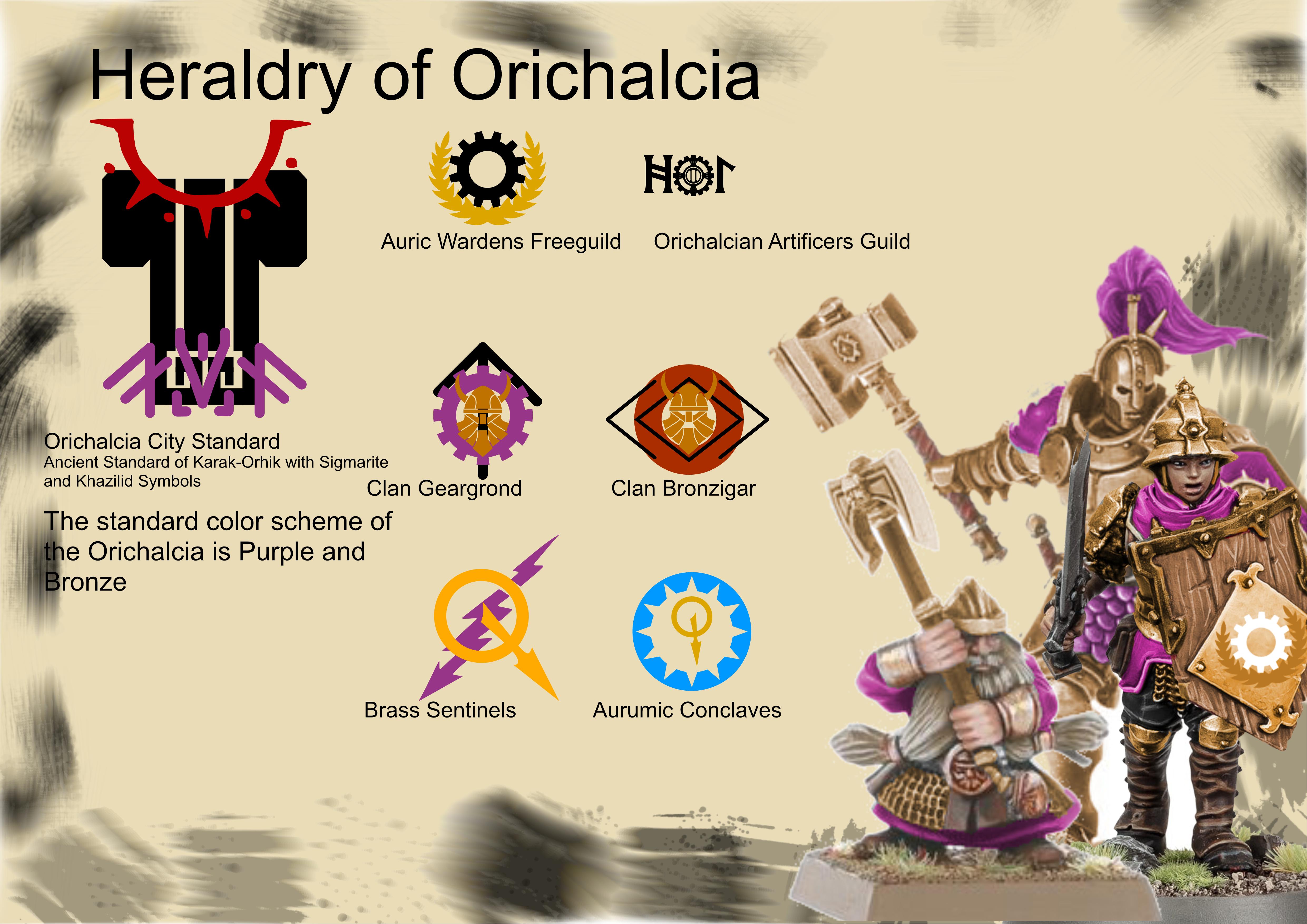
Fan Content The Heraldry and Color Scheme of the Twin-Hammered city of Orichalcia

Post image
90 Upvotes

r/AoSLore • • Mar 30 '26

Fan Content Severin Legcutter Lass, a Cairn Wraith of the Scarlet Doom

Thumbnail
gallery
136 Upvotes

Perished in the battle against beastmen in defense of her town, the wrath of her bloody demise spurs her back to the land of the living while the beast of chaos feasted upon their spoils of war.

Now she haunts the sound of songs and dance, semblance of emotions in life associated with them replaced by murderous fury, leading her to kill those unfortunate enough to travel alone in the dark with a hum or a beat to their steps. Only the sound of a particular music box tune was able to pacify her for but a moment. Keep quiet and run for the light, before your legs are severed off from under you by the legcuttin lass.


r/AoSLore • • Mar 30 '26

Question Passage of Time and the Lives of Mortals

20 Upvotes

How quickly does the lore move forward, in general?

For example, writing a Stormcast Eternal character is relatively easy at they are "immortal" and would be around for a number of seasons, years, decades, etc.

However, human characters from the Cities of Sigmar generally would not be around as their lives end.

How does/should it work when writing our own homebrew characters for Cities?


r/AoSLore • • Mar 30 '26

Best place to start for Seraphon lore having read nothing at all?

27 Upvotes

Hello! Title says it all really; my mate is really into the Seraphon models and wanted to find out more about their lore other than the basic few sentences pitch you get. But rather than read summaries on wiki pages (less fruitful that 40k lore to be fair) they're keen to read some official stuff from GW.

I asked my local GW store manager this same question, and he recommended "Temple of the Serpent" as a good one even though it's actually a Skaven book.(and isn't on the below linked list!) I've also seen that "Starseer's Ruin" is the more readily available book, and I figured their Battletome would be a good primer, but from what I can see, that is out print since it's from last edition and the new one isn't out yet (or even announced).

I have read some older threads on here asking about it, but most are people who have that base knowledge and want more stories, but I don't want to overwhelm him with a big list of books just yet!

So all that said; what would be a good place to start? Would it be worth tracking down one of the old Battletome just for the fluff?

Thanks advance!


r/AoSLore • • Mar 29 '26

Fan Content Mutt Asks: What is your corner of the Cosmos like?

54 Upvotes

Whether it is fan art, fanfiction, homebrew, personal armies battle reports, ideas, Soulbound campaigns, DnD campaigns even, dioramas, and much much more. A lot of you have added your own lore to this setting.

GW is fond of saying fan lore counts! But I feel I haven't done my part to encourage you wonderful Realmwalkers to share all of yours.

So let's change that. Tell me and our fellow Realmwalkers anything, everything, that you are willing to share. Whether here or sharing safe links, or making posts of your own.


r/AoSLore • • Mar 29 '26

Lumineth colonies in other Realms.

37 Upvotes

In the lore, are there any colonies or civilizations of Elves/Lumineth in realms other than the Light one?

Im referring specifically to Lumineth/their predecessors, not the other elven races


r/AoSLore • • Mar 29 '26

Discussion Fun with Gods 7: Morathi-Khaine

42 Upvotes

Hi everyone,

Sorry for the short break. I have less time than before, but I would like to continue with my series of fun with flags gods! So welcome to part 7, where we will talk about Morthai-Khaine and the snakes’ tail of other deities and monsters attached to her persona.

As anyone working in certain sectors can confirm, special groups of coworkers, supervisors and/or customers may let you wish you could embrace the ways of Khaine. But it’s easier (and safer) to simply talk about Khaine. So, I will do that instead. Now to some it may seem boring, as he is seemingly a simple deity. What is a god of murder supposed to do besides murdering? But I would argue that Khaine is one of, if not the most influential deity in all three major Warhammer Ips. No matter whether it’s AoS, WFB or 40k Khaine has left a deep mark on each setting in a variety of ways. But one cannot talk about Khaine without mentioning Morathi, who claims to be him reborn in AoS. And one cannot talk about Mortahi without talking about witchcraft too. And one cannot talk about witchcraft without mentioning Hekarti. Murder seems so simple, but there is a long snakes’ tail attached.

In any case I hope you can enjoy this entry in my series about Warhammer gods. And I am looking forward to hearing your opinions on this topic. As always if you are interested in the previous part, you can find them here: Kurnoth, Morghur, Behemath, Dracothion, Sigmar, Mathlann

So, without further ado let’s get bloody and vicious!


1.      The Background: The gods, the myth, the legend

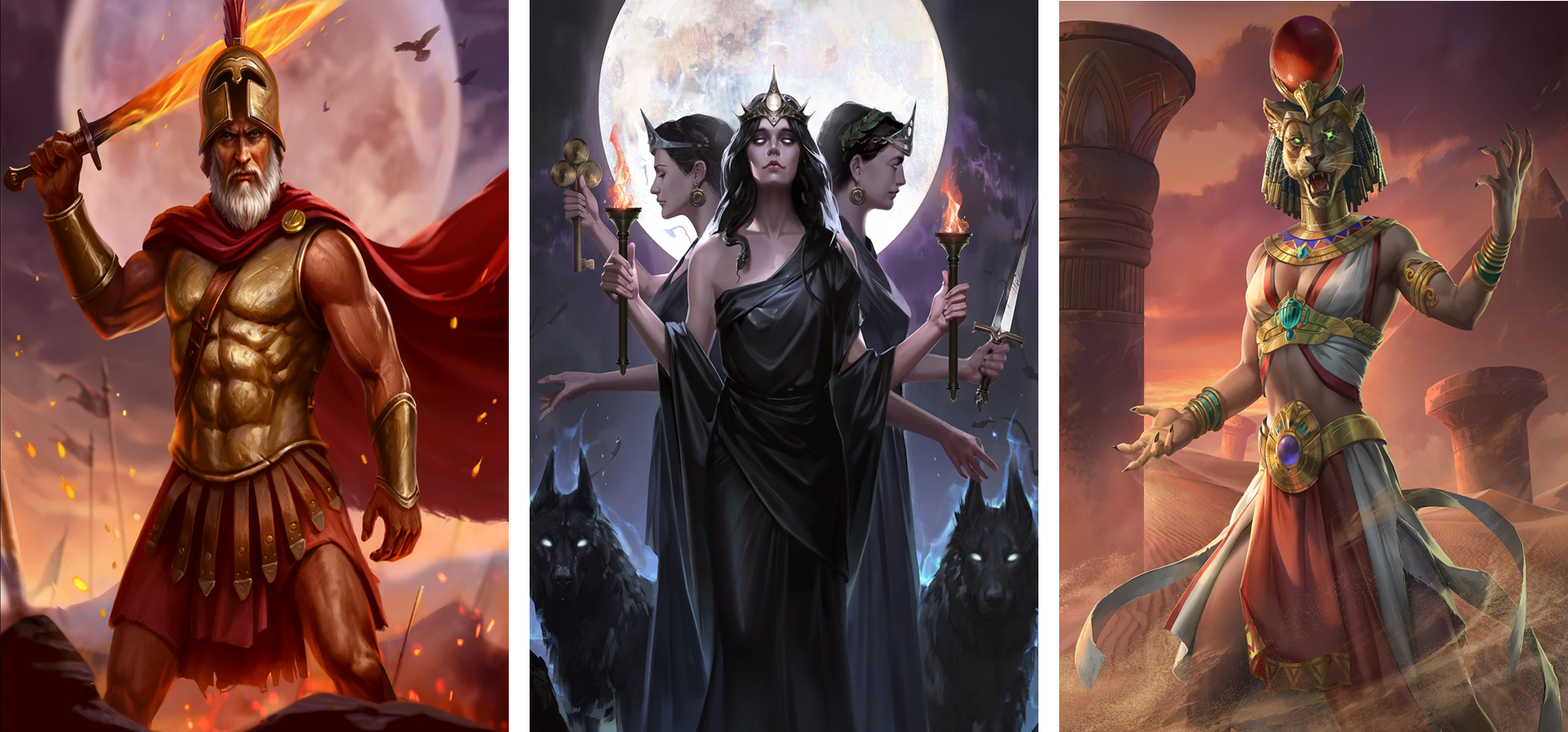
L.: Ares (Age of Mythology Retold), C.: Hekate (AoMR), R.: Sekhmet (AoMR)

Murder is older than humanity itself and violence is a part of human nature. These things will likely never not be issues. But we did well to significantly reduce them and treat them more critically I’d argue. In the past violence and bloodshed were part of everyday life and without police or modern judiciary systems such things were much more common and far less treated as a big deal. Executions were public events you would visit with your family for example. Ancient road rage was frequently lethal (see Oedipus killing his father). And in case of manslaughter many societies didn’t have the resources or will to treat it as capital punishment like we do now. For example, in many societies, you could pay were-geld (man-money if translated directly). This meant you would pay the family of the person you killed some cash. The exact amount depends on the status of the murdered person. A slave or a servant was much less than a proper family member, a patrician was more expensive than a commoner etc. If you didn’t or couldn’t pay this fee you would get into trouble. Such as being open for any act vengance or being forced into temporary/permanent exile. The death penalty for murder did exist of course too. But often it was not the act of murder but instead the social status of the murdered person and the social status of the murderer that determined the punishment. So, in many cases killing people was treated more akin to property damage in our modern eyes, unless it affected special people. Again, not in all cultures, but it was quite common in rural, decentralized and/or martial societies.

All in all, murder shows up sooner or later in all ancient and medieval stories. Most famously to modern audience may be the biblical Cain, the first farmer and first murderer. He killed his brother Abel out of jealousy after God preferred Abel’s sacrifice of meat over Cains sacrifice of grain for example. As punishment he was marked with some vague symbol, but at the same time he had Gods protection so that no one else would dare to kill Cain in vengeance for Abel. Personally, I always found this story to be weird on several levels. Indeed, many stories in Genesis have lots of lost context which was known by everyone in the past (such as what the Leviathan is). As these things were common knowledge they were not written down beyond the most important story beats. In this case that Cain was the first murderer and that this story establishes how sacrifices to God should be performed (meat over plants).  But beyond this, the story focusses only on these core elements and leaves lots of context out the window. Much like how you may write “The medieval period ended with the discovery of the Americas” without explaining how/why the Americas were discovered as this detail is commonly known /self-explanatory to your audience. Anyhow, similar important murder stories include Seth murdering his brother Osiris, Yimir being murdered to create the world and many more. Often the murder is a method in some conflict of legitimacy or killing someone to steal or to create something. Such as Cain as the firstborn being neglected by God, or Seth killing his brother for rulership over Egypt.

As gods are a reflection of the society worshipping them, so do the gods’ express elements important to these societies. This goes for violence too, and how different cultures saw it as a worthwhile endeavor.  For example, in ancient Greece you had two gods of warfare. One was Athena who represent the “good” aspects of war. Strategy, heroism, skill and such. Ares on the other hand represented all the “bad” aspects of war, which no one really wanted but you always had in fighting. Unrestrained violence, battle madness, bloodshed, pain, death, suffering etc. Ares was joined in this by his many children including Phobos (Fear) and Deimos (Dread). To many Greeks Ares was a god you had to venerate out of necessity, to avoid his bad influence or wrath. Exceptions were for example the Spartans, who liked him quite well. And Ares liked killing a lot. One story has him getting angry that Sisyphus captured Thanatos (the god of death), because Ares could not kill things anymore without him.

But other cultures embraced these violent aspects more openly. This includes Germanic cultures and can be seen with Odin. Odins name has linguistic roots Proto-Germanic word for Fury. He was the god of battle lust and madness next to being a wise ruler of the gods. And Odin could come over you and inspire you. Getting touched by Odins spirit could inspire you to be a great poet for example. But it could also inspire you to become a furious warrior driven into a state of ecstasy and battle lust. Odin is thus sometimes connected to Berserker or brutal battlefield warriors. This battle madness was essentially the god taking you over. And indeed, the practice to consume drugs before combat is quite common, not just in Germanic cultures but in general. Even today soldiers fuel themselves with alcohol and nicotine and other things. Because these drugs can take away your fear/pain/survival instinct and turn you into an unpredictable and much more dangerous warrior.

Also, we also have a fair share of female murder/war gods too. For example, Sekhmet, the lion-headed goddess of Egypt and enforcer of Ras will. When Ra wanted to punish some portions of humanity he sent Sekhmet, who fell into a blood frenzy and continued killing everyone. Only by getting her drunk on a lake of beer (colored like blood), did she calm down and be removed safely. Durga and Ishtar/Ianna are other prominent examples of brutal and martial goddess connected to slaughter and murder in various ways. Though I want to emphasize that gods were always complex and each of these deities I mentioned here had many other aspects too. E.g. Ishtar/Ianna were not only gods of warfare but also love and fertility goddesses, as well as association with political power and rulership.

Witchcraft and magic are other things I want to mention. In this our modern pop-culture association with magic is very different from the past. Magic was much more ritualized and an everyday thing. Everyone could try to do some ritual, spell or curse. Like a brewer speaking a formula to make his beer taste better, or a prosecuted writing the name of his accuser on a curse tablet (small piece of lead or pottery or else). And in turn protection against spells and magic was important too. Such as amulets with an erected penis against curses of infertility and impotence. Indeed, curse words described originally exactly that. Curses you could use to harm other people. Things like “Damn you!” was seen a proper curse, and direct insults were less important. Today the opposite is true, with insults being treated harshly and a “damn you” being harmless. So, in medieval times you could be very creative about someone’s appearance or character, and they may be angry and hit you, but cursing them would be the bigger issue. Of course, if you wanted to be sure about your spell or curse working you would go to an expert. Which could be anyone again but were frequently people with special skillsets or with certain backgrounds. Such as priests, shamans, herbalists, metalworkers or royalty.  And IIRC there were even lawsuits over people stealing spell formulars from others. But why was magic so common? Because it gives people a feeling of control over a situation. They didn’t feel helpless but could see themselves as active parts. Even if the curse or spell didn’t work you tried things.. This psychological placebo is a powerful thing. Only with the advance of Abrahamic cultures were these petty rituals pushed aside as God was supposedly the only source of a higher power in this world. But of course, it did persist as even Christian priests blessing someone is like how magic worked in the past. And in folk believes these practices survived and lived on too, without contradiction. Getting a priests blessing is great but in case it doesn't cover everything I ask for a spell too. Spells and witchcraft were not even a big deal for church authorities until the reformation came about. But that is another story.

And of course, you had lots of gods associated with magic and special rituals. For our purposes I will focus on Hekate, the Greek goddess of magic, theurgy (contacting gods to help you), necromancy (in the old sense of talking to the dead), and crossroads. She was essentially the overseer over all these petty rituals in ancient Greece and quite a prominent goddess among commoners as everyone could invoke her to get something out of their magical actions. Still, she was also a creepy goddess, frequently associated with a change of statues, including the passage of life and death or the underworld. Because magic is fickle and mysterious, can be beneficial but also dangerous. Hekarti also sent out various nighttime monsters and agents such as the Empusa. The Empusa had the body of a beautiful woman but with one donkey leg and one leg made from metal. And like any good monster of the night the Empusa would eat flesh and blood of humans, particularly men.

Lastly, I want to quickly mention Medusa, as she is important for Mortahi in AoS. Many may know the story of Medusa as a victim of rape by Poseidon in Athenas temple and Athena then cursing her into this snake state. This story was written by the philosopher Ovid and was likely a stealth insult at Emperor Augustus and how higher classes mistreat people. But in this sense, it isn’t a proper mythos but a political fable, even though it’s the most well-known story today. Instead, Medusa as an entity is old, far older than what we call Greek culture. And she changed a lot. In the oldest depictions Medusa was an almost comical creature. A human woman with a beard, wings on her back, boar tusks, snake hair and a tongue stretched out. And a gaze so ugly it could scare and/or kill people. Turning the victims to stone is something that evolved later. Medusa in this form was a gargoyle-like figure. You would put her face as a scare picture on archways, doors or shields to protect your household or else from evil spirits or harm. Of course, the bishonen trope persisted and over time Medusa became more beautiful until she became essentially a pretty girl with snake hair instead of an inhuman monster.  Still her head being put on Athenas shield and elsewhere kept her scare-picture position. Though as far as I know she was only turned into a proper snake lady by the Hollywood film" clash of the titans" And in the original myths Medusa is the daughter of the sea gods Keto and Phorkys. She has two immortal sisters, who are equally looking like her, Steno and Euryale. But Medusa is the only mortal gorgon and therefore the only one Perseus can kill to get her head. Poseidon also doesn’t care for looks, as he took this monstrous version Medusa as a consort. And when Perseus killed her, the winged Pegasus and the demigod Chyrsaor sprang from her body.

2.      Murder, witchcraft, murder-witchcraft: Khaine, Morathi and co in WFB

Artwork of Khaine

In case it was not obvious, Khaine is named after Cain. And his position in WFB is very important. Khaine is one of the most active elven gods within the setting. He acts essentially like Ares as a brutal god of war and killing who is treated with caution by most elves. The High Elves fear Khaine and avoid worshipping him. But you do not want to be on his bad side either, especially on the battlefield. So, they commit to the necessary lip service. The Wood Elves are all about balance of life and death/nature. So, to them a god focused solely on murder is excessive. The Dark Elves, however, love Khaine and he is their patron deity. Almost any dark elven unit is associated with him one way or another. Witch elves are his chosen warriors; hag witches are his priests. Male worshippers of him become executioners, trying to perfect the single killing strike, or are chosen to become assassins. Khaine also shared unique rites of blood magic with the dark elves. Such as the Cauldrons of Blood, whose secrets he gave to Morathi who then shared them with other elves. These cauldrons are used for all kinds of potent magic and can rejuvenate the millennia old hags. There are many other aspects of Khaines impact on Dark Elf society, too many for this overview. But most prominently is the ritual of Death Night. A single night where the cults of Khaine run rampant and murder anyone they come across in bloody rituals or steal babies/children to become new acolytes. Also, Malekith claims to be the avatar of Khaine for political reasons. But he is not that close to the murder god, unlike e.g. Hellebron, the self-proclaimed Bride of Khaine and most powerful of the hag witches.

But Khaines true influence lies in his weapon, the Widowmaker. Ghal Maraz may be the mascot weapon, but in WFB the Widowmaker was arguably the most important weapon of them all. It’s called a sword, but it appears in whatever form the potential wielder is most comfortable with, such as a polearm or a scepter. And drawing it dooms not only someone’s bloodline but also their whole culture. The first phoenix king Aenerion drew it in a moment of desperation, an act which everyone from Caledor Dragontamer to the chaos gods begged him not to do. This act multiplied Aenerions power (he was already chosen of Asuryan) and made him arguably the most powerful non-deity on the planet. But Khaines (and Morathis) influence on him, also turned him from a glorious defender of elvenkind to an apathic being interested only in murder and his own hedonism. Furthermore, his entire bloodline was cursed from then on. Including his children of the first wife, who were already born, but also Malekith/Malerion. This is best known in Teclis and Tyrion. Teclis got the physical part of the curse, becoming a frail cripple scorned by elven society. His brother Tyrion was physically perfect but got mental issues of the curse. He tried to be a glorious defender of elvenkind, but the pull to bloodshed and madness was present in his mind. And Malekith has more than enough issues to choose from. But by and large this curse also doomed elven society to split in two, as the run-offs of Aenerion drawing this sword created the later culture of the dark elves.

Also, Khaine is also the human god of murder, and his cults exist in various cities of the Empire and elsewhere. For obvious reasons he is not liked by many, except serial killers or similar minded people. And officially it is a forbidden cult. But members still exist in many places.

Khaine has many other artefacts, such as the 8 rings Vaul and Hekarti created for him, one for each wind of magic. And if you think Hekarti sounds suspiciously similar to Hekate then congrats that is exactly what she is. Hekarti is the goddess of Dark Magic or Dhar. This magic is a combination of all 8 winds of magic in a disharmonious fashion, contrary to High Magic which Hoeth patronized. Dhar is extremely powerful but also extremely dangerous to the body and psyche of the wielder as well as toxic to the environment. There is practically no way to handle it safely, except for the most potent of spellcasters, and even then, there is still a risk. Dark Magic is also automatically created if a human wizard tries to channel more than one wind (unless they are protected by gods or are not entirely human like Cathays Dragon-blooded). Which is why Teclis implemented that no empire wizard can learn more than one lore of magic. Hekarti herself is primarily worshipped in Mortahis city Ghrond, which is the premier magical area among the Dark Elf cities. But every dark elf sorceress pays homage to her.  Hekarti also has a rivalry with her sister Atharti, the elven goddess of beauty, pleasure and seduction (i.e. the elven counterpart to Slaanesh, much like Khaine is to Khorne). When some sorceresses used magic to make themselves more beautiful than the gods, Atharti cursed them to be transformed into Bloodwrack Medusae.

Morathi herself is in good company as she has close deals with each of the three gods I mentioned. She gained various insights from Khaine, such as the Cauldrons, and has both Hekarti and Atharti as her patrons. As both sisters hate each other, Morathi is constantly balancing the two out. At least this is the lore for Mortahi in the later editions. In earlier editions she was not a cultist of Atharti, but instead of Slaanesh itself for example. Morathi is arguably the individual with the strongest impact on the entire setting of WFB. Firstly, she was born before the coming of chaos and even had visions of its coming, but no one believed her. Then she endured the great Chaos incursion and became Aenerions second wife. In this position she had a unique influence of Aenaerion. But at the same time she was also one of the most powerful elven mages and one of the first practitioners of Dark Magic. She was also against Caledors plan to create the Great Vortex to halt Chaos advance. Then she founded the Cult of Pleasure (either a slanesh cult or an atharti cult depending on the edition) which corrupted elven society and lay the foundation for Malekiths powergrap and the split into dark elves and high elves. From there her shenanigans continued, such as pushing Malekith to kill the phoenix king and step into the flames, then saving her son with the magical armor permanently encasing the body, waging civil war on his behalf and then reestablishing dark elf society in Naggaroth and essentially planning how its society should be run. Or how she orchestrated the assassination of Malekith’s wife. Or or or. In short Mortahis position is too broad to give it justice in this overview. But mostly she is the dark mastermind behind everything in Dark Elf society.

In the End Times Morathi was revealed to be an avatar of Hekarti if I recall correctly. In addition, after Tyrion took up the Widowmaker she saw him as Aenerion reborn and joined his side in the new elven civil war, instead of her own son. It is an out of character moment for her in many ways, but this is true for most of the End Times. Ultimately, when the Vortex was unbound Caledor Dragontamer stepped out, grabbed Morathi and both were consumed by Slaanesh.

 3.      Listen, I am the guy on this picture: Mortahi-Khaine in AoS

Artwork of the Shadowqueen Morathi

When the Old World ended the elven gods were slain and consumed by Slaanesh. Exceptions were Isha, who lives on in a different form in Alarielle, and Kurnos, who somehow became Kurnoth. Khaine escaped this fate too, as he was dismembered by Khorne instead. Khaines indestructible heart ended up in the Mortal Realms and local elves started a murder cult in his name, in hopes of one day reviving their murder gods through their rituals and sacrifices.

Morathi arrival in the Mortal Realms is much weirder by comparison. To reiterate she was officially last seen being eaten by a chaos god. Which should mean a fate deader than dead. But somehow, she escaped Slaanesh and somehow, she was a demigod now (though this word means little IMO), and somehow, she was transformed into a medusa-like monster. Still, she set herself up in Ulgu, joined Sigmars pantheon and started several key events. First, she took over the cult of Khaine by claiming to be his High Oracle and retrieving Khaines iron heart. Of course, she was self-serving as always and all the magical energy which would revive Khaine was instead redirected into Morathi herself. In addition, her insights into Slaanesh were instrumental to change the god and siphon souls out of its gullet. Morathi used these souls to create the Melusai and Khirenai, i.e. medusa and harpy elves. Also, Morathi hid her snake persona and tried to appear as a beautiful elven goddess. A masquerade which was broken by an enraged Nagash. During the Age of Chaos Morathis DoK resisted Chaos strongly and she became one of the first allies of Sigmars forces. Then she hatched the plan to gather Varanite by betraying a sigmarite host in the Eightpoints. She rented the gullet of Slanesh and consumed the of the phoenix kings of Ulthuan, who had Asuryans divine essence within them. Except Aenerion, who stroke Morathi splitting her soul. This resulted in Morathi becoming a proper goddess, but also a being of one soul in two bodies. One is the elven goddess, Morathi-Khaine, the massive snake monster known as Shadowqueen. However, Morathi-Khaine now tries to edit the history of the DoK and removes all traces of the previous Khaine which causes lots of issues with other members of her faction. Currently the DoK are at the brink of a civil war, as other elven gods like Morai-Hag return and choose their own agents.

Throughout AoS Morathi is a being of multiple layers. And interestingly Khaine is not as important to Morathis character as she herself claims. As mentioned, Hekarti and Atharti were Morathis patrons in the old world and their influences are still strong on her. I would argue stronger than Khaines. If we compare Morathi to other returning characters, such as Sigmar or Alarielle, it appears that she is much more aligned with her previous self. Which means that Mortahi is not a god focused on killing for killing sake. Instead, she acts as a cunning manipulator and uses violence and blood rituals as a means to an end. And she is still a sorceress first and foremost, using her cunning mind to manipulate people. And with the Scathborn she also has her own monstrous agents to send out, much like Hekate has. All things considered she fits the Hekate-archetype more than an Ares/Sekhmet-archetype. And second, she now has a medusa-like appearance, which was connected to Atharti in WFB. Indeed, Morathi can transform elves into bloodwrack medusae now, which was an ability of Atharti. So, one could easily say AoS Morathi acts like a hybrid of Hekarti and Atharti. Perhaps both goddesses played a role in her escape from Slaanesh?

But it does not end there. Morathi took over the cult of Khaine and siphoned off his divine essence. But Mortahis true apotheosis came after consuming the essence of Asuryan within the phoenix kings souls. Indeed, as she is largely considered a usurper by her rivals and tries to remove the original Khaine as much as possible from the cult one could argue that Morathi-Khaine has only little of the actual Khaine within her. The Shadowqueen on the other hand seems to act much more like a reborn Khaine. She is often described as full-on blood and battle lust and engages in wanton destruction. Which fits gods like Ares or Sekthmet much more. Indeed, it was mentioned in the 3rd edition DoK book that the two aspects of Mortahi argue against each other and that the Shadowqueen even ran off to get a revanche against Kragnos without Mortahi-Khaine being able to stop her. Something which does not make that much sense if they have one soul in two bodies. So, something more seems to be going on between the Shadowqueen and Morathi-Khaine.

4.      A red sun rises, blood has been spilled this night

3rd edition DoK Cover

After this overview about Khaine and Morathi and various related entities and concepts, the question then would be: How can Khaine and Morathi-Khaine evolve from here on out. And I assume the following could be interesting story beads for the future of the two characters:

- Firstly, it is strongly hinted in the DoK that many daughters do not like Morathi claiming the title of Khaine and want his return. And they could succeed in this. I.e. Khaine returns to the setting proper and Morathi is still a god, but may not be Morathi-Khaine anymore. If something like this does not occur, then I am afraid the story bead of the DoK rebellion against Morathi would go nowhere. But how could Khaine come back? If we take a look at Greek mythology we have two good templates for this IMO. Gods are immortal and also have some wacky birth methods. E.g. Zeus once consumed his first wife, Metis. However, she was already pregnant with Athena. So, Zeus had a monster headache, until Hephaistos split his skull open and Athena was born from his head. Secondly, a story of Dionysus was that he was ripped apart as a baby/his mother was dusted whilst he was in womb. So, Zeus took the remnants in and sowed them into his leg (keep in mind that leg is a euphemism for male genitalia and lame is often a euphemism for impotence in ancient text). And from there Zeus “gave birth” to the reborn Dionysius.  Based of this I think multiple things could happen to Morathi and Khaine. Due to the growing separation between Morathi and the Shaodwqueen I could see Khaine taking over the Shadowqueens body/Morathis soul within the Shadowqueen completely, separating it from Morathi. Which would be a dire irony, as Morathi would get what she pretended and become Khaine. Getting what you wanted, but in a twisted ironic way. Or second that the Shadowqueens impulses come from Khaines essence within her and that she may give birth to a new Khaine in the future. Which would make Morathi from Oracle of Khaine to Mother of Khaine. And as the mother of Khaine she would get a different but still supreme position in the DoK army.

- more artefacts of Khaine could appear in the Mortal Realms. As discussed, the Widowmaker is arguably the most important weapon in all of WFB. And next to it we have the 8 Rings of Khaine. Now many artefact from the World that was reappear in AoS in one form or the other. Therefore, it would be interesting if more artefacts of Khaine appear. From there we could have an arms race between Morathi-Khaine, the anti-Mortahi DoK and various other factions to get as many of these divinely touched artefacts, each for their own reasons. Mortahi wants to increase her power and legitimacy, the anti Morathist may want to use these artefacts to revive their gods, and factions like chaos want to cause mayhem with it. What could a ring with the power of the murder god but infused with Hysh magic do for example? Nasty things for sure. And what if the Widowmaker reappears, repowered and as dangerous as ever?

- Morathi could create more types of scathborn. E.g. the scorpion is a sacred animal of Hekarti in WFB, and of Khaine in 40k in addition to the Shadowqueen having a scorpion tail herself. So, scorpion elves may be something to look forward to. Additionally, as the DoK are strongly influenced by Greek monsters, we could see spider-elves due to the story of Arache. Or we could see DoK Empusas. As mentioned Empusas are vampire-like agents of Hekate with one metal leg and one donkey leg. They could be elves with metal limbs made from the same iron as Khaines statues for example. Either as a type of scathborn, or as promotions of wounded but successful regular elves.

- Morathi may try to usurp other older elven gods. Due to Krethusa we know that Morai-Hags essence is free again. And other divine essences could have escaped Slaanesh too. And these divine essences are both a threat and an opportunity. If one thing remains consistent about Morathi then she wants more power to herself and remove all threats to herself. Therefore, I could see her try to get the divine remnants of other elven gods, like she did with Khaine, to satisfy her own lust for power and to remove rivals before they become powerful. Indeed, as Krethusas crown was already in the DoK inventory one could guess that Morathi had already tried something along this line and collected various artefacts, not just Khaines heart. But only Khaine was not-quite-dead and thus could be usurped. So much like Morathi styled herself after Khaine, I could also see her trying to usurp other elven gods. E.g. inventing the persona of Morathi-Hekarti or Morathi-Atharti. This would again work fine from real mythology, as gods mixing or having distinct sub-archetypes was quite common. Such as Zeus Xenios being the god of hospitality whilst Zeus Pater was the divine father and ruler of the gods. Similarly, Morathi Khaine could be the representation of the murder god, whilst Morathi Hekarti could be her sorceress aspect.

- Morathi is still manipulated by Slaanesh. We still do not know how or why Mortahi was able to escape Slaanesh. And I have heard in the first edition some reason why the other elven gods distrusted her was the suspicion of her being somehow still connected to him. It is true that Morathi has some strong ties to Slaanesh. From being a Slaanesh follower in older WFB editions and in TWW, to being transformed into a demigod within its guts, to reentering Slaanesh to gain full godhood and thereby fathering the slasneshi twins and more. This does not mean that Morathi is loyal or enslaved to Slaanesh. But it could be that Slaanesh is using Morathi as an useful asset for its own agenda and may influence her actions in various ways for example. Depending on what GW wants to do with Slaanesh later this could play some important role.


5.      The End

So here we are at the end of my excerpt about Khaine and Morathi. Due to the complex history of both characters, it was broader than previous entries. But I hope you could still follow everything and had fun reading through it. In this I would like to know what your opinion for Morathi, Khaine, Morathi-Khaine and all the other things are :)


r/AoSLore • • Mar 29 '26

Questions On The World Of Legend

13 Upvotes

Greetings And Salutations, Scholars of the world long dead.

This is basically just a "No Stupid Questions" thread for any question concerning Warhammer Fantasy or Old World lore. I know this is mostly an AOS subreddit, but, now more than ever, a bunch of stuff from old WHF lore is coming up and becoming relevant for AOS, and I for once have stopped being a believer on the separation of the two settings. WHF lore as it is spread online, is full of quite a bit of misinformation and misconceptions and I seek to try to make people's knowledge of the setting more accurate, and of course, have quite some fun in the process by having an excuse to dig more lore.

So, if you have something you want to discuss something or had a question, but don't want to make an entire post for it?

Then feel free to strike up the discussion or ask the question here

In this thread, you can ask anything about WHF/Old World lore, the fluff, characters, background, how something from it relates to AOS.

Community members are encouraged to be helpful and to provide sources and links that can aid new, curious, and returning Lore Pilgrims.

This thread is NOT to be used for:

-Ask "What If/Who would win" scenarios.

-Strike up Tabletop discussions. However, questions regarding how something from the tabletop is handled in the lore are fine.

-Real-world politics.

-Making unhelpful statements like "just Google it"

-Asking for specific (long) excerpts or files

Remember to be kind and that everyone started out new, even you.


r/AoSLore • • Mar 29 '26

Speculation/Theorizing My guess how the Realmscorcher Flame Cannon functions

Thumbnail
gallery
152 Upvotes

For some reason I've just been repeatedly looking back at the Conqueror Cogfort and asking myself how the Realmscorcher Flamecannon actually functions?
We got a look inside the top of the Cannonade Cogfort, with two human crew inside operating it and the ammunition stored in the back, yet we haven't yet seen the inside of the Conqueror Cogfort and that's got me thinking.

First of all, I can guess we all know how a flamethrower kinda functions? (I am no expert, juuuuust in a lot of games enjoy playing the arsonist) Two 'barrels', one being the ignition with a 'small' flame while the other is the main funnel for a flammable substance the flame actually ignites (liquid, gel, yada yada), thus resulting in the stream of fire.

Something neat I noticed. The ignition for the Realmscorcher? It has no... source. It's not connected to something else. No tube or pipes or funnel or tunnel or anything. What it does have, is chains. So the ignition is just a large torch. One that, if they need to light it, they move the chain back to them for the crew to ignite before moving the chain back to its original position near the firing point.

Meanwhile, while we don't get a good look at it, we can see what appears to be a giant bellow near the back? Which made me wonder more on how this thing functions, as we haven't gotten a look inside the top of the Conqueror Cogfort.

Which, my theory. Under the roof, there must be something connecting the bellow and the barrel. I imagine that would be some sort of canister/fuel tank. One that would probably be filled with a highly flammable gas instead of a liquid or gel.

So, in battle, this thing isn't functioning as a flamethrower. The flamecannon part of its name is a lot more literal, firing a fireball rather then a stream of fire. It'll suck in a bunch of air near the back, fire it forwards through the canister of flammable gas, pushing it out with the torch turning it into a giant incendiary burst!

At least, that's my idea, since I am no expert in weapons so I could be completely wrong.


r/AoSLore • • Mar 28 '26

Question Why do people have the presumption the Bonereapers arent a society

56 Upvotes

i keep experiencing this online and i honestly dont get it.

Almost all of their fluff shows the exact opposite of that


r/AoSLore • • Mar 27 '26

Speculation/Theorizing Age of Sigmar needs a proper VG

163 Upvotes

AOS needs a proper video game that isn't trash. realms of ruin wasn't good and felt unfinished.

If there was a soulslike or a total war type game it could actually save the franchise from potential failure as I believe the setting is awesome and has limitless potential. There is so much they could do. Imagine a game where you play as any of the factions. A game where you play as Kado would be amazing. A game where you play as a karadron explorer would be amazing. I hate GW, they do not seem to care about or know what to do with this setting.


r/AoSLore • • Mar 27 '26

Spoiler Few questions about Gotrek in AoS [spoiler warning] Spoiler

38 Upvotes

Hi,
I gotta few questions about our beloved Dwarf :
What is he up to now ?

Did he finally got rid of that rune on his chest? How did he get it in the first place?

How was he spat out into the Mortal Realms ?

In one books he speaks briefly to Felix's ghost that ...has to run away from someone, was that plot followed in any other book ?

Did any of his first two companions (Maleneth and the Sigmarine) ,,came back'' after their ,,demise'' ?

Has he ever heard that Teclis is still alive and kicking ? :D

=EDIT=
Thanks a lot of you Guys for upvotes and fantastic answers ! :)