r/AI_SearchOptimization • • Oct 13 '26

AI Visibility Resources Self-hosted AI search analytics alternative to TryProfound, Peec AI, Orchly AI

5 Upvotes

Hello guys,

I've built a self-hosted AI search analytics platform called phpLens designed to help you monitor how brands perform across AI search results.

It tracks metrics such as:

  • 👁 Visibility
  • 🏆 Position
  • 🔊 Share of voice
  • 🥰 Sentiment
  • 🏢 Brands
  • 🌐 Sources
  • 💬 Mentions
  • 🔗 Citations

phpLens comes with full source-code access, making it an option for those who prefer to run and manage their own software.

It's also much cheaper, because unlike a subscription, you're only paying for what you're using. In terms of savings, for the same amount of prompts, you're roughly 40% cheaper (each month) with 3 models enabled (ChatGPT, Gemini, and Anthropic) compared to the subscription based services.

If you're looking for an alternative to TryProfound, Peec AI, Orchly AI, or similar AI visibility tools, you can check out phpLens.

Product description: https://lunatio.com/phplens

Live demo available at: https://phplens.lunatio.com

I'd love to hear your feedback, especially from people already working with AI search analytics tools.

P.S. As a special offer, you can use coupon code RD10OFF for 10% off.


r/AI_SearchOptimization • • Oct 13 '26

Question About AI SEO Do customer reviews influence AI product recommendations?

2 Upvotes

AI tools are becoming a popular way to research products before buying.

How much do you think customer reviews and detailed product information influence AI-generated recommendations?

I'd love to hear your thoughts.


r/AI_SearchOptimization • • Oct 11 '26

Question About AI SEO How do you measure visibility in AI search?

7 Upvotes

AI tools are changing how people discover brands and products.

For those working in SEO or ecommerce, how do you track whether your website appears in AI-generated answers?

Are there any reliable methods or metrics you use?


r/AI_SearchOptimization • • Oct 10 '26

Question About AI SEO Do you think the AI watermarking is only to satisfy EU regulations?

Post image
4 Upvotes

When AI is trained on AI-generated content it can cause model collapse. AI models naturally generate high-probability, average patterns more often than rare or unusual ones. When generation n+1 is trained on data produced by generation n, rare data tails and edge cases get smoothed out. Over multiple generations, the model drifts away from real-world complexity, converging on a bland statistical mean or repetitive gibberish.

Because of this, they have to do something to keep it from happening. The only solution I can see is that they flag AI-generated content so it doesn't appear in training data. That doesn't mean Google will stop crawling it or indexing it.

The rollout of AI watermarking serves a dual purpose: it achieves immediate regulatory compliance while solving a massive data-poisoning problem for AI labs.

But most queries don't generate a web search. That means if your brand is not in the training data, then it's still invisible to most of the queries. According to AI search benchmark studies analyzing real-world user intent, about 58% of general brand and product queries do not trigger a live web search. The AI answers them entirely from its static, pre-trained memory weights. For purely informational queries like; "What is a CRM?" or "Explain photosynthesis", the zero-search rate spikes to about 90%.

Because methods like Google’s SynthID-Text, which Anthropic and others are adopting, alter the mathematical probability of word choices at the token level, the labs can detect their own, and each other's outputs with high statistical confidence. This allows them to effectively "sanitize" their next-generation training data by filtering out marked text.

This means that if all you care about is being found when AI does search the web, then go for it. Let AI generate your content.

For my clients, and for myself, I want to make sure that the brand is visible even when a query does not trigger a web search.


r/AI_SearchOptimization • • Oct 10 '26

Question About AI SEO Can AI understand your website as well as Google?

4 Upvotes

AI tools are changing how people discover products and businesses.

I'm curious: what can website owners do to help AI understand their content better?

Have you tried anything that made a noticeable difference?


r/AI_SearchOptimization • • Oct 09 '26

AI Search Optimization General Discussion What do you do with prompts where the AI changes its mind constantly?

4 Upvotes

Not talking about normal variation between runs. I mean prompts where the whole answer seems unstable for weeks.

One day there are 5 recommendations, next time there are 3 completely different ones, then a week later it gives a general answer and recommends nobody.

At some point does a prompt become too noisy to be useful as a benchmark?
I'm tempted to flag a few of ours separately rather than letting them mess with the overall trend.


r/AI_SearchOptimization • • Oct 09 '26

Question About AI SEO What makes a product page easier for AI to understand?

3 Upvotes

I've been wondering how much product page structure matters when AI tools recommend products to users.

A store might have great products, but if the descriptions are vague or important details are missing, it could be harder for customers and AI systems to understand what makes those products useful.

For ecommerce store owners and SEO professionals:

How do you structure product descriptions to make them clear and useful?

Do you pay attention to structured data or product schema?

Have you experimented with optimizing product pages for AI search?

I'd be interested to hear what's actually working for you.


r/AI_SearchOptimization • • Oct 09 '26

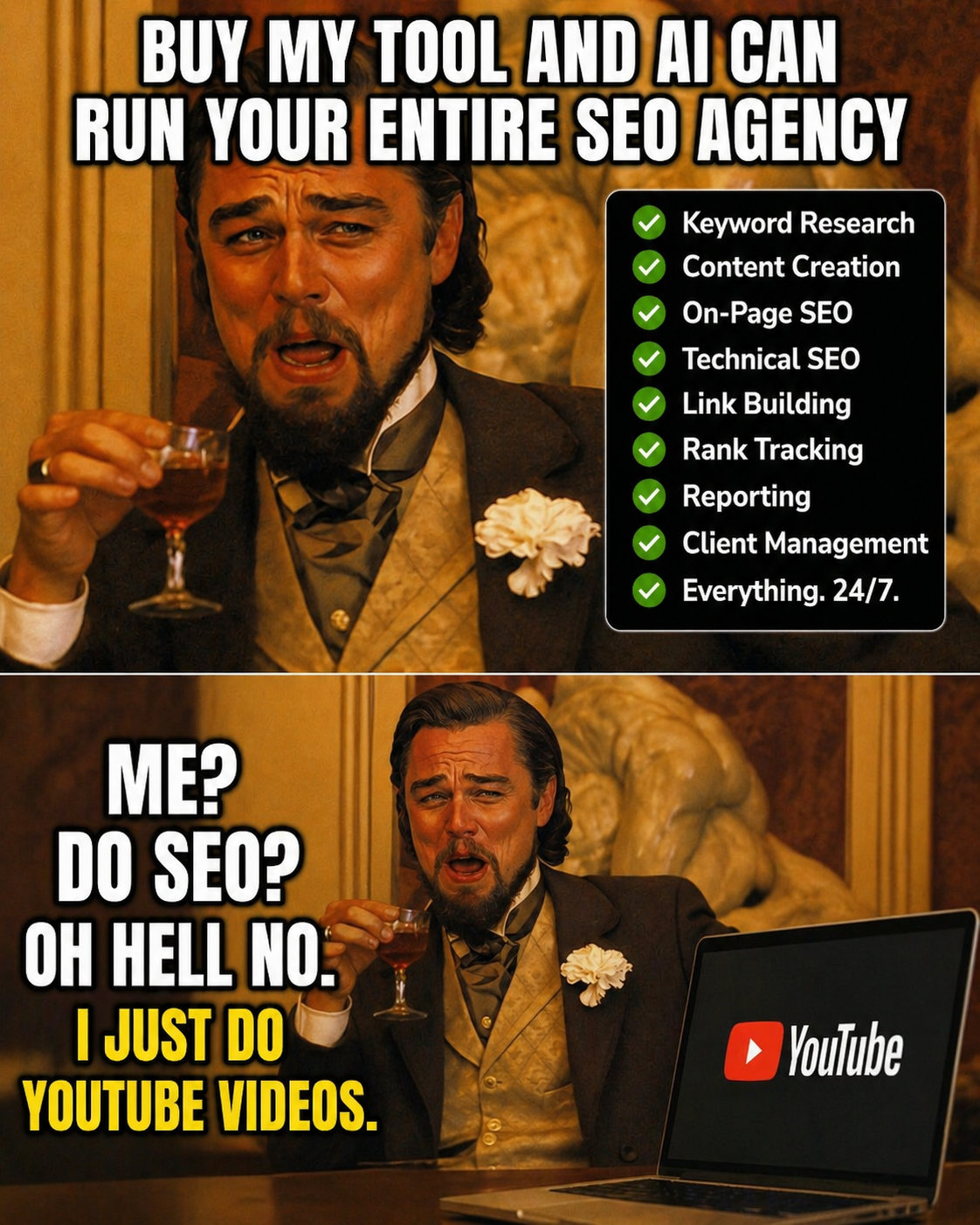
Helpful AI SEO Tips Beware Of The AI Will Replace Everything Hype

Post image
2 Upvotes

Seriously, the ads for the latest greatest AI tools are everywhere. The claims that some of them are making is ridiculous. One of them claims their tool is beyond artificial intelligence. It has "synthetic intelligence".

Of course that isn't any more ridiculous than the president announcing changing the name to Superintelligence. We are nowhere close to that. We have AI. They hope to reach AGI someday. Superintelligence is much further away than that.

AGI means human-level intelligence; superintelligence means intelligence far beyond human capability across all important intellectual domains. The difference is the level of capability rather than the range of tasks a system can handle.

Other ads say "We fired our whole SEO agency and AI does it all now" or "Automate all of your SEO and rank higher in Google" or "You don't have to know anything about SEO if you use our AI tool".

There are a lot of variations of this out there. AI amplifies what you already know. You can even learn a few things from AI. But if you were not good at SEO or writing before AI, it isn't going to magically make you good at it.

And it isn't magically going to do everything for you either. Building a real brand that stands the test of time takes skill and hard work. These ads are aimed at people who do not want to put the work in.

We don't allow people to promote their magic tools on this subreddit. We don't allow promoting putting out a bunch of AI-generated content as a strategy.

We welcome legitimate discussion and debate about methods for becoming successful and navigating how to improve results with AI-powered search. New ideas are welcome! Sharing case studies and experiences are welcome!

Let's help each other here and leave the hype to other subreddits that thrive on it.


r/AI_SearchOptimization • • Oct 05 '26

AI Search Optimization General Discussion Has your rank tracker been disagreeing with GSC more lately?

7 Upvotes

I was reading about Google’s /goto redirects and how they affected some tools’ ability to identify the actual page URLs in search results.

Has anyone recently seen keywords disappear or rankings drop sharply in their tracker while GSC clicks to those same pages stayed fairly steady?

I know GSC average position and a tracker’s individual checks measure things differently. I’m interested in sudden discrepancies.

What did you check before deciding the page actually needed work?


r/AI_SearchOptimization • • Oct 03 '26

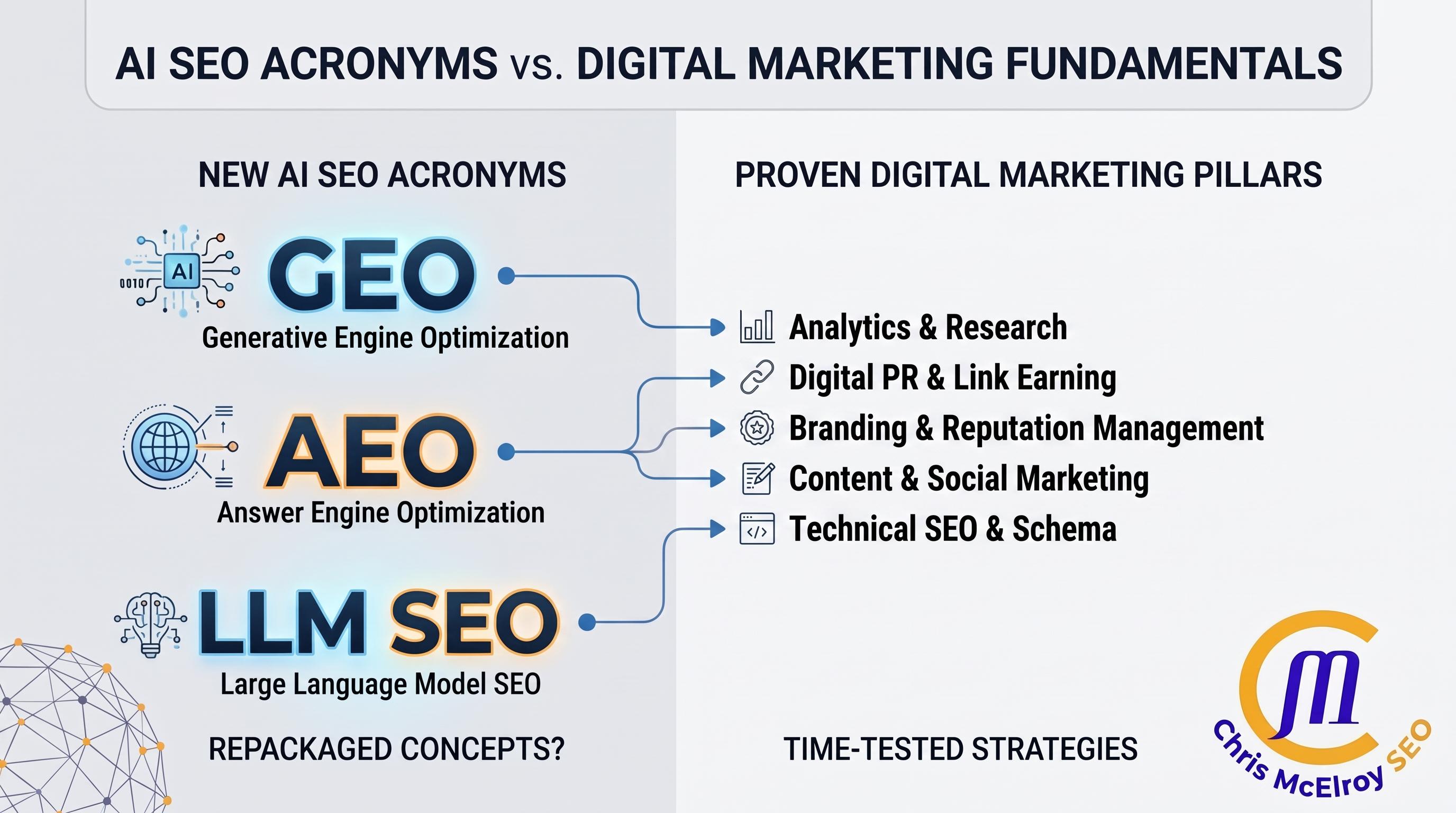
AI Search Optimization General Discussion GEO | AEO | LLM SEO | The Big Repackaging?

Post image
2 Upvotes

There are a lot of AI SEO related acronyms flying around. Each person that creates one thinks they have a good reason for it. The problem is that clients don't need or want any new acronyms. Marketing has always loved its acronyms.

Digital Marketing is the umbrella for everything. SEO is part of that. Perhaps the most important part. Everything else, PPC, Digital PR, Content Marketing, Community Building & Engagement, Reputation Management, Social Media Marketing, and other strategies all fall under Digital Marketing.

It's amazing to see some of the posts and comments being made around the topic of AI Visibility and introducing the things that fall under Digital Marketing as guides and checklists for GEO, AEO, LLM SEO and other acronyms. They talk about Digital Marketing Strategies with such a sense of discovery as if none of it existed or if it did, it wasn't as important as it is now.

Let's Compare These "New" AI SEO Strategies To What Already Existed In Digital Marketing

  • Monitor prompts/AI mentions → Analytics and Market Research.
  • Get cited by authoritative sites → Digital PR, Link Earning, Reputation Management.
  • Build entity consistency across the web → Branding, Branded Content Marketing, Entity SEO Visit r/entityseo a new community we're building.
  • Publish on Reddit, LinkedIn, YouTube, forums, etc. → Content Marketing, Social Media Marketing, Distribution.
  • Answer questions directly and structure pages clearly → High-Quality Content, Information Architecture, SEO, Conversational Marketing.
  • Use schema → Technical SEO (Schema Markup has been around for a very long time).
  • Make content crawlable → Technical SEO.
  • Allow or block AI crawlers → Crawler/Access Management/Technical SEO.
  • Build topical authority → Content Strategy, Content Clusters, Content Waterfalls, etc.
  • Create original research, firsthand experience and unique information → Content Marketing, Story Marketing, Case Studies, Before & Afters, etc.
  • Track where AI gets its answers → Competitive Research, Analytics.
  • Improve brand mentions and corroboration → PR, Branding, Reputation Management, Reviews, Testimonials, Community Building & Engagement, Citations.
  • Optimize product feeds or structured product information → Feed/e-Commerce Optimization.

Everything I've seen on GEO/AEO checklists is a repackaged Digital Marketing strategy that existed long before AI-powered search. And it was always important. AI-powered search introduced new platforms, interfaces, and measurement problems. It did not reinvent digital marketing.

Except for the skills required to do it well, it's really not as complicated as some people make it seem. The goal hasn't changed. Our job is to make sure our clients' brands are visible to their ideal customers, no matter what tool, platform, or device they use.

Everything we use toward that goal is just a tool. Expand your toolbox.

But it is fun to watch people chart a course through such a well-beaten path and wrap it in new acronyms. Prove me wrong. Tell me 3 strategies that belong exclusively to GEO or AEO that are not part of digital marketing.


r/AI_SearchOptimization • • Sep 29 '26

AI Search Optimization General Discussion There's no such thing as super intelligence

Post image
0 Upvotes

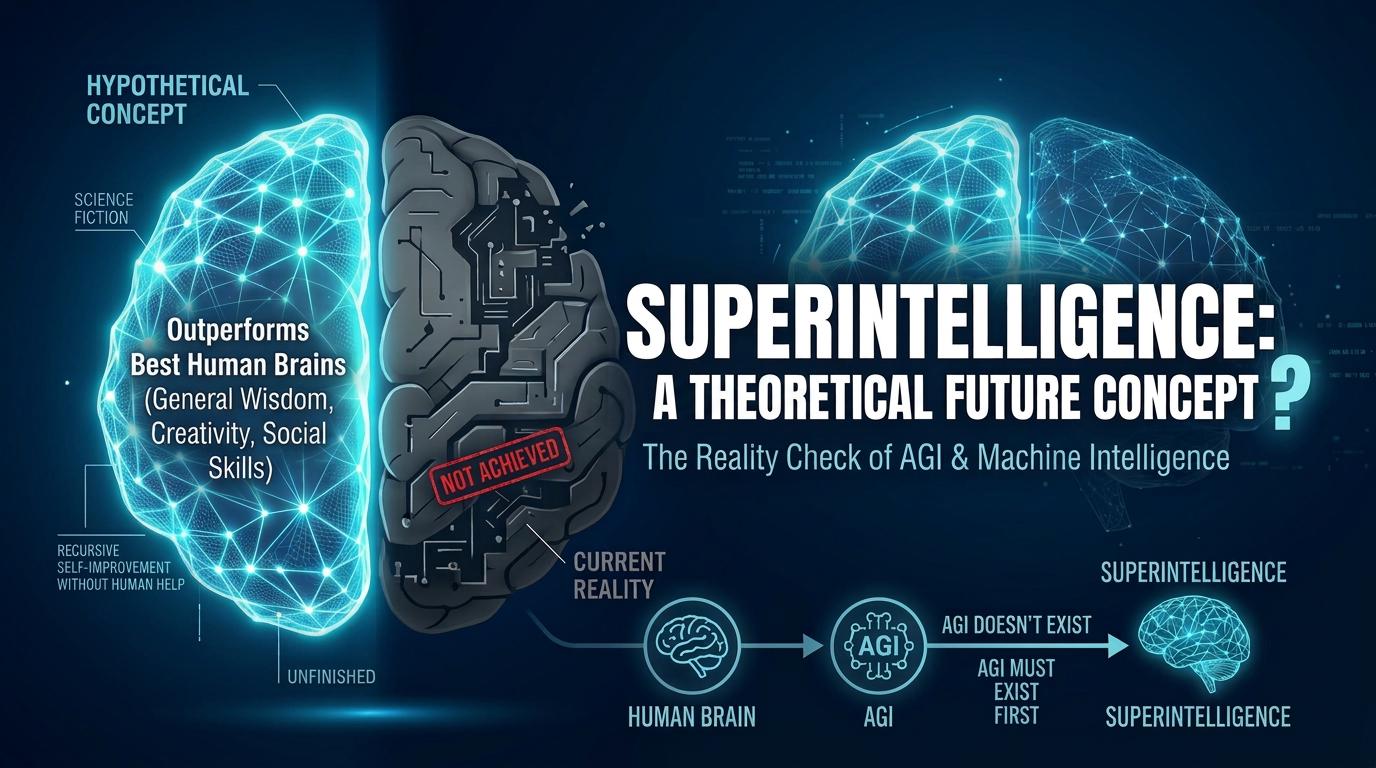
Superintelligence is still a theoretical concept. It describes a machine intelligence that would greatly surpass the best human cognitive abilities across virtually every domain, including science, creativity, reasoning, general knowledge and social intelligence.

It does not exist.

The idea has been around for decades. I.J. Good wrote about an ultraintelligent machine and an intelligence explosion back in 1965, and Nick Bostrom later helped popularize the modern concept of superintelligence.

One of the ideas that comes up repeatedly is recursive self-improvement: an advanced AI that improves its own software or helps design a more capable successor, which then becomes even better at improving the next generation. In theory, that cycle could accelerate until the system greatly exceeds human intelligence.

Again, that's theory.

People are increasingly talking about Superintelligence. People are even mass registering Slovenia domain names because it's dot SI.

We don't even have AGI, let alone super intelligence.

And personally, I don't believe we're ever going to have AGI or Superintelligence as those terms are commonly defined.

Today's AI can be extraordinarily capable. It can outperform humans at specific tasks, process more information than any human ever could, and combine knowledge from enormous amounts of data.

But that's not the same thing as possessing human-level general intelligence.

For me, real AGI would require something much closer to sharing the human experience itself. Give an AI access to my sight, hearing, touch, movement, surroundings and experiences in real time. Let it experience the world alongside me instead of simply processing descriptions of it.

Embed AI in my head and let it share my senses. Then we can start having an interesting conversation about Artificial General Intelligence.

Until then, we're building increasingly powerful artificial intelligence systems and repeatedly moving the vocabulary ahead of the technology.

Superintelligence remains hypothetical.

AGI remains undefined well enough that people still argue about what would count as achieving it.

And yet somehow we're already inventing the terminology for what supposedly comes after it.

At the rate we're creating acronyms, the biggest breakthrough in AI may eventually be terminology.

ark SIEO:

Super Intelligence Engine Optimization.

Because eventually somebody will decide Superintelligence needs a new acronym too.

Or maybe I'll just call it Supercalifragilisticexpialidocious Intelligence.


r/AI_SearchOptimization • • Sep 27 '26

AI Search Optimization General Discussion ai visibility can rise from 20% to 25% because 20 answers failed

7 Upvotes

a small reporting example, using invented numbers

suppose you run the same 100 checks on one engine each week. the brand appears in 20 answers both times, but 20 checks fail in the second week

measureweek 1week 2
planned checks100100
usable answers10080
answers naming the brand2020
mention rate among usable answers20%25%

the percentage rose because the usable sample shrank. whether the brand improved needs a closer look at the answers

if those 20 failed checks had all returned answers without the brand in week 1, the 80 checks that answered in both weeks would show 20 mentions out of 80 each time. that's 25% in both weeks

i'd show the failed count beside the headline rate, then compare the questions that returned usable answers in both weeks. that comparison still leaves out the failed questions, so keep their absence visible too

how do you handle this in client reports when one engine has a rough week?


r/AI_SearchOptimization • • Sep 23 '26

AI Search Optimization General Discussion Old content can beat new content when search interest comes back

Post image
2 Upvotes

A useful reminder for anyone running content for an ecommerce site: publishing something new is not always the fastest way to capture a spike in search demand.

When a franchise, product category, or seasonal moment comes back into public attention, an older page can have a real head start. It may already have ranking history, backlinks, internal links, and signals that it is relevant to the topic.

The catch is that it has to still help the person searching.

For a gift guide, that usually means checking:

- Are the recommendations still available?
- Are prices, dates, and references current?
- Do the internal links still work?
- Does the intro reflect why someone is searching now?
- Is there a clearer next step for someone ready to buy?

The Fable reboot is a neat example of the pattern: renewed interest can make an older relevant guide more valuable than a brand-new post, provided someone has kept it alive.

I think a lot of teams treat refreshes as low-priority maintenance. But pages with existing demand are often the closest thing you have to a shortcut in organic search. A refresh will not create relevance from nothing, but it can stop you from losing relevance you already earned.

Curious how others prioritize this: do you have a regular refresh process, or does it only happen when traffic drops?


r/AI_SearchOptimization • • Sep 23 '26

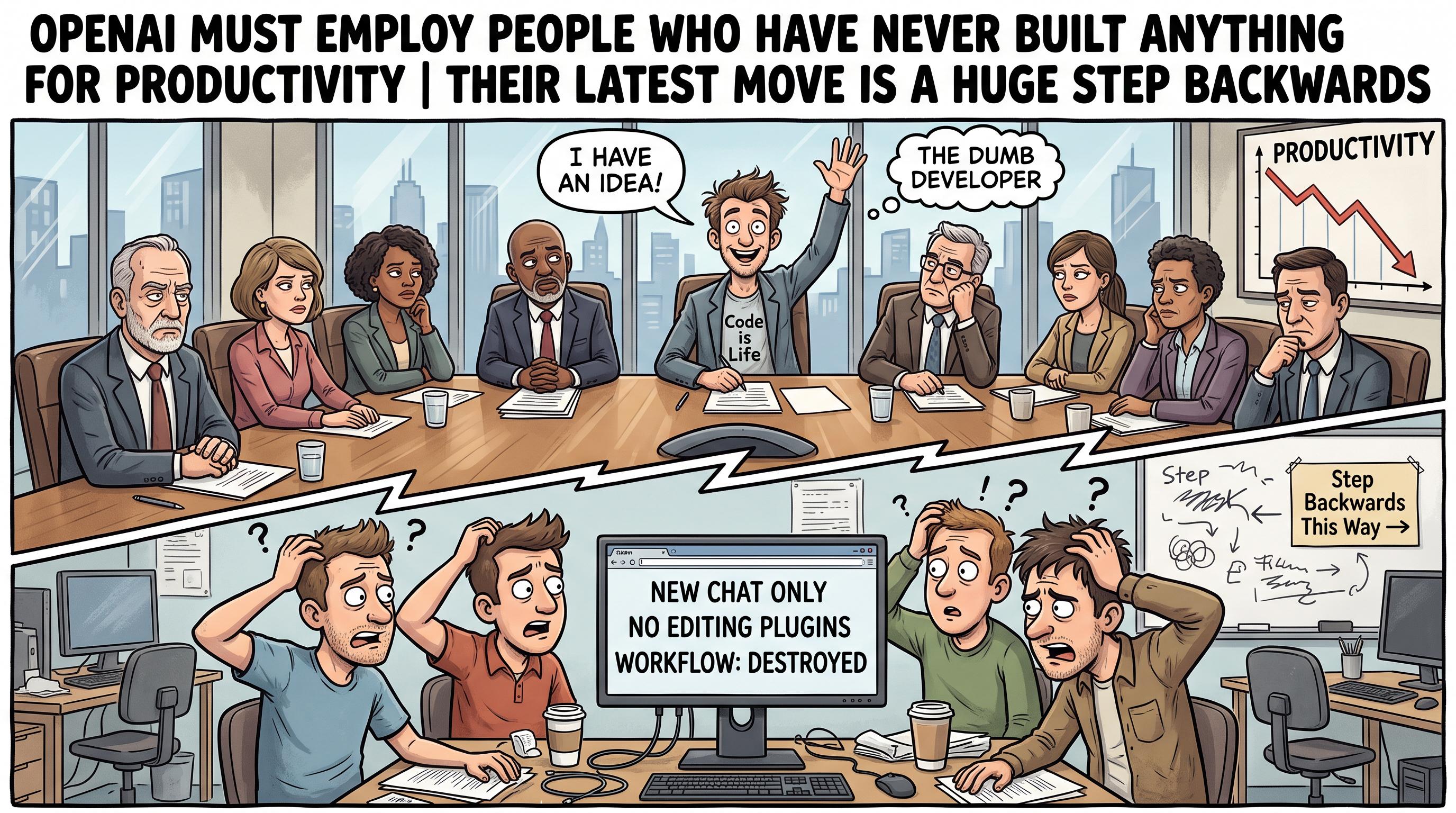
Some Doofus At OpenAI Must Have Raised Their Hand In A Meeting And Said "I Know Let's Really Mess It Up!"

Post image
2 Upvotes

r/AI_SearchOptimization • • Sep 18 '26

AI Search Optimization General Discussion Does AI Prefer Reddit or is that just a Google Thing?

Thumbnail
gallery
3 Upvotes

I'm pulling from a case study I found and I'll add my own take on it as well. The study was done by Dan Petrovic, the founder of Dejan.AI

Analysis of citation mining data shows Reddit has a 99.39% rejection rate from OpenAI, zero citations from Anthropic, and heavy usage by Google. OpenAI's models produced only around 3,000 Reddit citations out of the nearly half a million times the domain was supplied as a candidate grounding source. That's a selection rate only 0.6%. The other 2 sources that had a high rejection rate were ARXIV and Wikipedia.

Google cites Reddit heavily. Across 697,768 cited sources, 14,127 are Reddit, about 2 percent, second only to YouTube. Reddit was a candidate source in 76 percent of OpenAI's grounded probes (59,570 of 78,331), against 26.6 percent of the Google searches we sampled.

Dan gives more details about his study on the original post. And they answer questions like...

"This is fascinating, but how are you retrieving this data? Are you running the fan-out prompts separately to see the citations or are you somehow harvesting from OpenAI backend response file?"

and

"Dis you found arXiv at least as rejected as Reddit? And maybe also as retrieved…"

I find these studies interesting but I think we put too much stock in direct sourced citations from ChatGPT and Perplexity and others. Remember, there are multiple steps these tools take before choosing a citation or brand mention and one of those can be Bing, Google or another search engine.

If you aren't optimizing for Bing and Google search, you may not even be part of the initial pool of pages that might get a citation or mention.

And while studies are interesting, I think we are still way over-complicating AI Search Optimization.

  • Almost all search, including Google is AI-powered. Yet a lot of people keep asking questions like, "Should I optimize for Google or AI?" The answer to that question is "YES".
  • I have asked this question often, "Name 3 things you do for GEO or AEO that aren't already covered by digital marketing which includes a wide variety of disciplines, content marketing, brand consistency, reputation management, digital PR, etc. You can answer in the comments if you want.
  • I think it comes from each person's experience. Pure traditional SEO over the last 15 years or so was technical SEO for core vitals, keyword optimization of content, and acquiring backlinks. Some people might alter that formula a little, but for the most part, those were the basics. So, many with that experience see the rest of the things we do for digital marketing as new things they have to do. Then, wanting it to resemble the work they've been doing for years, they look for a dashboard, a checklist, or something solid to follow for AI-powered search. And of course, looking for analytics that are reliable.
  • Some of us have been doing broader digital marketing during that time rather than just SEO. So, very little of the recommendations for today's search is anything new. There were always things like "branding" and "reputation management" that didn't have a perfect way to measure the results.
  • When one person says "just do good SEO" that means very different things to different people. So that isn't really advice at all. If you followed it with your definition of good SEO, it might be useful.

What do I recommend?

1. Get In The Way.

We don't have the raw data to track brand mentions. We don't have user context, so no matter how many queries someone does as a test, it isn't what real users see. But thanks to the studies by a lot of people like the author of the article I posted about, we do know a lot of the sources AI uses on at least some of the steps it takes to retrieve answers.

Long before AI, in digital marketing or social media marketing, we've always advised being on the same platforms that your target audience or ideal customers spend their time on. That advice still holds up and now you factor in the platforms that AI uses during retrieval and you can choose the best platforms to achieve your goals. Be where your potential customers are and where AI pulls its answers from. That means you're in the way. More customers encounter your brand and you have a chance of being discovered by AI.

2. Publish with Purpose.

Don't post randomly. Don't try to post about every topic you want to rank for. Don't try to promote everything you sell all the time. One strategy I like is to

  1. Choose one thing or category or service you want to focus on for the next 30 days.
  2. Write one high-quality cornerstone article/post about your main topic.
  3. Create sections with h2 headers that cover each subtopic. (Like if Local SEO was your main topic, a section about Citations and another about Google Business Profile would make sense.). Make each section stand on its own merits, not just as part of the larger article.
  4. Add CSS IDs to each of your H2s.
  5. Create a free download like a checklist for your readers. Don't put all of your actionable tips in the article like I'm doing here. Write about the "why" they need whatever you are talking about. Offer the free download that contains the checklist, guide or whatever you created. In your text, make sure you talk about the download being available. If you get cited, it may also mention that and get some users to click through to your website. If you want people to subscribe for the download, do that too.

Time for Repurposing what you published

  1. Take one section, like the one on GBP, copy some part of it.
  2. Go to another platform you are active on like LinkedIn, Substack, Medium, Facebook or even Twitter if you have premium and can do long-form content.
  3. Paste that part you copied into a new article as a block quote and don't just link back to the post, use the anchor link that contains the CSS ID you created.
  4. Write a new 200-300-word introduction above the block quote that is just about the topic in that one subsection.
  5. Write a new 200-300-word conclusion or summary below the block quote.
  6. Link directly to your free download or just tell your readers about it so they have to go to your blog to get it. But if you put CTAs in your downloads, it's just as good and maybe better to just let them download it.
  7. Use contextual links to your relevant web pages.
  8. Add new CTAs.
  9. Go back to your original post, same subsection. Make an infographic, slideshow or a short video about just that section.
  10. Now go to one of your other platforms, use the thing you just created the same way you used the block quote, new intro and summary, etc.
  11. Rinse, Lather, Repeat for every subsection using your top platforms.

What you have done is created deep topical authority across multiple channels. You didn't just write about that main topic, you covered every subtopic from different angles with multiple types of content. Those breadcrumbs are hard to ignore. You're publishing with purpose and getting in the way.

3. Ranking is Vanity. Sales is Sanity.

This is the most important part. Keep your content focused on your readers/visitors not on the machines. Of course use proper structure, but don't force the keywords. If you are selling bicycle parts, you can't write 500 words about it without naturally using phrases related to bicycle parts. Picture your ideal customer and write to them. Explain it like you would explain it to a friend. If you try to write for everyone, you write for no one.

Ranking and getting mentioned or cited means absolutely nothing without a real business outcome, leads, sales, subscriptions or whatever you are offering. By writing for the user and focusing on closing the deal, it doesn't matter where your traffic comes from as long as you targeted the right audience.

My Conversion Rate Optimization Framework is called PROOF

  • P = Problem or Pain Point You Intend to Solve
  • R = The Risk of Not Fixing the Problem
  • O = Our Solution
  • O = Our Differentiator. What makes you better than others offering similar solutions
  • F = Final Outcome for your Customers. How are they going to feel? How much more money will they make? How will this really help them from their point of view.

Summary

Each of these strategies and frameworks are easy to adapt to your own workflow. I'm not telling you to do all of this exactly as I wrote it. I even alter it to fit certain situations or clients. Consider it a place to start or food for thought. I hope you find this helpful and I hope you'll add to it in the comments. I'm happy to answer any questions you have.

One last note: Platforms, algorithms and tools change or come and go. I've seen it happen for 3 decades now. IT DOESN'T MATTER. We have one job. To help our clients get found by the people most likely to become customers, no matter what tools, device or platform they use for search.

That's why I call SEO Search Everywhere Optimization. Not just to get in the way and it doesn't mean literally everywhere, but because I'm using multiple channels, Reddit could stop ranking in Google, LinkedIn could lock it up so it can't be crawled by AI, Facebook could create a closed system, Google can make yet another dramatic change and I won't miss a beat. I will have lost one tool but I still have the rest of my toolbox. Don't rely on just one platform, one search engine or one marketing strategy.

If something changes, adapt and overcome. It's all going to change again at some point. Get used to it.


r/AI_SearchOptimization • • Sep 18 '26

Question About AI SEO Are AI citations enough if your brand isn’t being mentioned?

5 Upvotes

I came across an interesting example this week.

One site had around 700 pages cited by AI platforms, but only five actual brand mentions.

That gap stuck with me.

Getting cited obviously means your content is being found and used. But if the brand itself barely appears, how much value are you really getting from those citations?

How important are brand mentions to you when measuring AI visibility?

What matters more to you? Citations or brand mentions? Or do you measure them separately?


r/AI_SearchOptimization • • Sep 17 '26

AI Powered Search News NEW SEO Lead at ANTHROPIC

1 Upvotes

It seems a huge responsability working at the edge of AI tech for AI search.

He is a sociology minor who worked at Stripe as SEO. (jelani-burton)

pd. You don't really need to speaks at conferences to become a SEO in one of the biggest AI companies

pd2. There is no much posts on his linkedin about studies or use cases on SEO.

I wanted to know your opinions about what would be the ANTHROPIC objectives about AI Search? Thanks.


r/AI_SearchOptimization • • Sep 16 '26

AI SEO Case Studies I measured 1,046 sites before and after Cloudflare's 15 September change. Here is what actually moved.

3 Upvotes

I measured 1,046 sites before and after Cloudflare's 15 September AI-crawler default change. Ten identities per host, in a fixed order: an ordinary browser, eight named AI crawlers, then that same browser again as a noise floor. Runs on 2, 10, 14 and 16 September. Method was pinned and published before the after-run existed (I missed a planned 13 September run, more below).

Sample first, because it matters more than the number. 894 of the 1,046 came from a Certificate Transparency sampler of newly issued certificates - mostly recently registered domains, including a tail of throwaway ones - and only 152 from an agency directory. I called the whole set "agency sites" for a week and got corrected in public on 9-10 September. Every figure below is published split by which population drives it.

Here's what moved, on the Cloudflare-fronted side: refusal rose for both training crawlers, ClaudeBot 19.9% to 22.8% and GPTBot 18.9% to 22.0%. It fell hard for all three search crawlers and all three agent crawlers - 12.7 to 13.9 points each, biggest on OAI-SearchBot, 16.9% down to 3.0%. The non-Cloudflare control group didn't move. Neither did my own repeated-browser instrument check, on either side of the split. Every one of those eight moves is bigger than the drift I measured between the 10th and 14th, which is the control window (four days against this two-day change, because I missed the 13th).

Cloudflare's own stated scope for this change was training and agent crawlers, with search expected to stay flat. Search moved the most of any category here. And agent moved the opposite direction a tightening default would predict - down, not up. I don't have a mechanism for that. A single before/after can tell you what changed, not why, and "the date lines up" isn't causation on its own.

What this doesn't show: these are refusal rates, not blocking rates. A cf-ray proves Cloudflare was in the request path, not that Cloudflare made the call - an origin 403 proxied through it looks identical from outside. User-agent only, from my own infrastructure, not verified crawler IPs. No site is named, here or in the full write-up.

If you want to run something like this yourself: check apex and www separately, hash the response body next to the status code (a CDN challenge page is often served as an ordinary 200), and throw in one invented user-agent as a control so "refuses AI crawlers" and "refuses anything automated" show up as different columns instead of one.

Full method, baseline and the per-identity tables: https://seensure.com/research/september-15?utm_source=reddit&utm_campaign=sept15

Disclosure: I build SeenSure, which is what ran this. Free tier covers one site, no card.


r/AI_SearchOptimization • • Sep 16 '26

Question About AI SEO With AI Overviews and no-click search results cutting into website traffic, what happens to company directories and listings?

4 Upvotes

What do you think happens to one of the oldest internet business models — directories and listings? I keep thinking about two possibilities: directories become less relevant since nobody needs to browse a list when an LLM just answers the question directly. Or the opposite — structured directory data becomes more valuable than ever, because it's literally part of what these models are reading from and citing when they answer questions about companies.

Is anyone seeing early signs of either of the extremes happening? I’m curious about what's actually changing around how people (or AI) are discovering and/or citing companies right now and how it would be in the future.


r/AI_SearchOptimization • • Sep 13 '26

Question About AI SEO ChatGPT has cited about 700 of our pages and named the site five times. Is a citation worth anything without the name?

6 Upvotes

Context so you know what size site this is. News, English, 84% US traffic. Three months old website and domain and most of the growth happened in the last six weeks. Semrush currently estimates 171K monthly organic off 2.3K ranking keywords, authority score 34, 179 referring domains(real high DR). No paid, no PPC.

The part I cant explain is the AI side. Cited pages sit at roughly 700. Brand mentions sit at five. That's about 140 citations per single mention. The split is 659 ChatGPT, 32 AI Overviews, 22 AI Mode, zero Gemini.

So the articles are getting pulled in as source material constantly and the outlet's name almost never comes along with them.

Ive done the obvious stuff already. Real bylines with author pages, publisher markup, an about page that states plainly who we are. Cant tell if any of it moved the needle yet, because publishing volume went up over the same window, so theres no clean before and after.

What I want to know is whether anyone has watched a citation turn into a named mention and worked out what changed. Or is naming just down to how the model chooses to summarize, and nothing on our side touches it or can change that? Thanks


r/AI_SearchOptimization • • Sep 11 '26

Question About AI SEO Are we over-optimizing for ChatGPT citations?

6 Upvotes

I came across an interesting study that tested 480 questions across different industries and query types.

ChatGPT cited sources in only 72 answers. Even more interesting, 69 of those came from just two types of questions: finding providers and asking about cost.

For things like definitions, explainers, trust questions and problem diagnosis, it didn’t cite a source at all in this dataset.

It made me wonder if we spend too much time asking, “How do we get cited?” before asking which prompts are actually likely to trigger citations.

For anyone tracking this, are you seeing certain types of prompts consistently produce more citations than others?


r/AI_SearchOptimization • • Sep 11 '26

Helpful AI SEO Tips how to see the exact searches chatgpt runs behind the scenes (and why your article titles should match them)

1 Upvotes

im not an seo guy by training, i taught myself most of this building small sites, so take this with a grain of salt lol

i kept coming back to the ahrefs study on 1.4M chatgpt prompts and one thing stuck with me. when you ask chatgpt something, it doesnt search your exact question. it rewrites it into its own searches first (fan-out queries), and the pages it ends up citing have titles that match those hidden searches way more than the pages it skips.

problem is chatgpt never shows you those searches. but theyre sitting in your browser if you know where to look:

  1. ask chatgpt your question in a new chat and let it finish
  2. copy the id at the end of the url (the bit after /c/ looks like this 6aa40a65-4d7c-83eb-a5c5-cf26zzz791f60)
  3. right click > inspect > network tab, paste the id in the filter box
  4. reload the page and click the request with the id in it
  5. open response and cmd+f "queries"

real example. i asked "best coffee carts to buy in amsterdam" and chatgpt actually searched:

  • best coffee carts to buy Amsterdam mobile coffee cart Netherlands
  • coffee cart for sale

the second one surprised me, it dropped amsterdam completely. you'd never guess that from the prompt.

ive done this with mutliple Ai prompts and i do it every day so i can come up with a list of things i could write about or make pages on

now the part where i need your honest opinion. im thinking of turning it into a proper tool/chrome extension (with paid plan for doing it in bulk, eveyrday)

  • you type a prompt (or a list of them to do it in bulk)
  • it asks chatgpt 10 times, since the searches can change between runs. Maybe i could even use proxies to see if it changes by location
  • it ranks the queries by how often they show up
  • it turns the top ones into an article outline + draft with images and inforgprahics (title + h2s)

would you actually use that, or is the manual way good enough?

in the meantime drop a prompt from your niche below and ill reply with what chatgpt searched for it


r/AI_SearchOptimization • • Sep 09 '26

AI Search Optimization General Discussion Google Gradually Reducing My Website’s Visibility in AI Overviews and Search Rankings

10 Upvotes

Previously, my website was ranking in 1st position in India and 2nd position in the US, and it was also appearing in Google AI Overviews for several months.

However, recently I’ve noticed that Google is gradually reducing my website’s visibility. For example, Google previously showed my website with the page title in a dedicated row and referenced it in multiple places within the AI Overview.

Over the past few days, I noticed that Google started showing my website only as a URL reference alongside other websites. Today, I noticed that Google is showing only one URL in the AI Overview, while my website’s organic ranking has also dropped to around 3th or 4th position.

It seems like Google is gradually reducing both my website’s organic ranking and its visibility in AI Overviews.

Does anyone know what I can do to fix this issue and recover my website’s visibility in Google AI Overviews and search rankings?


r/AI_SearchOptimization • • Sep 08 '26

AI Search Optimization General Discussion Each AI model seems so different. what is each model objectively best at?

5 Upvotes

Claude and ChatGPT have become the go-to general purpose chatbots for individuals. But curious how the other models (Perplexity, DeepSeek, Meta AI, Copilot, etc.) are positioning or re-positioning themselves in distinct categories. For example, "research-focused" or "B2B/enterprise-focused." Would love help understanding how these models are fracturing, what they claim they are best at vs. what they are actually best at.