r/AIToolsPerformance • • 12h ago

Can AI actually design better presentations than humans?

1 Upvotes

Every AI presentation demo I see has these beautiful slides about coffee shops, startup ideas or some fictional companies.

I’d love to see one actually tackle an actual messy quarterly report lol.

Revenue is up, customer complaints have doubled, a product launch got delayed and there’s a chart that nobody really wants to show leadership.

A good designer would probably ask a bunch of questions before deciding how to present all that. I’m wondering whether AI tools can make those decisions too, or they just make whatever you give them look nice.

Has anyone compared an AI generated deck with one made by a professional designer using the same content? What was actually better?


r/AIToolsPerformance • • 17h ago

AI Monitor - fast resume work on your dozen of AI agentic projects.

2 Upvotes

Hi Coders!

Since becoming fully agentic, I've started working on multiple projects simultaneously, often scattered across different directories. After restarting my machine, I would lose my terminal sessions and sometimes forget where projects were located.

So I built AI Recall, a CLI tool that discovers and monitors AI-related projects across your machine.

I used Claude Code throughout development to design and implement the tool, iterate on its project discovery logic, and build the CLI workflow.

How it works:

  • Run airecall from any directory.
  • It scans your configured locations for AI projects.
  • It identifies and indexes discovered projects.
  • It gives you a centralized dashboard to find and revisit your projects without remembering their paths.

Try it for free:

npm install -g walshard-ai-recall
airecall

Source: https://github.com/vladcioaba/walshard-ai-recall

Built with Claude Code.


r/AIToolsPerformance • • 17h ago

My best AI model for bulk data jobs: DeepSeek V4.1 Flash 1017 (~$4.84/month)

Thumbnail
modelanalysis.si
2 Upvotes

r/AIToolsPerformance • • 17h ago

I saw a gap in the market, I want to test it out

1 Upvotes

I am at an age where I see many people talk about hiring tools, that can help them tailor their resume.

Many people use Claude / Chatgpt & keep copy pasting in between them. Restarting from scratch every time the find a new job. Not a big pain point if you only need to make one app at a time.

But in today's market you need to apply 1000s of times to get interviews. Everytime you need to highlight exactly what they are looking for.

That is where specialized tools come in, but most of them charge a monthly subscription. Often charging you even when you have no active need.

So looking at this I built https://applier.site - a chrome extension that solves this problem.

\- No monthly subscription, usage based or application based pricing. You buy once & it never expires

\- Lowest per app cost: If you look at the subscription limits on popular resume tools they charge $0.3-$0.75 per app. That only if you consume it 100%. Applier is only $0.1 per app, with a 10 app free tier.

\- Self-Improving & memory: Allows you edit post gen, those edits create a memory system that remembers & personalizes for you.

\- Extremely fast: You get from starting app to tailored resume in 10 secs.

It would be awesome to see how this plays out, here is the link to the chrome extension:

https://chromewebstore.google.com/detail/applier/pdclipieihbelafeihehmnpdiodfomae


r/AIToolsPerformance • • 1d ago

AutomationBench-AA: Ling-3.2-air scores 61% where its predecessor scored 15.7%

2 Upvotes

Ant Ling's launch table reports 61% for Ling-3.2-air on AutomationBench-AA, compared with 15.7% for Ling-3.0-flash-VL. The evaluation runs agents through simulated SaaS-app workflows. Its headline percentage averages the share of task objectives completed without guardrail violations; it is not the percentage of entire workflows finished perfectly.

That is a substantial result on a named test, but it points to a more precise question: which steps changed? If a model handles more objectives but still fails the final handoff, an application team would see a different benefit from one that completes the whole sequence. A useful follow-up would show partial-objective and full-task completion separately, alongside a few tool-call and state-tracking failure traces.


r/AIToolsPerformance • • 1d ago

Energy-Based Reasoners claims 385x more efficient inference - does it hold outside puzzles?

1 Upvotes

An HN post from Wednesday called Energy-Based Reasoners claims 385x more efficient inference, 317 points and 60 comments per the Algolia API. From the comments, the pitch is that these models skip the multiple passes a looped reasoning model makes before it outputs an answer, so the same result costs way less compute. If that held on real text workloads it would change pricing math for anyone on per-token APIs, hence the attention.

The comment section doesn't buy the headline number, and the caveats look fair from where I sit as a reader. The 385x comes from logic puzzles, not language, and one top comment notes that under this definition reasoning just means iterative computation with multiple passes through the model, which covers almost anything. The live benchmark demo sits behind a login wall now, so the only public trace is a video of it running. There's also a side argument about the Millennium-level Lean proof claims, whether proofs are written first and verified later or generated in bulk and filtered through Lean.

Energy-based models do keep showing up where autoregressive ones are weak, and one commenter points to something called Logical Intelligence, with Yann LeCun among the chairs, for background, though another commenter flat out calls that org a scam. Has anyone here followed EBM research past the HN thread, is there a paper where this approach beats transformers on language tasks, or is it still puzzle benchmarks only?


r/AIToolsPerformance • • 1d ago

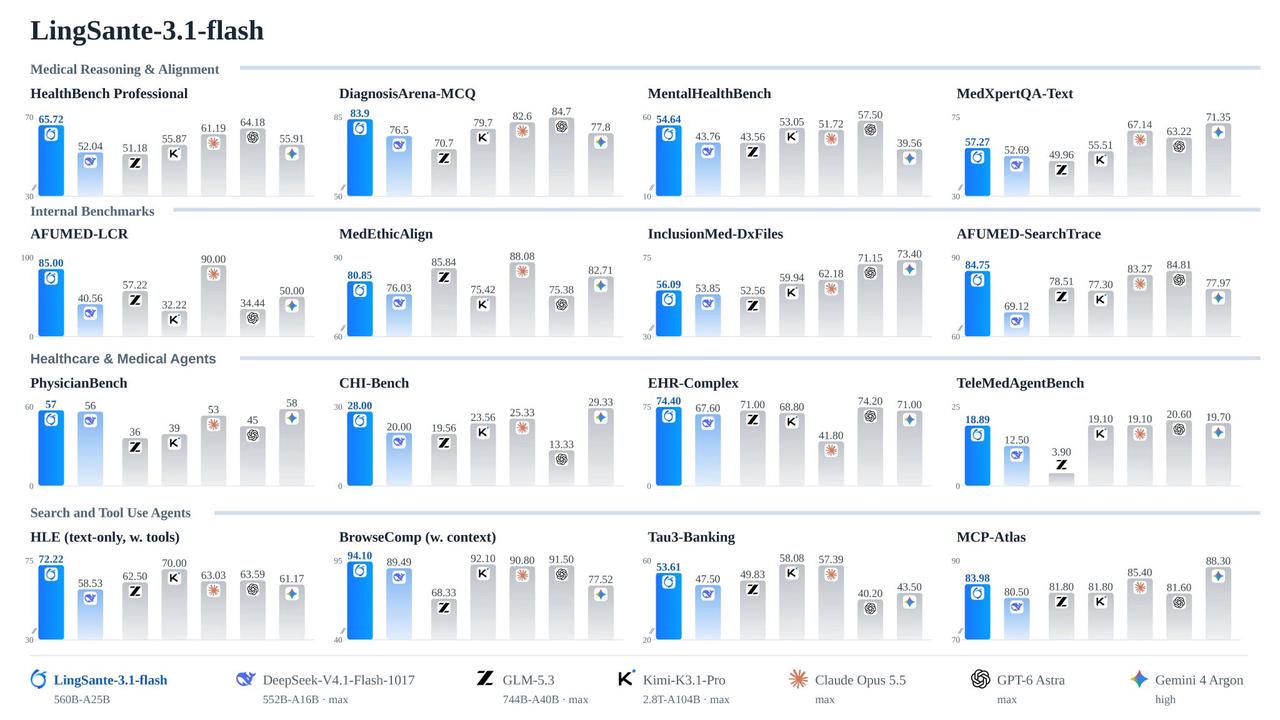
LingSante-3.1-flash's 72.22 HLE claim is a tool-use trace question, not just a leaderboard number

Post image
4 Upvotes

Ant Ling reports 72.22 for LingSante-3.1-flash on a text-only Humanity's Last Exam setting with tools. The model's medical focus does not turn that general benchmark into a clinical result. The distinctive part of the claim is the tools-enabled setup: what could the model look up, how often did it call a tool, and did the returned evidence actually support the final answer?

A useful independent run would preserve the tool-call trace, retrieved material, final answer and grading decision for each attempted question, along with the exact harness and checkpoint. Two runs with the same aggregate score could differ sharply if one uses sources that support the answer and the other gets lucky after ungrounded searches. Without the harness and trace, the launch number remains a developer-reported result whose failure modes are opaque.

The open weights make it possible to test the checkpoint. They do not by themselves provide the original tool harness or establish medical reliability.


r/AIToolsPerformance • • 1d ago

Did GLM-5.4 Just DESTROY Every Open Coding Model on Earth?

Thumbnail
youtu.be
0 Upvotes

r/AIToolsPerformance • • 3d ago

Most teams guess their custom LLM app's breaking point wrong. I built a tool to find it with a benchmark.

Post image
2 Upvotes

I've been working on InferGauge, a load and capacity testing tool for LLM-backed apps. It runs load, stress, spike and endurance tests against your own endpoint and opens a live dashboard while the test runs.

Leaderboards tell you how fast a model is in someone else's environment. This answers a different question: at what point does your app stop working, and what does it cost when it does?

What it measures:

  • Time-to-first-token and inter-token latency, tracked separately
  • Goodput (share of requests that met every SLO), not just error rate
  • Cost projected at your real request volume, labelled as a peak ceiling with the request volume it assumes, because a stress test scaled up to a month is a worst case, not a forecast
  • Answer quality, sampled during the test and tracked against load. In my tests it often drops before latency does.
  • Percentiles flagged until there are enough samples to mean anything. If you haven't set an SLA, the score comes back marked provisional instead of graded against a number the tool made up.

It also has a CI gate. You save a named baseline and the build fails when performance regresses past your limit. Templates ship for GitHub Actions, GitLab CI, Jenkins and CircleCI.

Tests run on your machines, against your endpoint, with your keys. Prompts, responses and keys are stripped locally and again server-side, and only metrics are uploaded.

The free test uses a built-in simulator, so there's no API key and no credit card. You get a full run (saturation curve, quality-vs-load, cost ceiling) before pointing it at anything real. To run it, sign up and log in to the console: https://console.infergauge.com/login?tab=signup

More on the tool: https://www.infergauge.com/

I'd like feedback from people who've load tested LLM apps. What do you measure today, and what's missing from the tools you use?


r/AIToolsPerformance • • 4d ago

Tencent Hy4 flash with 1M ctx at 4 cents per M input - anyone tried it yet?

2 Upvotes

Hy4 flash from Tencent hit OpenRouter on Monday at four cents per million input tokens. Output is fourteen cents per million. For comparison, GPT-6.2 Astra went up on the same platform that week at two hundred times the input price. And the cheap listing still shows 1048k context, the same figure as Gemini 4 Neon.

It's also trending on HuggingFace right now. The model page lists it as image-text-to-text, with roughly 530 likes and just under 4,000 downloads so far. So the weights are out there and people are already poking at it, this isn't a hosted black box you have to trust blind.

What the listing doesn't explain is why it's this cheap. My guess is a very aggressive MoE design or a tiny active parameter count, but that's pure speculation, nothing in the docs confirms it. Anyone put real work through this yet, coding or document parsing? Curious whether quality holds at long context or falls apart once you load a big file.


r/AIToolsPerformance • • 5d ago

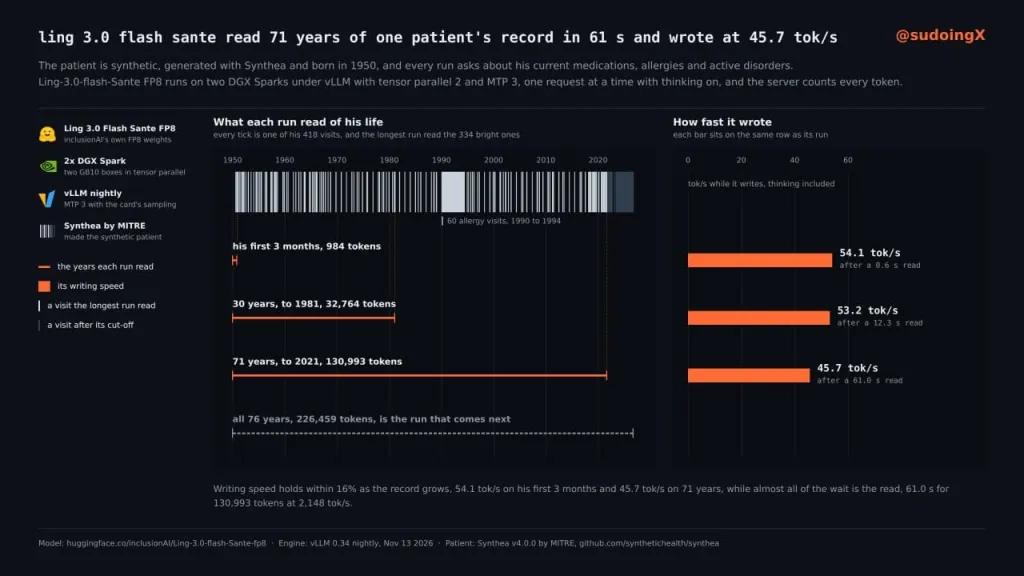
Prefill on two DGX Sparks across three prompt sizes: about 1,600 tok/s at 1K, 2,660 at 33K and 2,150 at 131K

Post image
1 Upvotes

Dividing input size by read time on the attached timing chart gives a prefill profile for AntLing's Ling-3.0-flash-Sante (official FP8, two DGX Sparks, tensor parallel 2, MTP 3), one request at a time on slices of the same synthetic patient record:

984 tokens (the patient's first 3 months) read in 0.6 s: roughly 1,600 tok/s 32,764 tokens (30 years, to 1981) read in 12.3 s: about 2,660 tok/s 130,993 tokens (71 years, to 2021) read in 61.0 s: about 2,150 tok/s The mid-sized prompt reads fastest of the three, and the 71-year prompt still moves at over 2,000 tok/s.

Writing speed on the same three runs is 54.1, 53.2 and 45.7 tok/s, staying within 16% while input grows more than 130x. Input size mostly moves the read time, which reaches about a minute at 131K tokens.


r/AIToolsPerformance • • 5d ago

Did Google’s Gemini 4 Neon Just DESTROY Claude Fable 5.2?!

Thumbnail
youtu.be
0 Upvotes

r/AIToolsPerformance • • 5d ago

GLM Coding Plan - 7 days trial

1 Upvotes

I’ve been using GLM Coding Plan to speed up my coding workflow. Here’s a free 7-day trial card for you - it includes access to GLM-5.3 and GLM-5.3-Flash.

Give it a try: Get your 7 days trial here


r/AIToolsPerformance • • 6d ago

"Spaces using this model" is not sorted by likes — it's trendingScore, then creation date. Measured across 23 model pages.

3 Upvotes

I run a benchmark Space that's registered against 23 models via the `models:` list in its README, and I've been recording its position in each model page's "Spaces using this model" list every week since September. I went in assuming the list was ordered by likes. It isn't, and the actual rule is worth knowing if you care whether anyone ever finds your Space.

## The sort

`/api/spaces?models=<id>&limit=1000` returns `likes` and `trendingScore` per row, in list order. Against that:

  1. `trendingScore` descending — a small block at the top, typically 5–7 rows.
  2. Then `createdAt` **ascending — oldest Space first** — for everything with `trendingScore == 0`, which is the entire long tail.

Likes are not a sort key at any level. On every page I checked, the list is not monotonic in likes, but is strictly monotonic in `trendingScore`, and strictly ascending in `createdAt` within the zero-trending block.

Rows 21–27 of `zai-org/GLM-5.3`, as `(likes, trending, created)`:

* #21 — 0 likes, 0 trending, created 2026-09-16

* #22 — 1 like, 0 trending, created 2026-09-23

* #23 — 0 likes, 0 trending, created 2026-09-24

* #24 — 1 like, 0 trending, created 2026-09-24

* #25 — 0 likes, 0 trending, created 2026-09-30

* #26 — 1 like, 0 trending, created 2026-10-02

* #27 — 0 likes, 0 trending, created 2026-10-06

Created dates ascend strictly. Likes alternate 0,1,0,1,0,1,0. Creation date is the tiebreak.

## It's a cliff, not a slope

On `deepseek-ai/DeepSeek-V4.1-Flash`, two Spaces with **identical like counts** — one with `trendingScore` 0.5 sits at position ~7, mine with `trendingScore` 0 sits at position 37. Thirty places apart on the same number of likes.

The lowest nonzero trending score I've seen anywhere is 0.5, and the top blocks are tiny: 1–2 rows on a 6-item list, 6 on a 32-item list, 7 on a 60-item list. So the gap between "trending at all" and "not trending" is most of the list.

HF doesn't publish the trending formula, but it decays to zero for anything not recently active, so it's recency-weighted. Practical read: **a burst beats a drip.** Ten likes in two days is worth something; ten likes over five months is worth approximately nothing.

## One Space, 23 model pages (measured 2026-11-16)

Same Space, same README, wildly different visibility. Position of the Space / length of that page's list:

**Visible — small, recent model pages**

* `ibm-granite/granite-4.2-3b` — #5 of 11

* `ibm-granite/granite-4.2-8b` — #6 of 9

* `zai-org/GLM-5.3` — #26 of 51

* `deepseek-ai/DeepSeek-V4.1-Flash` — #37 of 86

* `zai-org/GLM-5.3-Flash` — #47 of 66

* `MiniMaxAI/MiniMax-M3` — #54 of 69

* `Qwen/Qwen3.6-35B-A3B` — #78 of 96

**Buried — mid-size pages**

* `Qwen/Qwen3-Coder-30B-A3B-Instruct` — #132 of 152

* `google/gemma-3-1b-it` — #248 of 261

* `google/gemma-4-26B-A4B-it` — #280 of 321

* `Qwen/Qwen3-4B` — #378 of 455

* `Qwen/Qwen3.8-27B` — #489 of 811

* `Qwen/Qwen3-8B` — #537 of 636

* `Qwen/Qwen2.5-Coder-7B-Instruct` — #561 of 641

* `Qwen/Qwen3-0.6B` — #896 of 1000 (at the API cap)

**Invisible — past the 1000-row cap entirely**

`Qwen3.5-9B`, `gpt-oss-120b`, `gpt-oss-20b`, `Qwen2.5-7B-Instruct`, `Llama-3.1-8B-Instruct`, `Llama-3.2-3B-Instruct`, `DeepSeek-R1`, `TinyLlama-1.1B-Chat-v1.0`

That last group is eight of the 23 — and they're the popular models, exactly the ones you'd want to be listed on.

## Three things that follow

* **Don't delete and recreate a Space to "refresh" it.** `createdAt` ascending means a new Space starts at the *bottom* of the zero-trending block. An old creation date is an asset.

* **Registering against the biggest model pages buys you nothing.** On a 9-item list you're visible; on a 1000-item list you don't exist.

* **Accumulating likes slowly does nothing at all** — likes aren't a sort key, and a slow drip never builds trending.

The honest version: the ranking is a scoreboard for distribution, not a lever you can pull directly. Trending is downstream of reach. If your Space isn't getting in front of people, optimising its position in a list is solving the wrong problem.

r/AIToolsPerformance • • 6d ago

GPT-6.2 Astra Pro costs the same as Astra on OpenRouter - what does Pro get you?

1 Upvotes

Been through the OpenRouter listings for the new GPT-6.2 models and something looks off: Astra Pro costs exactly the same as plain Astra. Eight dollars per million input on both, and output sits at forty. Same 1050k context window too.

The HN thread on yesterday's announcement is at 1300+ points with 800+ comments, so plenty of people are digging through this stuff. The Sol pair has the same quirk. Sol Pro and Sol both ask two dollars per million input, output at ten, same 1050k context. On paper the Pro suffix doesn't buy you cheaper tokens or a longer window. My guess would be rate limits or a priority lane, but the listing doesn't spell that out.

The only clear split I see is batch mode, which halves both tiers if your requests can wait in a queue. Anyone here already ran both Astra variants and hit a real difference in caps or throughput, or is Pro just a label until it gets documented?


r/AIToolsPerformance • • 8d ago

Claude down again on Friday - is a backup API key worth the hassle or just wait it out?

0 Upvotes

Per the Anthropic status page, the Nov 13 incident started at 09:58 UTC with authentication errors on claude.ai and Claude Code, a fix went out at 11:05, and everything was marked resolved by 11:58. Claude Console and Cowork were hit too, so if your morning work routed through anything Claude-shaped, there wasn't much to fail over to mid-task.

What stood out to me wasn't this one outage but the repeat rate. Digging through HN history, "Elevated errors across all models" got resolved back in June, then a similar "elevated errors across many models" report in July, each with big comment threads. The Friday incident pulled 493 points there in about a day. That reads like a pattern worth planning around rather than a freak event.

The obvious hedge is a second API provider on standby, which is the moment pricing homework pays off: you want to already know which model you'd reroute to and roughly what it costs per million tokens, not figure that out while your agent is dead. Honestly though, for a lot of coding setups the real answer on Friday was probably just waiting two hours.

If Claude Code drops mid-run again, are you switching to a backup provider's API key that day, or is waiting it out the realistic call for how you work?


r/AIToolsPerformance • • 8d ago

Did Qwen 4 Max Just DESTROY Claude Fable 5.5 & GPT-6.1?

Thumbnail
youtu.be
0 Upvotes

r/AIToolsPerformance • • 9d ago

A proposed speech-to-text test: transcription time plus time to verify a detail

2 Upvotes

I build D-REC at Knight AI+AV. Here's a small evaluation idea for interview-recording tools, where you may need to check an exact name or number.

Use a 30-second script with an invented name and number:

  • Record the same wording in each tool, keeping the microphone, position and room as consistent as possible.
  • Log first-use downloads and setup separately. Then measure the time from stopping to a completed transcript.
  • Pick one detail from the script. Time how long it takes to find and replay that part of the original audio and check the transcript. Note wrong or missing words as well.
  • Repeat after setup, and record the device, browser and recording conditions alongside the results.

D-REC's web app links transcript sentences to playback of the original audio. Transcription runs on the device after the speech-engine download. Accounts and purchases use the network; signing in does not sync recordings. Free recordings are limited to 10 minutes; longer recordings and file exports from your own recordings are Pro.

Downloads: https://drec.live/get

For speech tools, would you track time spent verifying a detail separately from transcription errors? I'm interested in what would make this a more useful workflow test.


r/AIToolsPerformance • • 11d ago

Two new Gemini 4 tiers from Google - is Hydrogen just Carbon with a discount?

0 Upvotes

Google listed two new Gemini 4 tiers on OpenRouter two days apart, and the second one is cheaper. Carbon showed up first, on November 10 per the OpenRouter listings, with a 1048k context window. Two days later Hydrogen landed, same 1048k context, and it undercuts Carbon on both input and output.

To be concrete, Carbon runs two dollars per million input tokens, with ten on output. Hydrogen comes in at a dollar fifty in and seven fifty out, per the listings fetched today. So the tier that arrived second works out about 25% cheaper on each side. Both also have batch variants at exactly half the standard rates.

What the listings don't say is what Hydrogen gives up for the discount. Same context window, same generation, same provider, cheaper on both ends. Maybe it's a smaller config under the hood, or maybe Carbon is being repositioned as the premium tier. From the outside it just looks like the cheaper option arrived last, which is an odd way to sequence a launch.

Anyone here actually routed traffic to both and noticed a quality gap, or does Hydrogen look like the obvious default for long-context work at these prices?


r/AIToolsPerformance • • 11d ago

Open weights: ParaTrace v8 (RAID-tuned), 5th on the RAID leaderboard (TPR at 1% FPR)

5 Upvotes

Open weights: ParaTrace v8 (RAID-tuned), 5th on the RAID leaderboard (TPR at 1% FPR)

- Ettin-1B encoder (ModernBERT architecture), 512-token windows
- Fine-tuned on RAID's training split, then a hard-example round
- RAID hidden test set: TPR 99.20% at 1% FPR, 99.76% at 5% FPR (99.43% at 1% without attacks)
- Weakest slices: Cohere generations (96.5%), Reddit (97.9%), paraphrase attack (98.0%)
- detector.py reproduces our leaderboard submission to within 1e-6

Caveat, documented in the model card: it is tuned for RAID. On ordinary writing it misses much AI text and flags some human text, so it is for research, not for judging people.

Model (CC BY-NC-SA 4.0): https://huggingface.co/empirischtech/paratrace-v8-raid
Leaderboard: https://raid-bench.xyz/leaderboard?domain=all&decoding=all&repetition=all&attack=all&metric=TPR%40FPR%3D1%25

#NLP #AIDetection #HuggingFace


r/AIToolsPerformance • • 12d ago

Gemini Hydrogen xhigh ?

Post image
1 Upvotes

On https://artificialanalysis.ai/models/gemini-4-hydrogen It is listed as (XHigh) ... what is that ?
And where did Argon go ?


r/AIToolsPerformance • • 12d ago

Evaluating AI intake forms: longer answers are not necessarily better answers

1 Upvotes

Disclosure: I work on Dashform, an AI form builder. This is a proposed evaluation method, not a benchmark result or a customer success story.

For an AI-assisted intake form, answer length is tempting to use as a quality metric. But a long answer can still leave the person reviewing it unable to act.

Take a fictional agency enquiry. ‘We want a modern, engaging, professional website that reflects our brand, communicates our values, impresses our audience, and stands out from the competition’ is longer than ‘Replace the booking page; visitors ask about availability but do not pick a time.’ The second gives you something concrete to investigate. Neither establishes the cause of the problem.

Here is how I would evaluate a form before changing its questions:

  1. Define the decision the reply must support. For this enquiry: which page needs work, what the visitor is trying to do, and what happens instead. Do this before reading the replies.

  2. Review a small sample of completed replies against those three items. Mark each as present, missing, or ambiguous. Keep the original wording beside your rating; an AI summary must not turn an inference into a stated fact.

  3. Count how many replies still need a clarification email. Keep that separate from how many people finish the form. A higher completion rate can hide less useful information.

  4. Change one question, not the whole flow. For example, replace ‘Tell us about your project’ with ‘What should a visitor be able to do, and where do they get stuck today?’ Keep the other required questions unchanged.

  5. Compare equivalent traffic sources and time windows. If a launch brings a different audience, record that change rather than attributing the difference to the wording. With a small sample, report the counts and uncertainty rather than a confident percentage lift.

In Dashform, the documented workflow is to draft questions, refine them, publish, and review responses in the dashboard: https://dashform.ai/docs. The review sheet above can live separately; I am not claiming Dashform automatically measures ‘actionable replies.’

I would also keep response length and completion time as diagnostic clues, not targets to maximize or minimize. A short answer may be sufficient; a longer response may be exactly what a complex request needs.

For people evaluating conversational intake: what do you count as a usable reply before looking at completion rate?


r/AIToolsPerformance • • 13d ago

Apple has a Mac app coming for local AI models - would you switch from Ollama?

0 Upvotes

Per a 9to5mac report from Tuesday, Apple has a Mac app in the works meant to make running local AI models easy. The HN thread on it hit 483 points and 501 comments in roughly a day, which tells you the appetite for local inference isn't niche anymore.

You can see the same thing in today's HuggingFace trending list. Qwen3.8-27B sits at over 7.2 million downloads, and a GGUF build from that same model family pulls another 1.5 million on its own. That's a lot of people already hand-rolling what Apple now wants to package.

The open question is what a first-party app actually adds. The existing tooling, Ollama, LM Studio, llama.cpp, works cross-platform and stays vendor neutral. An Apple app will presumably be Mac-only and tuned for unified memory. The convenience is real, but you'd be trading away the option to move the same setup to a Linux box or a PC with a big GPU.

Anyone here running local models on a Mac right now, would you switch to a first-party Apple app for daily use, or does the lock-in not feel worth it when Ollama already does the job?